The Sunday Potthesundaypot.com/recipes/vin-chaud/
Vin Chaud: French Mulled Wine, Warmed and Never Boiled
By The Sunday Pot Kitchen Updated
- • One 750 ml bottle of light red wine and 6 tablespoons (75 g) of sugar make 5 small cups
- • Heat it under a lid to 158°F (70°C), the ceiling German food inspectors give for mulled wine, and never let it bubble
- • Steep it off the heat for 20 minutes, then rewarm it for 3 to 5 minutes
- • Use a stainless-steel or enameled pan, not copper or aluminum
- • Each cup holds 5 fl oz (150 ml) of wine, so count it as a full glass
Ingredients
5 small cupsInstructions
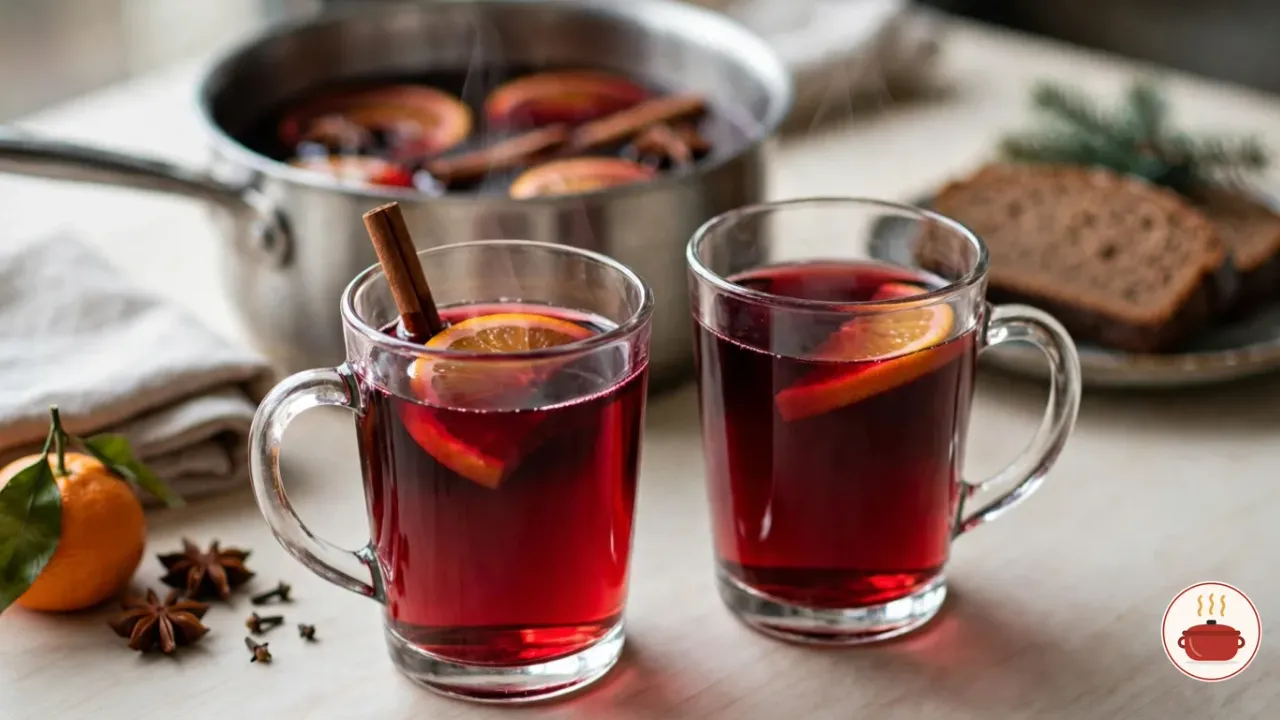
Vin chaud is French mulled wine: a bottle of light red wine warmed with sugar, orange, cinnamon, star anise and cloves. This version heats it to 158°F (70°C), steeps it off the heat and never lets it boil. One bottle fills 5 small cups in about 40 minutes.
To boil or not: 31 recipes disagree
French cooks cannot agree on the first instruction. We read 31 recipes on 29 pages: 22 for red wine and 9 for white. Most are from France. Six come from Belgium, Switzerland and Quebec, and 3 are in English.
Here is how they split:
- Bring it to a boil: 12 recipes. Half of them stop early: at the first bubbles, after 10 seconds, or within 4 minutes.
- Never let it boil: 11 recipes.
- No word either way: 8 recipes. These say “simmer” or “low heat” and leave it there.
One page, two answers
The recipe site Marmiton shows the muddle on a single page. The method of its Alsace-style recipe says to bring the wine to a boil “very gently” and simmer it for 5 minutes. The tips under it say to avoid boiling, so as not to lose “the alcohol and the aroma of the wine”.
The food critic François-Régis Gaudry boils his for 10 seconds, then covers it and simmers it for 25 minutes. That is how The Connexion printed his recipe in 2023. Quebec’s liquor board, the SAQ, takes the other side. It calls it “important” not to boil, for a drink that stays fresher and less bitter.
One thermometer in 31
Only 1 recipe of the 31 names a temperature. The French news site 24matins says to hold the pot at “about 70-80°C”, which is 158 to 176°F. The usual word is frémir, to shiver. It leaves the cook to guess.
Where 158°F (70°C) comes from
The firmest number is German. Glühwein is the same kind of drink, and state food labs there inspect it at Christmas markets.
Bavaria’s health and food safety authority, the LGL, puts it in one line. Mulled wine should be heated “only slowly, not above 70°C and as briefly as possible”, its Glühwein report says. Past that point, too much alcohol cooks off. The Christmas spice notes fade, and cooked or bitter notes take their place.
The food labs of Baden-Württemberg wrote the same rule into a leaflet for stallholders in 2014: warm the wine to about 70°C, and never boil it. They also ask for a lid, to hold the alcohol in. A district office in Rhineland-Palatinate allowed a little more in 2023: “not above 70 to 75°C”, or 158 to 167°F.
Why not simply stay under 173°F?
Pure alcohol boils at about 173°F (78°C). The NIST data for ethanol give 351.5 kelvin. So you may read that mulled wine is safe just below that mark.
It is not that simple. Wine is mostly water, and alcohol starts to leave a warm pot long before anything boils. The Baden-Württemberg leaflet warns that above 70°C the alcohol can escape completely, depending on the cooking time. We found no official table of how much a pot loses at each temperature. Treat 158°F as the inspectors’ working rule, not as a law of physics.
If you have no thermometer
Watch the surface. At the right heat the wine steams and is too hot to drink at once, but it lies still. If bubbles rise from the bottom, it is too hot: pull the pan off the burner.
Steel or enamel, not copper
The pan matters as well. The LGL names stainless steel and enamel as suitable. Copper, aluminum and iron can pass into the wine, it says.
That is not a theory. The office tested 78 mulled wines in 2016 and 2017 and measured copper in 22 of them. One sample was far over the legal limit. Two samples were below 7% alcohol, the legal minimum.
How this vin chaud was built
Every quantity in the recipe comes from the 31 we compared.
A light, fruity red
Do not open a grand bottle. The SAQ’s advice is a low-priced red “that you like”. Pinot noir is the wine named most often, in 4 recipes. Bordeaux follows with 3. Merlot, gamay and côtes-du-rhône have 2 each.
The words that come up are “fruity”, “young” and “low in tannin”. The Connexion’s article explains why: heat brings out the weakest side of a poor or tannic wine. It also lists Beaujolais, which is made from gamay. This year’s Beaujolais Nouveau reached shops on November 19, as our coq au vin notes.
Six tablespoons of sugar
Twenty-four recipes give their sugar in grams. Scaled to one 750 ml bottle, the middle value is about 94 g, and most fall between 75 and 125 g.
We start at 75 g, the low end of that range. Three of the recipes use exactly this ratio. You can add sugar at the end, but you cannot take it out. The tourist board of Valais, in Switzerland, sweetens its version only after the spices come out.
Cinnamon, star anise, cloves
Cinnamon is in all 31 recipes. Star anise comes second, in 27, ahead of cloves in 22. After that the field thins: nutmeg in 10, ginger in 9, cardamom in 6 and vanilla in 4. Not one uses bay leaf or black pepper.
Go easy on the cinnamon. The Baden-Württemberg leaflet says long heating and heavy doses of it turn mulled wine bitter. It also prefers Ceylon cinnamon to cassia, because Ceylon holds less coumarin.
Orange before lemon
Orange goes into 28 of the 31, mostly as slices. Lemon is in 17. We use one orange: half in the pot, half fresh in the cups.
No water, no brandy
Eight recipes thin the wine with water, and 5 add a spirit such as rum, kirsch or cognac. We do neither.
European law takes the same line for the German name. Under Regulation 251/2014, a drink sold as Glühwein must be made only from red or white wine, or both. It must be flavored mainly with cinnamon, cloves or both, and hold at least 7% alcohol. Beyond what the sweetener brings, “the addition of water is forbidden”.
That rule covers a sales name, not your kitchen. And the French name is free: the words “vin chaud” appear nowhere in the regulation.
How much alcohol stays in the cup
Gentle heat is meant to keep the alcohol in. So assume it is all still there.
Flaming does little
One French recipe boils the wine and sets it alight “to evaporate the alcohol”. That works less well than it looks. In the USDA’s table of retention factors, a flamed dish keeps 75% of its alcohol. A dish simmered for 15 minutes keeps 40%, and after 30 minutes 35%.
Those figures come from alcohol cooked into food, not from a pot of warm wine. We found no study that measured mulled wine itself. A lighted pan of wine is also a fire risk, so we leave the match out.
Count each cup as a glass
Each of our 5 cups holds 5 fl oz (150 ml) of wine. In the United States, that amount of 12% wine is one standard drink, with about 14 grams of pure alcohol.
The NHS counts in units. By its unit guide, a 750 ml bottle at 13.5% holds 10 units, so one cup carries up to 2. Its advice is no more than 14 units a week. A sweet, hot drink goes down fast, so pour small cups.
For children, drivers and pregnancy
On pregnancy the CDC is blunt. Its advice page names red and white wine among the drinks that can harm. And it says: “There is no known safe amount of alcohol use during pregnancy.”
Make a second pot without wine. Strasbourg’s market sells hot fruit juice for children. Marmiton’s alcohol-free recipe warms 1 quart (1 liter) of red grape juice with 1¼ cups (300 ml) of water and the same spices. It adds no sugar, because the juice is sweet enough. Label the two pots clearly.
Strasbourg pours from November 27
The 2026 dates
Strasbourg calls itself the Capital of Christmas, and vin chaud is on its market’s program. This year the market runs from Friday, November 27 to Thursday, December 24, the city’s site says. Most days it opens from 11:30 am to 9 pm.
The city dates its Christkindelsmärik to 1570 and calls it one of the oldest in Europe. It has stood on place Broglie since 1871.
A cup with a deposit
Every drink there comes in a reusable cup with a 1 euro deposit. You get the euro back at any chalet that sells drinks, or you can leave the cup in a collection point, and the euro goes to a local charity.
Other markets, other prices
Strasbourg is not alone. Nuremberg’s Christkindlesmarkt opens on the same Friday. London’s Winter Wonderland in Hyde Park opened on November 19, and Birmingham’s Frankfurt Christmas Market has been running since November 5.
Prices are known for Germany only. A cup should cost about 5 euros at many big markets this year, a wine trade group told the news agency dpa in a report of November 14. Its count for last year was an average of 4.54 euros before the deposit, across 58 cities. In Mainz, Bonn or Essen a standard cup is still 4 euros.
For France we found no dated 2026 price. Nor did we find a 2026 search or sales figure for the drink. The season is the reason to make it now.
Vin chaud in Alsace: red or white
Alsace pours a white version too. Strasbourg’s 2026 program promises “an authentic vin chaud made with white wine from Alsace” at a chalet called the Tribu des Gourmets.
Which color came first there, we could not settle. One Belgian daily calls white the old tradition. A 2011 report on a French wine forum describes it as a new idea from winegrowers, set against a drink that had been red. No reference work we could open decides it.
How to make the white version
Nine of our 31 recipes are white. They name riesling and pinot blanc 4 times each, and sylvaner and pinot gris 3 times each. The wine merchant Vinatis finds gewurztraminer and muscat “too aromatic”, but 2 recipes use gewurztraminer anyway.
Swap the red for a dry Alsace white and keep everything else. Use the same 6 tablespoons of sugar, or honey to taste: 2 of the white recipes sweeten with honey alone. Add a few slices of lemon if you like. The 158°F rule does not change.
In print since 1840
Musset’s bowl and Colette’s embers
The Trésor de la Langue Française, a historical dictionary of French, defines it plainly. It is heated wine with sugar “and often cinnamon and various spices”. The oldest example it quotes for the modern name is from a play by Alfred de Musset, in 1840. A character orders “a big bowl of vin chaud with sugar and cinnamon”.
An older name, vin brûlé or burnt wine, turns up in Stendhal in 1835. The dictionary marks it as dated.
Colette, in 1922, was on the side of the boilers. In La Maison de Claudine the wine “boiled on a fire of embers”, lifting lemon and cinnamon on its crimson swell.
A medieval cousin
Spiced wine is far older than the name. The same dictionary describes hypocras as sweetened wine infused with cinnamon, cloves and more, “highly esteemed in the Middle Ages”. The word is on record from 1377. Nothing in the entry says it was drunk hot, so call it a cousin, not a proven ancestor.
You will also read that the drink descends from a Roman recipe. We met that claim only in passing, never with a source, so we leave it aside.
For a party: ahead, warm and left over
Make it the day before
Three of the 31 recipes are built for this. They heat the wine with its spices, let it cool, and strain and rewarm it the next day. If you do the same, take out the fruit and spices before you chill it, and rewarm it under a lid to 158°F (70°C).
Keep it warm without cooking it
German stallholders get three rules from their inspectors. Cover the pot. Heat only what you expect to pour soon. Do not reuse what stood hot the day before. Wine kept hot for too long takes on a cooked taste, and even a slight brown tint is a warning sign.
At home, heat one bottle at a time and keep the lid on between rounds. A slow cooker is the other route. BBC Good Food runs one on low for 1½ to 2 hours, then switches to “keep warm”. Its gentle heat means the wine “doesn’t boil”, the site says. Cookers differ, so check yours with a thermometer the first time.
Leftovers
We found no food safety agency page on storing mulled wine. The plainest advice comes from BBC Good Food’s stovetop recipe: keep it in the fridge for 24 hours. With fruit in it, the site would not go longer, because it “may start to ferment”. Strain it first, and rewarm it gently.
If it tastes bitter, flat or too sweet
- Bitter: it boiled, or the cinnamon cooked too long. You cannot undo it. A little more sugar softens it.
- Flat, with a stewed taste: it got too hot or stayed hot too long. Start a fresh bottle and use the thermometer.
- Too sweet: stir in a splash of wine or a squeeze of lemon juice.
- Too sharp: add sugar 1 teaspoon at a time, tasting as you go.
- Not spicy enough: steep it longer off the heat. Several recipes rest theirs for 30 minutes or more.
- Gritty: ground spices leave sediment. Use whole ones, or strain through a fine sieve.
Swaps for what you can’t find
- Pinot noir: gamay, merlot or a light côtes-du-rhône. All are named in the recipes.
- Star anise: leave it out, as 4 of the 31 do.
- Sugar: honey or maple syrup. The SAQ lists both next to brown sugar.
- Orange: a clementine. One of the white recipes uses one.
- Nutmeg: a slice of fresh ginger, which 9 recipes add.
- Loose cloves: push them into an orange slice, so they are easy to fish out.
- A stronger cup: stir in a little kirsch, rum or cognac at the end, as 5 recipes do. Count the extra alcohol.
Serving and nutrition
In the cup
Use heatproof glasses or mugs, and warm them with hot water first so the drink stays hot. It suits spiced bakes: a slice of Christmas cake, or Greek melomakarona. For supper before it, think of French onion soup.
For a winter cup with no alcohol at all, try Turkish salep. A pot of Jamaican sorrel is alcohol-free until someone adds rum.
Allergens
Most wine contains sulfites, and its label says so. Some people react to them.
Nutrition
One cup has about 185 calories and 19 g of carbohydrate, of which 15 g is the added sugar. If none evaporates, it also holds about 16 g of alcohol. We added these up from the USDA FoodData Central figures for red table wine and granulated sugar. The orange is not counted.
Frequently asked questions
Is vin chaud the same as Glühwein?
It is the same family: wine heated with sugar and spice. Glühwein is a name defined in European law, with cinnamon or cloves, no added water and at least 7% alcohol. The French name has no legal recipe. French versions nearly always add star anise and orange.
What temperature should mulled wine be?
Aim for 158°F (70°C). That is the ceiling two German state food authorities give. One district office allows up to 167°F (75°C).
Which wine is best?
A young, fruity red that is low in tannin and not expensive. Pinot noir, gamay and merlot are the usual picks. Save old or oaky bottles for the table.
Does the alcohol cook off?
Some may, but we found no study that says how much. Even flaming leaves 75% of the alcohol in a dish, by the USDA’s table. Treat a cup as a full glass of wine.
Can I make it without alcohol?
Yes. Use red grape juice thinned with water, the same spices and no sugar. Heat it the same way.
Can I use a slow cooker?
Yes. Set it on low until the wine is hot, then switch to the warm setting. Check the temperature with a thermometer, because cookers differ.
How long does it keep?
BBC Good Food gives leftovers 24 hours in the fridge. Strain out the fruit and spices before you chill it.
Can I use white wine?
Yes. Alsace does. Choose a dry riesling, pinot blanc or sylvaner and follow the same steps.