The Sunday Potthesundaypot.com/recipes/tempe-mendoan/
Tempe Mendoan: The Javanese Tempeh You Stop Frying Halfway
By The Sunday Pot Kitchen Updated
- • Fry at 350°F (175°C) for 2 to 3 minutes in all, and stop while the batter is still pale
- • Mendo means soft or half-cooked in Banyumas Javanese, so a crisp slice has missed the point
- • Use pasteurized tempeh, or steam raw tempeh to 165°F (74°C) before it goes in the batter
- • Cut a block through its widest face into sheets ¼ inch (6 mm) thick
- • The batter is loose: 270 g of flour to 360 ml of water, the median of 11 recipes
- • Make the dip before you unwrap the tempeh, so raw tempeh stays away from it
Ingredients
4 servingsInstructions
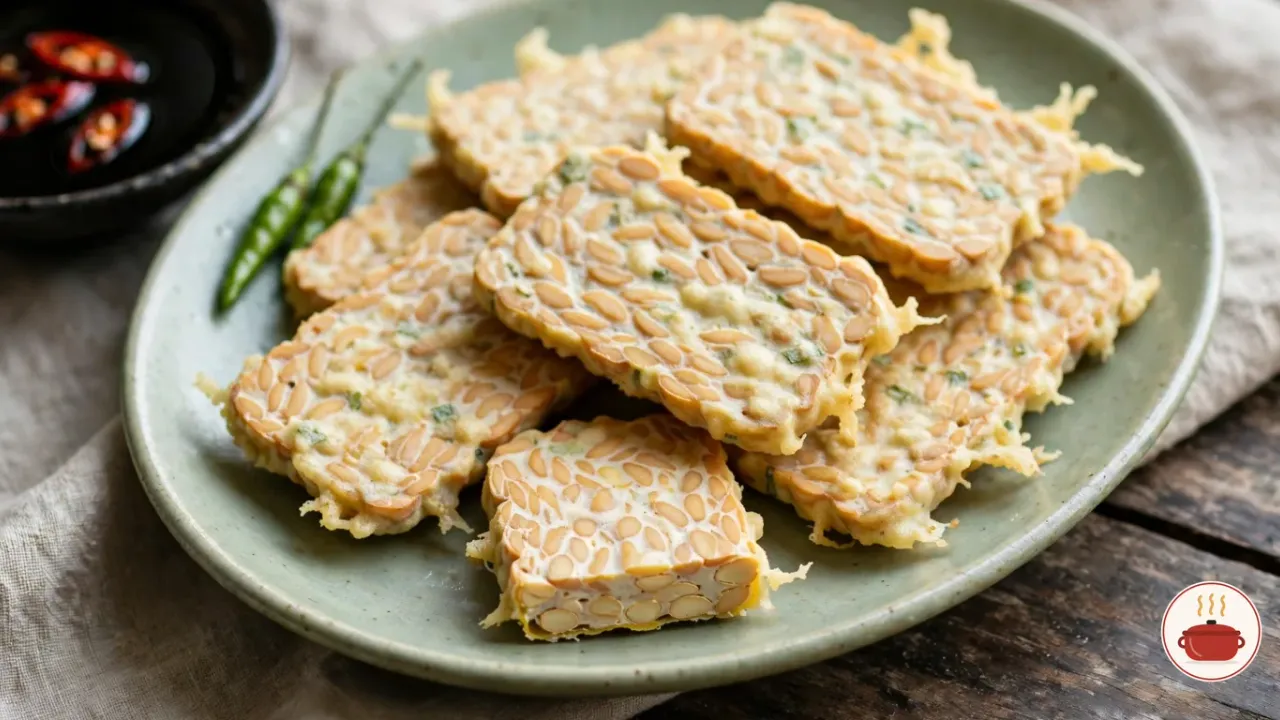
Tempe mendoan is a snack from Banyumas, in Central Java: thin tempeh dipped in a loose spiced batter and lifted from the oil while it is still soft. This version serves 4, takes 40 minutes and is vegan. Its one hard rule is timing, about 2 to 3 minutes in the oil.
Five recipes say crisp. The name says no
The word comes from mendo, in the Banyumas dialect of Javanese. Detik, the Indonesian news site, glosses it as soft, or not yet done. Central Java’s tourism site simply calls the snack “half-cooked”.
Published recipes don’t all listen. We read 22 of them, most by Indonesian cooks and outlets. About 13 stop while the batter is soft. Five tell you to fry until crisp, and three of those five are in English.
Even one headline argues with its own method. A 2026 Kompas recipe has “crispy” in its title, then tells you to wait until the middle is a little soft.
Crisp tempeh is fine to eat. It is just closer to ordinary fried tempeh, which Detik contrasts with mendoan because it is cooked until dry. For the opposite treatment of the same ingredient, see our tempe bacem, which simmers for most of an hour.
How long to fry tempe mendoan
“Fry briefly” is the usual instruction, and it leaves a new cook guessing. Only 3 of the 22 recipes give a time in minutes. Here is every useful number we found:
- 2 to 3 minutes, turned once: the cook Vira, in very hot oil, for Indonesia’s public radio, RRI.
- 1 to 2 minutes a side: Lisa Aprilia on Chefadora, over medium heat.
- Under 5 minutes: Detik’s outer limit for the Banyumas method.
- 340°F (170°C) and 356°F (180°C): the only two oil temperatures printed, from Daily Cooking Quest and tempeh.info. Both of those recipes aim for crisp.
This recipe sits in the middle: 350°F (175°C), 1 to 1½ minutes a side. Go by color more than the clock. RRI’s cue is the one to watch: the coating should still be a yellowish white when it leaves the oil.
Fry only 3 pieces at a time, because a crowded pan cools the oil.
Is half-fried tempeh safe?
No food-safety agency we could find gives a time or temperature for cooking tempeh. We also found no study that measures the center of a half-fried slice. So the safety of this dish rests mostly on what you buy and how you handle it.
What the 2012 outbreak does and doesn’t show
The case everyone cites is a Salmonella outbreak in North Carolina, written up in the CDC’s journal Emerging Infectious Diseases. The bacteria arrived in a Rhizopus starter culture, which the maker added after the beans were cooked. The finished tempeh was never pasteurized.
The investigators did not blame undercooking. They found restaurant kitchens preparing raw tempeh on the same surfaces as ready-to-eat food, and staff who skipped handwashing afterward. Their conclusion was that the bacteria spread “probably through cross-contamination of RTE foods”, meaning food that gets no further cooking.
That is why this recipe has you make the dip before the tempeh is unwrapped. The dip is never heated, so it is the one thing on the table that raw tempeh must not touch.
What the agencies say
Sweden’s food agency, Livsmedelsverket, reviewed home-fermented tempeh in 2024. It says tempeh is cooked before eating, and that the heat kills many microorganisms. Note the word many. It gives no figure.
The USDA’s minimum-temperature chart has no row for tempeh at all. Its nearest entries, leftovers and casseroles, are set at 165°F (73.9°C).
Our rule for the pack
- It says pasteurized: fry it as written. Pasteurizing is the heat step the outbreak tempeh skipped.
- It says raw or unpasteurized, or says neither: steam the whole block until a probe in its middle reads 165°F (74°C). Cool it, then slice.
- Thin sheets from an Indonesian grocer: ask whether they are pasteurized. If nobody knows, stack them, steam the stack and probe its middle.
- You’re cooking for someone more vulnerable to food poisoning: steam it, whatever the pack says.
The 165°F target is our own caution, borrowed from the USDA’s chart. It is not an official rule for tempeh.
Making it from a supermarket block
True Banyumas mendoan starts with tempeh made for the job. Detik stresses that it is shaped thin and wide on purpose, rather than sliced from a normal block. Kompas adds that its soybeans tend to stay round and whole. The province’s tourism site says it comes wrapped in two layers of leaves.
If you can’t buy that, a block will do. Detik’s report notes that the mendoan sold in Jakarta is usually sliced block tempeh too, fried in the mendoan style.
Cut along the block’s widest face, the way you would split a bagel. That gives broad sheets rather than narrow fingers. Aim for ¼ inch (6 mm), the thickness in Loma Linda University Health’s version. Don’t go much thinner: Popmama tells cooks using ordinary tempeh to keep it a little thick, or the soft texture can fail.
The batter, in numbers
Eleven of the 22 recipes give enough weights to compare. Their median is 0.75 g of dry mix per milliliter of water, and this recipe follows it: 270 g of flour to 360 ml. The range runs from a thin 0.58 to a paste-like 1.5.
- Rice flour is in 15 recipes, usually as the smaller share beside wheat flour.
- Coriander is in nearly all of them.
- Scallions are close to universal.
- Turmeric is in 8. Central Java’s tourism site says some cooks add it to turn the mendoan slightly yellow.
- Kencur, or aromatic ginger, is in 7. RRI’s version is built around it.
- Resting time appears in none, so mix the batter just before you fry.
If your shop has no kencur
- Kencur: leave it out, as most of the recipes do.
- Rice flour: use the same weight of all-purpose flour. At least four recipes use wheat flour alone.
- Kecap manis: stir 3 tablespoons of soy sauce with 3 tablespoons of brown sugar over low heat until the sugar melts.
- Bird’s eye chilies: use a thinly sliced serrano, or leave them out for a mild dip.
- Thin mendoan sheets: Indonesian markets sell them ready-made, so an Indonesian grocer is worth a look.
When mendoan was a registered trademark
For about six years, the word mendoan was legally one person’s brand. A drinking-water businessman filed it as a trademark for food products on May 15, 2008, and the certificate arrived on February 23, 2010, Hukumonline reports.
The story broke in November 2015, and the Banyumas regional council said it would ask for an explanation. The owner told The Jakarta Post the aim was “purely to prevent mendoan from being registered by foreign entities”.
It ended quietly. The owner asked for the mark to be deleted, and it left the register on February 25, 2016, with no court case. In October 2021, Indonesia’s education and culture ministry added mendoan to its national list of intangible heritage.
UNESCO’s experts have backed tempeh
The news this month is about tempeh as a whole. The Xiamen session of UNESCO’s heritage committee opens on November 30 and closes on December 5, 2026, with Indonesia’s “Culture of Tempe” on its agenda. In the working paper for that meeting, the Evaluation Body recommends adding it to the Representative List.
That is advice, and the committee has the last word. The draft decision calls tempe “a dietary staple that can be found in most households”. It names no single dish, so mendoan gets no mention.
Tempeh makers have a nearer worry. About 95% of Indonesia’s soybeans are imported, Kontan reported on November 17. An economist it quoted said a 19.8% rise in world prices could lift makers’ costs by about 10%. In Jombang, some are already making their tempeh smaller and holding the price.
Mendoan itself has no 2026 price or sales number that we could trace, so read all of this as tempeh’s story.
Eat it straight from the rack
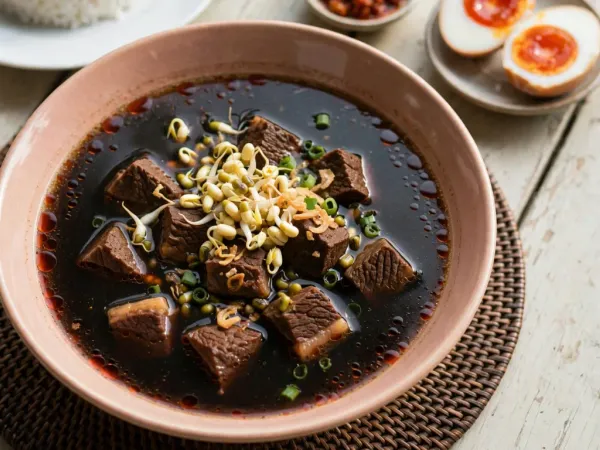
Serve it hot, while the batter is still soft. Nearly every recipe pairs it with sweet soy sauce and chili, and several add a whole green chili on the side. It also makes a good opener before a pot of rawon.
If you have leftovers, follow the CDC and chill them within 2 hours. Warm them back up to 165°F (74°C).
Our estimate for 3 pieces without the dip is 460 calories, 26 g of protein, 27 g of fat and 35 g of carbohydrate. It uses USDA values for tempeh and both flours, and assumes that half the batter clings. It also assumes each serving takes up 1 tablespoon of oil, which is a guess, because we found no measurement for mendoan.
This recipe contains soy and wheat, both on the FDA’s major allergen list. Kecap manis often contains wheat as well.
Frequently asked questions
What does mendoan mean?
It comes from mendo, a Banyumas Javanese word for soft or half-cooked. The name describes how the snack is fried.
Should tempe mendoan be crispy?
No. The batter should be set but soft and pale. Some recipes fry it crisp, but that moves it away from what the name promises.
Is the tempeh raw inside?
Pasteurized tempeh has already been heated. Unpasteurized tempeh has not, which is why this recipe steams it to 165°F (74°C) first.
Can I use regular block tempeh?
Yes. Slice it ¼ inch (6 mm) thick through its widest face. Mendoan sold in Jakarta is usually made from sliced block tempeh too.
Is tempe mendoan vegan?
This version is. Some published recipes add egg to the batter, including Chef Devina Hermawan’s, so check before you order it or follow another recipe.
Has UNESCO listed tempeh yet?
Not as of November 24, 2026. Its experts have recommended the listing, and the committee rules at its Xiamen session, which ends on December 5.