French Onion Soup with Caramelized Onions and Gruyère
By The Sunday Pot Kitchen Updated
- • 20 minutes of prep and about 1 hour 50 minutes of cooking
- • 3 lb (1.4 kg) of yellow onions and 8 cups (1.9 liters) of broth make 6 crocks
- • Caramelize the onions slowly, for 50 to 60 minutes, until deep brown
- • Scrape up the brown film with a splash of water whenever it darkens
- • Broil the Gruyère for 3 to 5 minutes, and never leave the oven while it broils
Ingredients
6 servingsInstructions
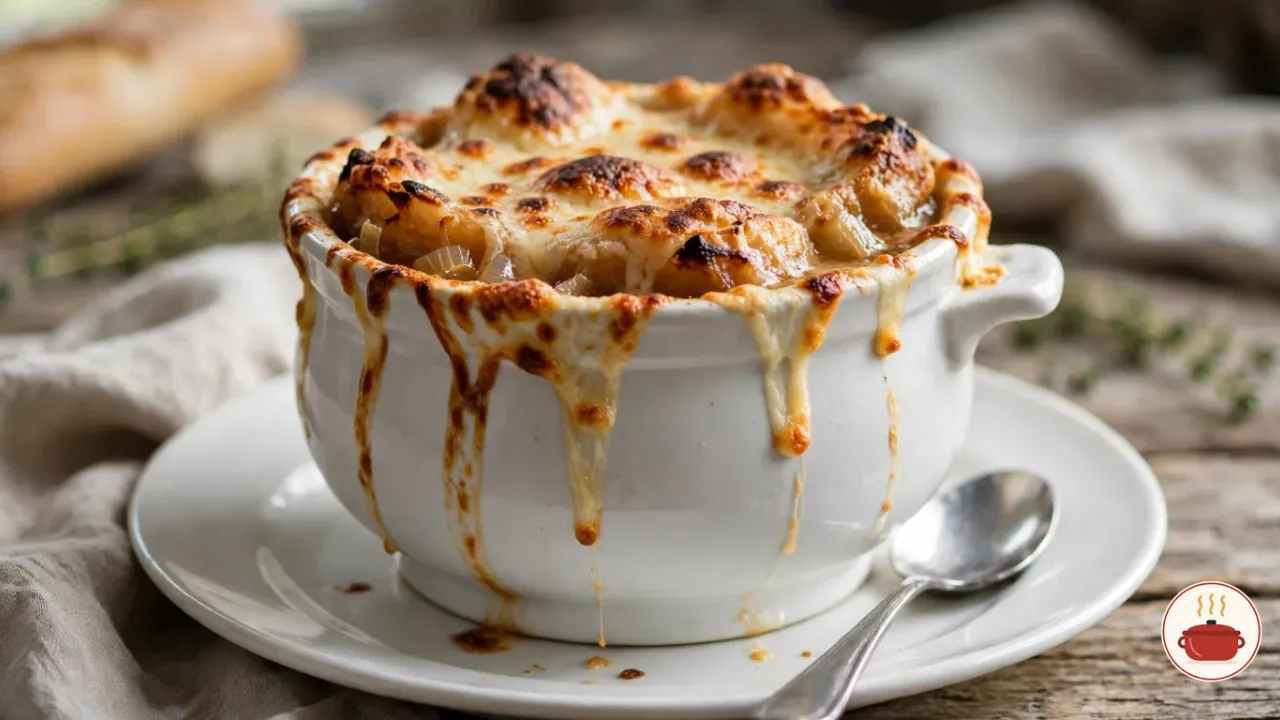
French onion soup is beef broth filled with slowly caramelized onions, under a crust of toasted bread and melted cheese. The onions cook for 50 to 60 minutes, until deep brown. They simmer in the broth for 30 minutes. Then each crock gets toast and a thick layer of Gruyère, and goes under the broiler for 3 to 5 minutes.
A soup from the Paris market
Onion soup is very old. For centuries, French cooks made it from cheap onions, broth and bread. The version with a cheese crust has a more specific story, and it starts at Les Halles. That was the huge central food market of Paris, which the novelist Émile Zola called “the belly of Paris.”
As food writer Emily Monaco tells it, the restaurants around the market topped the soup with grated cheese. Then they set the bowls under the broiler. The market porters ate it for breakfast. Party-goers leaving the cabarets late at night ate it too, as a cure for too much wine.
The market has since moved out of the city, to Rungis, near Orly airport. The soup stayed. The cheese-topped version is often called a gratinée, for its broiled crust.
The best onions for French onion soup
Use plain yellow onions. They have plenty of natural sugar and a strong onion flavor. Both survive the long cooking, so the soup tastes sweet and savory at once.
Sweet onions, such as Vidalia, also work. They give a sweeter, milder soup.
You need a lot of them. At first, 3 lb (1.4 kg) of sliced onions fill about half the pot. By the end, they only just cover the bottom. That sounds like too much at the start, but it is just right in the bowl.
Slice them from root to tip, not across. The slices keep their shape through the long cooking, so the soup has soft ribbons of onion instead of mush. Cut them thin and even, about ⅛ inch (3 mm), so they cook at the same pace.
How long to caramelize onions
Plan on 50 to 60 minutes over medium heat. There is no shortcut. The onions need that time for their sugars to brown and for their flavor to deepen. Recipes that promise caramelized onions in 10 or 15 minutes give you onions that are only soft and golden.
Start with the lid on for about 10 minutes. The onions give up their juices and soften, so they fit in the pot and cook evenly. Then take the lid off and let the juices boil away. From there, the onions start to brown.
Stir every 3 to 5 minutes at first, and more often near the end. The onions pass through several colors on the way:
- Pale gold, after about 20 minutes. They are soft and sweet but taste of little else.
- Amber, after about 35 minutes. This is where many recipes stop, and the soup would taste thin.
- Deep brown, after 50 to 60 minutes. They are soft, jammy and reduced to a small heap. Now they are ready.
Deglazing as you go
As the onions cook, a brown film builds up on the bottom of the pot. That film holds much of the flavor. When it turns dark brown, pour in 2 tablespoons of water and scrape it loose with a wooden spoon. The onions soak it up and turn a shade darker. Repeat this each time the film forms.
If the film turns black instead of brown, the heat is too high. Lower it to medium-low and add a splash of water.
Skip the sugar some recipes add. The onions have plenty of their own. A pinch of baking soda browns them faster, but it can turn them soft and mushy.
The broth
The broth makes up most of the soup, so choose it with care. Beef broth is the classic choice. It gives the deepest color and the richest flavor. Homemade beef stock is best, but a good boxed broth works well.
Buy low-sodium broth. The soup reduces as it simmers, and the cheese adds salt too. You can always add salt at the end, but you cannot take it out.
Store-bought beef broth varies a lot from brand to brand. Some taste flat or a little tinny. If yours does, use half beef broth and half chicken broth. Chicken broth adds body and a rounder flavor, and the soup still tastes of beef. Taste your broth before you start, and pick the one you would happily sip on its own.
A little flour, stirred into the onions, gives the broth a light body. The white wine lifts the last brown bits from the pot and adds a gentle sharpness. Many cooks add a splash of dry sherry or brandy at the end. It is optional.
The bread and cheese
The bread should be dry and crisp before it meets the soup. Toast the slices in the oven until they feel dry all the way through. Dry toast soaks up the broth slowly and holds its shape. Soft bread turns to paste. A day-old baguette works best, since it is already a little dry.
Gruyère is the classic cheese. It is a firm Swiss cheese with a nutty flavor, and it melts smoothly and browns well. Two other cheeses make good partners or stand-ins:
- Comté, a French cheese from the Jura mountains, tastes much like Gruyère.
- Emmental is milder, with a stretchier melt.
Grate the cheese yourself, on the large holes of a box grater. Bagged shredded cheese carries a powder that stops it from clumping, so it melts less smoothly. Pile the cheese right to the edges of each crock. It sticks to the rim and browns there, which gives the best bits.
Broiling the crocks safely
The broiler is the last step, and it moves fast. A few simple habits keep it safe.
- Use the right crocks. Choose soup crocks that are sold as ovenproof or broiler-safe. Ordinary bowls can crack under the broiler.
- Fill them with hot soup. Stoneware can crack when its temperature changes fast. Never move a cold crock from the refrigerator straight under the broiler.
- Use a rimmed baking sheet. It catches the cheese that drips over the edges. It also lets you move all 6 crocks at once.
- Mind the distance. The tops of the crocks should sit 4 to 6 inches (10 to 15 cm) below the heat. Any closer, and the cheese burns before it melts.
- Stay at the oven. The cheese can go from brown to burnt in under a minute. The NFPA advises staying in the kitchen while you broil food. For an oven fire, it says to turn off the heat and keep the door closed.
- Handle them with dry oven mitts. A damp mitt lets the heat straight through. Set each crock on a plate before it goes to the table.
The crocks stay very hot for a long time, and so does the cheese. Let them rest for 5 minutes, and warn everyone before they dig in, above all children.
Making it ahead and storing
The soup base keeps very well, and it often tastes better the next day. Make the soup through its 30-minute simmer, then store it without the bread or cheese. Follow the USDA advice on leftovers:
- Refrigerate the soup within 2 hours of cooking.
- A big pot of soup cools slowly, so divide it among shallow containers. Hot food can go straight into the refrigerator.
- Eat it within 3 to 4 days, or freeze it for 3 to 4 months.
- Bring it to a rolling boil when you reheat it.
You can reheat frozen soup straight from the freezer in a saucepan. It just takes longer. Once the soup is hot, fill the crocks, top them with fresh toast and cheese, and broil them as usual.
The toasts keep for 2 days in an airtight container at room temperature. Grate the cheese ahead too, and keep it in the refrigerator.
Leftover soup that already holds bread and cheese turns soggy. Scoop off the topping and store the soup on its own.
What to serve with it
French onion soup makes a warm start to a long Sunday meal. Serve smaller crocks before a classic pot roast, since both share the same deep beef flavor. It also works before a big pot of Italian Sunday gravy with rigatoni.
On its own, a full crock makes a light supper. Add a green salad with a sharp vinaigrette to cut the richness. For dessert, a warm sticky toffee pudding keeps the Sunday mood going.
Substitutes for missing ingredients
- Yellow onions: sweet onions such as Vidalia, for a sweeter soup. You can also swap in shallots for up to a quarter of the onions.
- Beef broth: half beef and half chicken broth. For a vegetarian soup, use a rich mushroom or vegetable broth. Gruyère is often made with animal rennet, so check the cheese label too.
- Dry white wine: dry vermouth, or more broth with 1 teaspoon (5 ml) white wine vinegar stirred in at the end.
- Sherry or brandy: leave it out.
- Gruyère: Comté, Emmental, Jarlsberg or a good Swiss cheese. A little grated Parmesan on top adds salt and browns well.
- Baguette: any crusty country loaf, sliced and cut to fit the crocks.
- Fresh thyme: ½ teaspoon (0.5 g) dried thyme.
- Butter: olive oil for half of it. The onions brown the same way.
- Kosher salt: brands differ, so go by the weight. Table salt packs more salt into each spoon, so use about half the volume.
- Gluten-free: skip the flour and use gluten-free bread. Check the broth label too.
- Soup crocks: use other bowls sold as broiler-safe. Without them, top the toasts with cheese on a baking sheet and broil them there. Then float them on the soup in ordinary bowls.
Frequently asked questions
What are the best onions for French onion soup?
Yellow onions are the best choice. They hold plenty of natural sugar, so they caramelize to a deep brown, and they keep a strong onion flavor. Sweet onions such as Vidalia also work, but they make a sweeter, milder soup.
How long does it take to caramelize onions for French onion soup?
Plan on 50 to 60 minutes over medium heat for 3 lb (1.4 kg) of onions. Cook them covered for the first 10 minutes, then uncovered until they turn deep brown and jammy. Shortcuts give you soft, golden onions, not caramelized ones.
What cheese goes on French onion soup?
Gruyère is the classic cheese. It melts smoothly, browns well and has a nutty flavor. Comté and Emmental are good stand-ins, alone or mixed with Gruyère.
Can I make French onion soup ahead?
Yes. Make the soup base, then refrigerate it within 2 hours of cooking. It keeps for 3 to 4 days. Bring it to a rolling boil to reheat it, then fill the crocks, add fresh toast and cheese, and broil.
Can I freeze French onion soup?
Yes, without the bread and cheese. Freeze the soup in airtight containers for 3 to 4 months. You can reheat it straight from frozen in a saucepan. Then add fresh toast and cheese and broil it as usual.
Can I make French onion soup without wine?
Yes. Deglaze the pot with ½ cup (120 ml) of broth instead. Stir 1 teaspoon (5 ml) of white wine vinegar into the soup at the end, to add the sharp note the wine would give.
How do I make French onion soup without oven-safe crocks?
Toast the bread, top it with the cheese on a baking sheet and broil it for 2 to 3 minutes, until it bubbles and browns. Ladle the soup into ordinary bowls and float the cheese toasts on top.