The Sunday Potthesundaypot.com/recipes/christmas-cake/
Traditional British Christmas Cake, Baked Low and Slow
By The Sunday Pot Kitchen Updated
- • Per 2 lb (900 g) of dried fruit, use about 8 oz (225 g) each of butter, dark sugar and flour, and 4 eggs
- • Soak the fruit overnight in ½ cup (120 ml) of brandy, as 24 of the 31 recipes we compared do
- • Bake at 300°F (150°C) for 3 to 3½ hours in a tin lined with a double layer of parchment
- • Feed 1 to 2 tablespoons of brandy every 1 to 2 weeks, and stop a week before the marzipan goes on
- • Bake it in October or early November, so it has 4 to 8 weeks to mature before Christmas
- • Royal icing uses raw egg white: use British Lion or pasteurized eggs, or meringue powder
Ingredients
1 cake, 8 inches (20 cm) round; 20 slicesInstructions
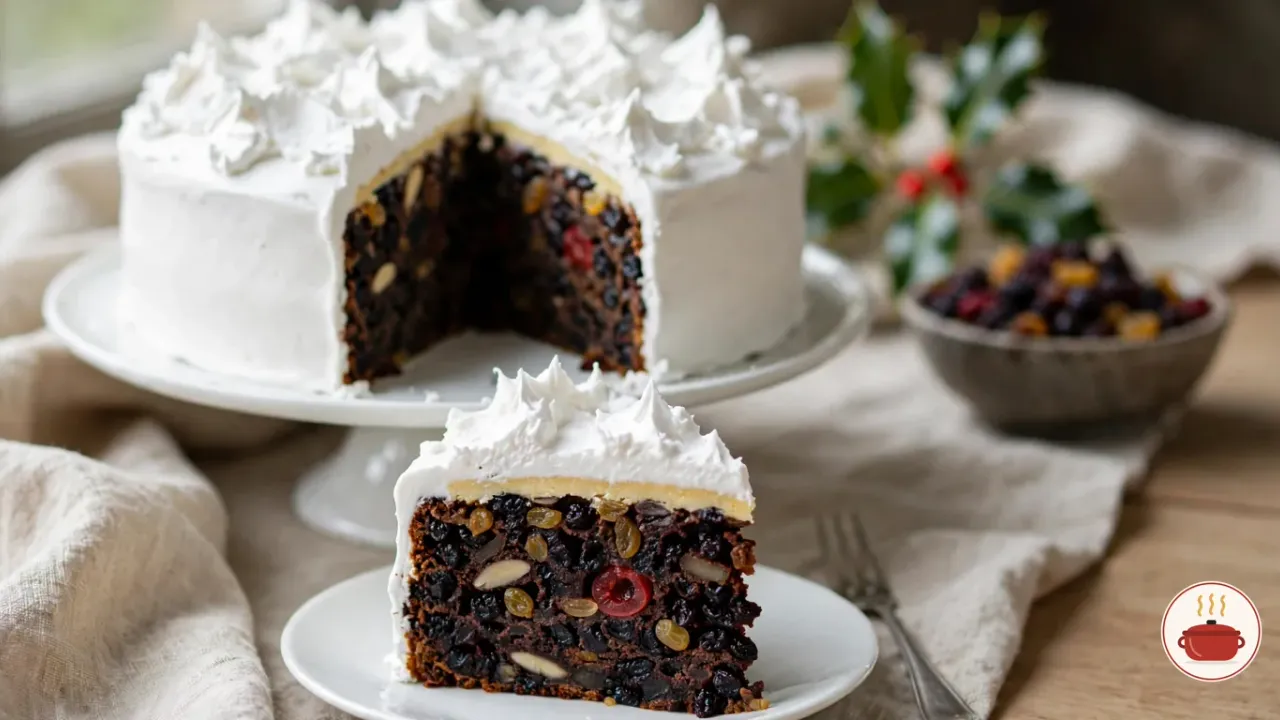
A Christmas cake, in Britain, is a rich, dark fruit cake: dried fruit soaked in brandy, baked low and slow, fed with more brandy for weeks, then covered in marzipan and white royal icing. This recipe makes one 8-inch (20 cm) cake, about 20 slices. It takes about 4 hours of work and baking, plus an overnight soak.
What a British Christmas cake is
The Christmas cake is a dense cake that is mostly fruit. In this recipe, dried fruit makes up about half the weight of the mixture. A soak of brandy, whisky or rum helps it keep for months. It is baked weeks before Christmas, and it gets better as it waits.
The marzipan and white icing usually set it apart from an everyday fruit cake.
From Twelfth cake to Christmas cake
The cake began on another day. The Twelfth cake was eaten on Twelfth Night, in early January. It was “first recorded in England around 1570”, writes the food historian Pen Vogler for the Charles Dickens Museum. It hid a bean and a pea. Whoever found them became king and queen for the night.
Twelfth Night faded during the 19th century. The tokens moved into the Christmas pudding as coins, Vogler explains, and the cake itself “was downsized and billetted onto Christmas day”. Under Queen Victoria, Twelfth cake turned into the Christmas cake, says Historic UK.
Old recipes call this kind of cake a plum cake. Until the 18th century, “plum” meant raisins, currants and other dried fruits. The historian Troy Bickham explains this in a piece republished by Texas A&M University.
Marzipan and royal icing
The double coat came from wedding cakes. Elizabeth Raffald published The Experienced English Housekeeper in 1769. It was the first cookery book to pair a bride cake with almond paste and royal icing, according to the V&A. English Heritage says earlier plum cakes had sugar icing but no marzipan.
Two popular stories don’t hold up. One says Oliver Cromwell banned Twelfth cakes, so cooks hid them under marzipan. “This is sadly untrue,” writes the food historian Neil Buttery on British Food: A History. The other says Queen Victoria banned Twelfth Night around 1860 to 1870. The food historian Mary-Anne Boermans found no evidence for it, she writes on Deja Food.
Cousins around the British Isles and beyond
Every corner of the islands has its own version. Irish cooks soak the fruit in whiskey and start about 12 weeks before Christmas, notes a Galway community heritage project. Scotland has the Dundee cake, topped with whole almonds, and black bun, a fruit cake baked inside pastry for Hogmanay.
In Yorkshire, the cake comes with cheese, often Wensleydale. “Christmas cake without the cheese is like a kiss without the squeeze,” the Leeds food historian Peter Brears told The Yorkshire Post in 2014.
Caribbean black cake is a close relative. Its fruit soaks “in rum and wine for roughly six months”, NPR reported in a piece carried by GBH News. It is part of Christmas across the Caribbean, including Jamaica, where sorrel is the season’s drink.
Why bake a Christmas cake in October
Searches for Christmas cake are up
British shoppers are planning early this year. In mid-September, the supermarket Waitrose said searches on its website for “Christmas Cake” were up 83% on the same 30 days last year. Searches for “Christmas Cake Kit” were up 540%, according to its Christmas 2026 announcement. The figures come from Waitrose’s own data, and it gave no absolute numbers.
Stir-up Sunday is November 22
British families mix their Christmas puddings on Stir-up Sunday, the last Sunday before Advent. In 2026 it falls on November 22, the Church of England’s daily prayer page shows. The name comes from that day’s prayer in the Book of Common Prayer: “Stir up, we beseech thee, O Lord, the wills of thy faithful people”.
The day belongs to the pudding. A cake wants more time. The Sainsbury’s magazine recipe says to bake it in October, and Irish cooks start about 12 weeks ahead. Treat November 22 as the latest comfortable date.
The main ingredients cost less
Butter in the UK cost 7.0% less in August 2026 than a year earlier, the Office for National Statistics reported. The ONS index for dried fruit and nuts rose just 0.9% over the same year, after 7.2% the year before, its figures show.
A homemade comeback?
Shop-bought Christmas cake has been losing ground. Sales data from the market research firm Circana show “a significant decline in the share held by classic Christmas cakes”. Food & Drink Technology reported it in November 2025. Panettone took 41% of UK festive cake sales between October and December 2024.
Nobody publishes a figure for homemade cakes. The Waitrose searches suggest plenty of people are planning to bake their own.
What you need for a Christmas cake
We compared 31 published recipes, 24 of them by British and Irish cooks and outlets. They include Delia Smith, Mary Berry, Nigel Slater, Felicity Cloake, Darina Allen and Rachel Allen. This recipe follows the British and Irish medians.
Dried fruit
The median cake holds about 2 lb (900 g) of dried fruit, glacé cherries and peel included. Currants, raisins and sultanas are the base. Sultanas are called golden raisins in the US.
Rinse the syrup off glacé cherries, dry them well and chop them, advises BBC Food, so they don’t sink. Whole cherries “will sink even if dusted with flour”, warns Nigella Lawson’s team.
Butter, sugar, eggs and flour
Per 2.2 lb (1 kg) of fruit, the British and Irish recipes use a median of 9 oz (250 g) each of butter, sugar and flour, and 4 to 5 eggs. This recipe scales that to 2 lb (900 g) of fruit. Plain flour is in 23 of the 31 recipes.
Dark sugar, dark muscovado or dark brown, is in 18 recipes. Black treacle is in 14. It is the British counterpart to molasses, and molasses works in its place.
Brandy
The fruit soaks overnight in spirit in 24 of the 31 recipes, at a median of about ½ cup (124 ml) per 2.2 lb (1 kg) of fruit. Brandy is the classic choice. Whisky, rum and sherry work too.
For an alcohol-free cake, BBC Good Food suggests strong unsweetened tea, such as Earl Grey, or orange or apple juice.
Spice and almonds
Mixed spice is the British blend of cinnamon, nutmeg, ginger, and cloves or allspice, says BBC Food. In the US, use pumpkin pie spice. The two are “interchangeable”, says Nigella’s team.
Ground almonds are in 12 recipes. They make the crumb richer and moister, but you can leave them out.
How to bake a Christmas cake low and slow
Line the tin twice
A long bake can scorch the outside before the middle cooks. In 14 of the 31 recipes, a double layer of baking parchment lines the tin. Nine tie a band of brown paper or newspaper around the outside as well. Delia Smith even rests a square of parchment over the top.
A low oven
The median oven is 300°F (150°C). Nine recipes go lower, to 275°F (140°C) or under, and several of those bake for 4 hours or more. Delia’s classic cake bakes for 4 hours, “until it feels springy in the centre when lightly touched”.
Sainsbury’s magazine goes further: 250°F (120°C) for 9 to 10 hours. “I bake it ‘low and slow’ so the finished cake is really moist,” writes its recipe author.
Test with a skewer
Most recipes test with a skewer in the center, which should come out clean. Mary Berry checks her cake after 2 hours and covers the top with foil once it is “a perfect colour”, she writes on BBC Food. Then she leaves it to cool in the tin.
Feed it, or don’t
Feeding means spooning spirit into the cake through small holes while it matures. In 13 recipes the cake is fed again and again, and in 9 just once. Nine never feed it.
BBC Good Food feeds “1-2 tbsp alcohol every fortnight”. It stops for the final week, so the top can dry before icing. The Sainsbury’s author is relaxed: “You don’t even need to ‘feed’ it with alcohol.”
Wrap it well
Leave the lining paper on, which keeps the cake moist, Mary Berry advises. She wraps the cold cake in two layers of greaseproof paper, then foil, and keeps it somewhere cool for up to three months.
Marzipan and royal icing
Marzipan first
In Britain, marzipan sits under the icing for two reasons, explains BBC Good Food. It gives a flat base, and it stops the cake’s moisture from staining the white icing. A thin coat of apricot jam glues it on.
Let it dry before icing. Delia puts the marzipan on a week ahead, “to allow its oiliness to dry out”. Nigel Slater says four days is about right.
In the US, look for marzipan, not almond paste. American almond paste has less sugar, so it is less smooth, Nigella’s team explains.
Royal icing
Royal icing is egg whites, icing sugar and lemon juice. It sets hard, and it is the traditional cover for fruit wedding and Christmas cakes, says BBC Food. A teaspoon of glycerine keeps it from turning brittle as it dries.
Raw egg whites
Classic royal icing uses raw egg white. In the UK, hen eggs with the British Lion mark or from the Laid in Britain scheme are safe to eat raw. That includes pregnant people, young children and older people, according to the Food Standards Agency. Its advice does not cover anyone severely immunocompromised.
This year the warning matters more. UK health officials have been tracing Salmonella outbreaks linked to imported eggs. One cluster reached 355 confirmed cases and one death by mid-September 2026, the UKHSA reported. The FSA says there is no evidence that UK-produced eggs are affected.
Outside the UK, or if in doubt, use pasteurized egg whites or meringue powder, as Iowa State University Extension recommends for royal icing. The FDA gives the same advice for any dish that keeps its eggs raw.
Serving and storing Christmas cake
Cut the cake into thin slices with a long, sharp knife. Serve it with tea, or in Yorkshire with a slice of Wensleydale cheese. For a second British pudding at the same table, try sticky toffee pudding.
How long it keeps
A rich fruit cake keeps for months. The Sainsbury’s author says hers keeps “for at least 3 months” wrapped in paper and foil in an airtight container. Fruitcake’s “low water activity” makes it very shelf stable, says Ben Chapman, a food safety researcher at NC State University.
Check it each time you feed it. If you see mold, throw it out. Mold can grow below the surface of porous baked goods, warns the USDA.
Alcohol, children and pregnancy
Spirit fed to a cake after baking is never heated, so the alcohol stays in. A fed cake is not alcohol-free. The NHS advises no alcohol at all in pregnancy. The CDC agrees: “There is no known safe amount of alcohol use during pregnancy.”
For children, pregnant guests or anyone avoiding alcohol, soak and feed the fruit with orange juice or cold tea instead.
Calories and allergens
One slice, a twentieth of the cake with marzipan and icing, has about 560 calories. It has 95 g of carbohydrate, most of it sugar, with 18 g of fat and 7 g of protein. Our figures are estimates, made from USDA data for each ingredient.
The cake contains wheat, eggs, milk and tree nuts, as almonds and marzipan. All four are among the 14 allergens that UK food law names, the FSA lists. Dried fruit often contains sulphur dioxide, a preservative that can affect people with asthma. Check the labels.
Fixes for a Christmas cake that sank, burned or dried out
- The fruit sank: the cherries were whole or still wet, or the batter was too soft. Rinse, dry and quarter the cherries next time.
- The top or sides burned: the oven ran hot, or the tin had a single lining. Use a double layer of parchment and a brown paper collar, and cover the top halfway through.
- The top cracked or domed: the oven was too hot. Check it with an oven thermometer.
- The cake is dry: it was overbaked. Feed it a little more often until Christmas.
- The icing is stained or oily: the marzipan went on too soon before the icing. Give it 3 to 7 days to dry.
- The icing is rock hard: add a teaspoon of glycerine next time.
Substitutes for missing ingredients
- Brandy: whisky, dark rum or sherry; or orange juice or cold tea for an alcohol-free cake.
- Black treacle: molasses, in the same amount.
- Dark muscovado: dark brown sugar.
- Mixed spice: pumpkin pie spice, or 1 teaspoon cinnamon with ½ teaspoon each of ground ginger and nutmeg.
- Ground almonds: leave them out; 19 of the 31 recipes do.
- Raw egg whites: pasteurized egg whites or meringue powder.
- Royal icing: ready-to-roll white fondant, as 6 of the recipes use.
Frequently asked questions
How far ahead should I make a Christmas cake?
Four to 8 weeks ahead is ideal, so October or early November. The cake improves as it matures, and it keeps for up to 3 months.
How often should I feed a Christmas cake?
Every 1 to 2 weeks, with 1 to 2 tablespoons of brandy. Stop a week before you put on the marzipan, so the top can dry.
Can I make a Christmas cake without alcohol?
Yes. Soak the fruit in orange juice or strong cold tea, and feed it with more juice or tea. Without alcohol it keeps for less time, so BBC Good Food suggests feeding it no more than a month ahead.
Do I have to cover it with marzipan and icing?
No. Many people leave it plain, or glaze the top with apricot jam and arrange nuts and glacé fruit on it.
Why did my fruit sink to the bottom?
Usually the glacé cherries were whole or sticky. Rinse, dry and chop them, and keep the batter thick.
How long does Christmas cake keep?
Wrapped well in a cool place, a fed cake keeps for 2 to 3 months or more. Mary Berry gives hers up to three months.
Is Christmas cake safe in pregnancy?
A fed cake contains alcohol, which health services advise against in pregnancy. Royal icing made with raw egg white is fine in the UK with British Lion eggs; elsewhere, use pasteurized whites.
What is Stir-up Sunday?
The last Sunday before Advent, when British families traditionally make their Christmas pudding. In 2026 it falls on November 22.