The Sunday Potthesundaypot.com/recipes/melomakarona/
Melomakarona: Greek Honey Cookies Made with Olive Oil
By The Sunday Pot Kitchen Updated
- • Use about half as much olive oil as flour by weight: 250 ml oil to 500 g flour
- • Dissolve the baking soda in the orange juice, and fold in the flour without kneading
- • One must be hot and the other cool: hot cookies into cool syrup, or cool cookies into hot syrup
- • Bake to a deep golden brown, 22 to 25 minutes at 350°F (175°C), so they stay crisp outside
- • Most recipes keep them 2 to 3 weeks in a tin; honey makes them unsuitable for babies under 1
Ingredients
about 30 cookiesInstructions
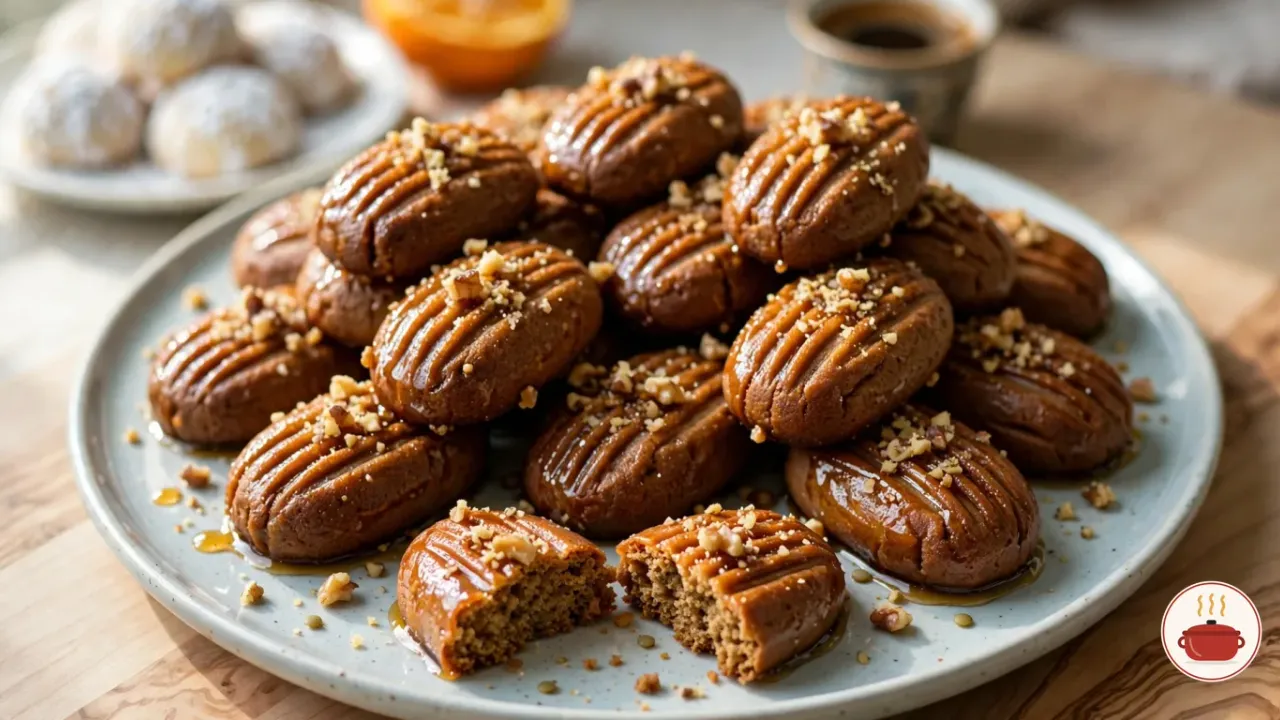
Melomakarona are Greek Christmas cookies made with olive oil, orange juice, sugar and warm spices, then dipped in honey syrup and topped with chopped walnuts. They have no butter and no eggs. This recipe makes about 30 cookies in 2 hours, most of it waiting for the syrup to cool.
What melomakarona are
Oval, honeyed and nutty
A melomakarono, in the singular, is an oval cookie about 2 inches (5 cm) long. It bakes deep golden brown and then soaks in syrup. The result is crisp outside and soft, almost wet, inside. The Greek pastry chef Stelios Parliaros sums them up as “crispy outside, soft inside” (our translation).
The Triantafyllidis dictionary of modern Greek defines the cookie as an egg-shaped sweet of dough and oil, drenched in honey and sprinkled with walnut. Its sample sentence is a good summary of the season: “How can you feel it’s Christmas without turkey and melomakarona!” (our translation).
A name with pasta in it
The same dictionary breaks the word into meli, honey, and makaroni, macaroni. It then traces makaroni, with a “perhaps”, through Venetian back to a medieval Greek word for the meal served after a funeral.
Many articles go further and say the cookie began as an ancient funeral bread dipped in honey. We found no ancient text that describes one. The oldest version of that story we could date is a Greek press piece from December 2013, so read it as a legend.
The darker twin of kourabiedes
A Greek Christmas has two classic cookies. Kourabiedes are butter cookies buried in powdered sugar, white as snow. Melomakarona are their brown, sticky, oil-based twin. They reach Greek bakery windows in late November, The Greek Foodie notes, usually beside a bowl of kourabiedes.
Finikia, the stuffed cousin
The same dictionary calls finikia “a kind of melomakarono”. The food magazine Gastronomos says refugees from Asia Minor and Constantinople brought them to Greece. They are larger, long like a date, and filled with honey, walnuts and cinnamon. The magazine adds that cooks first raised that dough with ash water, and later used orange juice, as in melomakarona.
Why melomakarona are in the news this November
The Nativity fast starts on November 15
The Orthodox Christmas fast runs for 40 days, from November 15 to December 24. In 2026 it begins on a Sunday. Most recipes have no butter and no eggs, so several recipe writers present these cookies as a fasting sweet.
The strict monastic rule is tighter. The Orthodox Church in America quotes the Typikon: during this fast, Mondays, Wednesdays and Fridays allow “neither oil nor wine”. The strict “dry eating” days still allow honey, the same page notes, but not olive oil. So olive-oil melomakarona fit the fast on days when oil is allowed.
Olive oil costs 8.4% less than a year ago
On November 10, 2026, Greece’s statistics office, ELSTAT, published its October price figures. Olive oil was 8.4% cheaper than in October 2025, the biggest yearly fall of any item in the index. Bread and bakery products rose 1.8%, and overall prices 5.7%.
That matters for a batch that takes a full cup of oil. In ELSTAT’s tables, flour rose about 5% between December 2025 and October 2026. Honey and jams rose 1.5% and sugar fell 1.6%, by our reading of the same tables.
A bigger harvest, by trade estimates
Greece’s 2026-27 olive oil crop “could total up to 300,000 tonnes”, the trade magazine OFI reported on October 22, citing an industry report. That would be the largest since 2022-23. It is a trade forecast, not an official figure.
Honey: new labels and a hard season
Since June 14, 2026, honey blended from several countries must list each country on the EU label, with its share in percent. That rule comes from Directive 2024/1438. Its preamble notes that EU checks found a high share of honey on the market suspected of being adulterated. Greece has also set up an electronic system to track honey production, imports and sales, under a 2026 law.
The season itself was poor in places. Beekeepers in Naousa, northern Greece, called 2026 a “black” year, with losses above 50%. That is one local association, not a national figure.
No price yet for this year’s cookies
Shops have not set 2026 Christmas prices yet. Last December, Athens Voice found melomakarona selling for 13 to 20 euros a kilo, up from 12.50 to 17 euros the year before.
What 31 melomakarona recipes agree on
Our comparison takes in 33 published recipes, of which 31 count: two copied others almost word for word. Thirteen are in Greek, including a pastry chef, a baker and the Kathimerini food title Gastronomos. Four are by Greek authors writing in English, and 14 are other English-language recipes.
Orange juice, oil and no eggs
All 31 put orange juice in the dough, and 28 add orange zest. None uses eggs. Twenty-seven use no butter or margarine. Twenty-eight use olive oil, 19 as the only fat; others blend it with sunflower oil, which the Greek cook Argiro Barbarigou says gives a lighter texture.
About half as much fat as flour
Per 500 g of flour, the median is 248 g of fat, 90 ml of orange juice and 86 g of sugar. That is half as much fat as flour, by weight. Ten recipes swap some flour for fine semolina, usually 15% to 25% of the dry mix.
Brandy, cinnamon and clove
Twenty-four add brandy, cognac or another spirit, a median of 50 ml. Cinnamon appears in 26 and clove in 24; nutmeg only in 5. Baking soda appears in 29, usually stirred into the orange juice first.
Syrup: honey cut with sugar
Every recipe soaks the cookies in honey syrup. Only 2 use honey and water alone. The median syrup is 262 g of honey, 222 g of sugar and 240 ml of water. Pastry chefs lean on sugar: Parliaros uses 700 g of sugar to 100 g of honey, then drizzles honey over the stack.
The hot-and-cold rule splits Greece
Most recipes insist that one of the two is hot and the other cool. They disagree on which:
- Hot cookies, cool syrup: 12 recipes, including Parliaros and both Gastronomos recipes.
- Cool cookies, hot syrup: 10 recipes, including Argiro, whose “golden rule” is cold cookies into hot syrup.
- Both hot or warm: 8 recipes. The cookbook author Vefa Alexiadou pours boiling syrup over cookies straight from the oven, then leaves them overnight.
Greek-language recipes split six to six. This recipe uses hot cookies and cool syrup, the larger group. If you follow Argiro, bake first, let the cookies cool, and dip them in warm syrup.
Soak time sets the texture
Gastronomos leaves them in the syrup for 30 seconds to 2 minutes. The shorter the soak, it says, the more biscuit-like and crisp they stay; the longer, the more honeyed and soft. The median dip across the recipes is 35 seconds.
Choosing oil, honey and nuts
- Olive oil: any good olive oil. Argiro blends in some sunflower oil for a lighter cookie.
- Honey: any honey you like. Under the new EU rule, a blend’s label shows where it came from.
- Walnuts: chop them finely, but not to powder. Vefa Alexiadou asked for walnuts “lightly coarse-chopped” (our translation).
- Orange: fresh juice and zest, not a carton.
Tips for soft centers and crisp edges
- Don’t knead. Fold just until the dough comes together.
- Don’t add much flour. Argiro warns that extra flour gives hard, dry cookies.
- Use the soda at once. Shape and bake the dough soon after mixing.
- Bake them dark. A deep golden brown cookie holds its crunch in the syrup.
- Dip in small batches. Five or six at a time keep the syrup cool.
- Wait a day. They taste more honeyed once the syrup has soaked through.
Serving melomakarona
Stack them on a platter, two or three layers high, with a few walnut crumbs on the plate. Put a plate of kourabiedes beside them, with Greek coffee or tea.
For a Greek meal before them, start with tirokafteri and a pot of fasolada. For other Christmas baking, try a British Christmas cake. Cooks who like syrup-soaked sweets can compare India’s gulab jamun.
Storing and safety
Keeping them
Greek and English recipes store them in a sealed tin on the counter, layered with parchment. Their keeping times run from 2 weeks to about a month. General home-baking advice is more cautious. NC State Extension says to cover cookies, and to chill or freeze baked goods you won’t eat within 1 to 2 days. If in doubt, keep part of the batch in the freezer. Freeze the cookies before they go in the syrup, then thaw them and dip them in warm syrup.
Honey and babies
Honey can carry bacteria that cause infant botulism. The NHS says not to give honey to a child under 1. These cookies are soaked in it, so keep them away from babies.
Allergens and alcohol
Melomakarona contain wheat (gluten) and walnuts, a tree nut. Both are major allergens under EU and UK rules and on the FDA’s list. Some versions use sesame or pistachio on top. Most recipes add brandy to the dough. If you avoid alcohol, use extra orange juice.
Raw dough and hot syrup
Don’t taste the raw dough. The FDA advises never to eat raw flour, dough or batter. Boiling syrup with honey sticks to skin and burns deeply, so let it cool as the recipe says. For a burn, the NHS first-aid advice is 20 minutes of cool running water.
Nutrition
One cookie has about 183 calories. It has 2 g of protein, 9.6 g of fat, 22 g of carbohydrate, 1 g of fiber and 37 mg of sodium. We added these up ourselves, ingredient by ingredient, from USDA FoodData Central. We assumed each cookie keeps about 40% of the syrup and counted no brandy, so treat them as an estimate.
Fixes for hard or soggy cookies
- They are hard: the dough was kneaded or got too much flour. Mix less next time, and let them soak longer.
- They are soggy: both cookie and syrup were hot, or they were underbaked. Bake to a deep golden brown, and keep the syrup cool.
- The dough feels greasy and falls apart: the oil separated from overmixing. Bring it together gently with your hands.
- They spread flat: the dough was too soft. Rest it 10 minutes, or add 1 tablespoon of flour.
- The syrup crystallized: it boiled too long. Add a splash of water and warm it until clear.
Substitutes for missing ingredients
- Olive oil: sunflower oil, or half and half, as several Greek recipes do.
- Brandy: extra orange juice, or another spirit such as raki.
- Part of the flour: fine semolina, up to a quarter of the dry mix.
- Walnuts: pistachios or toasted sesame.
Frequently asked questions
How do melomakarona differ from kourabiedes?
Melomakarona are made with oil and soaked in honey syrup. Kourabiedes are butter cookies coated in powdered sugar.
Are melomakarona vegan?
Most recipes have no butter or eggs, but honey is an animal product. For a strict vegan cookie, make the syrup with sugar alone or with another syrup.
Can I eat melomakarona during the Nativity fast?
Recipe writers often call them a fasting sweet, since the dough has no dairy or eggs. Under the strict monastic rule, olive oil is off on Mondays, Wednesdays and Fridays.
Why do my melomakarona go soft and soggy?
The cookies and syrup were probably both hot, or the cookies were underbaked. One must be hot and the other cool.
How far ahead can I make them?
Most recipes say 2 to 3 weeks ahead, in a tin, and they taste best after a day or two. To keep them longer, freeze the baked cookies before the syrup goes on.
What does melomakarono mean?
It is the singular. The dictionary breaks it into honey and macaroni.
Tags: Christmasholidaybakingwalnutsdairy freemake aheaddessert