The Sunday Potthesundaypot.com/recipes/buche-de-noel/
Bûche de Noël: The Yule Log That Rolls Without Cracking
By The Sunday Pot Kitchen Updated
- • Of 26 recipes compared, 18 roll the sponge hot and 5 cool it flat under a cover
- • Sugar and added fat show no clear split between hot and cool rollers
- • Bake only 10 to 12 minutes at 375°F (190°C), since overbaking invites cracks
- • For Christmas Day 2026, bake and fill on Wednesday, December 23
- • All the eggs are baked: the filling and ganache contain none
Ingredients
10 slicesInstructions
A bûche de Noël hangs on one nervous moment: rolling a thin chocolate sponge without breaking it. We compared 26 published recipes to see how cooks avoid the crack. Sugar and fat show no clear split between their methods. Instead, 23 of the 26 do one of two things: roll the sponge hot, or cover it while it cools.
Roll it hot or cover it? How 26 bûche de Noël recipes avoid the crack
Our set holds 16 English-language recipes and 10 French ones, all classic rolled chocolate logs. We sorted them by what happens in the minutes after the oven:
- Rolled hot or warm: 18 recipes. The sponge goes into a towel or paper within minutes. America’s Test Kitchen found that this gave a cake that “retained its rolled memory”.
- Cooled flat under a cover: 5 recipes. Olivia Potts in The Spectator, adapting a Stella Parks method, seals the tin with foil, which “keeps it flexible when it cools”. Nigella Lawson uses a clean tea towel, Darina Allen a damp one, and Ricardo leaves the baking sheet on top. Switzerland’s Blick covers the sponge with an upturned tray.
- Neither: 3 recipes. PBS Food’s flourless roulade stays in its tin, with a warning to “expect the roulade to dip and crack a little”. Meilleur du Chef cools its sponge on a rack, then soaks it in rum syrup. One CuisineAZ recipe doesn’t say how the sponge cools.
The shared idea is holding on to moisture while the cake loses its heat. Pardon Your French rolls its génoise in a cloth straight from the oven and says this “keeps the cake moist”.
What separates the two camps
We expected the cooks who skip the hot roll to lean on extra fat or syrup. The counts say otherwise. Leaving out one butter-cake outlier from the per-egg figures, here is hot against cool:
- Sugar per egg: 29.4 g against 28.3 g
- Recipes with butter or oil in the sponge: 7 of 18 against 2 of 8
- Soaking syrup: of the 5 recipes that use one, 4 still roll hot
The sponge itself is where they part ways:
- Flour per egg: a median of 15.6 g in the hot group and 6.1 g in the cool group
- No flour at all: three recipes, from Nigella, PBS and Darina Allen, and all three cool flat
- Time in the oven: a median of about 10 minutes for hot rollers and about 16 for the others
So floury sponges tend to be rolled early, while the flourless ones are left to cool flat. King Arthur Baking reports something similar from its Baking School, where one moist chocolate cake “could cool as a flat rectangle and only need to be rolled up once”.
Twenty-six recipes, sorted by us, can show a pattern but not a cause. We also found no lab study of why a rolled sponge breaks, so the moisture explanation rests on bakers’ experience.
This recipe follows the larger group. Its 30 g of sugar, 15 g of flour and 5 g of cocoa per egg sit close to the medians of about 29, 15 and 4. The 2 tablespoons of oil are optional insurance, an idea from Preppy Kitchen, which suggests oil for “a more flexible sponge”. Watch the clock above all. Sally’s Baking Addiction is blunt about a sponge left in too long: “it will crack if over-baked”.
If the sponge cracks anyway
Carry on. A log is meant to look rough, and ganache forgives a lot. King Arthur says even a large crack is “easily hidden under a thick layer of frosting”. Nigella tells readers not to worry, since “any tears or dents will be covered by icing later”.
Turn the worst split to the underside when you re-roll, and let the ganache do the rest.
A bûche from 1900 that was never rolled
The phrase began with real firewood. France’s Trésor de la langue française describes a big log burned in the hearth on Christmas Eve, meant to last all night. The Académie française’s 1878 dictionary knows only that log.
The earliest mention of the cake we could verify is from 1894. In La cuisine anglaise et la pâtisserie, Alfred Suzanne lists the signature dishes of fashionable Paris houses. Shortly after Chiboust’s Saint-Honoré comes “les bûches de Noël d’Ozanne”, Ozanne’s Christmas logs. The book doesn’t say how they were made.
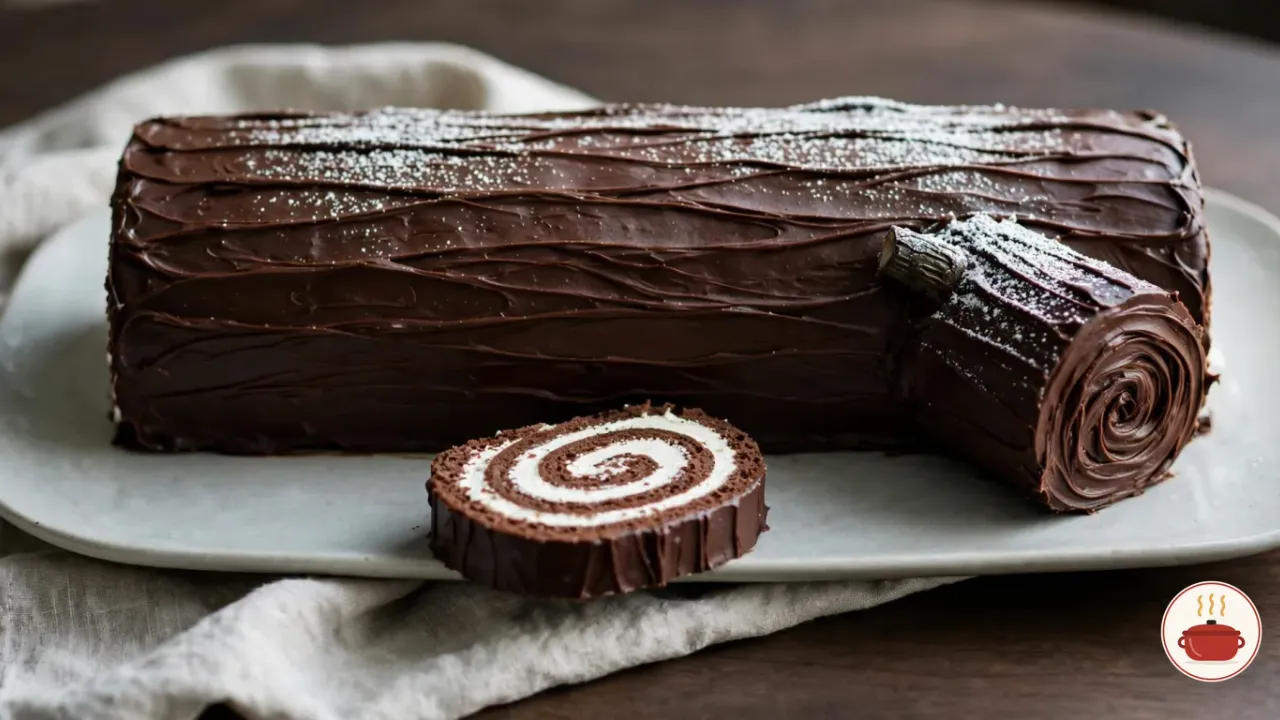
The 1900 edition of Pierre Lacam’s Mémorial historique et géographique de la pâtisserie prints a method, and it involves no rolling. Cut about ten equal rounds of génoise, it says, glue them side by side with mocha or chocolate cream, coat them and pipe on the bark. Gault&Millau places the rolled, buttercream-filled log in the 1950s, without naming a source.
Popular accounts claim that Napoleon’s chimney rules inspired the cake, that Antoine Charabot created it in Lyon in 1860, or that Lacam invented it in 1898. We found no document behind the first two. The third runs into Suzanne, who named Ozanne’s logs four years earlier, and the 1900 edition of Lacam’s book claims no such thing.
What a Paris bûche costs this Christmas
On November 19, Gault&Millau published the 2026 logs of five prize-winning pastry chefs. They run from €76 for Cédric Grolet’s at Le Meurice to €190 for Maxime Frédéric’s at Cheval Blanc Paris. Nina Métayer’s costs €120 and serves six. These are sculpted showpieces rather than sponge rolls, so they show the luxury end of the market, not the price of this cake.
Cocoa has come well off its peak. Trading Economics put it at $5,270 a tonne on November 20, 2026, less than half the record $12,906 of December 2024. It was still 3.66% above a year earlier. We couldn’t find 2026 data showing that shop chocolate has become cheaper, or any 2026 sales count for bûches.
Timing it for Friday, December 25
Christmas Day falls on a Friday this year, and the work splits neatly across three days:
- Wednesday, December 23: bake, roll, fill and re-roll. Wrap the log and refrigerate it. Sally’s allows a filled roll up to 2 days in the fridge.
- Thursday, December 24: make the ganache, coat the log, comb the bark and chill it, loosely covered.
- Friday, December 25: take it out about 30 minutes before slicing, and add the powdered sugar last.
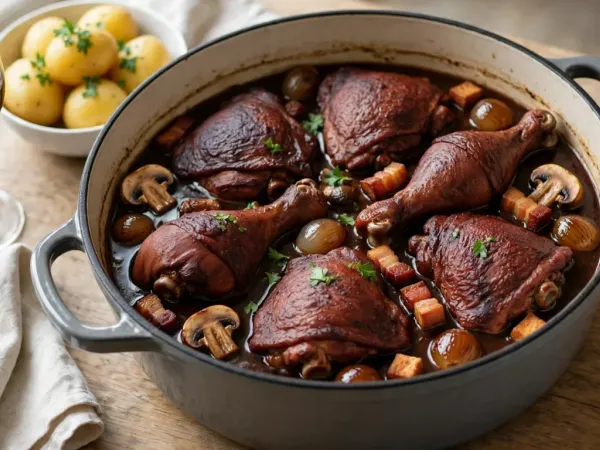
It makes a fitting end to a French menu of coq au vin, with small mugs of vin chaud beside it. If your table is British, it can stand in for a Christmas pudding too.
No food agency we could find sets a keeping time for a cream-filled sponge roll. The closest guide is the FDA’s egg safety page, which says to use leftover cooked egg dishes within 3 to 4 days. It also limits them to 2 hours out of the fridge, or 1 hour above 90°F (32°C). For longer storage, University of Illinois Extension lists frosted cake at 1 month in the freezer.
Raw batter, allergens and a slice in numbers
Every egg in this recipe goes into the sponge and gets baked. Some logs fill with mousse or buttercream made from raw or lightly warmed egg. If you swap one in, the FDA advises pasteurized eggs or egg products for dishes served raw or undercooked.
Leave the bowl unlicked as well. The FDA’s flour guidance is direct: “Never eat or taste raw flour, dough, or batter.”
This log contains wheat, egg and milk, all major food allergens. The French consumer magazine Que Choisir notes that chocolate bars often contain soy or sunflower lecithin, so read the label. Check it for nut warnings too if you are serving someone with an allergy.
One of 10 slices has about 405 calories, 7 g of protein, 28 g of fat, 34 g of carbohydrate and 110 mg of sodium. We added these up from USDA FoodData Central entries, with its 70 to 85% dark chocolate standing in for yours.
Swaps for flour, dairy and chocolate
- Gluten-free: King Arthur’s gluten-free log cools flat and is brushed with syrup, because “it’s too fragile” to roll in a towel. Nigella’s sponge has no flour at all, and the recipe says to check your cocoa and sugar packets.
- Dairy-free: Great British Chefs’ vegan log makes its ganache from 200 ml of coconut cream and 300 g of dark chocolate. Confirm that your chocolate is dairy-free.
- Chestnut filling: Mary Berry uses 225 g of unsweetened chestnut purée with sugar and 150 ml of whipped double cream. Georgina Hayden uses 150 g of the sweetened kind with 150 ml of whipped double cream.
- No dark chocolate: Preppy Kitchen’s frosting relies on cocoa, butter, powdered sugar and cream.
- No clean towel: King Arthur and Mary Berry both roll the warm sponge in paper.
Frequently asked questions
Is a bûche de Noël the same as a yule log?
Yes. The French name means “Christmas log”, and English recipes use the two names for the same rolled, bark-covered cake.
Why did my yule log crack?
King Arthur, Sally’s and Preppy Kitchen all blame overbaking. Cooling the sponge flat with no cover is the other risk most recipes guard against. Either way, turn the split to the underside and let the ganache hide it.
Do you have to separate the eggs?
No. Of our 26 recipes, 21 separate them, but King Arthur, Mary Berry and Claire Saffitz all whip whole eggs instead. Separating gives this sponge its light foam, so keep to the method if it’s your first log.
How far ahead can you make a bûche de Noël?
Bake and fill it up to 2 days ahead, as Sally’s allows, and keep it in the fridge. Our timetable adds the ganache the day before serving.
Can you freeze a yule log?
Yes. University of Illinois Extension gives frosted cake 1 month in the freezer. Wrap the log well and thaw it in the fridge before serving.