The Sunday Potthesundaypot.com/recipes/coq-au-vin/
Coq au Vin: Classic French Chicken Braised in Red Wine
By The Sunday Pot Kitchen Updated
- • Marinate bone-in thighs and drumsticks overnight in one bottle of fruity red wine
- • Boil the strained marinade before it goes back in, and dry the chicken well before browning
- • Brown lardons, pearl onions and mushrooms separately, so they stay firm
- • Simmer young chicken gently for about 1 hour; an old rooster needs 2 to 3 hours
- • Reduce the sauce until it coats a spoon; it tastes better the next day
Ingredients
6 servingsInstructions
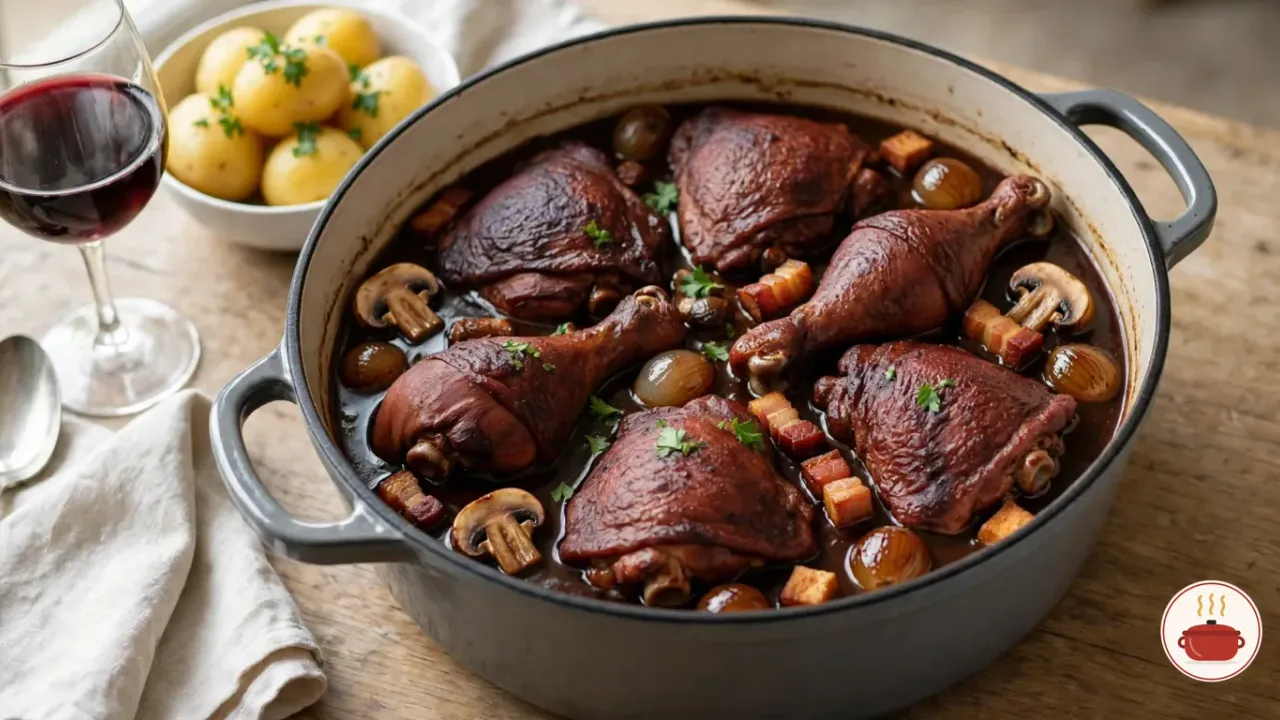
Coq au vin is the French braise of chicken in red wine: bone-in pieces marinated, browned, then simmered in a full bottle until tender, with lardons, mushrooms and small onions. The sauce ends up dark, glossy and just thick enough to coat the meat. It takes about 2½ hours to cook for 6, and an overnight marinade is optional.
What coq au vin is
A rooster, a bottle and a long simmer
Coq means rooster. An old cock is tough, and wine and slow heat were the way to make it tender. The USDA still describes a “cock or rooster” as “a mature male chicken with coarse skin and tough, dark meat”. It “requires long, moist cooking”, says its guide to chicken.
French cooks knew this well. Joseph Favre’s kitchen dictionary of 1903, now on the Internet Archive, allows “three or four hours” for a cock over a year old (our translation). A supermarket chicken is a few weeks old and needs about one hour.
The oldest printed version we found
The dish lived in farmhouses long before it reached print. In 1913, the writer Pampille (Marthe Daudet) put it in the Auvergne chapter of Les Bons Plats de France, on the Internet Archive. She admitted she had “never seen it in cookbooks” (our translation).
Her version is simple. She bleeds the cock and keeps the blood with a dash of vinegar. She browns the pieces in butter with small onions and bacon. Then comes a roux with one glass of stock and one of “very good red wine”.
The blood goes in five minutes before serving, to thicken the sauce. “Je recommande le coq au vin,” she ends: I recommend it.
We searched the scanned texts of Escoffier’s Le Guide culinaire (1903) and Ali-Bab’s Gastronomie pratique (1912). Neither has a coq au vin. Food historians cite another early 1900s account, from Edmond Richardin’s L’Art du bien manger. It takes place at an inn on the Puy-de-Dôme in Auvergne. We could not read that book ourselves.
Burgundy, Auvergne or Beaujolais?
Most English recipes call coq au vin a Burgundy dish, and it suits the region’s pinot noir. The oldest printed versions we found point to Auvergne instead, cooked with local wine. Around Lyon, the Beaujolais claims it too: Paul Bocuse first made his with a Juliénas, says the wine region’s trade body, Inter Beaujolais. No source proves a single birthplace. It is a dish of wine country, made with whatever wine was at hand.
The Caesar story
A popular legend says the Gaulish chief Vercingetorix sent Julius Caesar a tough old rooster as an insult, and Caesar cooked it in wine. No ancient text supports it. Caesar’s own account of the war, on Project Gutenberg, describes the siege of Gergovia without any rooster. The pun may explain the tale: in Latin, gallus means both a rooster and a Gaul.
Julia Child’s signature dish
Americans learned coq au vin from Julia Child. It is in Mastering the Art of French Cooking, the 1961 book she wrote with Simone Beck and Louisette Bertholle. She cooked it on her TV show The French Chef in an episode first aired on January 6, 1964, and again in color in 1971.
Why coq au vin fits this November
Beaujolais Nouveau arrives on November 19
The new Beaujolais reaches shops on the third Thursday of November every year, as Inter Beaujolais explains. In 2026, that is Thursday, November 19, Lyon Capitale confirmed in September. Last year, the region sold 104,000 hectoliters of Nouveau, about 13.8 million bottles, according to Inter Beaujolais.
Nouveau itself is light, made to drink young. For the pot, the region’s own recipe uses a Beaujolais cru such as Juliénas or Chénas, and Bocuse favored Fleurie. Cook with a cru, and pour the Nouveau at the table.
A small, very early wine harvest
The 2026 French wine harvest is short. Agreste, the farm ministry’s statistics office, estimated it at about 35 million hectoliters on October 1, down 2% on 2025 and 14% below the 2021 to 2025 average. Burgundy and Beaujolais together fell harder: 22% below 2025 and 30% below average, in Agreste’s table.
Hail, drought and heat waves did the damage. In early September, franceinfo reported losses of more than 50% for Burgundy pinot noir. The heat also brought picking forward. In the Beaujolais, it began on August 13, Lyon Capitale reported. In 2024, it had started on September 6.
What a short harvest means for your pot
Even so, Burgundy’s trade bodies have advised producers not to make up the lost volume with higher prices, because demand is falling. Radio France’s ICI Bourgogne reported this in September. Either way, a coq au vin does not need a costly bottle. Felicity Cloake, testing recipes for The Guardian, advises “a silky, fruity pinot noir”, which “doesn’t have to be from Burgundy”.
No count for the dish
Nobody, as far as we could find, has measured coq au vin itself in 2026, by sales, menus or searches. The year’s news is about the wine, the calendar and the harvest.
What goes into coq au vin
We compared 36 published coq au vin recipes. Eleven are French-language, from 750g, Marmiton, Cuisine AZ, ELLE à table, Inter Beaujolais and Burgundy wine houses. The other 25 are in English. They include Felicity Cloake, BBC Good Food, Simon Hopkinson, Melissa Clark at NYT Cooking, America’s Test Kitchen, Anthony Bourdain and Julia Child.
Rooster or chicken
The French and English recipes split here. Ten of the 11 French recipes ask for a coq, a rooster, while 24 of the 25 English ones use chicken. Twenty-two joint a whole bird, and 11 use only legs and thighs. Dark meat stays moist through the braise, so this recipe uses thighs and drumsticks.
The cooking times follow the bird. Rooster recipes braise for a median of 120 minutes; chicken recipes, 52 minutes.
One bottle of red
Nineteen recipes use exactly one 750 ml bottle. Eighteen name a Burgundy or pinot noir; the two Bocuse versions use Beaujolais crus. Pick a dry, fruity red with good acidity and little oak. Avoid anything sold as “cooking wine”.
To marinate or not
Ten of the 11 French recipes marinate the bird overnight in the wine, with onion, carrot, garlic and herbs. Most English ones skip it: 15 of 25. The marinade matters most for a tough rooster. With chicken, it deepens the color and flavor, but you can leave it out. Cloake suggests making the whole dish a day ahead instead.
Cognac, flamed or not
Seventeen recipes add cognac or brandy, and 12 set it alight. The other 24 recipes do not flame anything. “If you’re too nervous to ignite it, just cook brandy down for 1 minute,” Clark writes. This recipe gives you both options.
Lardons, mushrooms and small onions
This trio is the classic garnish. Pork is in 33 recipes, as lardons, bacon or pancetta, at a median of 150 g. Mushrooms appear in 35, at a median of 250 g, and small onions in 28. Thyme and bay are in nearly every one.
Browning the garnish in a separate pan keeps the mushrooms and onions firm. They join the sauce only at the end.
Flour, not blood
Thirty-three recipes thicken with flour. Most sprinkle it over the browned chicken; six whisk in beurre manié, a paste of soft butter and flour, at the end. None uses blood, as Pampille did. Three use liver or foie gras instead, a richer modern stand-in.
How to get a dark, glossy sauce
- Dry the chicken well. Wet, wine-soaked skin steams instead of browning.
- Boil the marinade first. Skimming the foam gives a cleaner sauce.
- Simmer gently. A hard boil toughens the meat and clouds the sauce.
- Reduce at the end. With the chicken set aside, boil the sauce until it coats a spoon.
- Thicken if needed. Mash 1 tablespoon each of soft butter and flour and whisk it in, a little at a time.
- Make it a day ahead. The flavors settle overnight, and the fat sets on top so you can lift it off.
Regional versions
- Coq au riesling: Alsace makes it with dry white riesling, often finished with cream.
- Coq au vin jaune: the Jura uses its nutty yellow wine and morel mushrooms.
- Coq au vin de Chanturgue: Auvergne’s version, named for a small red wine from near Clermont-Ferrand.
- Beaujolais style: a Juliénas, Chénas or Fleurie in place of Burgundy.
Serving coq au vin
Serve it from the pot or on a deep platter, with the sauce spooned over. Twelve of the 16 recipes that suggest a side name potatoes: boiled, steamed or mashed. Six name fresh tagliatelle or buttered noodles. Crusty bread and a green salad suit it too, with a glass of the same kind of wine.
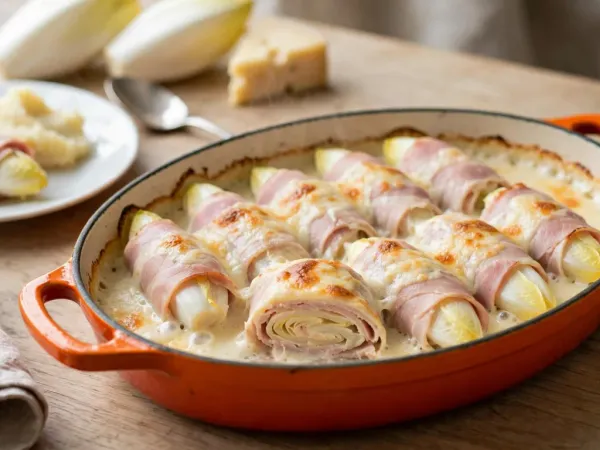
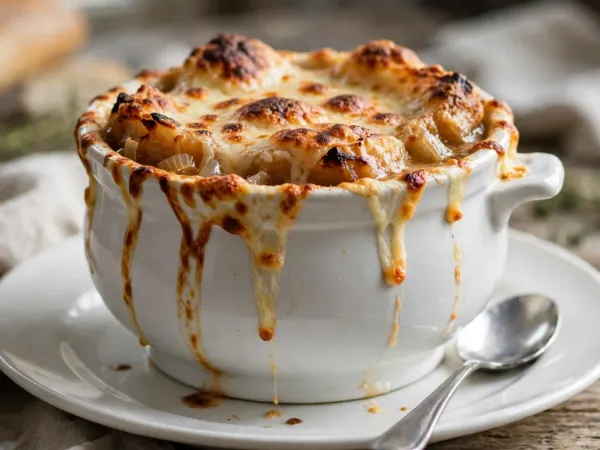
Start with a bowl of French onion soup, or serve endives au jambon at another meal for a second French classic. If you like long braises, try classic pot roast or the Polish St. Martin’s roast goose, served on November 11.
Storing, safety and nutrition
Leftovers and freezing
Coq au vin keeps well. Spread leftovers into shallow containers and chill them no later than 2 hours after cooking. Chicken pieces covered in gravy last 3 to 4 days chilled and about 6 months frozen, the USDA’s chicken guide says. Reheat it until it bubbles, and to 165°F (74°C) in the thickest piece.
Safe chicken and a safe marinade
Cook the chicken to 165°F (74°C), the lowest safe temperature the USDA’s temperature chart allows for any poultry. The wine stains the meat, so color tells you nothing; use a thermometer.
Marinate in the fridge, never on the counter, and for no more than 2 days. Bring a marinade that held raw poultry to the boil before it becomes a sauce, the USDA’s marinating guide advises. Boiling the wine in step 2 and simmering it for an hour covers that.
Flaming the cognac
Always move the pot away from the burner before adding the spirit, and pour it from a measuring cup, never the bottle. Keep a lid nearby. The US Fire Administration says covering a burning pan with a lid will put the fire out. Tie back long hair and keep sleeves clear of the flame.
How much alcohol stays
Not all of it burns off. In the USDA’s table of retention factors, flaming leaves 75% of the alcohol. After 1 hour of simmering, 25% remains; after 2½ hours, 5%. So this dish still holds some alcohol. Keep that in mind for children, pregnancy, or anyone who avoids it.
Nutrition and allergens
A serving, one-sixth of the pot, has about 590 calories, 36 g of protein, 36 g of fat and 13 g of carbohydrate. Our figures add up USDA FoodData Central data for chicken thighs with skin, red wine, bacon, mushrooms, onions and butter. It assumes you skim the fat and that a quarter of the wine’s alcohol remains.
Wine contains sulphites. Above 10 mg per liter, food labels in the UK and the EU have to name them, under Regulation 1169/2011. The flour adds gluten, and the butter adds milk. For a gluten-free sauce, skip the flour and reduce the sauce longer.
Fixes for thin, sour or tough coq au vin
- The sauce is thin: take the chicken out, boil the sauce hard, then whisk in beurre manié.
- It tastes sharp or sour: the wine was too young or acidic. Simmer it longer, add a pinch of sugar, or stir in a spoonful of redcurrant jelly, as Cloake suggests.
- The meat is tough: it needs more time at a gentle simmer, or it bubbled too hard. A rooster needs 2 to 3 hours.
- The skin is flabby: it softens in any braise. Brown it well at the start, and serve it skin side up.
- The sauce looks purple: it has not reduced enough. Boil it down until it turns deep brown.
- It is greasy: chill it overnight and lift off the fat.
Substitutes for missing ingredients
- Rooster: a stewing hen or an older bird, braised for 2 to 3 hours. Supermarket chicken works with the times above.
- Pinot noir: a Beaujolais cru, a Côtes du Rhône or any dry, fruity red.
- Slab bacon: thick-cut bacon or pancetta, cut into strips.
- Pearl onions: frozen pearl onions, thawed and dried, or small shallots.
- Cognac: any brandy, or leave it out.
- Chicken stock: water, with a little more salt.
Frequently asked questions
What wine is best for coq au vin?
A dry, fruity red with good acidity, such as pinot noir or a Beaujolais cru. Half the recipes we compared name a Burgundy or pinot noir. Skip “cooking wine”.
Do I have to marinate coq au vin overnight?
No. Most French recipes do, but most English ones don’t. With chicken, the marinade adds color and flavor; with a rooster, it matters more.
Is coq au vin made with chicken or rooster?
Traditionally a rooster, which is what coq means. Today most recipes outside France use chicken, which cooks in about an hour.
Does the alcohol cook off in coq au vin?
Not completely. After an hour of simmering, about a quarter of the alcohol remains, according to USDA data.
Can I make coq au vin ahead?
Yes, and it often tastes better. Make it a day or two ahead, refrigerate it, lift off the fat and reheat it gently.
What goes well with coq au vin?
Boiled or mashed potatoes, buttered noodles or fresh tagliatelle, crusty bread, and a green salad.
Can I freeze coq au vin?
Yes, for about 6 months. Thaw it in the fridge overnight and reheat it until it bubbles.
How does coq au vin differ from boeuf bourguignon?
Both braise meat in red wine with lardons, mushrooms and small onions. Coq au vin uses chicken or rooster; boeuf bourguignon uses beef and cooks longer.
Tags: Sunday dinnerchickenbraisemake aheadfreezer friendlydairy free option