The Sunday Potthesundaypot.com/recipes/jamaican-sorrel/
Jamaican Sorrel: The Spiced Hibiscus Drink for Christmas
By The Sunday Pot Kitchen Updated
- • Eight glasses take 10 cups (2.4 liters) of water, 3 cups (115 g) of dried sorrel, 3 oz (85 g) of ginger and 12 pimento berries
- • Simmer only the ginger and spices, for 5 minutes, and add the sorrel off the heat so it does not turn bitter
- • Cool it for about 1 hour, then steep it in the fridge for 8 to 24 hours
- • Sweeten after straining: 1 cup (200 g) of sugar gives about 25 g a glass
- • Add rum by the glass, so children and non-drinkers can share the batch
- • Keep it covered in the fridge and drink it within 1 week
Ingredients
8 servingsInstructions
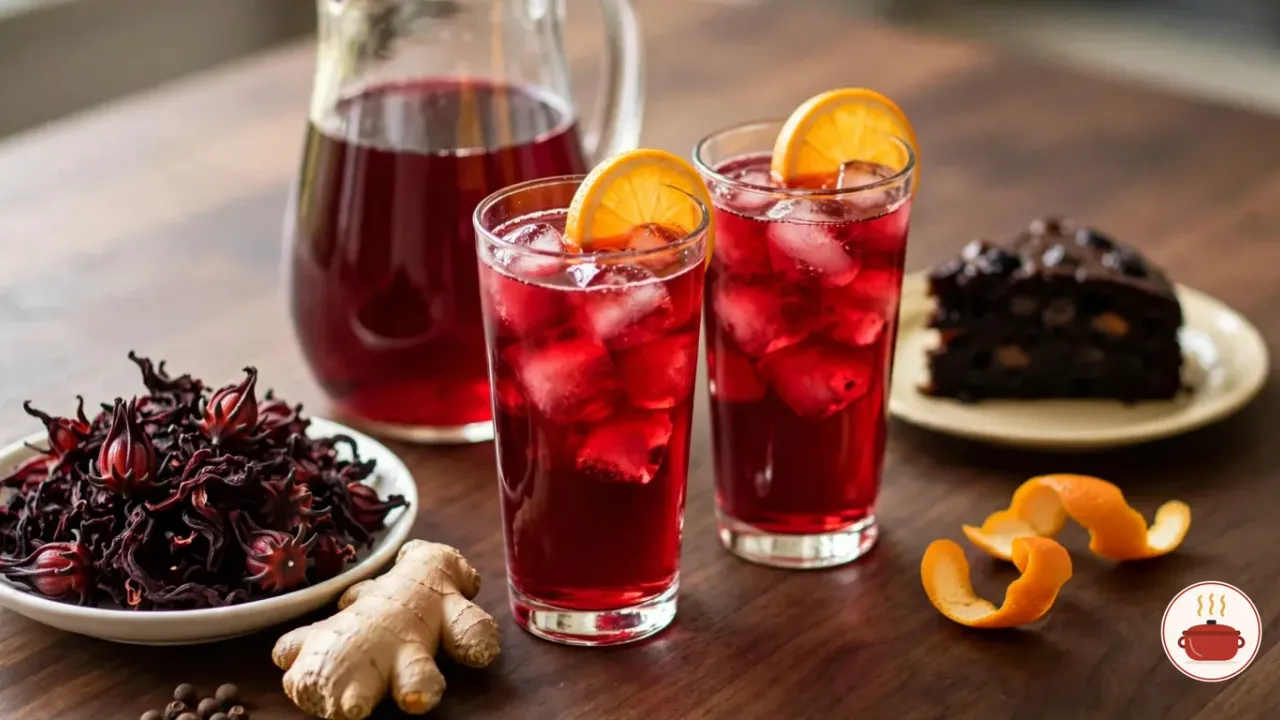
Jamaican sorrel is the island’s Christmas drink: dried roselle calyces steeped with fresh ginger and pimento, sweetened, and served cold, often with rum. This version simmers only the spices. The sorrel steeps off the heat, then in the fridge for 8 to 24 hours. It makes 8 glasses, with about 25 g of sugar in each.
What Jamaican sorrel is
The sorrel in this drink is not the leafy green herb. It is roselle, Hibiscus sabdariffa, and the part you use is the calyx: the fleshy red cup that wraps the flower’s seed pod. The leafy herb, Rumex acetosa, belongs to a different plant family, the Royal Horticultural Society notes.
The two share a name because they share a taste. In 1707, the naturalist Hans Sloane described Jamaica’s “French Sorrel” in his account of the island. The whole plant had “a sowr tast like Sorrel, whence the name”, he wrote. It grew “in most Gardens of this Island”, and people made the calyces into tarts, jellies and wine.
One flower, many drinks
The same calyces make bissap in Senegal, zobo in Nigeria, sobolo in Ghana and karkadé in Egypt and Sudan. In Mexico they are sold dried as flor de jamaica, for agua de jamaica. The drink is known as bissap in many African countries, the food historian Adrian Miller told NPR. “Then it became sorrel in Jamaica,” he said.
Ginger and pimento make the Jamaican version Jamaican. We compared 19 published sorrel recipes. Pimento was in 10 of the 11 Jamaican ones, and in none of the 4 from Trinidad and Guyana. “In Jamaica ginger is a key ingredient in sorrel and it is not optional,” writes the Guyanese cook Althea Brown of Metemgee. Her own Guyanese sorrel leaves it out.
How roselle came to Jamaica
Roselle is “probably of tropical African origin”, according to the PROSEA plant handbook. Its seeds are said to have reached the New World with enslaved Africans, the botanist Julia Morton wrote in Fruits of Warm Climates. It was growing in Jamaica by 1707. Miller links sorrel to the red drinks that “crossed the Atlantic during the Atlantic slave trade”.
Some Jamaican sources call the plant native. The National Library of Jamaica says it is “probably indigenous”. A University of Florida extension agent disagrees: it “is not indigenous to Jamaica”.
Why it is a Christmas drink
Roselle is a short-day plant. It “flowers when days are shorter”, 3 to 4 months after planting, a 2026 University of Florida guide explains. The calyces are ready to pick about 2 weeks after the flowers open. In Jamaica, farmers sow in July to reap in time for Christmas, the Jamaica Observer reported. One farmer remembered a season that ran from November to February.
So sorrel became the taste of the holidays. The National Library pairs it with Jamaica’s rum-soaked fruit cake, “enjoyed with a glass of chilled sorrel by many”. Before refrigerators were common, families cooled it in stone or earthenware jars. New varieties now crop for up to 10 months of the year, the University of the Virgin Islands reports. In Jamaica, though, most sorrel is still grown for Christmas.
Why sorrel is scarce, and in fashion, in 2026
We found no sales or menu figure for sorrel the drink. The signs this year are a short crop in Jamaica and a hibiscus boom elsewhere.
Hurricane Melissa, then drought
Hurricane Melissa struck Jamaica on 28 October 2025. It “might have wiped out more than 90 per cent” of the island’s sorrel crop, the Gleaner reported in December, without naming a source. The crop was already shrinking. Jamaica grew 837.7 tonnes of sorrel in 2024, down 27% from 1,152.6 tonnes in 2023, by the Planning Institute of Jamaica’s figures.
Prices followed. One juice maker paid J$250 to J$300 a pound before the storm and about J$500 after. At Kingston’s Coronation Market, sorrel sold for about J$800 a pound in the week before Christmas, the Observer found.
This year, drought has followed the storm. In June 2026, 11 of Jamaica’s 14 parishes had less rain than their 30-year average, the Met Service said, as the Gleaner reported. On 9 October 2026, the Observer found no sorrel at all at Coronation Market. One vendor guessed that a pound that cost J$1,500 last year might cost about J$2,000 this Christmas.
Hibiscus goes mainstream
Abroad, the flower behind sorrel is having a moment. On 7 October 2026, the research firm Datassential moved hibiscus into its “New Classics” for 2027, beside chili crisp and sticky toffee pudding. It named them in a press release on its trends report. It gave no figure for hibiscus. In March 2026, Chick-fil-A put Strawberry Hibiscus drinks on its US menu for the spring.
In January 2026, Mexico’s government launched “Jamaica para el Bienestar”. The program aims to buy flor de jamaica from growers in Guerrero at a fair price, El Heraldo de México reported. Guerrero is the country’s top producer, its governor said.
For readers outside Jamaica, that is good news. Much of the dried sorrel sold even in Jamaica is imported. In 2024, one Jamaican tea maker told the Gleaner that it imports most of its supply, from as far as Nigeria. Flor de jamaica from a Mexican shop, or bissap from a West African one, is the same plant.
What goes into Jamaican sorrel
Dried or fresh sorrel
Dried sorrel is the easiest to find outside the Caribbean. Choose dark, deep red calyces. The light red kind “has less flavor and contains more acid”, the writer John Feeney noted in Aramco World. A cup of dried sorrel weighs about 38 to 50 g, judging by the recipes that give both. This recipe uses 3 cups, about 115 g, for 10 cups of water.
Fresh calyces are mostly water, 86.6% by USDA figures, so you need far more by weight. The 5 fresh recipes we compared use a median of about 360 g per liter of water. For this batch, that is about 2 lb (900 g).
To prepare fresh sorrel, cut around the tough base of each calyx and push out the green seed pod. The pods carry short, stiff hairs that prick the fingers. Wear gloves, as Ros Singh of We Trini Food advises. They also keep the red dye off your hands.
Ginger and pimento
Ginger gives sorrel its bite. After a sip, Jamaicans beat their chest and say “aaaah, it ginga”, the Observer jokes. The recipes we compared use a median of 38 g of ginger per liter of water. This one uses 3 oz (85 g) for 10 cups, thinly sliced.
Pimento is the dried berry the rest of the world calls allspice. It is native to Jamaica and seasons the island’s savory food too, such as Jamaican oxtail. Melissa hit it hard as well. The storm destroyed an estimated 70% of pimento crops in key growing areas, the Gleaner reported in May 2026.
Cinnamon, cloves and orange peel are common extras. Cinnamon was in 12 of the 19 recipes, cloves in 10 and orange peel in 8.
Sugar
Sorrel is a sweet drink. The recipes we compared use a median of 33 g of sugar per 250 ml glass, from 19 g to 47 g. That is two-thirds of the FDA’s Daily Value of 50 g for added sugars. It is also more than the NHS daily maximum of 30 g for adults.
This recipe starts with 1 cup (200 g) of sugar, about 25 g a glass. Add it after straining, as 16 of the 19 recipes do, so you can taste as you go.
Rum and wine
Rum is optional, and traditional. Jamaican cooks reach for Wray & Nephew White Overproof, often with the brand’s Red Label wine, Punch notes. The overproof is 63% alcohol, by the brand’s own figure. Too much can make sorrel taste “medicine-like”, warns Ainseanlea Bonds of The Stush Kitchen.
How to make Jamaican sorrel without boiling it bitter
Of the 19 recipes we compared, 11 are Jamaican, 4 come from Trinidad and Guyana, and 4 from mainstream outlets. They agree on the spices. They split on heat.
Steep it, don’t boil it
Nine of the 19 never simmer the sorrel. They pour boiling water over it, or add it off the heat. Five simmer it for 15 to 30 minutes. Long heat can turn the drink “bitter and acrid”, Bonds warns.
Science backs the gentle route. At the University of Florida, researchers steeped hibiscus at 77°F (25°C) for 4 hours. It drew out as much red pigment as 16 minutes at 194°F (90°C). The color held up far better in the cold method, they reported in the Journal of Food Science. In Sudan, cooks make karkadé by soaking the calyces in cold water for 2 days, with no boiling at all, Feeney wrote.
So this recipe simmers only the ginger and spices, for 5 minutes, to draw out their flavor. The sorrel goes in once the heat is off.
Steep it in the fridge
Most recipes steep sorrel overnight, and some leave it on the counter. Food-safety advice for brewed tea is stricter. Illinois Extension says to refrigerate tea after brewing, and never to keep it at room temperature for more than 8 hours. No agency has written rules for sorrel itself. We follow the tea advice: cool the pot for about 1 hour, then steep it in the fridge for 8 to 24 hours.
How strong to make it
The middle of the range is about 1.16 cups of dried sorrel per liter of water, and this recipe sits close to it. A longer steep makes sorrel more tart, not just stronger, several cooks note. Some brew it strong and dilute it. The food historian Jessica B. Harris serves hers half sorrel, half water, in a recipe the Smithsonian shares.
Why some cooks add rice
A few recipes drop some rice into the bottles and leave the sorrel to ferment for a day or more. Grace Foods adds a few grains per bottle. There are many theories about what the rice does, Harris writes, “but all agree that the best reason to add it is that it’s traditional”. Fermented sorrel has a subtle fizz, and the rice can thicken it, Punch explains.
If you try it, use loose caps. Sealed bottles of a fermenting drink build up carbon dioxide and can burst, University of Maine Extension warns of kombucha. Move the bottles to the fridge after a day or two.
Serving, storing and spiking sorrel
Serve sorrel cold, over ice, with a slice of Christmas fruit cake. Its tart edge also cuts through rich holiday food. If you want something hot instead, Mexican champurrado is another drink for the season.
How long it keeps
In the fridge, sorrel keeps about 1 week, the median of the 6 recipes that say. Chris De La Rosa of CaribbeanPot freezes it for longer. Two recipes claim it keeps for up to a year. We found nothing to support that.
Save the spent sorrel. Singh turns it into jam, chutney or fruit cake. Sloane recorded sorrel tarts and jellies back in 1707.
Rum by the glass
Spike each glass, not the batch, so children and non-drinkers can share it. A 30 ml shot of 63% overproof holds almost 2 UK units of alcohol, by the NHS formula. The NHS advises no more than 14 units a week. The 2025–2030 Dietary Guidelines for Americans tell adults to drink less, and say pregnant women should avoid alcohol completely.
Is sorrel good for you?
Hibiscus is often sold as good for blood pressure. The evidence is mixed. A 2022 meta-analysis of 17 trials in Nutrition Reviews found that hibiscus lowered systolic pressure by 7.10 mmHg against a placebo. But the trials varied widely, and they used unsweetened tea or extracts, not sugary sorrel. A 2021 Cochrane review found the evidence “insufficient” to judge.
Hibiscus can also change how the body handles some medicines. In small human studies, it lowered blood levels of the antimalarial chloroquine and the statin simvastatin. If you take regular medicine, ask your doctor before you drink a lot of it. No good studies show it is safe in pregnancy or while breastfeeding, so ask a midwife or doctor first.
Calories
A 1-cup (240 ml) glass of this sorrel has about 100 calories and 26 g of carbohydrate, nearly all from the sugar. Brewed hibiscus on its own has close to zero, by USDA figures. A 30 ml shot of overproof rum adds about 100 calories more.
Fixes for sorrel that is bitter, weak or too tart
- It tastes bitter: the sorrel boiled too long, or lime rind or ground cloves went in. Next time, add the sorrel off the heat and use whole cloves.
- It is weak or pale: steep it longer, up to 24 hours, or use more sorrel. Pale calyces give a lighter, sourer drink.
- It is too tart: add sugar 1 tablespoon at a time, or dilute it with cold water.
- It is too strong: dilute it, up to half and half, as Harris does.
- It tastes of medicine: too much overproof rum. Add it by the glass, a little at a time.
- It fizzes in the fridge: it has started to ferment. If you did not add rice to ferment it on purpose, throw it out.
- It stained the counter: sorrel dye marks wood and cloth. Wipe up spills at once.
Substitutes for missing ingredients
- Dried sorrel: flor de jamaica, bissap, zobo or karkadé. They are all the same calyces.
- Fresh sorrel: about 2 lb (900 g) per batch, with the seed pods removed, in place of 3 cups of dried.
- Fresh ginger: leave it out, the Guyanese way, and add a second cinnamon stick and 6 more cloves.
- Pimento berries: whole allspice is the same thing. Ground allspice clouds the drink, so strain it through a coffee filter.
- Granulated sugar: brown sugar or demerara, which add a hint of molasses.
- Overproof rum: any white rum, a dark rum, or Red Label wine.
- Orange peel: dried orange peel, or leave it out.
Frequently asked questions
What is Jamaican sorrel made of?
Dried or fresh roselle calyces, steeped in water with ginger and spices, then sweetened. In Jamaica, the spices are usually pimento, cinnamon and cloves.
Is sorrel the same as hibiscus tea?
It is the same plant and the same part, the calyx of Hibiscus sabdariffa. Sorrel is brewed stronger, spiced with ginger and pimento, sweetened and served cold.
Why is sorrel a Christmas drink?
Roselle flowers as the days get shorter, so in Jamaica the calyces are ready in November and December.
Should you boil sorrel?
You don’t need to. Simmer the ginger and spices, then add the sorrel off the heat. Long boiling can make it bitter.
How long should sorrel steep?
At least 8 hours, and up to 24, in the fridge. A longer steep makes it darker and more tart.
How long does sorrel last?
About 1 week, covered, in the fridge. Freeze it if you want to keep it longer.
Is sorrel alcoholic?
Not unless you add rum or wine. Add it by the glass, and the batch stays alcohol-free.
Can I use fresh sorrel?
Yes. Use about 2 lb (900 g), with the seed pods removed. Wear gloves, because the pods have prickly hairs and the juice stains.