The Sunday Potthesundaypot.com/recipes/endives-au-jambon/
Endives au Jambon: Endive and Ham Gratin with Béchamel
By The Sunday Pot Kitchen Updated
- • Allow 2 endives per person: the median of 28 published recipes, 24 of them French or Belgian
- • Cut a small cone from the base, and never soak the endives
- • Cook the endives first, then drain and press them so the sauce doesn't turn watery
- • About 2 cups (480 ml) of béchamel and 1 cup (100 g) of Gruyère cover 8 rolls
- • Bake at 400°F (200°C) for 20 to 25 minutes, until the sauce bubbles and browns
- • Refrigerate leftovers within 2 hours and reheat them to 165°F (74°C)
Ingredients
4 servingsInstructions
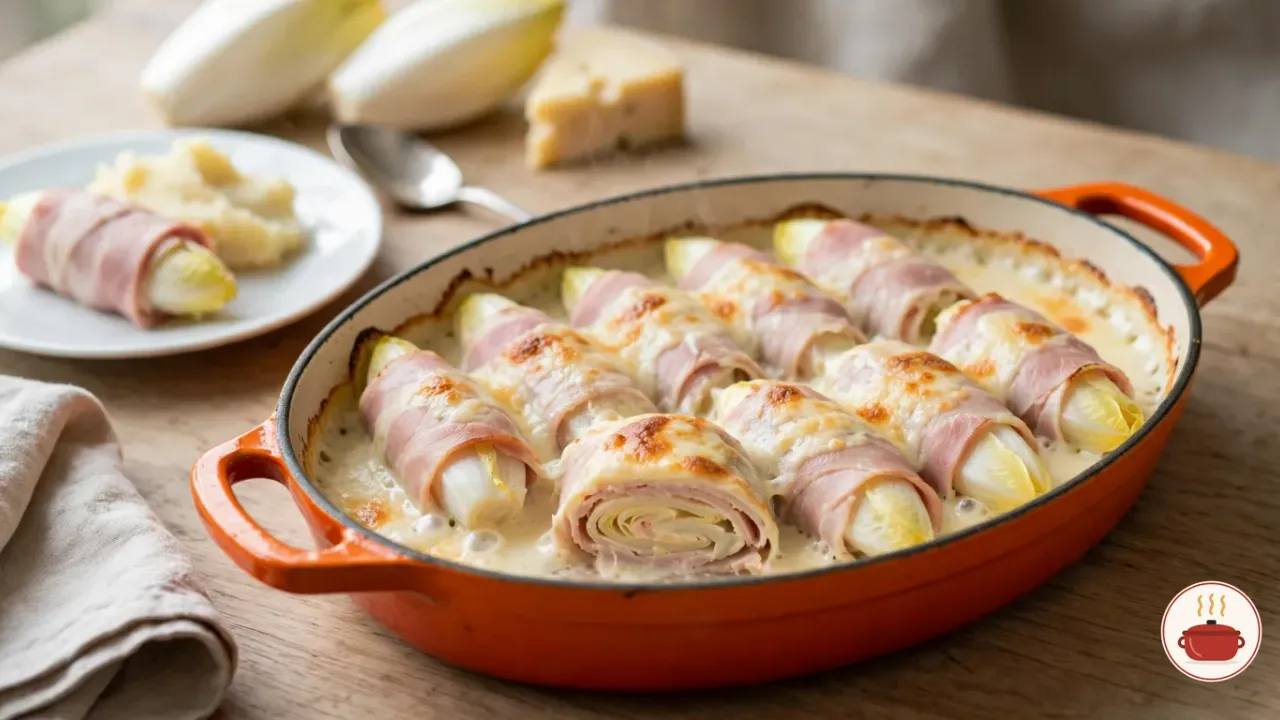
Endives au jambon is a family gratin from northern France and Belgium. Whole Belgian endives are cooked until soft, rolled in a slice of ham each, then baked under béchamel and Gruyère. The endive’s bitter edge cuts through the rich sauce. Serves 4, in about 1 hour 10 minutes from start to finish.
What endives au jambon is
One dish, several names
In France it is endives au jambon. In French-speaking Belgium it is chicons au gratin, and in Flanders witloof met hesp. It is “very popular in Nord-Pas-de-Calais (and neighbouring Belgium)”, notes the English-language magazine Connexion.
Belgians claim it as their own. Introducing a recipe by the chef Carlo De Pascale, RTBF, the Belgian public broadcaster, calls it a must of Belgian cooking.
Endive, chicory or chicon?
The vegetable is a forced chicory, grown in the dark from a root. American shops sell it as Belgian endive. British shops call it chicory, and Australians say witlof. The curly endive and escarole of salad bowls are a different plant.
These are tight, pale heads, white with yellow tips. They turn green in the light, which is why growers force them in darkness, Oregon State University explains.
A Brussels discovery
The story everyone tells is a legend. Around 1830, a farmer near Brussels hid his chicory roots in a dark cellar to dodge a tax, the tale goes, and found pale shoots growing. “Wit loof” means white leaf in Dutch, hence witloof.
The likelier story, says the Belgian broadcaster VRT, credits François Breziers, head gardener of the Brussels Botanic Garden, around 1840. By the 1860s, he had bred the Brussels chicon we know today. Accounts differ on the dates.
The first crate reached the market of Les Halles in Paris in 1879, sold as “endive de Bruxelles”, VRT adds. The name stuck. In 2021, endive growing joined the Brussels list of intangible heritage, The Brussels Times reported.
Grown in soil, or in water
Most endives today are forced in dark forcing rooms. The older way forces the roots outdoors, under a cover of soil. Brussels soil-grown witloof, Brussels grondwitloof, is an EU protected geographical indication. In France, soil-grown endives can carry the Label Rouge quality mark.
Why endives au jambon is in season now
Bitter is back
Whole Foods Market’s forecast for 2027, out on October 14, 2026, has a trend called “Bitter Done Better”. “Grocers are also offering more bitter greens, like radicchio, endive, escarole, broccoli rabe and dandelion greens,” the US grocer writes in its press release. It is a forecast from its trends council, without sales figures.
A new French season, after a hot summer
France is the world’s biggest endive grower, with 60% of world production in 2023, according to the farm magazine Réussir. It grew 134,300 tonnes in the 2025-26 season, up 4% on the year before, FreshPlaza reported from the farm ministry’s figures. About 90% comes from the Hauts-de-France region, in the north.
The new season starts now. Growers lift the roots from late October into November, then force them indoors for about 3 weeks. Summer 2026 was hard on those roots, with heatwaves above 40°C (104°F). “Il faudra s’attendre à une baisse des rendements,” Pierre Varlet of the French growers’ association told Agra Presse: expect lower yields.
Growers want younger cooks
French households bought 2.4% less endive each year from 2021 to 2025, on average, according to panel data cited in the same Agra report. Prices paid rose 5.3% a year. So this autumn, the growers are trying to win back families with children. Their posters go up in French railway stations at the start of the All Saints’ school holidays, Terres et Territoires reported.
There are signs it can work. A shortage of salad greens in the dry summer pushed shoppers toward endive. The share of households buying it rose 15.6% in August 2026, according to Kantar figures cited by the trade magazine Végétable. No one tracks endives au jambon as a dish, so there is no 2026 number for it.
What you need for endives au jambon
We read 28 published recipes for this dish. Twenty-four come from French or Belgian cooks and outlets, including Marmiton, Cuisine Actuelle, Colruyt, RTBF and the Flemish TV chef Jeroen Meus. Our amounts follow their medians.
Endives
Allow 2 endives per person: 17 of the recipes do. Choose firm, plump heads with tightly closed white leaves and pale yellow tips. Skip any with green tips or brown edges. Weigh them if you can, since sizes vary: about 1¾ lb (800 g) for 4.
Ham
Use one thin slice of plain cooked ham per endive, as 21 of the recipes do. Avoid smoked or honey-glazed ham. In France, look for jambon supérieur. It is made without polyphosphates, additives that hold water in the meat, the French consumer group Que Choisir explains.
Béchamel
Twenty-five of the 28 recipes use a béchamel-style sauce. For 4 people, the median is 40 g of butter, 50 g of flour and 500 ml of milk, about 2 cups. Seventeen add nutmeg.
Cheese
Gruyère is the favorite, in 12 recipes, ahead of Emmental and Comté. The median is about 25 g per person, so 1 cup (100 g) for the dish. Mix half into the sauce and scatter half on top.
How to make endives au jambon without a watery sauce
Cut the cone
Twenty of the recipes cut a small cone from the base, where the bitterness is strongest. The French growers’ association suggests the same on its tips page, if you like endives mild. Milder varieties have also made them less bitter over the years, it adds.
Don’t soak them. “Elles deviennent amères lorsqu’elles sont mouillées,” warns the recipe site 750g: they turn bitter when wet. A wipe with a damp paper towel is enough.
Braise, or boil
Endives are about 94% water, by USDA figures, and that water ends up in the dish. So every recipe we read cooks them first. Twelve boil them, five steam them, and seven braise them in butter or oil under a lid. All seven braisers are Belgian.
This recipe braises them, with a pinch of sugar and a squeeze of lemon. Seven of the recipes add sugar, and the growers suggest lemon to keep endives white. “I like the concentrated flavor that oven-roasting gives to vegetables, rather than boiling them,” writes David Lebovitz.
“It is important to cook the chicory slowly to remove most of its bitterness,” advises the chef Raymond Blanc on SBS Food. Boiled endives work too: simmer them for 20 minutes in salted water.
Drain, then press
This is the step that saves the sauce. Twenty-one of the recipes drain the endives well, and six press them. The Belgian supermarket Colruyt drains them tips down. Then it presses them with a spoon “pour en extraire un maximum d’eau”, to get out as much water as possible.
“Je wil geen eindresultaat met een waterige kaassaus,” says Jeroen Meus on Dagelijkse Kost: you don’t want a watery cheese sauce.
Cook the roux, then add cold milk
Cook the butter and flour for 2 minutes before the milk goes in. The Belgian writer Regula Ysewijn waits for a paste “that smells a bit like pancakes”, in her recipe for Great British Chefs. Cold milk, added slowly, keeps the sauce smooth.
Bake hot
The median is 200°C (400°F) for 20 minutes. Bake until the sauce bubbles at the edges and the cheese is golden brown. A few recipes finish under the broiler, as for French onion soup.
Serving and storing endives au jambon
What to serve with it
Mashed potatoes are the most common partner in the recipes, suggested by 6, all of them Belgian. Boiled potatoes, rice or crusty bread soak up the sauce as well. A sharp green salad keeps the meal light.
Endive also works raw, as one of the dipping vegetables for Piedmont’s warm anchovy sauce, bagna cauda.
Make it ahead
You can braise and press the endives up to 2 days ahead, as Lebovitz suggests. Keep them covered in the fridge. Assemble and bake the gratin just before the meal, adding 5 to 10 minutes if the dish goes in cold.
Leftovers
Refrigerate leftovers within 2 hours, and eat them within 3 to 4 days, the USDA advises. Reheat them to 165°F (74°C), the USDA’s safe temperature for casseroles and leftovers.
If you are pregnant, avoid nibbling the cold ham while you assemble the dish. The CDC advises eating deli meats only when heated to 165°F “or until steaming hot”. The baked gratin is.
Nutrition and allergens
One serving of 2 rolls has about 490 calories, 24 g of protein, 32 g of fat and 26 g of carbohydrate. Our estimate adds up the USDA figures for raw endive, sliced ham, whole milk, butter, flour and Gruyère. Ham and cheese bring most of the salt, about 700 mg per serving before you season the dish.
The béchamel holds milk and wheat, both major food allergens, according to the FDA. Some cooked hams also contain milk or soy, so check the label.
Fixes for endives au jambon that is watery, bitter or pale
- The sauce is watery: the endives weren’t drained or pressed enough. Next time, press them and pat them dry before you roll them.
- It’s too bitter: cut a deeper cone from the base, and cook the endives longer with a pinch of sugar.
- The endives are still firm: cook them until a knife slides in easily at the base before they go in the dish.
- The top is pale: broil it for 1 to 2 minutes, watching closely.
- The sauce is lumpy: the milk went in too fast. Whisk it hard, or pass it through a sieve.
- The endives turned green: they were stored in the light. Keep them wrapped and in the dark.
- It’s too salty: the ham and cheese are salty. Season the sauce lightly.
Substitutes for missing ingredients
- Belgian endives: leeks, which French cooks also bake with ham and béchamel. They cook faster and lack the bitter edge.
- A bitter alternative: radicchio di Treviso, halved lengthwise. It turns brown as it cooks.
- Gruyère: Emmental, Comté, or another firm cheese that melts well.
- Cooked ham: thin slices of prosciutto or speck, as Lebovitz uses.
- Some of the milk: the endive cooking juice, as the Flemish magazine Libelle Lekker uses.
- Wheat flour: for a gluten-free sauce, thicken the milk with 3 tablespoons of cornstarch instead.
Frequently asked questions
What is the difference between endives au jambon and chicons au gratin?
None: it is the same dish. Endives au jambon is the French name, and chicons au gratin the Belgian one.
Why is my endive gratin watery?
Endives are about 94% water. Cook them first, then drain them tips down and press them before you roll them in ham.
How do I make endives less bitter?
Cut a small cone from the base, don’t soak them, and cook them gently with a pinch of sugar.
Should I boil or braise the endives?
Both work. Most French recipes boil or steam them. Belgian cooks often braise them in butter, which gives more flavor and less water.
Can I make endives au jambon ahead?
Yes. Cook and press the endives up to 2 days ahead. Assemble and bake the gratin just before serving.
Can I freeze endives au jambon?
Yes, for 3 to 4 months, the USDA says of leftovers. The sauce may turn a little grainy when it thaws.
What do you serve with endives au jambon?
Mashed or boiled potatoes, and a green salad. Belgian recipes usually suggest mash.
What wine goes with endives au jambon?
A dry white wine such as Sancerre, which the recipe site 750g suggests, or a beer.