The Sunday Potthesundaypot.com/recipes/chipa/
Chipa: Paraguay's Anise-Scented Cassava and Cheese Bread
By The Sunday Pot Kitchen Updated
- • Use 1 part cheese to 2 parts cassava starch by weight, the median of 22 recipes
- • Mix the dough cold: unlike pão de queijo, chipa is not scalded
- • Add milk slowly, until a thumb dent holds without cracking
- • Bake at 400°F (200°C) for 18 to 22 minutes
- • Cover the baked rings with a cloth, and freeze any you won't eat the same day
Ingredients
16 ringsInstructions
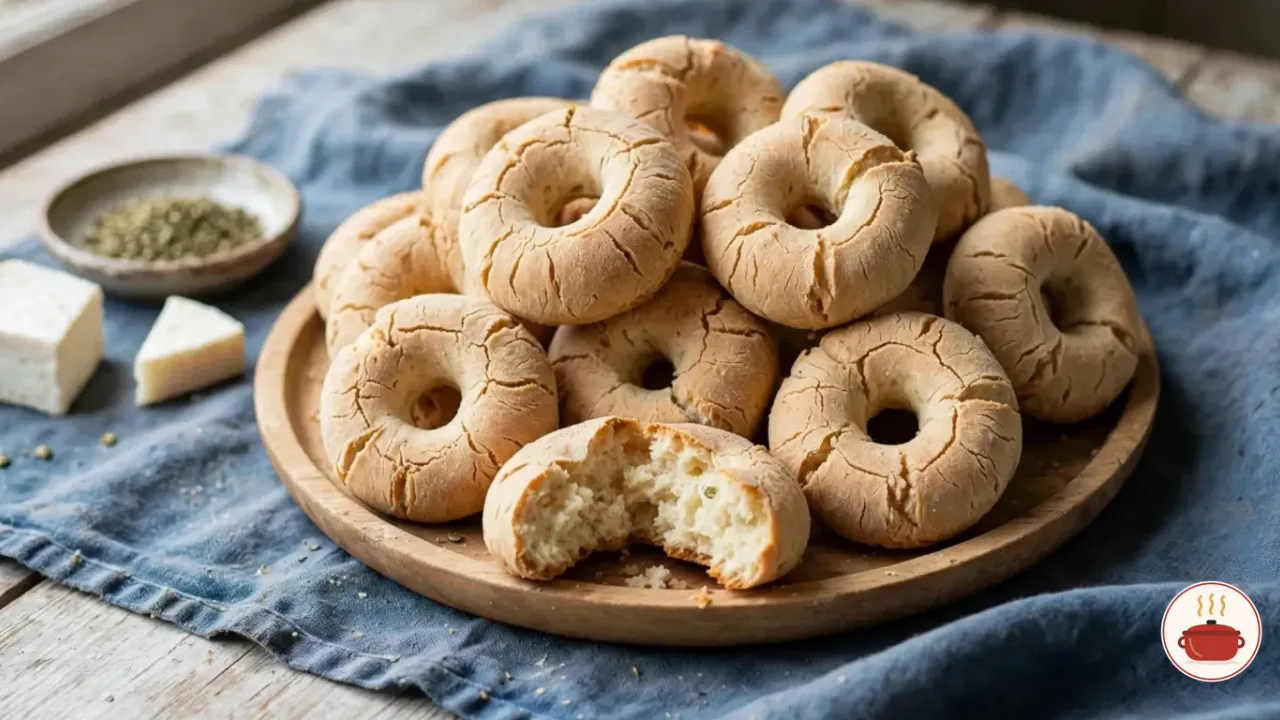
Chipa is Paraguay’s everyday cheese bread: cassava starch, cheese, egg, fat and anise, mixed cold and baked hot. A 2026 survey in Caacupé says a traditional batch can take a kilo of cheese per kilo of starch. We measured 22 published recipes, and the median is half that. This version makes 16 rings.
One kilo of cheese, or half? What 22 chipa recipes do
In March 2026, ABC Color asked sellers in Caacupé about the rising cost of their ingredients. A traditional recipe, the paper wrote, “can call for up to a kilo of cheese for every kilo of starch” (our translation).
Lucía Riquelme, who sells in front of the basilica, doesn’t think the cheese can be trimmed. “If you put in less cheese to make it cheaper, you notice it right away in the flavor and the texture” (our translation).
So we counted. We read 30 published recipes and kept the 22 that give usable weights for plain starch chipa. Fifteen are Paraguayan, four Argentine and three by cooks writing in English. The other eight were different breads, leaned heavily on cornstarch, repeated another recipe or left out a key quantity.
Here is the median for every 500 g of starch, with the range beside it:
- Cheese: 250 g (156 to 500 g)
- Fat: 125 g (50 to 200 g)
- Eggs: 2.5 (1.5 to 3.8)
- Milk: about 100 ml, in the 18 recipes that give an amount
- Oven, Paraguayan recipes: 200°C (400°F) for about 20 minutes
Only one of the 22 truly reaches a kilo of cheese per kilo of starch, a small home batch on Cookpad. Eight of the 15 Paraguayan recipes land exactly on one part cheese to two parts starch. The Argentine and English versions run richer, at a median of 325 g and 350 g.
What that extra cheese costs
The same survey priced queso Paraguay at 36,500 to 39,000 guaraníes a kilo, and starch at 7,000 to 13,500. By our sums, moving from half a kilo to a full kilo of cheese adds 18,250 to 19,500 guaraníes per kilo of starch. That is more than the starch itself costs.
ABC Color called cheese the ingredient that weighs most on the total cost. This recipe stays at the median. For a richer ring, raise the semi-hard cheese to 10½ oz (300 g), which brings the total near the English median.
Caacupé, and a file at UNESCO
The road to December 8
The novena of the Virgin of Caacupé starts on Saturday, November 28, 2026 and runs to Monday, December 7, ABC Color reports. The central Mass is on Tuesday, December 8, a holiday across the country, adds Diario HOY.
In that March survey, Máxima Noguera, on 8 de Diciembre street, was selling fresh chipa and also ready-made dough to bake at home. A normal piece cost 5,000 guaraníes there, and a large one 10,000. We found no prices yet for this year’s feast.
A nomination still waiting
On February 11, 2026, Paraguay began the national steps to put chipa forward for UNESCO’s Representative List of intangible heritage, ABC Color reported. By April 1, Paraguay’s director general of cultural heritage, Natalia Ántola Guggiari, said the candidacy had been filed, according to Prensa Mercosur. La Nación mentioned the bid again on October 22.
Don’t expect a verdict this year. UNESCO’s committee meets from November 30, and its table of files for this session lists none from Paraguay. Any decision will come at a later meeting.
At home the question is settled. Law 5267 of 2014 names chipa the national food and gives it a day, the second Friday of August. How many people bake it each year is another matter: we could not find a dated figure.
Why chipa dough is mixed cold
No scald, no yeast
Brazilian university methods for pão de queijo begin by scalding the starch with boiling water. Not one of our 22 chipa recipes does that. Fat and cheese are worked together, and the eggs, starch and milk go in cold.
That choice shapes the crumb. Cassava starch puffs in the oven when its dough is “partially gelatinized”, through water vapor, explains a 2025 paper in a Brazilian journal. Our reading is that a cold dough rises less, so expect a closer ring than a pão de queijo.
Leavening is rare here. Only 2 of the 15 Paraguayan recipes add baking powder. Cocina Rica draws on the work of Margarita Miró Ibars, a Paraguayan historian, and is blunt: “all the traditional chipa recipes are made without yeast” (our translation).
The feel of the dough
Treat the milk as a guide. Four of the 22 recipes give no amount at all, and the rest run from 20 to 250 ml per 500 g of starch. Graciela Cabral puts the test in two short lines on Cookpad Paraguay: “Hard dough, hard chipa. Soft dough, soft chipa” (our translation). If a pressed piece cracks at the edge, it needs more kneading or another spoonful of milk.
Cooks disagree about the rest. Clemente Cáceres, a culinary researcher at Asunción’s city hall, told ABC Color in 2022 that egg whites harden the bread and that whey beats whole milk. We know of no test of that advice, and most of the 22 recipes still use whole eggs and milk.
Lard, butter and the anise line
Fat is the loosest part of the formula. Seven recipes use butter alone and four use lard alone. Seven more let you pick either, and two blend them. One calls for commercial shortening and one for oil.
Anise draws the sharpest border in the table. It is in 14 of the 15 Paraguayan recipes and all 3 English ones, and in none of the 4 from Argentina. Leave it out and you are closer to the Argentine style.
Not always a ring
Most of the English recipes we read make rings. Paraguayan sources are far less strict. One 2026 ABC Color recipe rolls a cord and cuts it into diamonds. A monk from Santa María de Fe told the same paper of chipa shaped as rings, ladders and caimans.
Pick any shape, with one rule from Cabral: “All the chipas on a tray must be the same thickness” (our translation). We use rings because a rope is easy to keep even.
Why chipa turns hard by morning
We found no staling study on this bread itself, but its closest relative has one. In a 2018 study, Brazilian researchers stored cheese bread in plastic bags at 77°F (25°C). The batch made with sour starch stayed soft for 8 hours, then staled quickly.
The cause is retrogradation: as the bread ages, its starch molecules pack back into an ordered structure and push water out. In the plain-starch bread, the force needed to compress it rose from 30.47 to 40.63 newtons between hour 24 and hour 30. That is about a third harder in six hours.
Three habits work with that clock:
- Cover it while warm. Cocina Rica says to serve the bread hot or keep it under a cloth, so it doesn’t harden.
- Revive it with steam. A tip reported by La Nación wraps a hard piece in damp paper and microwaves it for 30 seconds. Any longer and it turns to chewing gum. The same piece suggests a dip in water and a return to the oven.
- Freeze it raw. In a Brazilian trial, a week in the freezer did not change the volume or flexibility of cheese bread baked straight from frozen.
To freeze, set the shaped rings on a lined sheet until firm, then bag them. One US cook, Camila Made, keeps them frozen as long as 2 months. Bake from frozen and allow a few extra minutes. Baked rings keep for up to 5 days in the fridge, by the same cook’s count. We prefer the fridge to the counter, because the bread holds cheese and egg.
The word, the cross and the wider chipa family
The word is often labeled Guaraní online, usually with no source. Two Paraguayan researchers say otherwise. Graciela Martínez wrote in ABC Color in 2017 that it is Quechua for anything pressed or clumped, and Miró Ibars also calls it Quechua. We could not check a Quechua dictionary, so treat this as their reading.
Early history is thin. Colonial and Jesuit records mention Guaraní cakes of cassava or corn “but do not specify what type”, Miró Ibars notes in Cocina Rica (our translation). The first dated scene in that account is from 1766, when a record by one Aguirre describes chipas decorating the cross at Yaguarón. Cheese, egg and milk came with the Jesuits and Franciscans, Miró Ibars told the state news agency IP.
The family is large. These are the names you are most likely to meet:
- Chipa almidón: the all-starch bread on this page.
- Chipa mestiza: starch mixed with corn flour. Three Paraguayan recipes in our count add some.
- Chipa Barrero and chipa Bogado: Barrero is round and mestiza, and Bogado is all starch and braided, says ABC Revista.
- Chipa so’o: corn dough with a meat filling.
- Chipa manduvi: made with peanuts, and now eaten less, according to Miró Ibars.
- Chipa guasu: a soft fresh-corn bake, closer to sopa paraguaya than to these rings.
Cheese, cassava and raw dough: the safety notes
Queso Paraguay is traditionally farm-made from raw milk, a university thesis explains. It also says chipa takes the aged cheese, while sopa and mbeju take it fresh. Listeria outbreaks have repeatedly been tied to queso fresco-type cheeses, warns the FDA, so buy pasteurized cheese where you can.
Heat protects you here. The CDC says heating these cheeses to 165°F (74°C) or steaming hot kills Listeria. Anyone pregnant, over 65 or immunocompromised should check that the thickest ring reaches that temperature, and eat it hot.
Don’t taste the dough, which holds raw egg. The FDA’s advice on raw dough is plain: baking is what kills the bacteria.
Raw cassava root can carry cyanide compounds, but refined starch is a different product. Commercial starch production is “effective in eliminating total hydrocyanic acid”, Food Standards Australia New Zealand wrote in 2008. Buy packaged starch, and don’t grate your own from raw root for this recipe.
This bread contains milk and egg, and pork if you use lard. Cassava and tapioca are naturally gluten-free, says Coeliac UK, which also warns that flours can be milled alongside wheat. If you have coeliac disease, choose starch labeled gluten-free.
One ring has about 260 calories, 5 g of protein, 13 g of fat, 29 g of carbohydrate and 270 mg of sodium. Our estimate uses USDA entries, with pearl tapioca standing in for the starch and queso asadero for the semi-hard cheese. Butter in place of lard saves about 15 calories a ring.
When the dough or the bake goes wrong
- The dough cracks when shaped: it is too dry. Knead in a little more milk.
- The dough sticks to your hands: it is too wet. Give it 10 minutes under a cloth, then work in a little starch.
- The rings spread flat: the kitchen or the fat was too warm. Chill the shaped rings for 15 minutes.
- Pale tops: give them 2 or 3 more minutes on the upper rack.
- Dark bottoms: use a lighter baking sheet, or stack two together.
- Hard the same day: they were left uncovered, or the dough was stiff. Use the steam trick above.
Swaps outside Paraguay
- Queso Paraguay: Monterey Jack, low-moisture mozzarella, queso panela or a mild cheddar. Cooks abroad use all of these, some with a little Parmesan.
- Cassava starch: tapioca starch or tapioca flour, usually the same product. Cassava flour is ground from the entire root and won’t behave the same way.
- Sour starch (polvilho azedo): it is fermented and expands more, so the rings will be lighter and less traditional. None of our 22 recipes uses it.
- Lard: unsalted butter, weight for weight.
- Milk: whey, as some Paraguayan cooks prefer.
- Anise seeds: one English recipe we read uses fennel seeds, or leave them out.
With a mug of cocido
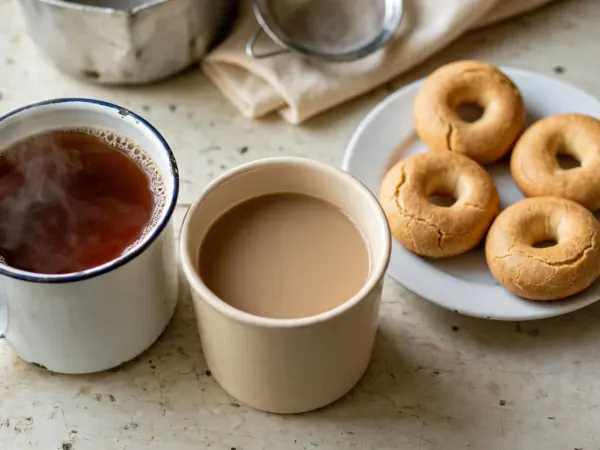
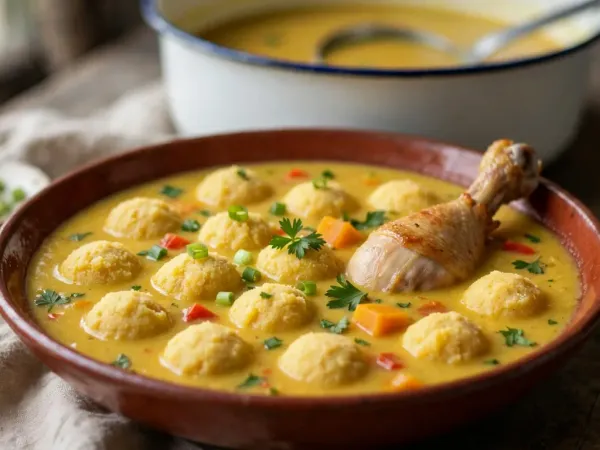
The traditional Paraguayan breakfast is chipa with cocido, ABC Revista notes, and our cocido quemado is the burnt-sugar yerba version. The rings can also sit beside a bowl of vori vori.
Frequently asked questions
How does chipa taste?
It is savory from the cheese and scented with anise. The crumb is dense and slightly chewy.
How is chipa different from pão de queijo?
Both use cassava starch and cheese. Traditional pão de queijo is scalded with boiling liquid, while this dough is mixed cold, usually with anise.
Is chipa gluten-free?
The ingredients here contain no wheat, and cassava is naturally gluten-free. Check that your starch is labeled gluten-free if you have coeliac disease.
Why did my chipa go hard?
Cassava starch firms up as the bread ages, and cheese bread in one study was clearly harder after 24 hours. Keep the rings covered, and warm them with a little steam.
Can I freeze chipa?
Yes, and raw is best. Freeze the shaped rings on a sheet, bag them, use them within 2 months, and add a few minutes to the bake.
Can I use cassava flour instead of starch?
No. Cassava flour is the whole ground root, so it behaves differently. Look for cassava or tapioca starch.
How much cheese should chipa have?
The median of the 22 recipes we compared is 1 part cheese to 2 parts starch by weight. ABC Color’s Caacupé survey mentions traditional recipes with up to equal weights.
Tags: bakingcheesebreadtapiocagluten freebreakfastfreezer friendly