The Sunday Potthesundaypot.com/recipes/beyran/
Beyran: Gaziantep's Slow Lamb, Rice and Garlic Soup
By The Sunday Pot Kitchen Updated
- • Use bone-in lamb neck or shoulder, never beef: Gaziantep cooks reject it
- • Simmer the lamb for 3 to 3½ hours at home; Gaziantep shops cook it 10 to 12 hours
- • Boil the rice on its own, with no salt and no fat, as the Gaziantep rules ask
- • Use about 2 garlic cloves and 1 teaspoon of mild red pepper flakes for each bowl
- • Pour the broth on boiling and serve it at once, with lemon
- • Keep broth, meat and rice apart in the fridge, and chill the rice within 1 hour
Ingredients
6 bowlsInstructions
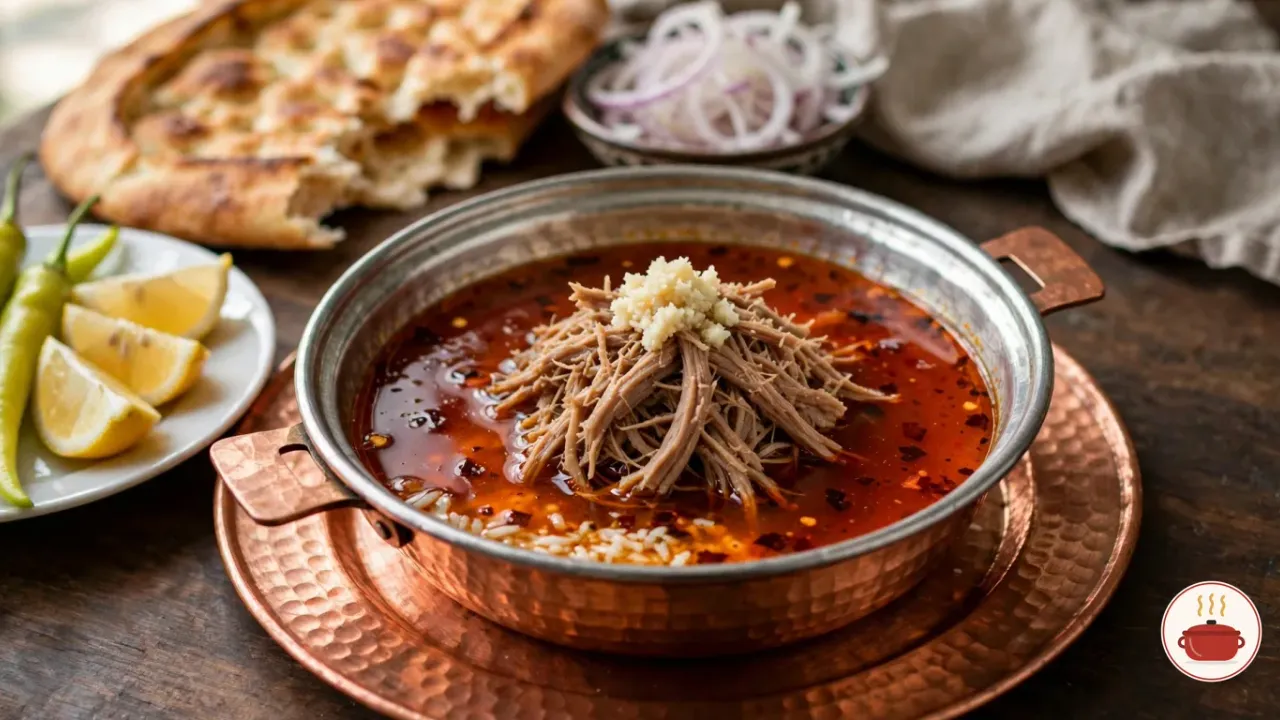
Beyran is the breakfast soup of Gaziantep, in southeastern Turkey: lamb simmered for hours and pulled into strands, plain rice, pounded garlic and red pepper, under a boiling broth. In the city it is served in a copper bowl from early morning. This home version makes 6 bowls.
What beyran is
A meal that comes in a bowl
Turkey’s patent office defines Antep beyranı as “a regional dish with meat and rice”, in its geographical indication file (our translation). The word it uses is yemek, a dish, not çorba, a soup.
People in Gaziantep insist on that difference. “Beyran is not a soup but a brothy main dish,” the cook Yusuf Pektaş told NTV in April 2026 (our translation). His shop charged 360 Turkish lira a bowl.
Breakfast in Gaziantep
Beyran shops open at dawn, and the pots go on the night before. In winter it is a breakfast staple, “eaten especially early in the morning”, reported the news agency DHA in December 2025 (our translation). Locals eat it when they have a cold, too.
“Only the early bird gets it,” wrote Al-Monitor in 2019. Its favorite shop, Metanet in the old city, tends to sell out quickly.
A dish with rules
The patent office registered Antep beyranı as a designation of origin in January 2017. Gaziantep’s city council had applied in 2015. The file sets the rules. The meat comes “only from the forelegs and the neck” of young sheep, cooked with plenty of marrow bones (our translation).
The broth simmers on low heat “for at least 10 to 12 hours”, usually overnight. The rice is boiled in water, without fat or salt, and the file calls it kel pilav, bald pilaf. Each bowl must be a copper sahan.
According to the same file, records show the first beyran shop opened in the Gaziantep bazaar in 1885. The name’s origin is less clear. Cooks say it was a dish for the beys, the Ottoman lords, but we found no historian who confirms it.
The city of gastronomy
Gaziantep has been a UNESCO Creative City of Gastronomy since 2015. Turkish news sites often say UNESCO “protects” beyran itself. That is a mix-up: the UNESCO title belongs to the city, and the 2017 registration is the Turkish patent office’s.
Why beyran is in the news
Second-best soup in the world
In December 2025, the food guide TasteAtlas ranked beyran the second-best soup in the world, with 4.5 out of 5. The list is built from user ratings, as Daily Sabah reported. Paraguay’s vori vori, a chicken soup with corn and cheese balls, came first.
TasteAtlas updated the list in September 2026. Beyran held second place, still at 4.5, behind vori vori at 4.7, reported Yeni Asır on September 23.
The cooks were proud, but not fully pleased. “We deserve first place,” Ahmet Çadır told DHA (our translation). He also argued that beyran should leave the soup category, since Gaziantep sees it as a meal.
A food festival and a search for the specific
From October 3 to 11, 2026, Gaziantep hosted GastroAntep, part of Turkey’s Culture Road Festival. It had 246 events and more than 70 tasting points, reported the business paper Dünya.
In the United States, Nestlé USA’s 2027 forecast, released on October 15, 2026, names regional cooking as a trend. It says “66% are interested in exploring regional variations within international cuisines”, citing Mintel, in its press release. Beyran belongs to one city, so it fits that idea well.
No search, sales or survey figure for beyran itself exists for 2026. Its rise this year is a ranking and a festival, not a number.
What goes into beyran
We compared 27 distinct beyran recipes, 25 in Turkish and 2 in English, along with the rules in the patent office’s file. We counted reprints of the same recipe only once. The amounts below are medians per kilo of bone-in lamb.
Lamb neck and shoulder
Neck is the cut most recipes name, followed by shoulder, shank and foreleg. The median recipe uses about 800 g of bone-in lamb. One Turkish recipe allows beef, but a Gaziantep reader of the food site Yemek.com puts it bluntly. “Beef is not used in beyran.” (our translation) This recipe keeps to lamb.
Rice, boiled on its own
Sixteen of the 27 recipes boil the rice separately, and both Gaziantep sources do. The rest cook it in the broth, which clouds it and makes a thicker soup. The median is 180 g of raw rice per kilo of lamb. Use a medium-grain white rice and keep it slightly firm.
Garlic and red pepper
These two make beyran. The median home recipe uses about 8 garlic cloves and 4 teaspoons of red pepper flakes per kilo of lamb. The Gaziantep file asks for far more: 8 to 12 g of garlic and 10 to 15 g of pepper flakes in every bowl.
This recipe sits in between, with about 2 cloves and 1 teaspoon of flakes a bowl. Only 5 of the 27 recipes add red pepper paste, and the Gaziantep file has none.
Fat
Fourteen recipes use butter. Eleven use lamb fat: tail fat, suet, or the fat skimmed off the broth. The file adds 40 to 50 g of suet to the pot, plus an optional spoonful in each bowl.
How to make beyran
Start with a clear broth
The Gaziantep file soaks the meat for 1 to 3 hours and changes the water, “so the broth is clear” (our translation). Skim the foam as it rises. A whole onion and a whole lemon go in for flavor and come out at the end.
Give it time
Shops simmer the bones for 8 to 13 hours. Home cooks use a few hours, often in a pressure cooker: the median home time is 2 hours. Three hours of gentle simmering makes the neck meat fall from the bone.
Pull, don’t cube
Beyran is about strands of lamb, not cubes. The file says to pull the meat apart while it is hot and to remove sinew and fat. Cold lamb is much harder to shred.
Build each bowl over a fierce flame
In Gaziantep, the cook sets each copper bowl over a high flame with tongs. Fat goes in first, then pepper flakes, then rice, lamb and garlic. Süleyman Kaya, a manager of the Köşkeroğlu restaurant, explained the order to Hürriyet in 2016. The fat comes first “so the pepper doesn’t burn”, and black pepper goes in last, since added early it “turns the beyran black” (our translation).
Then the boiling broth goes in, and the fat flares. At home, a small skillet over high heat does the same job, two bowls at a time. Serve it straight away, still boiling.
Serving and storing beyran
At the table
Serve beyran with lemon wedges to squeeze in, raw onion, mild green peppers and warm flatbread. In Gaziantep the bread is often tırnaklı pide, an oval loaf dented with fingertips. For a Sunday table, start with tirokafteri and bread, or follow a bowl with a pot of ash reshteh for a meal of soups.
Keeping broth, meat and rice apart
Store the three parts separately. That is how the Gaziantep shops work, and it keeps the rice from turning to mush.
Cooked rice needs the most care. Uncooked rice can carry spores of Bacillus cereus, which “can survive being cooked”, warns Food Standards Scotland. It advises chilling cooked rice “ideally within 1 hour” and eating it within 24 hours. “Never reheat rice more than once.”
Refrigerate the broth and the lamb within 2 hours and use them within 3 to 4 days, as the USDA advises. Bring the broth to a rolling boil before you build the bowls. The USDA’s temperature chart sets 165°F (74°C) for leftovers, and boiling broth passes that easily.
Calories and allergens
A bowl has about 510 calories, 26 g of protein, 31 g of fat and 31 g of carbohydrate. We totaled the USDA FoodData Central values for each ingredient, then divided by 6, with lamb neck and butter. Most of the fat comes from the lamb, so skimming more fat off the broth makes a lighter bowl.
Beyran contains none of the major food allergens on the FDA list, unless you finish it with butter, which is milk. With skimmed lamb fat or oil it is dairy-free. The flatbread on the side contains wheat.
Fixes for beyran that is bland, cloudy, pale or tough
- Bland broth: it needs more salt, or longer simmering with the bones. Season after straining.
- Cloudy broth: it boiled hard, or the rice was cooked in it. Keep the simmer gentle and boil the rice apart.
- Pale, not red: the pepper flakes were too few or too old. Warm them in the fat before the broth goes in.
- Bitter or black: the pepper burned, or the black pepper went in too early. Take the fat off the heat before adding flakes.
- Tough meat: it needs another 30 to 60 minutes. Neck meat should fall away from the bone.
- Mushy rice: it was overcooked, or it sat in the broth. Boil it firm and add it only at the end.
- Too hot: use fewer flakes, and offer more at the table.
Substitutes for missing ingredients
- Antep or Maraş pepper flakes: Aleppo pepper is the closest match. Use mild paprika with a pinch of chili flakes if you find neither.
- Urfa pepper (isot): darker and smokier, so use it as a finish, not as the main pepper.
- Lamb neck: bone-in shoulder chops or lamb shanks, with a few marrow bones.
- Lamb fat or suet: butter or ghee, as most home recipes do, or a mild oil.
- Medium-grain rice: long-grain white rice, boiled firm.
- Copper sahan: a small cast-iron or carbon-steel skillet, or a small saucepan.
- Tırnaklı pide: any fresh flatbread, such as pita or lavash.
Frequently asked questions
Is beyran a soup or a stew?
Both, in a way. TasteAtlas lists it as a soup, but Gaziantep cooks call it a meal. The patent office’s file calls it a dish of meat and rice.
Why do people eat beyran for breakfast?
In Gaziantep the broth cooks overnight, so it is ready at dawn. It is a winter breakfast, eaten early before work, and locals turn to it when they have a cold.
Can I make beyran with beef?
You can make a beef and rice soup, but Gaziantep cooks would not call it beyran. The registered recipe uses only lamb or young mutton.
Can I use a pressure cooker?
Yes. Many Turkish home recipes cook the lamb in a pressure cooker, until it falls from the bone. Skim the foam before you lock the lid.
How spicy is beyran?
It can be very hot in Gaziantep, where each bowl takes 10 to 15 g of pepper flakes. At home, start with 1 teaspoon of mild flakes a bowl and add more at the table.
Can I make beyran ahead?
Yes. Make the broth and pull the meat a day ahead, then boil the rice and build the bowls just before serving.
Is beyran gluten-free?
The soup itself is, since it holds only lamb, rice, garlic, pepper and fat. The bread served with it is not.
What is the difference between beyran and kelle paça?
Kelle paça is another Turkish soup, made from slowly cooked head and trotters. Gaziantep people name both as winter cures, but beyran uses neck and shoulder meat with rice.