The Sunday Potthesundaypot.com/recipes/fasolada/
Fasolada: Greek White Bean Soup with Olive Oil and Tomato
By The Sunday Pot Kitchen Updated
- • Soak the dried beans for 12 hours, then boil them hard in fresh water
- • Simmer with carrot, celery and onion for about 1 hour, until tender but whole
- • Add the tomato and salt late, once the beans are soft
- • Stir in half the olive oil at the end so it thickens the broth
- • Rest it 15 minutes, then serve with raw oil, bread, olives and feta
Ingredients
6 bowlsInstructions
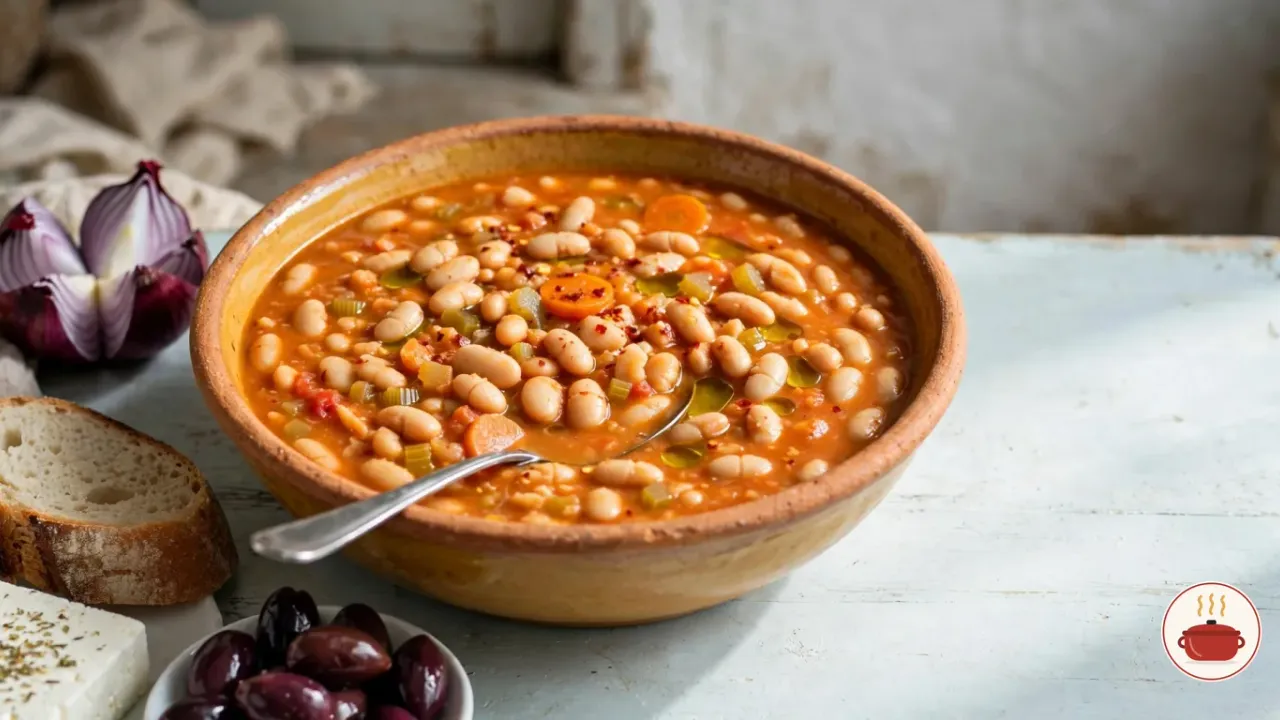
Fasolada is the Greek white bean soup: dried beans simmered with carrot, celery, onion and tomato until the broth turns thick and creamy. A generous pour of olive oil goes in at the end and again at the table. It is meatless and costs little. This recipe makes 6 bowls in about 2¼ hours, plus an overnight soak.
What fasolada is
“Our national food”
Greeks often call fasolada their national dish. The standard dictionary of modern Greek, the Triantafyllidis dictionary, uses that very line as its example. Fasolada “is considered the national food of the Greeks”, it reads (our translation). No government body has ever named a national dish, though. The title is a habit of speech, not an official one.
The name joins fasóli, a bean, to the suffix -áda, as in other Greek dish names. Some English recipes spell it fasolatha, closer to the Greek sound.
A soup from a New World bean
The common bean came from the Americas, so fasolada is younger than it looks. The first European drawing of the plant appeared in a German herbal in 1542, about fifty years after explorers saw beans in the Caribbean. That date comes from a 2022 study in Frontiers in Plant Science. No reliable source we found says when the bean reached Greece.
Greeks ate thick pulse soups long before that. Ancient Greek had a word, étnos, for a “thick soup made with pease or beans”, as the Liddell-Scott-Jones lexicon defines it. Aristophanes mentions it in his comedies. The beans in those pots were broad beans, peas and lentils, so fasolada is a newer member of an old family.
Red or white
Most Greek cooks make it red, with tomato. Some make it white, with lemon. “The classic recipe for our national dish wants carrot, celery, tomato, onion and olive oil,” the Kathimerini food magazine Gastronomos wrote this month (our translation). “Sometimes, though, we make it white, with lemon.” Which one a family makes depends mostly on where it comes from.
Why fasolada matters this autumn
A US trend list bets on beans
Whole Foods Market’s food forecast for 2027 came out on October 14, 2026. Beans get a trend of their own, “The Bean Boom”. The US grocer says shoppers want “whole-food sources of protein and fiber that also happen to be budget-friendly and gut-friendly”, in its press release. The list is a retailer’s prediction, not data, and it does not name fasolada.
Greek kitchens turn to it as the weather cools
Greek food media marked the first cool weeks with fasolada. Gastronomos ran a set of 10 fasolada recipes on October 14. “A bit of rainy weather, a bit of the drop in temperature” sent its editors’ minds to the soup, they wrote (our translation). The news site iefimerida published its own traditional version on October 1.
The fast before Christmas
Fasolada holds no meat, dairy or fish, so it suits Orthodox fasting. The 40-day Nativity fast runs from 15 November to 24 December, as the church news site poimin.gr explains. For the Church of Greece, that means it starts on Sunday, November 15, 2026. On Wednesdays and Fridays even olive oil is left out, so some families make an oil-free fasolada on those days. Practice varies, so follow your own parish.
Fasolada belongs to Clean Monday too, the first day of Lent. On February 23, 2026, “thousands of portions of fasolada” cooked in cauldrons across Greece, the public broadcaster ERT reported (our translation). In Chania, on Crete, the cooks started at 5 a.m. with 120 kg of beans donated by the town council.
Olive oil costs less than last winter
Olive oil is the most expensive thing in the pot. In Greece its price has eased through 2026. The olive oil line in the consumer price index of ELSTAT, the Greek statistics office, fell from 146.05 in December 2025 to 130.64 in September 2026. That is a drop of about 10.6%, by our calculation.
A missing number
We found no 2026 figure for fasolada itself: no sales, search or menu count. The year’s story is about beans in general, the fasting calendar and the price of oil.
What goes into fasolada
We compared 25 published fasolada recipes made with dried beans. Sixteen are in Greek, from Gastronomos, Proto Thema’s Cantina, iefimerida, SKAI, star.gr, Athens Voice, Argiro Barbarigou, Akis Petretzikis and others. The other nine are English-language versions by Diane Kochilas, My Greek Dish, SBS Food and Kalofagas.
The beans
Half the recipes call for 500 g of dried beans or more, about 1 lb. Most name medium white beans, mesosperma in Greek shops. Nineteen of the 25 soak them overnight or for 6 to 12 hours.
Ten boil them briefly in fresh water and throw that water away, which cooks say makes the soup easier to digest. The columnist Giorgos Pavrianos skips that step: “many pour off the water and add new. I don’t” (our translation).
Olive oil, and when it goes in
Oil is what sets fasolada apart. The recipes use a median of 143 ml per 500 g of beans, a little over ½ cup, and four Greek ones use a full cup. Eighteen of the 25 add some or all of it late, or raw at the table. The late oil blends with the starch from the beans and binds the broth, iefimerida explains. This recipe uses ⅔ cup (160 ml), half at the start and half at the end.
Tomato, or none
Twenty-two recipes use tomato. Nine use only tomato paste, and thirteen add fresh, canned or puréed tomato. Three leave it out, Kochilas among them; she finishes her soup with a splash of vinegar instead. Eight recipes add the tomato only once the beans are soft.
Carrot, celery and onion
All 25 recipes use carrot and celery, and 24 use onion. Only 8 add garlic. Bay leaf is the most common herb, in 9. Seven add dried chili or Greek boukovo flakes, and 11 more offer it as an option. Akis Petretzikis simmers a whole red apple with the beans, then lifts it out; it “will help the soup thicken,” he says.
Salt at the end
Fifteen recipes wait to salt the pot until the beans are soft, and 8 add it at the start. Greek cooks say salt keeps beans hard. We found no study either way, so treat that as kitchen lore. Adding salt with the tomato, as here, is simply when most recipes do it.
How to make fasolada thick, not watery
Greek cooks want the broth chylomeni: thickened by starch from the beans, not puréed. Argiro Barbarigou says the liquid should look like a thick sauce. Four habits get you there:
- Simmer long enough. The median recipe cooks for 85 minutes in all. Beans that are barely tender give a thin broth.
- Add half the oil late and simmer it for 5 minutes, so it blends in.
- Mash a few beans against the pot, or blend a ladle of soup and stir it back, as Gastronomos does.
- Let it rest. Several recipes leave the pot off the heat for 10 to 60 minutes. The broth sets as it cools.
Serving fasolada
Serve fasolada hot or warm in deep bowls, with a thread of raw olive oil on each. Greek tables add bread or rusks, Kalamata olives and raw onion. Salted sardines, smoked herring or pickled peppers are common sides; feta is popular too, except on fast days. A glass of red wine goes with it on any day the fast allows.
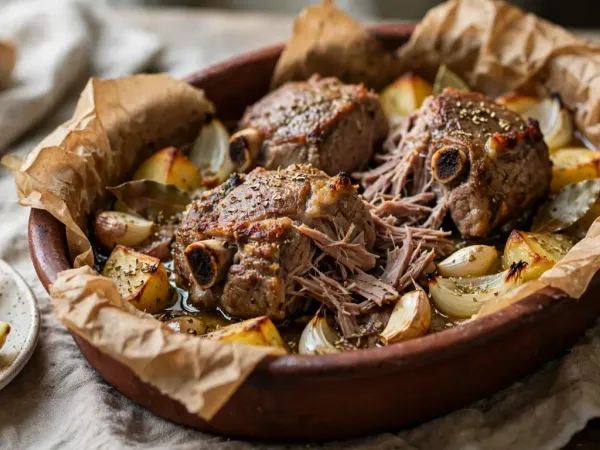
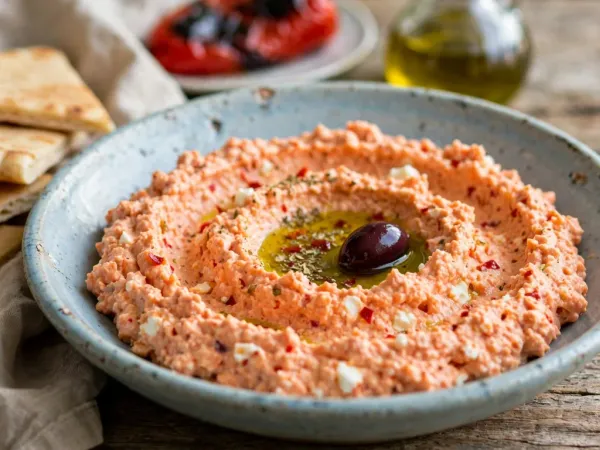
For a Greek meal, start with the spicy feta dip tirokafteri and bread. On a feast day, follow with slow-roasted lamb kleftiko. For other bean pots, try Iran’s herb-heavy ash reshteh or Mexico’s frijoles de la olla.
Storing, safety and nutrition
Leftovers
Fasolada keeps well, and many cooks like it better the next day. Spread it into shallow containers so it cools fast, and refrigerate it no more than 2 hours after cooking. The UK Food Standards Agency says to eat leftovers within 48 hours or freeze them. The USDA allows 3 to 4 days in the fridge in its leftovers guide, and up to 4 months frozen.
It sets thick overnight. Loosen it with water and reheat it until it boils all over.
Dried beans must boil
Raw beans contain a lectin that causes sudden vomiting. The FDA covers this in its Bad Bug Book, a guide to foodborne illness. White beans hold “about one-third the amount of toxin as the red variety”, it says, so they still need proper cooking. The FDA tells cooks to boil beans for at least 30 minutes. It also warns against raw beans in slow cookers, which can stay too cool to destroy the lectin. Ireland’s food safety authority asks for a soak of at least 12 hours in water you then discard.
This recipe meets all of that: a 12-hour soak, a 10-minute boil, then more than an hour of simmering. A pressure cooker is fine too.
Nutrition and allergens
Each bowl holds roughly 520 calories, with 21 g of protein, 24 g of fat, 60 g of carbohydrate and 15 g of fiber. We worked this out from USDA FoodData Central values for dried white beans, olive oil, carrot, celery, onion and tomato. The oil supplies nearly 40% of the energy. Sodium is about 800 mg, almost all from the added salt.
Celery is one of the 14 allergens that labels in the UK and the EU must declare, under Regulation 1169/2011. The soup itself has no gluten, dairy, egg or nuts. Bread, feta and fish on the side bring their own allergens.
Fixes for thin, hard or bland fasolada
- Thin, watery broth: simmer it uncovered for 15 minutes more, then mash a ladle of beans into it.
- Beans still hard after an hour: old beans take longer. Give them more time, topping up with boiling water; it can take 2 hours.
- Beans falling apart: they boiled too hard. Keep it at a gentle simmer once the first boil is done.
- Bland: add more salt and a last spoonful of raw olive oil. A squeeze of lemon or a dash of vinegar lifts it too.
- Oily on top: the oil has not blended in. Simmer it 5 minutes more, stirring hard.
Substitutes for hard-to-find ingredients
- Greek mesosperma beans: cannellini, great northern or navy beans. Navy beans cook faster.
- Dried beans: three 15-oz (425 g) cans of white beans, rinsed. Since canned beans come cooked, leave out steps 1 and 2. Simmer the vegetables and tomato in 6 cups (1.4 liters) of water for 20 minutes, then add the beans for 15 minutes.
- Fresh tomato: canned crushed tomatoes or passata, or leave it out for a white fasolada with lemon.
- Celery: celeriac, diced, or a little lovage.
- Boukovo: any mild red pepper flakes.
Frequently asked questions
Is fasolada the national dish of Greece?
Greeks often call it that, and the main Greek dictionary uses the phrase as its example. No law or official body names a national dish, so it is a popular title.
Is soaking the beans necessary?
It is strongly advised. Soaking cuts the cooking time, and food safety agencies pair it with a hard boil in fresh water. Five of the 25 recipes skip the soak but boil the beans for longer instead.
Why is so much olive oil in fasolada?
The oil carries the flavor and thickens the broth when it blends with the bean starch. The recipes we compared use a median of 143 ml per 500 g of beans.
Is fasolada vegan?
Yes, made with water as here. Some English recipes use chicken stock, which makes it neither vegan nor suitable for a fast.
Can I make fasolada in a slow cooker?
Not with raw beans. Boil soaked beans hard on the stove for at least 10 minutes first, or use a pressure cooker, which gets hotter than a pot.
What do Greeks eat with fasolada?
Bread, olives, raw onion and often salted sardines, smoked herring or pickles. Feta is common outside the fasting days.
What is the difference between fasolada and gigantes?
Fasolada is a soup of medium white beans. Gigantes plaki are giant beans baked in a thick tomato sauce in the oven.
Can I freeze fasolada?
Yes. Freeze it in portions, defrost it overnight in the refrigerator, then reheat it with a little water until it bubbles hard.
Tags: Sunday dinnerbeanssoupveganmake aheadfreezer friendlygluten freedairy free