The Sunday Potthesundaypot.com/recipes/kabak-tatlisi/
Kabak Tatlısı: Turkish Candied Pumpkin, Tahini and Walnuts
By The Sunday Pot Kitchen Updated
- • Use a dense pumpkin or squash, such as kabocha, butternut or a pie pumpkin, never a carving pumpkin
- • Rest the pieces with sugar in the fridge for 12 to 24 hours, so they cook in their own juice
- • Use about 350 g of sugar for each kilo of peeled pumpkin
- • Simmer covered for 25 to 35 minutes, then uncover for 10 to 15 minutes, without stirring
- • Serve it cold, with tahini and walnuts added only at the table
- • Refrigerate within 2 hours of cooking and eat it within 3 to 4 days
Ingredients
6 servingsInstructions
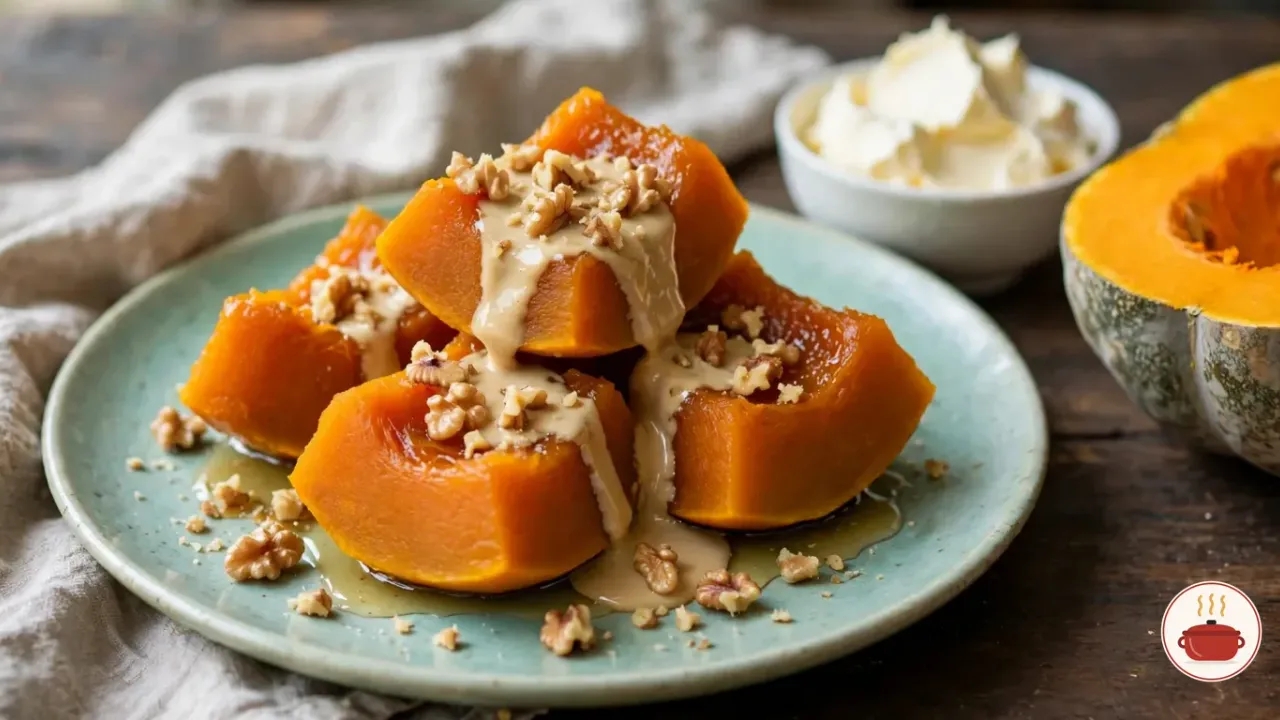
Kabak tatlısı is Turkey’s autumn pumpkin dessert. Chunks of peeled pumpkin rest overnight under sugar, then simmer slowly in the juice they release, until they turn glossy and almost translucent. It is served cold, with tahini, crushed walnuts and often kaymak. This recipe serves 6.
What kabak tatlısı is
Pumpkin cooked in its own juice
The name means “pumpkin dessert”. You may also see balkabağı tatlısı, from bal kabağı, the “honey squash” used for it. In Sakarya, in northwest Turkey, some restaurants simply call it elmas, “diamond”.
Turkey’s patent office describes the method in a registration file for the Adapazarı version. Sugar goes over the cut pumpkin, which rests in the fridge for about 24 hours before cooking. At the end, “toppings such as tahini, kaymak and walnuts are poured over it” (our translation).
The fall dessert of Turkish restaurants
It is a seasonal dish, made from the new harvest. “In the fall just about every restaurant will have their version of this syrupy treat,” says Go Türkiye, the country’s official tourism site. Turkish home cooks make it through the winter, and in Aydın it is a dessert for the Ramadan evening meal.
Four towns, four registered styles
Turkey has registered four regional styles as geographical indications, all in 2021. Each has its own rules.
- Adapazarı: sugar at half the pumpkin’s weight, a day in the fridge, and only 25 to 30 minutes on the stove.
- Antalya: rested with sugar and lemon, cooked for 2 to 3 hours in its own juice, then browned in the oven.
- Aydın: a fibrous pumpkin cut into slices only 2 to 4 mm thick, eaten cold.
- Hatay: soaked overnight in limewater, so the outside turns crisp while the inside stays soft.
A dish from an American plant
Pumpkins and squashes come from the Americas. They reached Europe and the Ottoman world only after 1492, so kabak tatlısı can’t be older than the 16th century. Many websites call it a dessert of the Ottoman palace, but we found no source for that. The first printed Ottoman cookbook, Melceü’t-Tabbâhîn of 1844, has squash only in savory dishes and pickles.
Why kabak is in season now
The Sakarya harvest
Sakarya’s pumpkin is registered too, as Adapazarı white chestnut pumpkin, a large gray-skinned squash with thick orange flesh. Its harvest runs “from the end of September to the end of October,” a farmer, İslam Aksoy, told the news agency İHA on October 12, 2026. He said it sold for 10 to 15 lira a kilo in the field and around 30 lira at the market, as Haberler.com reported (our translation).
He added that more was planted this year, after a dry 2025. A restaurant owner in the same story, Musa Kocaoğlu, said he had brought in “the 2026 harvest”. His kitchen cooks the dessert in one-hour sessions over 3 days.
A taste of place
In the United States, Whole Foods Market’s trend forecast for 2027, released on October 14, 2026, opens with “Terroir’s New Territory”. It says growing interest in “provenance and Protected Designations of Origin” draws shoppers to regional foods, in its press release. A dessert with four registered regional styles fits that idea, though the report doesn’t name it.
We found no 2026 figure for kabak tatlısı itself: no sales, search or survey number. Turkey’s 2026 crop estimate doesn’t even list winter pumpkin. The reason to cook it now is the season.
What goes into kabak tatlısı
We compared 32 versions: the four registration files, 21 Turkish recipes and 7 in English. We counted reprints of one recipe only once.
Pumpkin
In Sakarya the pumpkin is a Cucurbita maxima. Abroad, kabocha and Hubbard squash belong to the same species, says Purdue Extension. Butternut, a Cucurbita moschata, works well too, and Aydın uses that species.
Avoid the big carving pumpkins sold for Halloween. Their flesh is watery and stringy, and it falls apart in the pot.
Sugar
The median recipe uses 375 g of sugar per kilo of peeled pumpkin. The single most common amount is lower, 300 g. The registered styles are sweeter, at 400 to 500 g, and the English recipes are lighter, at 250 to 300 g.
This recipe sits at 350 g per kilo. Butternut is naturally sweeter than pumpkin, so use 300 g with it.
No water, as a rule
Twenty-two of the 32 recipes add no water at all. The pumpkin’s own juice becomes the syrup. Four add some only when the pumpkin is dry or the rest was skipped.
Spices and toppings
Most recipes add no spice. Eight use cloves or a cinnamon stick, and the Adapazarı file allows 2 or 3 cloves. Seven add a little lemon juice.
The toppings barely change. Walnuts appear in 29 recipes and tahini in 23, always with walnuts. Seven add kaymak, the thick Turkish cream.
How to make kabak tatlısı
Rest it overnight
Twenty of the 32 recipes rest the pumpkin with sugar for 8 to 24 hours. The sugar pulls out the juice, so the pieces cook in their own syrup. Most home cooks leave the pot on the counter, but the Adapazarı file keeps it in the fridge, and so does this recipe.
Peel to the orange
Cut away every bit of green rind and the pale layer under it. The Antalya file warns that a thick white layer “hardens during cooking” (our translation). Cut chunky pieces about 1 inch (2.5 cm) thick, since thin ones turn to mush.
Low heat, lid on, no stirring
Start with the lid on, so the pumpkin steams in its juice, and keep the heat low. “Fast, high-heat cooking can make the outside fall apart while the inside stays hard,” warns the Turkish newspaper Milliyet (our translation).
Don’t stir once it boils. The Adapazarı file says stirring breaks the pieces, so spoon the syrup over them instead. Take the lid off for the last 10 to 15 minutes to thicken the syrup.
Know when it’s done
The median cook time is 45 minutes, but it depends on the pumpkin and the size of the pieces. Test with a knife: it should slide in easily, and the piece should hold its shape. The flesh turns glossy and a little see-through, and the syrup coats a spoon.
Serve it cold
Let it cool in its syrup, then chill it. Add tahini and walnuts only at the table, so the nuts stay crisp and the tahini sits on top.
The Hatay crisp shell, and why we skip it
In Hatay, cooks soak the pumpkin overnight in limewater before cooking it in syrup. The Hatay registration file explains why. Calcium seeps in from the surface and firms it, so the outside turns crisp while the center stays soft.
Food science agrees. Calcium firms plant tissue by “binding to the pectin polymer in the middle layer of the cell wall”, explains a 2024 study of Turkish pumpkin desserts. Pectin is the natural glue between plant cells.
Turkish recipes use quicklime, which heats up violently when it meets water. Home cooks should never use it, or builder’s or garden lime. The only safe kind is food-grade pickling lime, sold for crisp pickles.
Even then, the excess lime “must be removed”, says the National Center for Home Food Preservation. It tells pickle makers to rinse and soak in fresh water three times. No tested ratio exists for pumpkin, so this recipe makes the soft, classic version without lime.
Serving and storing kabak tatlısı
With what
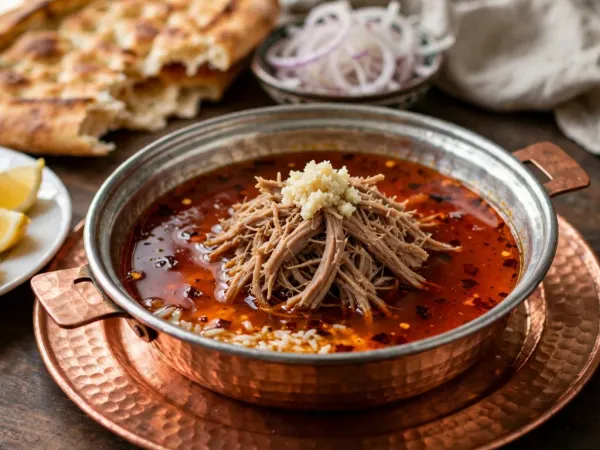
Serve one or two pieces on a plate with some syrup, tahini and walnuts. Kaymak or clotted cream on the side cools the sweetness. After a bowl of beyran, Gaziantep’s lamb and rice soup, it makes a Turkish Sunday lunch.
Indian cooks turn carrots into a sweet in much the same way, in gajar ka halwa. That one cooks in milk and ghee, though, not in its own syrup.
In the fridge
Refrigerate the cooled pumpkin within 2 hours of cooking. The USDA says leftovers keep “in the refrigerator for 3 to 4 days”. Keep the toppings apart until you serve it. Kaymak and clotted cream are fresh dairy, so don’t leave a plated serving out for more than 2 hours.
Calories and allergens
A serving has about 425 calories, 6 g of protein, 15 g of fat and 74 g of carbohydrate, most of it sugar. We added up the USDA FoodData Central values for pumpkin, sugar, tahini and walnuts and divided by 6. That assumes you eat all the syrup, so leaving some in the pot lowers the count.
Tahini is made from sesame, which the FDA has listed as the 9th major food allergen since 2023. Walnuts are tree nuts, and kaymak is milk. Without kaymak the dessert is vegan and gluten-free.
Fixes for kabak tatlısı that is mushy, hard or bland
- Mushy pieces: they were cut too thin, cooked too long or stirred. Cut 1-inch (2.5 cm) pieces and check them after 25 minutes.
- Tough edges: some rind or the pale layer under it was left on. Peel right down to the orange flesh.
- Hard inside, broken outside: the heat was too high. Keep it at a gentle simmer.
- Watery syrup: the lid stayed on, or you added too much water. Simmer uncovered until it thickens.
- Grainy syrup: the sugar crystallized. A tablespoon of lemon juice helps prevent it.
- Bland: the pumpkin had little flavor. Sprinkle a little more sugar on near the end, or add cloves.
- Too sweet: use 300 g of sugar per kilo next time, and serve it with unsweetened cream.
Substitutes for missing ingredients
- Turkish pumpkin: kabocha, Hubbard, Crown Prince or butternut squash, or a pie pumpkin.
- Kaymak: clotted cream, mascarpone, thick Greek yogurt or vanilla ice cream.
- Tahini: any smooth tahini, stirred well. In Antalya cooks use darker, double-roasted tahini.
- Walnuts: pistachios or hazelnuts.
- Cloves: a small cinnamon stick, or nothing at all.
- Lemon juice: a pinch of citric acid, or leave it out.
Frequently asked questions
What does kabak tatlısı taste like?
It is very sweet and soft, like a candied fruit, with the mild flavor of pumpkin. Tahini adds a nutty bitterness, and walnuts add crunch.
Can I use canned pumpkin?
No. The dessert needs firm pieces that hold their shape, and canned pumpkin is a purée.
Do I have to rest the pumpkin overnight?
It gives the best texture, but you can skip it. Add ½ cup (120 ml) of water to the sugar and pumpkin, and cook it gently with the lid on.
Can I bake it instead?
Yes. Five of the recipes we compared use only the oven. Cover the dish for most of the time, then uncover it to thicken the syrup.
Should kabak tatlısı be served hot or cold?
Cold or at room temperature, as in Turkey. It firms up as it chills.
How long does it keep?
Up to 3 to 4 days in the fridge, covered, in its syrup. Add the toppings just before serving.
Is kabak tatlısı vegan?
Yes, without kaymak. Pumpkin, sugar, tahini and walnuts contain no animal products.
Which pumpkin do Turkish cooks use?
In Sakarya, a large gray-skinned pumpkin with thick orange flesh, registered as Adapazarı white chestnut pumpkin. Aydın uses a fibrous, butternut-like squash, cut into very thin slices.