The Sunday Potthesundaypot.com/recipes/tirokafteri/
Tirokafteri: Greek Spicy Whipped Feta Dip, the Taverna Way
By The Sunday Pot Kitchen Updated
- • Seven ounces (200 g) of feta makes about 1½ cups of dip, enough for 6 as a meze
- • Roast a red pepper at 400°F (200°C) for about 20 minutes, until blackened in patches, then steam it and peel it
- • Blend half the feta with the peppers and yogurt, and mash the other half with a fork, as many Greek cooks do
- • Per 7 oz of feta, use about ¼ cup (60 g) of strained yogurt and 2 tablespoons of olive oil, or it turns runny
- • Wear gloves for the hot pepper, and never leave the dip out for more than 2 hours
- • Keep it in the fridge for 3 to 4 days; if you are pregnant, use feta made from pasteurized milk
Ingredients
6 servingsInstructions
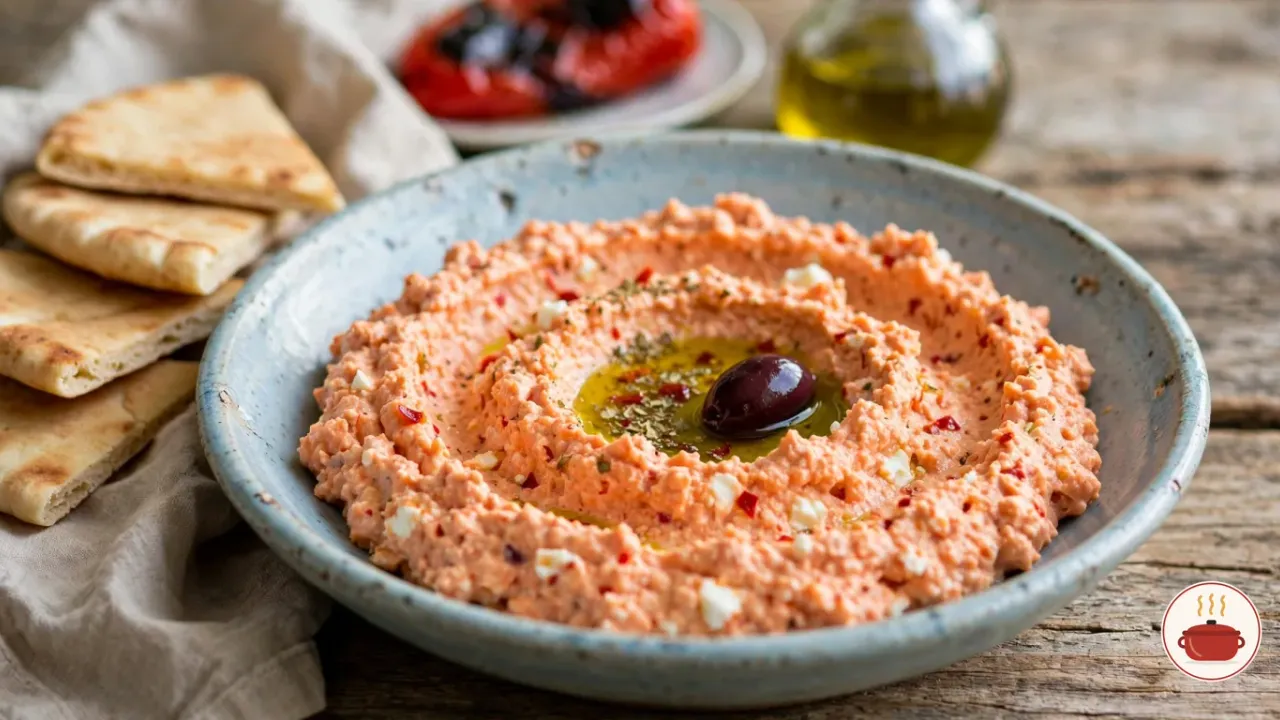
Tirokafteri is Greece’s spicy whipped feta dip: feta beaten with a roasted red pepper, a hot pepper, strained yogurt, olive oil and a splash of vinegar. This recipe makes about 1½ cups, enough for 6 as a meze. It takes 50 minutes, most of it roasting the peppers, and it is vegetarian and gluten-free.
What tirokafteri is
The name joins two Greek words: tyri, cheese, and kafteri, hot or burning. Diane Kochilas, the Greek-American cookbook author, translates it as “spicy cheese” on her site. You will also see it spelled tyrokafteri.
It is a meze, a small plate for sharing. “A dip is meant to be shared,” Kochilas writes. Greeks eat it with bread, beside grilled meat, and sometimes inside a souvlaki wrap. Elena Paravantes, a dietitian in Athens, describes the basic dip on Olive Tomato. It is “feta cheese mashed with a bit of olive oil and a hot pepper”, she writes. She adds a little yogurt to make it fluffier, as most cooks now do.
Tirokafteri, htipiti and whipped feta
These names overlap, and Greek cooks don’t agree on where one ends. Fotini of Real Greek Recipes says htipiti is “very similar” to tirokafteri, with fire-roasted red peppers added. Htipiti means “whipped”. Jenny Skrapaliori-Graves of The Greek Foodie calls them one family of dips, whose names and recipes change by region.
Kopanisti is something else: a fermented, peppery cheese from the Cyclades islands, with protected status. Its bite comes from the cheese itself, not from chili.
American whipped feta is the mild cousin. It is often feta whipped with yogurt and topped with honey. What sets tirokafteri apart? “The heat,” says Skrapaliori-Graves.
How old is it?
We found no documented date or place of origin for the dip. Some cooks link it with northern Greece, where the sweet red Florina pepper grows. That pepper has been a protected Greek product since a 1994 decree.
Feta itself is far older. The name dates from the 17th century and refers to cutting the cheese, the European Commission explains. It also points to the cheese the Cyclops makes in the Odyssey as a primitive form of feta. Treat that as a good story, not a recipe history.
Why whipped feta is a new classic in 2026
Datassential, a firm that tracks what US restaurants serve, put whipped feta among ten “New Classics” in its 2027 trends report. Its press release, out on 7 October 2026, calls them trends it “flagged early” that are now going mainstream. Sticky toffee pudding made the same list.
The climb was already visible. In March 2025, Datassential counted 106% more whipped feta on US menus than four years before. It found that 47% of Americans had heard of it and 20% had tried it, in a feature for Nation’s Restaurant News. In Britain, a 2025 cheese trends piece by Egg Soldiers, on the Speciality & Fine Food Fairs site, flagged tirokafteri. It was “currently appearing on menus across the UK”.
Feta is scarcer this autumn
Greek feta is under strain. Sheep and goat pox reached northern Greece in August 2024, To Vima reported. About 80% of Greek sheep and goat milk goes into feta.
Greece’s feta industry body estimates that 500,000 to 600,000 animals have been lost. Sheep milk output fell 7.4% in the first seven months of 2026, To Vima reported on 23 September. In July, farmers were paid 13.2% more for it than a year before. Recovery will take at least two years, the industry says.
Michalis Sarantis heads that body, the National Interprofessional Organisation for Feta. Feta stocks “may not last until the end of 2026”, he warned in September, Proto Thema reported. He expects the price to climb from €12 to €13 a kilo now to €15 to €16. A dip stretches a block of feta a long way.
No figure for the dip itself
We found no 2026 menu, sales or search figure for tirokafteri by name. Every 2026 number we found is for whipped feta in general or for Greek feta supply.
What you need for tirokafteri
We compared 27 published recipes, 20 of them by Greek or Greek-Cypriot cooks. This recipe sits close to their medians.
Greek feta in brine
Buy a block of feta sold in brine, not pre-crumbled feta. In the EU, feta is a protected name, so only Greek feta may use it, the EU’s top court confirmed in a 2022 ruling against Denmark. It must be made from the milk of native Greek ewes and goats and ripened for at least two months, according to the European Commission. At least 70% of the milk must be sheep’s milk, To Vima notes.
In the US, “feta” is not a protected name. To Americans, “feta is a crumbly cheese”, as The Wall Street Journal put it in a report syndicated by To Vima. So read the label: look for “Product of Greece”, the letters PDO, and sheep’s and goat’s milk on the ingredients.
Choose a soft, young feta. “The ripest a feta cheese is the harder it becomes,” Fotini warns, and a hard one won’t blend smoothly. Let it warm up first.
A sweet red pepper
A roasted sweet red pepper is in 18 of the 27 recipes, and 6 Greek cooks name the Florina pepper. It gives the dip its soft coral color. Jarred Florina peppers, roasted and peeled, are sold abroad. “A red bell pepper or jarred roasted red peppers work perfectly as a substitute,” says The Greek Foodie. Drain a jarred pepper well and pat it dry.
A hot pepper
A fresh hot pepper is in 18 recipes, and 8 of those roast or fry it first. Fotini uses a Hungarian wax pepper and suggests a banana pepper for a milder dip. Paravantes uses a jalapeño. Seven recipes use only dried heat, such as red pepper flakes or boukovo, the Greek chili flakes.
Yogurt, oil, vinegar and garlic
Strained Greek yogurt is in 22 of the 27 recipes. The median is about ¼ cup (50 g) per 7 oz (200 g) of feta. The median for olive oil is 2 tablespoons.
Fifteen recipes add vinegar, a median of about 2½ teaspoons, and five use lemon juice. Garlic is in 15, and most use less than one clove. “The garlic flavor will get stronger as the days pass,” Fotini notes on Real Greek Recipes. Skip the salt: feta brings plenty.
How to make tirokafteri thick, not runny
The method is simple. Three things decide whether it holds its swirl.
Roast the peppers until black
For whole peppers, the median oven is 400°F (200°C), for about 20 minutes. A small hot pepper needs only 6 to 8 minutes, notes the Greek blogger Madame Ginger. The Greek magazine Athinorama grills its Florina peppers until the skin blackens. It then shuts them in a bag for 5 minutes, so the skins slip off.
Wear gloves for the hot pepper. Capsaicin, its active ingredient, can burn skin and eyes. “Wear rubber, latex, or nitrile gloves when working with hot peppers,” advises Poison Control, and don’t touch your face afterwards.
Blend half, mash half
Every recipe uses a processor or blender for at least one step. But 7 keep some texture by mashing part of the feta by hand, and all 7 are by Greek cooks. Karolina Doriti, on the Greek TV channel SKAI’s Cookout site, blends the peppers, yogurt and half the feta into a cream. She then stirs in the rest, mashed with a fork. Akis Petretzikis does the same in his classic version. This recipe follows them.
For a silky dip, blend all the feta. Just stop early. “Over-blending can make the dip thin and runny,” warns The Greek Foodie.
Taste for heat
Peppers vary wildly. Start with half the hot pepper, pulse and taste, The Greek Foodie suggests. Dairy softens the burn, so you may need more than you think. The seeds and white ribs hold most of the capsaicin, the Greek chef Giorgos Tsoulis explains. Keep a few for a hotter dip.
Let it rest
Eight recipes chill the dip for about an hour before serving. It thickens as it cools, so aim a little looser than you want it. Take it out 10 to 15 minutes before serving, so it softens again.
Serving and storing tirokafteri
Serve it with warm pita or crusty bread, as part of a spread of meze. It sits well beside grilled meat or slow-roasted lamb kleftiko. Kochilas suggests it as a bed for grilled meat, or a topping for fish. With braised beans on top, it is “a classic taverna combination”, says The Greek Foodie. For a two-dip spread, pair it with Lebanese labneh, another thick, tangy dairy dip.
How long it keeps
Never leave the dip out for more than 2 hours, or 1 hour above 90°F (32°C), the CDC advises. Cover it and keep it in the fridge.
Cooks give it anywhere from 3 days to 10. We’d stick to 3 to 4 days, the USDA’s limit for leftovers. A little salty liquid may pool on top. Pour it off and stir. Don’t freeze it: the yogurt and feta can separate and turn grainy, The Greek Foodie warns.
Feta and pregnancy
Feta made from pasteurized milk is safe in pregnancy, says the NHS. The CDC also lists feta “when made with pasteurized milk” as a safer choice. Cheese made from raw milk can carry Listeria.
Greek PDO feta can be made from either pasteurized or unpasteurized milk, the European Commission notes. So if you are pregnant, over 65 or have a weak immune system, check the label for pasteurized milk. Use pasteurized yogurt too.
Calories and allergens
One serving, about ¼ cup with its share of the olive oil, has about 160 calories. It has 14 g of fat, 6 g of protein and 390 mg of sodium. We estimated this from USDA values for feta. A jarred pepper adds a little more salt.
The dip contains milk, one of the 9 major food allergens in the US, according to the FDA. It is gluten-free on its own, but pita and bread contain wheat.
Fixes for tirokafteri that is runny, grainy or too salty
- It is runny: it was over-blended, or the pepper was wet. Stir in more mashed feta, and chill it for an hour.
- It is grainy or stiff: the feta was cold or old. Let it warm up, and loosen it with a spoonful of yogurt.
- It is too salty: stir in more yogurt, a spoonful at a time.
- It is too hot: add more feta and yogurt. Next time, seed the pepper.
- It is not hot enough: add red pepper flakes, or a little more fresh hot pepper, and pulse.
- Liquid pooled on top: that is whey from the feta. Pour it off and stir.
Substitutes for missing ingredients
- Florina pepper: a red bell pepper, or a jarred roasted red pepper, well drained.
- Hungarian wax pepper: a jalapeño, serrano or banana pepper, or ¼ to ½ teaspoon of red pepper flakes.
- Strained Greek yogurt: regular plain yogurt makes a looser dip. Ricotta or cream cheese works too.
- Red wine vinegar: white wine vinegar or lemon juice.
- Greek PDO feta: another feta sold in brine, ideally made from sheep’s milk.
- A food processor: mash everything with a fork, and chop the peppers very fine first. It will be chunky, which many Greek cooks prefer.
Frequently asked questions
What does tirokafteri mean?
Spicy or hot cheese. Tyri means cheese in Greek, and kafteri means hot or burning.
What is the difference between tirokafteri and whipped feta?
The heat. Tirokafteri always has hot pepper or chili flakes. American whipped feta is usually mild, often topped with honey.
Is tirokafteri the same as htipiti?
They are close cousins. Some Greek cooks use the names for the same dip. Others say htipiti adds roasted red peppers and is less spicy.
Can I make tirokafteri without yogurt?
Yes. Five of the 27 recipes we compared use none. Add a little more olive oil, or a splash of milk, until it is spreadable.
Can I make it ahead?
Yes. Make it up to 3 days ahead and keep it covered in the fridge. Take it out 10 to 15 minutes before serving and stir.
Is tirokafteri safe in pregnancy?
Only if the feta and yogurt are made from pasteurized milk. Check the label: some Greek feta is made from raw milk.
Can I freeze tirokafteri?
It’s best not to. The feta and yogurt can separate and turn grainy once thawed.
What do you serve with tirokafteri?
Warm pita, crusty bread or raw vegetables. In Greece, it also comes with grilled meat and souvlaki.