The Sunday Potthesundaypot.com/recipes/ash-reshteh/
Ash Reshteh: Persian Herb, Bean and Noodle Soup with Kashk
By The Sunday Pot Kitchen Updated
- • Use about 14 oz (400 g) of dried legumes for 6 servings: chickpeas, kidney or pinto beans, and lentils, the median of 27 recipes
- • Soak dried kidney beans for at least 5 hours and boil them hard for 30 minutes before the soup, as the FDA advises
- • Use about 1½ lb (700 g) of herbs and spinach, and keep the lid off so they stay green
- • Add the noodles last and cook them for 15 to 20 minutes, until soft all the way through
- • Salt the ash only at the end, because reshteh and kashk are both salty
- • Fry the dried mint off the heat for about 10 seconds, or it turns bitter
Ingredients
6 servingsInstructions
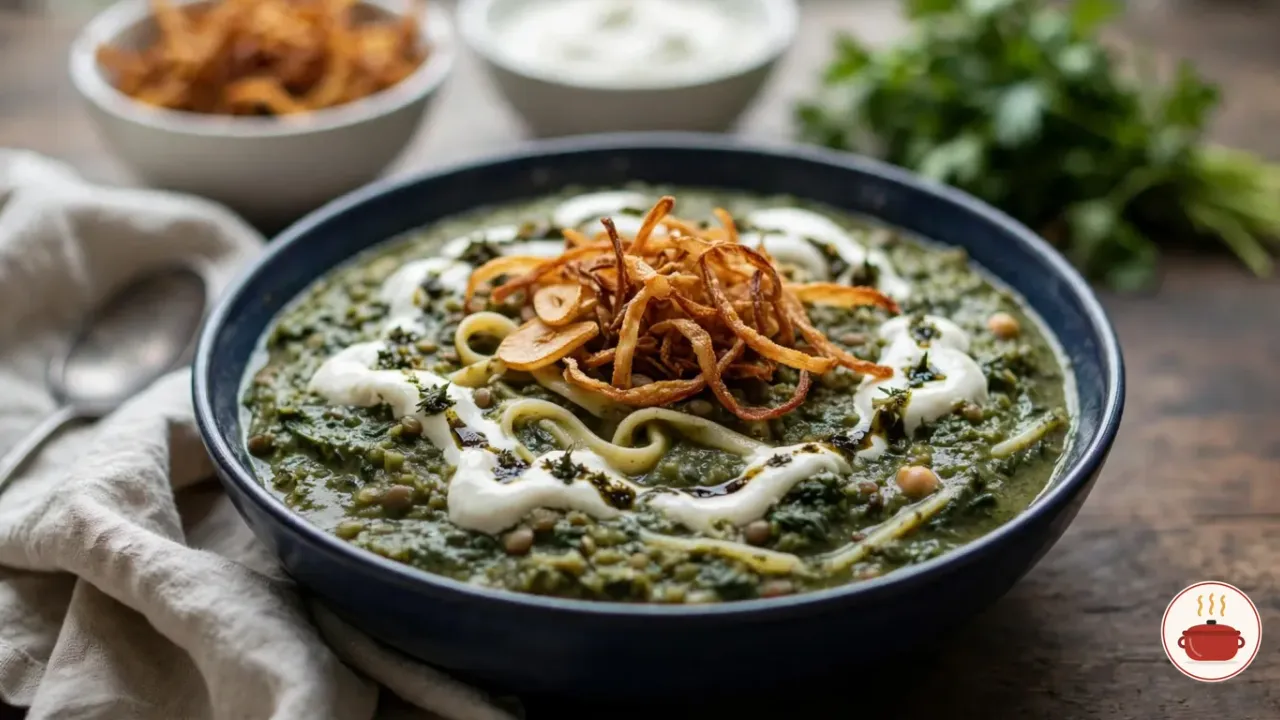
Ash reshteh is Iran’s best-known thick soup: chickpeas, beans and lentils simmered with a mountain of fresh herbs, then thickened with reshteh, a flat noodle. Each bowl is topped with kashk, a sour fermented dairy, plus crisp fried onions and mint oil. This recipe serves 6 and takes about 3½ hours, plus soaking.
What ash reshteh is
A word for soup, and for cooking
In Persian, ash is the family name for thick soups. Encyclopaedia Iranica calls it “the general term for a traditional Iranian dish comparable to the French potage”. It can hold rice, pasta, grains, beans, meat, fruit and tart flavorings.
The word sits at the heart of the Persian kitchen. A cook is an āshpaz, and the kitchen is an āshpaz-khāneh. Where the word itself came from is unsettled: scholars have proposed both Persian and Turkic roots.
Reshteh means string, or noodle. Of all the ashes, it is “the most beloved and well-known”, writes America’s Test Kitchen. The same piece notes that ash appears in the oldest surviving Persian cookbook, from 1521. “Ash is an ancient dish, and I usually don’t use the word ancient,” the food scholar Amir Sayadabdi told the writers.
Noodles for the new year
Ash reshteh belongs to Nowruz, the Persian New Year in March. Many families eat it on Chaharshanbe Suri, the fire festival on the last Wednesday eve of the year. The long noodles “bring good luck for the new year”, the cookbook author Najmieh Batmanglij told Al-Monitor.
At her table in 2008, the soup came first. Its noodles “symbolize unraveling the difficulties in the year to come”, NPR reported. Nowruz itself is on UNESCO’s list of intangible heritage, shared by 13 countries since 2024. The soup is not listed on its own.
A pot for travelers and vows
Ash is also a dish of hope. Iranica describes āsh-e reshteh-ye posht-e pā, cooked 3 or 5 days after a loved one leaves on a journey. Neighbors share it, in the hope that the trip will be short.
Ash is often cooked as nazri, a votive offering made in huge pots and given away. “You can’t do [ash reshteh] in small quantities,” the Iranian home cook Sylva Sedrakian told America’s Test Kitchen. “It has to be shared.”
Kashk, the sour finish
Kashk is what makes the bowl taste Persian. In modern Persian the word means dried yogurt, sun-dried into small balls, according to Iranica. Outside Iran, it is easiest to find as a liquid, in jars. It tastes creamy, sour and savory, a little like a salty, tangy cheese sauce.
Why ash reshteh fits this winter
Beans move to the center of the plate
On October 14, 2026, Whole Foods Market published its trend forecast for 2027. One of its 8 trends is “The Bean Boom”. Beans and legumes are “claiming center-of-the-plate real estate” as shoppers look for cheap protein and fiber, the retailer says in its press release.
It names “lentil-forward bowls and heirloom bean stews”. Ash reshteh holds 3 legumes in one pot. The forecast comes from the retailer’s trends council and gives no figures.
A test kitchen takes it on
In March 2026, America’s Test Kitchen published its own ash reshteh, with a long feature on how it was developed. Its recipe developer, Claudia Catalano, chose canned chickpeas and kidney beans. She calls them “a shortcut that many modern-day Persian cooks take”.
A dish for cold days
In Iran, ash reshteh is winter food. Hamshahri, a Tehran daily, called it “a complete meal for winter tables” in January 2026. Its presence on cold days “gives the home a special meaning and mood”, the paper wrote (our translation).
Yalda, the longest night of the year, falls on the evening of December 21, 2026. Nowruz follows in March. Nobody has measured ash reshteh itself this year, and we found no 2026 sales or search figure for it. What we can say is that its season, and its main ingredient, are both in the spotlight.
What you need for ash reshteh
For this recipe we read 27 published versions. Twenty-two are by Iranian cooks, and 16 are in Persian, from outlets such as Hamshahri, Asriran, Digikala Mag and Chishi. The amounts here sit on their medians, scaled to 6 servings.
Three legumes
Every version uses lentils, and all but one use chickpeas. Pinto beans appear in 16, kidney beans in 11 and white beans in 10. Together, the median is 400 g (about 2 cups) of dried legumes for 6.
This recipe uses chickpeas, kidney or pinto beans, and lentils. Of the 23 recipes with dried beans, 22 soak them, for a median of 12 hours. Most Persian recipes cook the beans separately before they go into the pot.
A mountain of herbs
The herbs make the soup. Every recipe that lists herbs uses parsley and spinach, and 22 add cilantro. Every Persian recipe that names its herbs includes tareh, a flat garlic chive. Most English versions use scallions or chives instead.
The median is 700 g (about 1½ lb) of herbs and greens per pot. The Persian recipes use about twice as much as the English ones. Persian grocers often sell a frozen herb mix for ash, so check its label for what is inside.
Reshteh, or linguine
Reshteh is a flat noodle of wheat flour, water and salt, with no egg. The median is about 200 g for 6. Dried linguine broken in half is the usual stand-in, which the James Beard Foundation recipe by the Iranian chef Mehrdad Dabir also suggests.
Kashk
Buy liquid kashk in a jar from a Persian or Middle Eastern grocer, and keep it in the fridge. Iranian health writers advise choosing pasteurized, labeled kashk. Traditional unpasteurized kashk is boiled for about 20 minutes before use. Jarred kashk sold abroad is usually pasteurized: check the label.
Without kashk, stir ½ cup (120 g) of sour cream or Greek yogurt with 2 tablespoons of lemon juice and a pinch of salt. Thick labneh thinned with a little water works the same way.
The three toppings
The garnish is half the dish. You need piaz dagh, deep-fried onions, plus sir dagh, fried garlic, and nana dagh, dried mint warmed in oil. “Fried onion gives the ash a wonderful flavor, so don’t skimp on it,” advises the Iranian travel site Kojaro (our translation).
How to make ash reshteh
Soak and boil the beans
Raw kidney beans contain a natural toxin. “As few as four or five raw beans can trigger symptoms,” the FDA warns. It advises soaking them for at least 5 hours, pouring the water away, and boiling them in fresh water for at least 30 minutes.
Never cook dried kidney beans in a slow cooker: it doesn’t get hot enough. Canned beans are already soaked and boiled, so they are safe as they are, the UK’s Food Standards Agency says. Use two 15-oz (425 g) cans, drained, and skip the first two steps.
Cook the herbs with the lid off
Rinse the herbs and spinach under plain running water, and dry them. You don’t need soap or a produce wash, the FDA says.
Then cook them uncovered. A lid traps steam and turns the greens dark and dull. “So the ash doesn’t lose its color, never put the lid on while it cooks,” Eghtesad Online warns (our translation). After 45 minutes, the herbs should be a deep olive green, or “a nice khaki colour”, as Ottolenghi puts it.
Add the noodles last
Reshteh goes in once the beans and herbs are soft. The median cooking time is 15 minutes, and 17½ in the Persian recipes alone. Cook it until it is soft right through, not al dente.
The noodles release starch and thicken the pot. Keep a kettle of hot water close, and stir often so nothing sticks. Samin Nosrat’s version, as adapted by Edina Magazine, says the soup should be “as thick as a hearty chili”.
Fry the mint for seconds
Dried mint burns in moments. “Fry the mint briefly on low heat and switch off; longer turns it black and bitter,” says the Iranian site Bartarinha (our translation). Take the pan off the heat before the mint goes in.
Let it settle
Persian cooks wait for the ash to “settle” before serving, when it turns smooth and evenly thick. “The noodles cook in about 20 minutes, but the ash needs 40 to 50 minutes to settle,” says the Iranian site Delgarm (our translation). A 10-minute rest off the heat helps.
Serving and storing ash reshteh
Kashk in the bowl, not the pot
Add the kashk to each bowl rather than the whole pot. It keeps its fresh sour taste, and leftovers keep better. Two Persian recipes warn that boiling kashk in the soup can make it split.
Serve the ash hot, with flatbread if you like. Another lentil classic is Lebanese mujadara. For a richer Persian meal, follow a small bowl of ash with fesenjan.
Leftovers
Cool the ash quickly. Divide a big pot of soup into smaller containers “so it will cool quickly”, the USDA advises. Refrigerate it within 2 hours, and eat it within 3 to 4 days, or freeze it for 3 to 4 months.
The noodles keep soaking up liquid, so the ash thickens overnight. Thin it with water, then bring it to a rolling boil before you serve it again.
Calories and allergens
One serving has about 550 calories, 23 g of protein, 17 g of fat, 79 g of carbohydrate and 18 g of fiber, without the kashk. These numbers come from USDA data for cooked legumes, fresh herbs, dry pasta and oil, totaled for the pot. A traditional liquid kashk tested in Hamedan, Iran, held about 2% salt, so go easy if you are watching sodium.
Reshteh and the flour contain wheat. Kashk is made from milk. The FDA lists both among the major food allergens. Without the kashk, the soup is vegan.
Fixes for ash reshteh that is thin, stiff, dark or bitter
- It’s thin: simmer it uncovered for longer, or stir in the flour paste. It thickens as it cools, too.
- It’s stiff and gluey: too many noodles. Add hot water a ladle at a time.
- The herbs turned dark: the pot was covered. Leave the lid off next time.
- The beans are still hard: they went in undercooked. Simmer the pot until they are soft before the noodles go in.
- The mint tastes bitter: the oil was too hot. Make a new batch off the heat.
- It tastes flat: add more kashk, or a squeeze of lemon.
- It’s too salty: the kashk and reshteh were salty. Add water and a little more cooked beans.
Substitutes for missing ingredients
- Reshteh: dried linguine, broken in half.
- Kashk: sour cream or Greek yogurt with lemon and salt, or thinned labneh.
- Tareh: scallion greens or chives.
- Fresh spinach: 5 oz (150 g) frozen spinach, thawed and squeezed dry.
- Fresh herbs: a frozen herb mix for ash from a Persian grocer.
- Kidney beans: pinto, white or borlotti beans, or canned beans.
- Lentils: mung beans, which 4 of the recipes add.
Frequently asked questions
What does ash reshteh mean?
Ash is the Persian name for thick soups, and reshteh means noodle. So ash reshteh is noodle soup, though it is thick with herbs and beans.
What is kashk?
It is a fermented dairy product made from yogurt, sold dried or as a liquid in jars. It tastes sour, salty and savory.
What can I use instead of kashk?
Sour cream or Greek yogurt mixed with lemon juice and salt. Thinned labneh works too.
Is ash reshteh vegetarian?
Yes, when it is cooked with water or vegetable stock. Without the kashk, it is vegan.
Can I use canned beans?
Yes. Many Persian cooks do. Add them, drained, with the herbs, and skip the soaking and boiling.
When is ash reshteh eaten?
At Nowruz, the Persian New Year, and on cold winter days. It is also cooked as a votive offering and when someone sets off on a journey.
Can I make ash reshteh ahead?
Yes. Many cooks prefer it on day two, once it has settled. Thin it with water when you reheat it, and add the toppings fresh.
Is ash reshteh gluten-free?
No. Reshteh is a wheat noodle, and some recipes add flour. Use a gluten-free pasta added at the very end, and leave out the flour.