The Sunday Potthesundaypot.com/recipes/vori-vori/
Vori Vori: Paraguay's Chicken Soup with Cornmeal Balls
By The Sunday Pot Kitchen Updated
- • Six servings take 3 lb (1.4 kg) of bone-in chicken, 2 cups (300 g) of fine yellow cornmeal, 4 oz (115 g) of queso fresco and a little Parmesan
- • Keep the dough at about 2 parts cornmeal to 1 part cheese by weight, as Paraguayan cooks do
- • Bind the dough with about 1 cup (240 ml) of hot broth from the fatty top of the pot, never cold water
- • Simmer the broth for 1 hour, then the balls for 10 to 12 minutes, until they float
- • Keep the soup at a gentle simmer once the balls go in: a hard boil breaks them
- • To freeze, freeze the broth and chicken, and make the balls fresh
Ingredients
6 servingsInstructions
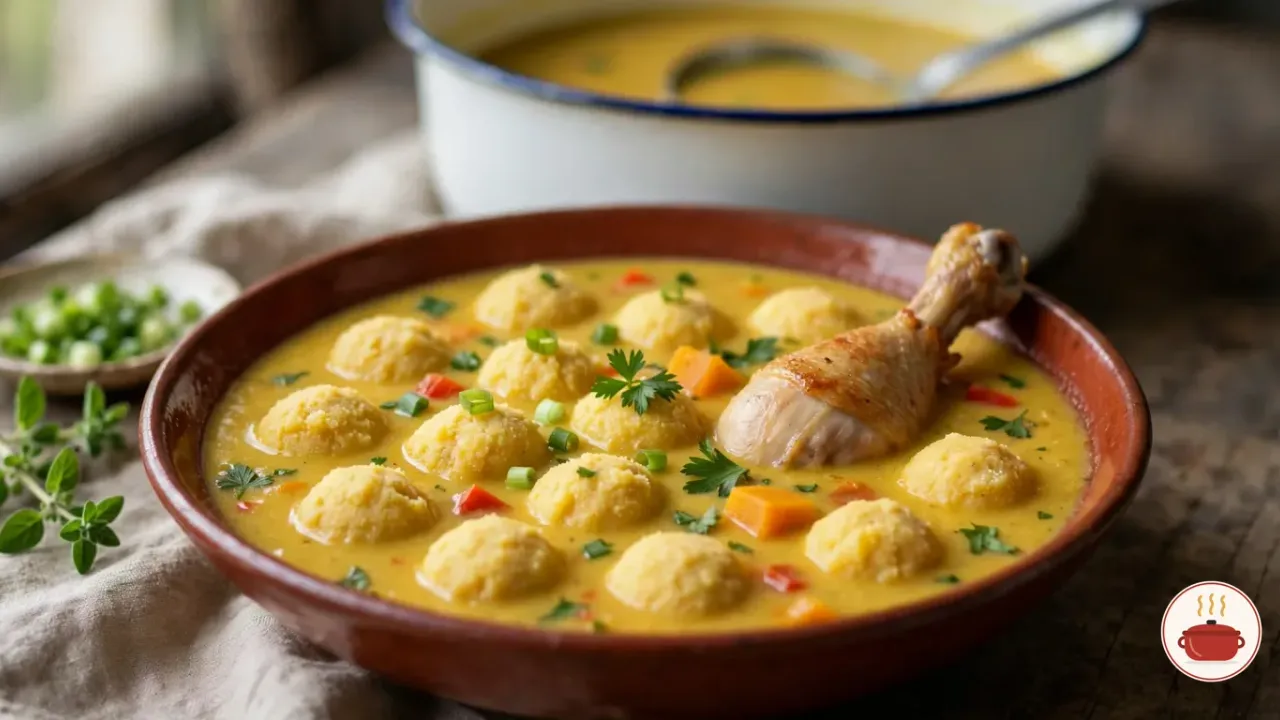
Vori vori is Paraguay’s best-loved soup: chicken broth with squash and peppers, thickened by little balls of cornmeal and fresh cheese. TasteAtlas users rated it the best dish in the world for 2025/26. This version takes one pot and about 2 hours, and serves 6.
What vori vori is
Vori vori is a thick, golden chicken soup. Its balls are made of cornmeal and crumbled fresh cheese, bound with hot broth from the pot. They soak up the broth without losing their shape, so the soup turns thick with no flour at all, as Diario HOY notes.
A name that means many little balls
The Spanish word bolita, little ball, became vorita in Guaraní, then simply vori. So explains the historian Margarita Miró Ibars in the Asunción magazine Cocina Rica. Saying it twice makes it plural: many little balls.
The researcher Graciela Martínez told Nicholas Gill of New Worlder that the recipe is a riff on the Spanish sopa de bolitas. When the balls are very small, Paraguayans call them tu’i rupi’a, parakeet eggs.
Hen, beef or cheese
Miró Ibars names 3 kinds. Vori ryguasu is made with chicken or hen broth, and is most prized with a farmyard hen. Vori so’o is made with beef. Vori kesu, the white cheese version, is for Lent, when there is no meat, and for the sick. Every kind gets whatever vegetables the cook has, with boiled mandioca (cassava) on the side.
Corn and cheese in Paraguay
Paraguayan food rests on maize, cassava and beef, the researcher Clemente Cáceres told Última Hora in 2017. The first Spaniards brought cheese, which the Guaraní did not know, he added.
The cheese in vori vori is queso Paraguay, a fresh cow’s-milk cheese made with raw milk and rennet. Cooks traditionally cure the rennet in sour orange juice, or in lemon juice, explains Cocina Rica. One dairy told Infonegocios in 2024 that its queso Paraguay sales triple before Holy Week.
When Paraguayans eat it
Vori vori is a main course for the cold months, from June to August in Paraguay. In Asunción, Monday lunch at the central markets is a tradition against the lunero, the Monday slump, Última Hora reported. Workers there tempt each other with “a vori vori with chicken”.
In 2017, Paraguay’s Secretariat of Culture declared vori vori part of the country’s intangible cultural heritage. Sopa paraguaya, locro and jopara joined it on the same list.
Why vori vori is in the news
In December 2025, TasteAtlas named vori vori the best dish in the world in its 2025/26 awards. It scored 4.64 out of 5, ahead of pizza napoletana at 4.58, Última Hora reported. The ranking drew on 453,720 user ratings of 11,781 dishes, La Nación wrote. TasteAtlas had already rated it the world’s best soup in 2023 and 2024.
It is still on top. In its September 2026 update, TasteAtlas put vori vori first among the world’s soups again, at 4.7, Diario HOY reported. Turkey’s beyran çorbası came second and Indonesia’s soto Betawi third, by LatiNation’s account. The Asunción Times covered the news in English.
These are ratings from TasteAtlas users, not a jury. The site says it counts only users who have tried a dish, and filters out bots.
A national day, by law
Paraguay has taken the prize to heart. On 11 August 2026, Congress passed a law that makes 14 April the national day of vori vori, Diario HOY reported. On 14 April 2026, the national tourism office handed out 1,600 free plates across the country. Tourists arriving in Paraguay already ask where to eat vori vori, the tourism minister Angie Duarte told Última Hora.
We found no figure for how many people cook vori vori outside Paraguay. North of the equator, the reason to make it now is simpler: soup season has begun.
What you need for vori vori
Chicken
Paraguayan cooks prize a farmyard hen, simmered for about 3 hours, as in the hen recipe from Cocina Rica. Bone-in, skin-on thighs and drumsticks give a rich broth in 1 hour. Do not rinse the raw chicken: the USDA warns that washing spreads bacteria around the kitchen. Pat it dry instead.
Fine yellow cornmeal
In Paraguay, cooks use a precooked yellow corn flour, Miró Ibars writes. Elsewhere, use fine yellow cornmeal. Coarse cornmeal makes the balls gritty and crumbly, warns Eats History.
Camila Benitez, who was born in Paraguay, uses P.A.N., a precooked corn flour sold for arepas, on Camila Made. Precooked flour drinks more broth, so add a little more.
Fresh cheese
Queso Paraguay is hard to find abroad. Gill suggests whole-milk ricotta or farmer’s cheese. Karl Lueck of Jabberwocky Stew found Parmesan alone too salty, and mozzarella too melty. He settled on queso fresco with some Parmesan, and so does this recipe.
Squash, pepper, tomato and scallions
Paraguayan recipes build the broth on zapallo, a winter squash, with onion, tomato and locote, the red bell pepper. Butternut squash or pumpkin stands in for zapallo. Scallion greens, parsley and oregano go in at the end.
A big pot
Use a pot of 6 quarts (5.7 liters) or more. The balls need room to float.
How to make vori vori balls that hold
We compared 12 recipes, 7 of them by Paraguayan cooks or published in Paraguay. All of them roll the balls by hand and drop them into simmering soup at the end.
About 2 parts cornmeal to 1 part cheese
By weight, the Paraguayan recipes use 2 to 2½ parts cornmeal to 1 part cheese. The Holy Week recipe in Última Hora uses 350 g of cornmeal, 150 g of queso Paraguay and 30 g of lard. Cocina Rica’s hen recipe uses 200 g to 80 g. This one uses 300 g of cornmeal to 135 g of cheese.
Bind with hot, fatty broth
Paraguayan cooks moisten the dough with hot broth from the pot. Última Hora’s recipe takes it from the surface, where the fat collects. Stop when the dough holds together when squeezed, soft but firm.
None of the 5 recipes published in Paraguay uses egg. The I Love Paraguay restaurant in Queens adds 1 egg to its dough, in a recipe it shared with ABC7 New York.
Roll them small
Sizes run from a marble, at I Love Paraguay, to a walnut. Benitez rolls 1-inch (2.5 cm) balls from about 1 tablespoon of dough. Let the dough rest for 10 minutes first, as she does.
Simmer gently until they float
The balls cook in 5 to 12 minutes, and they are done when they float. Keep the soup at a gentle simmer, Benitez warns: high heat can break them before they set.
Variations: hen, beef, cheese and milk
With a hen
Use a stewing hen in pieces, and simmer it for about 3 hours before you add the balls. Top up with hot water as the broth reduces.
Vori so’o, with beef
Use 2 lb (900 g) of beef shank or soup bones instead of chicken. Simmer for 2½ to 3 hours, until the meat is tender.
Vori kesu, with no meat
Make the broth with the vegetables alone, and add 2 cups (480 ml) of whole milk with the balls. A Paraguayan grandmother on Cookpad adds ½ liter of milk and butter beans this way.
More cheese
Cocina Rica’s chicken version stirs 200 g of grated queso Paraguay into the pot at the end. For the same effect, stir in 1 cup (115 g) of grated Monterey Jack just before serving.
Shredded chicken
Some cooks pull the chicken off the bone and return the meat to the pot. It makes the soup easier to eat, and easier to share out.
Serving and storing vori vori
Serve vori vori hot, with a piece of chicken in each bowl and boiled mandioca on the side. A bowl of grated Parmesan at the table suits it too, as TasteAtlas suggests. For another creamy chicken dish from South America, try Peruvian ají de gallina. For another Sunday soup, there is golumpki soup. To follow it, a slow-roasted lamb kleftiko feeds the same 6 people.
Leftovers
Follow the USDA’s advice on leftovers:
- Divide the soup into smaller containers, so it cools quickly, and refrigerate it within 2 hours.
- Eat it within 3 to 4 days, or freeze it for 3 to 4 months.
- Reheat it to a rolling boil.
The balls keep drinking broth in the fridge, so add hot water when you reheat. To freeze vori vori, freeze the broth and chicken alone, and roll fresh balls on the day. Jenny of Jenny is baking also finds fresh balls better than reheated ones.
Is the chicken done?
After 1 hour of simmering, it will be. The USDA’s safe minimum for all poultry is 165°F (74°C), checked with a food thermometer.
Calories and protein
One serving, a sixth of the pot with skin-on chicken, has about 590 calories, 37 g of protein and 25 g of fat. It has about 51 g of carbohydrate, 4 g of fiber and 950 mg of sodium. These are estimates from USDA figures, with queso fresco standing in for queso Paraguay.
Allergens and gluten
The cheese holds milk, one of the major food allergens the FDA lists. Vori vori has no wheat flour. If you avoid gluten, check that your cornmeal is labeled gluten-free.
Fixes for balls that crumble, sink or turn hard
- Balls fall apart: the dough was too dry, or the soup was boiling hard. Add hot broth to the rest of the dough, and lower the heat.
- Balls are hard and dense: too much cornmeal for the cheese. Next time, add 1 more ounce (30 g) of cheese and a little more broth.
- Balls are gritty: the cornmeal was coarse. Use fine cornmeal or precooked corn flour.
- Balls are raw in the middle: they were too big. Simmer 3 to 5 minutes more after they float.
- Soup is too thick: stir in hot water, ½ cup (120 ml) at a time.
- Soup is bland: add salt to the broth, and pass grated Parmesan at the table.
Substitutes for missing ingredients
- Queso Paraguay: queso fresco with a little Parmesan, or farmer’s cheese.
- Fine yellow cornmeal: precooked corn flour such as P.A.N., with a little more broth.
- A farmyard hen: bone-in, skin-on chicken thighs and drumsticks.
- Zapallo: butternut squash, pumpkin or kabocha.
- Locote: a red bell pepper.
- Lard in the dough: 1 tablespoon of the chicken fat from the pot, or vegetable oil.
- Fresh parsley: more scallion greens.
Frequently asked questions
What does vori vori mean?
It comes from bolita, Spanish for little ball, which became vori in Guaraní. Saying it twice means many little balls.
What is vori vori made of?
Chicken broth with squash, onion, pepper and tomato, and balls of cornmeal and fresh cheese. Oregano and scallions finish it.
Why is vori vori called the best dish in the world?
TasteAtlas users rated it first of 11,781 dishes in the 2025/26 awards, with 4.64 out of 5. In September 2026 it topped the site’s soup ranking again.
Is vori vori gluten-free?
It has no wheat flour. Check that your cornmeal is labeled gluten-free if you need it to be.
What cheese can I use instead of queso Paraguay?
Queso fresco with a little Parmesan, or farmer’s cheese. Mozzarella alone melts too much.
Why do my vori vori balls fall apart?
The dough was too dry, or the soup boiled too hard. Bind it with more hot broth and keep the soup at a gentle simmer.
How big should the balls be?
About 1 inch (2.5 cm), from 1 tablespoon of dough. Smaller balls cook faster.
Can I freeze vori vori?
Freeze the broth and chicken for up to 3 to 4 months, and roll fresh balls when you reheat it.
What do you serve with vori vori?
Boiled mandioca, as in Paraguay, or crusty bread. Grated Parmesan at the table is optional.