Sticky Toffee Pudding with Dates and Warm Toffee Sauce
By The Sunday Pot Kitchen Updated
- • 25 minutes of prep and about 45 minutes of baking and resting
- • 8 oz (225 g) of dates and one 9-inch (23 cm) square pan make 9 servings
- • Soak the chopped dates in boiling water with baking soda for 20 minutes, so they melt into the batter
- • Bake at 350°F (175°C) for 30 to 35 minutes, until a toothpick comes out clean
- • Pour warm toffee sauce over the hot sponge, then pass more at the table with cold cream
Ingredients
9 servingsInstructions
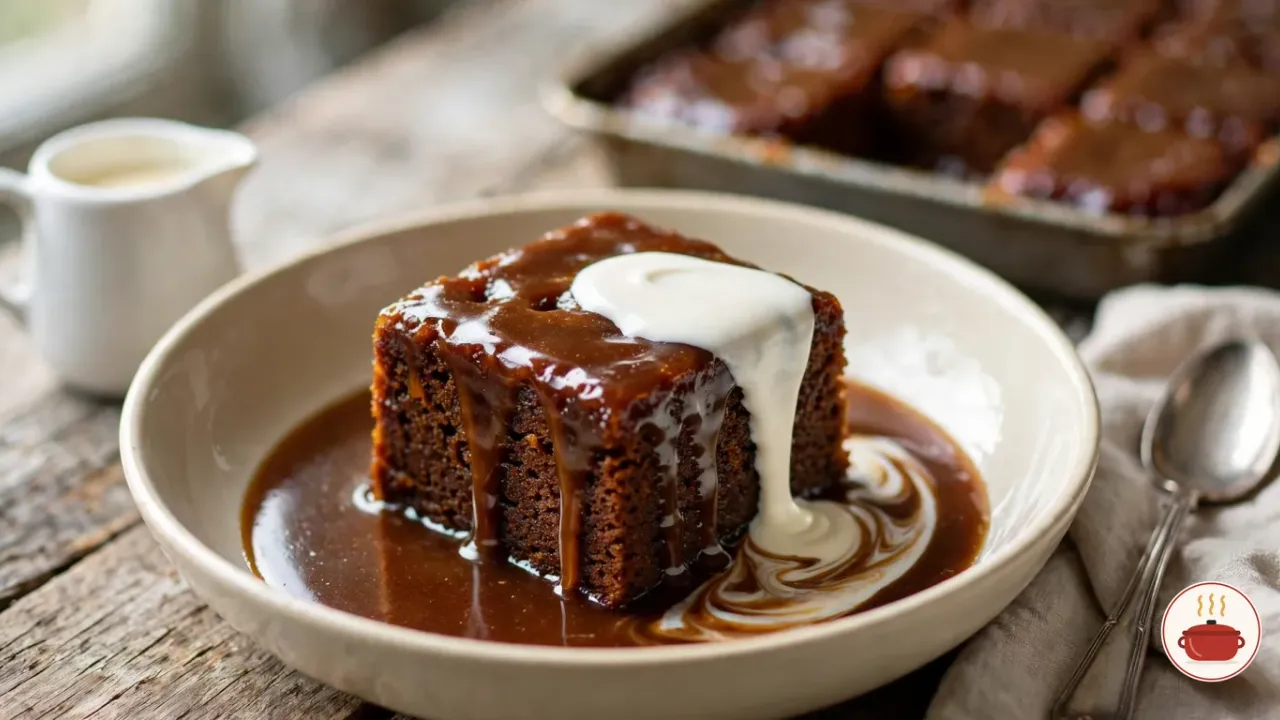
Sticky toffee pudding is a moist British date cake, served warm under toffee sauce. Chopped dates soak in boiling water with baking soda, then go into a brown sugar batter. The sponge bakes at 350°F (175°C) for 30 to 35 minutes. Then a sauce of dark brown sugar, butter and cream soaks into the top.
What sticky toffee pudding is
In Britain, “pudding” often means any dessert. This one is not the creamy pudding an American might expect. It is a soft, dark sponge cake, sweetened with dates and brown sugar. Warm toffee sauce soaks into the top, and more goes on at the table.
It belongs above all to the Lake District, in Cumbria, in the north-west of England. Eat out there and you will find it on menu after menu. Where it began is less clear. The stories disagree, and nobody has proved any of them.
The Sharrow Bay story
The best-known story starts at the Sharrow Bay hotel on Ullswater, one of the lakes of the Lake District. It was one of the first country house hotels in Britain. As BBC Travel reports, the Cumbrian author Tess Baxter wrote that the hotel introduced the pudding in the early 1970s.
The hotel’s co-owner, Francis Coulson, was the pudding’s first champion. Local lore says the recipe sat in the hotel’s vault, and that the staff signed an agreement to keep it secret. The BBC notes that all of this is hard to prove today. Coulson, who died in 1998, first named the dessert “icky sticky toffee pudding.”
Other claims
Some accounts point across the Atlantic. One says Coulson’s partner, Brian Sack, got the idea for the sauce during World War II, from two Canadian pilots who used maple syrup. Another says Canadian airmen wrote the recipe down for a hotel manager in Lancashire. From there, the story goes, it reached Ullswater years later.
Other places claim the pudding too. The Udny Arms Hotel in Aberdeenshire, Scotland, once said it first served it in 1967. A story from the Gait Inn in Yorkshire puts it on the menu as far back as 1907.
Cartmel
Today the Cumbrian village of Cartmel is home to England’s most famous version. The Cartmel Sticky Toffee Pudding Company made its first pudding in 1984, the BBC reports, and has sold more than 10 million since. Even Sarah Holliday, its co-owner, says it plainly: “We did not invent it.”
So take the Sharrow Bay story as what it is: the best-known version, not a settled fact. This recipe follows the style the Lake District made famous, a date sponge under a dark toffee sauce.
Why dates, and why baking soda
Dates are the heart of the sponge. They give it a moist crumb, a dark color and a deep caramel sweetness. Once soaked, they melt into the batter, so the cake tastes of toffee more than fruit.
Medjool dates are large, soft and sticky, and they are the easiest to use. Deglet Noor dates are smaller and drier, and they work too. Buy whole dates and pit them yourself. Press each one to feel for the pit, since a stray pit can crack a tooth.
Dates are rich in natural sugar and fiber. According to USDA FoodData Central, 3½ oz (100 g) of Medjool dates hold about 277 calories, 66.5 grams of sugars and 6.7 grams of fiber. The 8 oz (225 g) in this recipe hold about 150 grams of sugars on their own.
Chop the dates small, about ¼ inch (6 mm). Pour boiling water over them and stir in the baking soda. The water fizzes a little and turns brown.
Baking soda does three jobs here. It is alkaline, so it softens the tough skins of the dates. They break down into a soft mash that melts into the batter. It also darkens the sponge as it bakes, which gives it its toffee color. And it helps the batter rise, along with the baking powder.
Let the dates soak for 20 minutes, until the water is lukewarm. Hot dates would melt the creamed butter. Mash them with a fork for a smooth sponge, or leave a few pieces for texture.
Baking the sponge
Use a 9-inch (23 cm) square baking pan, metal or ceramic. It gives 9 even squares, one for each guest. A metal pan bakes a little faster. A glass or ceramic dish may need 5 minutes more.
Take the butter and eggs out of the refrigerator 1 hour ahead. Soft butter creams well with the sugar and traps air, so the sponge turns out light. Beat them for about 3 minutes, until the mixture looks pale and fluffy.
Add the eggs one at a time. The mixture may look curdled at this point, and that is fine. The flour brings it back together.
Fold in the flour and the dates by hand, with a spatula. Stop as soon as no dry flour shows, since too much mixing makes the sponge tough. The batter will look loose, much like a thick pancake batter. That is normal, because all the date water goes in too.
Bake at 350°F (175°C) for 30 to 35 minutes. The sponge is ready when:
- the top springs back when you press it lightly;
- a toothpick in the center comes out clean, or with a few moist crumbs;
- the edges pull away from the sides of the pan.
Take care not to overbake it. A dry sponge soaks up the sauce, but it never turns tender again.
The toffee sauce
The sauce needs three main ingredients: dark brown sugar, butter and heavy cream. Use dark brown sugar, not light. It holds more molasses, so the sauce tastes deeper and darker.
Dark muscovado sugar is even better, if you can find it. It is a less refined cane sugar, moist and sticky, with a strong toffee flavor. The Cartmel bakers swear by it. “No syrup; dark muscovado sugar,” Sarah Holliday told the BBC.
Melt the butter first, then stir in the sugar until it melts, about 2 minutes. Whisk in the cream. The sauce bubbles up hard at this point, so use a deep saucepan. Let it simmer for 3 to 5 minutes, stirring often, until it turns glossy and coats a spoon. It thickens more as it cools.
Hot sugar sticks to skin and burns badly. Stir with a long spoon, keep children away from the stove, and never taste the sauce straight from the pan.
A pinch of salt sharpens the toffee flavor. Some cooks also add a spoonful of golden syrup or black treacle to the sauce. The substitutes below cover both.
The recipe makes about 1¾ cups (420 ml) of sauce. About ½ cup (120 ml) goes over the hot sponge. The rest goes to the table in a warm jug.
Serving it
Serve the pudding warm, never cold. Poke holes all over the hot sponge with a skewer, then pour on the first ½ cup (120 ml) of sauce. Let it stand for 10 minutes to soak in. Then cut 9 squares and set each one in a shallow bowl. Spoon over more warm sauce.
Now add something cold and creamy. The contrast of hot and cold makes the dish. There are three classic choices:
- Cream. British cooks pour cold cream straight from a jug. In the US, heavy cream is the closest match. Pour it cold, or whip it lightly.
- Custard. British custard is a warm pouring sauce of milk or cream, egg yolks and sugar. It is much like the French crème anglaise.
- Vanilla ice cream. It melts into the hot sauce as you eat.
This pudding makes a warm finish to a long Sunday meal. Serve it after a classic pot roast with carrots and potatoes. For a bigger menu, start with small crocks of French onion soup. It follows a big pot of Sunday gravy well, too. After a rich pot roast, though, cut the squares a little smaller.
How sweet it is
This is a rich treat. The brown sugar and treacle come to about 36 grams of added sugar in each serving, before any cream or ice cream. The NHS advises adults to have no more than 30 grams of free sugars a day, roughly 7 sugar cubes. Free sugars include any sugar added to food, and the sugar in syrups such as golden syrup. So one serving holds more than an adult’s daily limit.
Share it as the treat it is. Cut smaller squares for children, and let each guest pour their own extra sauce. The NHS also suggests trying less sugar in your recipes. Here, the easiest cut is the sauce at the table.
Making it ahead and freezing
This pudding keeps well, and it makes a good dessert to bake ahead. Follow USDA advice on leftovers:
- Cool the pudding and the sauce, cover them, and refrigerate them within 2 hours of baking.
- Eat them within 3 to 4 days, or freeze them for 3 to 4 months.
- Reheat the pudding, covered, until it is hot all the way through, 165°F (74°C).
- Reheat the sauce in a saucepan until it comes to a rolling boil, stirring all the time.
For a dinner party, bake the sponge and make the sauce up to 2 days ahead. On the day, pour ½ cup (120 ml) of sauce over the sponge and cover the pan with foil. Warm it in a 350°F (175°C) oven until it is hot all the way through, about 20 to 25 minutes.
Sticky toffee pudding freezes well. Wrap the sponge tightly, whole or in squares, and freeze the sauce in its own airtight container. USDA notes that frozen leftovers stay safe indefinitely, but they lose moisture and flavor over time. Thaw both in the refrigerator overnight, then reheat them as above. You can also reheat squares straight from the freezer. It just takes longer.
Substitutes for missing ingredients
- Dark muscovado sugar: dark brown sugar, as in this recipe. For a deeper flavor, stir 1 tablespoon (20 g) of molasses into each cup (215 g) of dark brown sugar.
- Golden syrup: a pale amber British cane syrup. Many US supermarkets sell it in tins, in the baking or international aisle. Light corn syrup works in its place, or honey, which tastes stronger.
- Black treacle: a thick, very dark British syrup, close to molasses. Use unsulphured molasses, not blackstrap, which tastes bitter. You can also leave it out, for a slightly paler sponge.
- Medjool dates: the same weight of Deglet Noor dates. They are drier, so soak them the full 20 minutes and mash them well.
- Heavy cream: whipping cream works in the sauce. Half-and-half gives a thinner sauce.
- All-purpose flour: self-rising flour, the US cousin of the British self-raising flour. Leave out the baking powder and the salt in the sponge. For a gluten-free pudding, use a 1-to-1 gluten-free baking flour.
- Kosher salt: brands differ, so go by the weight. Table salt packs more salt into each spoon, so use about half the volume.
- Vanilla extract: leave it out.
Frequently asked questions
Why is it called a pudding when it is a cake?
In Britain, pudding often means dessert in general, not just a creamy custard. Sticky toffee pudding is a soft date sponge cake. It takes its name from the sticky toffee sauce that soaks into it.
Where does sticky toffee pudding come from?
It is most closely tied to the Lake District, in the north-west of England. The best-known story credits the Sharrow Bay hotel on Ullswater, which served it from the early 1970s. Other claims point to Canadian airmen, Lancashire, Scotland and Yorkshire, and nobody has proved any of them.
Why do you soak the dates with baking soda?
Baking soda is alkaline, so it softens the tough skins of the dates. They break down into the batter instead of staying in chewy pieces. It also darkens the sponge and helps it rise.
Can I make sticky toffee pudding ahead?
Yes. Bake the sponge and make the sauce up to 2 days ahead, and refrigerate both within 2 hours of baking. Pour some sauce over the sponge and cover it with foil. Warm it in a 350°F (175°C) oven until it is hot all the way through.
Can I freeze sticky toffee pudding?
Yes. Wrap the sponge, whole or in squares, and freeze it for 3 to 4 months. Freeze the sauce on its own. Thaw both in the refrigerator overnight, then reheat them until hot.
What can I use instead of muscovado sugar?
Use dark brown sugar, as this recipe does. For a deeper flavor, stir 1 tablespoon (20 g) of molasses into each cup (215 g) of dark brown sugar.
What do you serve with sticky toffee pudding?
Serve it warm, with more toffee sauce and something cool and creamy. A pour of cold heavy cream, British custard or a scoop of vanilla ice cream are the classic choices.