The Sunday Potthesundaypot.com/recipes/bagna-cauda/
Bagna Cauda: Piedmont's Warm Garlic and Anchovy Dip at Home
By The Sunday Pot Kitchen Updated
- • For 6 people: 7 oz (200 g) of salted anchovies, 2 heads of garlic and 1¾ cups (420 ml) of olive oil
- • That is about 2 parts oil to 1 part anchovy by weight, the median of the 28 recipes we compared
- • Cook the garlic over the lowest heat for 15 to 20 minutes, until soft; it must not color
- • Simmer the sauce for 25 to 30 minutes more, never letting it fry or smoke
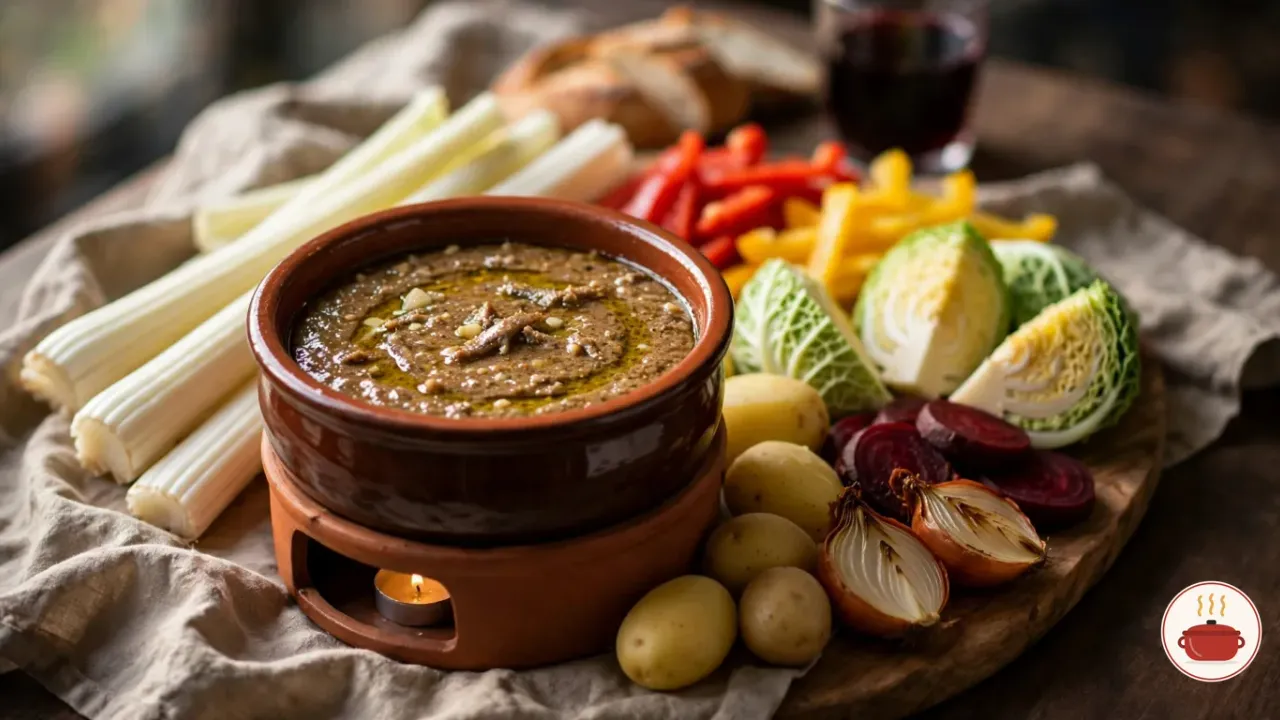
- • Serve it hot over a small flame, with cardoons, peppers, Jerusalem artichokes, potatoes, beets and roast onions
- • Leftovers are garlic in oil: refrigerate them within 2 hours and use them within 4 days, or freeze them
Ingredients
6 servingsInstructions
Bagna cauda is the warm dip of Piedmont, in northern Italy: garlic and salted anchovies melted slowly in olive oil, kept hot at the table for dipping cardoons, peppers and other autumn vegetables. This recipe serves 6 as a meal. The sauce takes about 45 minutes, the whole spread about 1¾ hours, and it is gluten-free.
What bagna cauda is
In Piedmontese, bagna means a sauce or dip, and càuda means hot. Lidia Bastianich puts it simply on Lidia’s Italy: “The name means ‘warm bath’ and that’s what it is.” You will also see it spelled bagna càuda and bagna caoda.
It is eaten together, from one pot. It simmers in an earthenware dish in the middle of the table, and everyone dips pieces of vegetable into it, the Slow Food Foundation explains. Many restaurants serve it as a small starter. That is not the true bagna cauda, says Carlo Petrini, the founder of Slow Food. For him it is a lavish meal, eaten slowly, he writes on the Bagna Cauda Day site.
A sea dish from a land without a sea
Piedmont produces neither of the dish’s main ingredients, anchovies and olive oil, Petrini points out. The dish exists because the Piedmontese traded with their neighbors in Liguria, on the coast.
Anchovies came inland over the old salt roads. For generations, sellers from the Maira valley, near Cuneo, went from farm to farm with barrels of salted anchovies. The Asti organizers of Bagna Cauda Day tell their story. A small museum in Celle di Macra, listed by Italy’s Ministry of Culture, keeps their tools and stories.
There is a story about how it began. In the early 1300s, the valley’s men traded salt free of duty, then had to pay it again. To hide the salt, they laid salted fish over the top of each barrel, Roberta Allasia of the valley’s eco-museum told Montagna.tv. It is a good tale, but treat it as a legend, as several Italian writers do.
The recipe signed before a notary
Nobody knows how old the dish is. Its first fixed text is recent. On 7 February 2005, the Asti branch of the Accademia Italiana della Cucina registered a bagna cauda recipe before a notary in Costigliole d’Asti. It chose the version it judged most reliable to hand down, the Bagna Cauda Day site reports.
For 12 people it asks for 12 heads of garlic and 6 wine glasses of olive oil. It adds a little walnut oil if possible, and 600 g of red Spanish salted anchovies. That is a head of garlic each. The Accademia itself now adds that in practice, cooks use 2 or 3 cloves a person.
Three bagne caude, by the garlic
At Bagna Cauda Day, each venue labels its pot. The traditional one is “Come Dio comanda”, as God commands. The “Eretica”, or heretic, has softened garlic, and the “Atea”, the atheist, has none, the festival’s venue page explains.
Some cooks add milk or cream. In December 2025, Piedmont made the creamy Bagna Caoda di Faule an official traditional food product, QdS reported.
Why bagna cauda is worth making this autumn
Bagna cauda belongs to November, after the grape harvest. The festival in its name, Bagna Cauda Day, returns for its 14th year on 20 to 22 and 27 to 29 November 2026, says its official site. Its organizers, the Associazione Astigiani, count 160 venues in Piedmont and abroad in 2025. Each serves its bagna cauda at the same price, €30 a head, with wine at €15 a bottle, the organizers’ August letter confirms. This year’s venue list is due at the end of October.
The festival travels. In 2025, its pots were lit in New York, in Raleigh, North Carolina, in Shanghai and Wuhan, and in Fukuoka, Japan. In Argentina, where many Piedmontese settled, the 36th bagna cauda festival in Humberto Primo sold all 930 seats in July 2026, El Litoral reported.
Anchovies are back
Datassential’s 2027 trends report, released on 7 October 2026, lists anchovy among five old favorites “making a comeback”. These foods “have been around forever”, said Jaclyn Marks, its trendologist, in the press release. Now restaurants are using them “in next-level applications and as flavors”.
The vegetables are in season too. Piedmont’s prized hunchback cardoon, from Nizza Monferrato, is harvested from early October to February, says Slow Food.
Italian cooking on UNESCO’s list
In December 2025, UNESCO added Italian cooking to its list of the world’s intangible cultural heritage. It calls Italian cooking “a communal activity” built on “shared moments around the table”. Few dishes fit that better, though the listing names no single dish. Nor is it the first cuisine listed: the French gastronomic meal came first, in 2010, AP noted.
We found no 2026 menu, sales or search figure for bagna cauda itself. The venue count is the festival’s own.
What you need for bagna cauda
We compared 28 published recipes, 18 of them by Italian cooks or institutions. This recipe sits close to the Italian ones.
Salted anchovies
All the Italian reference recipes use anchovies preserved in salt. The festival asks for “rosse di Spagna”, red Spanish anchovies cured for at least a year, and says to avoid ready fillets in jars. Most English-language recipes use fillets in oil, which work too.
To clean salted anchovies, soak them in cold water for 10 minutes, then rub off the salt under the tap. Open each fish with your thumb, separate the two fillets and lift out the bone, as the Spanish anchovy maker Ortiz advises on Brindisa. Don’t soak them much longer, or they turn mushy.
“Del Cantábrico” on a Spanish label is not a protected origin, the Spanish consumer group OCU points out. White, vinegar-cured anchovies, sold as boquerones, are a different thing and won’t work here.
Garlic
Garlic splits the cooks into two camps. Several Italian recipes use about a head per person, as the 2005 recipe does. Seven others, Italian and English, use only 2 to 6 cloves per 3½ oz (100 g) of anchovies. The median is 15 cloves. “The ‘purists’ insist on one head per person, but 4/5 cloves can be enough,” says Turismo Torino.
This recipe uses 2 heads for 6 people, about 4 cloves each. Use fresh, firm garlic, and pull out any green shoot, as 9 of the recipes advise.
Olive oil, butter and milk
The median is about 2 parts olive oil to 1 part anchovy by weight. The festival prefers a Ligurian oil, and new-season oil if you can get it. Choose a mild, buttery extra-virgin oil, not a peppery one.
Butter appears in 18 of the 28 recipes, but in different amounts. The Italian ones use little, a median of about 1 oz (33 g) per 3½ oz (100 g) of anchovies. The 2005 recipe adds just a knob at the end. The English ones use about five times as much.
Seven recipes soak or simmer the garlic in milk first, to soften its bite. Purists hate this, the Italian magazine Linkiesta notes. “The original recipe of the bagna cauda does not cook the garlic in milk,” admits Piedmont’s tourism site, Piemonte Italia. It offers milk anyway, for anyone not used to strong flavors.
The vegetables
Peppers appear in 20 recipes, cardoons in 15 and potatoes in 13. The Italian lists add Jerusalem artichokes, cabbage hearts, roast onions and beets, both raw and cooked. In the Langhe, the classic Alba cookbook Nonna Genia allows nothing else. “Cardoons and sweet peppers and nothing else,” says its recipe, reprinted on Langhe.net.
Only the hunchback cardoon of Nizza Monferrato is tender enough to eat raw, Slow Food says. Others are bitter, so blanch them for 15 to 20 minutes, as Food & Style advises. Keep cut cardoons and Jerusalem artichokes in lemon water so they stay pale, Bastianich adds.
How to make bagna cauda without frying it
The method is simple, but it needs patience.
Low heat, for a long time
Twelve recipes warn that the sauce must never fry. The 2005 recipe starts the garlic over the lowest heat, taking care that it does not color. It then cooks it with the anchovies for half an hour. The festival agrees: keep it hot, but it must not fry or smoke.
The Italian recipes cook the sauce for a median of 40 minutes, against 15 minutes for the English ones. A heat diffuser helps, as Il Cucchiaio d’Argento advises. The New York chef Stefano Secchi cooks his over simmering water for 75 to 85 minutes, in a recipe for Bon Appétit. He wants “only a few bubbles” breaking.
Let it separate
An oil-based bagna cauda won’t stay smooth. It “will separate and settle rather than form a cohesive emulsion, so use your best olive oil,” Secchi says. Bastianich whisks it briefly just before serving.
At the table
In Piedmont, each guest often gets a fojòt, a small terracotta pot warmed by a tea light. One big pot over a burner is closer to the old shared dish, Linkiesta notes. A fondue pot works well at home.
The festival’s own etiquette asks you not to dip a vegetable you have bitten. It also warns beginners that burns are very common. At the end, crack an egg into the last of the sauce and scramble it, as the 2005 recipe says is the tradition. Cook it until firm, as the FDA advises for scrambled eggs.
Drink a red wine from Piedmont. Barbera is the wine of choice for this dish, says Linkiesta.
Serving and storing bagna cauda
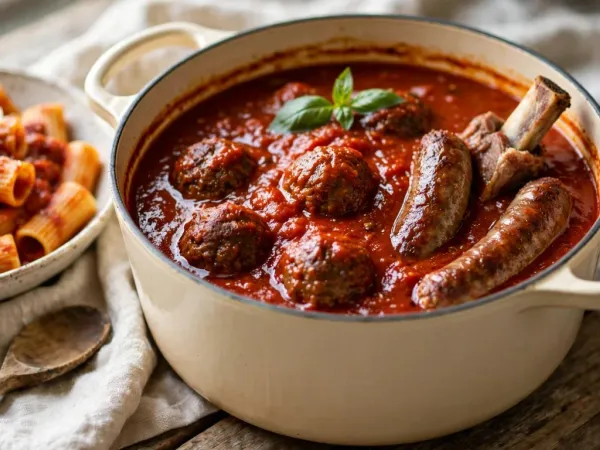
Bagna cauda is a meal in itself, with bread for the end. For another slow Italian pot on a cold Sunday, make Sunday gravy. For a lighter dip, try the Greek spicy feta dip tirokafteri, or Filipino kinilaw, another starter built on fish.
The flame
Set the burner on a stable, heat-proof surface. Keep a candle at least 1 foot (30 cm) from anything that can burn, and blow it out before you leave the room, advises the NFPA. Never refuel a burner that is lit or still hot. Fuel can catch fire and spray out, Health Canada warned in a fondue fuel recall.
Leftovers are garlic in oil
Garlic stored in oil can grow the bacteria that cause botulism. Refrigerate homemade garlic oils and “throw the oils away after 4 days”, says the CDC. Store it at 40°F (4°C) or below for no more than 4 days, or freeze it for longer, the National Center for Home Food Preservation advises. Cooking the garlic first does not change that rule, notes UGA Extension.
So never keep leftover bagna cauda at room temperature. Refrigerate it within 2 hours of the meal, the USDA’s limit for perishable food. Some Italian cooks keep it for 5 days, but we’d stick to 4. Reheat it gently until steaming, and whisk it.
Anchovies and histamine
Badly stored anchovies can build up histamine and cause scombrotoxin poisoning. “Cooking, canning, and freezing do not reduce the toxic effects,” warns the FDA’s Bad Bug Book. Buy them from a busy shop, keep an opened tin cold and covered, and throw away any that smell off.
Calories, salt and allergens
One serving, a sixth of the sauce with its vegetables, has about 870 calories and 70 g of fat. Most of that is olive oil, and much of it often stays in the pot. It also has about 1,400 mg of sodium before you rinse the anchovies, most of the 2,300 mg daily limit the FDA uses. We estimated these from USDA values for salted anchovies.
Bagna cauda contains fish. It contains milk if you add butter or milk, and egg if you finish with eggs. Walnut oil adds a tree nut, and in the UK and EU, celery as a dipper is a declared allergen too. All are on the FDA’s list of major allergens, except celery.
Fixes for bagna cauda that fries, splits or is too salty
- It fries or smokes: the heat is too high. Take it off the heat for a minute, then use a heat diffuser, or cook it over simmering water.
- It is too salty: next time, soak the anchovies a little longer and rinse them well. Add no salt.
- The garlic is too strong: pull out the green shoots, simmer the garlic in milk first, or use less, the “Eretica” way.
- It separates: that is normal. Whisk it just before serving.
- The anchovies won’t melt: keep mashing them with the spoon over low heat. Chopping them first helps.
- It set in the fridge: olive oil thickens when cold. Warm it gently until steaming.
Substitutes for missing ingredients
- Salt-packed anchovies: four 2-oz (56 g) tins of fillets in olive oil, drained.
- Cardoons: celery hearts, Belgian endive or cooked artichoke hearts. The cook Hank Shaw describes cardoon’s taste as “an odd combination of artichoke hearts, celery and bitter endive” on Hunter Angler Gardener Cook.
- Jerusalem artichokes: raw turnip or radishes.
- A fojòt: a fondue pot, or a small enameled pot over a tea-light warmer.
- Barbera: another dry Piedmont red, such as Dolcetto.
- Walnut oil: leave it out.
Frequently asked questions
What does bagna cauda mean?
Hot dip, or warm bath. In Piedmontese, bagna means a sauce or dip and càuda means hot.
Is bagna cauda a starter or a main course?
Both. Many restaurants serve a small one as a starter. In Piedmont, the full spread of vegetables, bread and a final egg makes a whole meal.
Do I have to use salted anchovies?
No, but Italian cooks prefer them. Fillets in olive oil work well; just drain them.
Can I make bagna cauda without garlic?
Yes. Bagna Cauda Day calls the garlic-free version “Atea”. It is milder, but still an anchovy dip.
Why do some recipes cook the garlic in milk?
To soften its bite. Seven of the 28 recipes we compared soak or simmer it in milk. Purists don’t.
How long does leftover bagna cauda keep?
Up to 4 days in the fridge, because it is garlic in oil. Freeze it to keep it longer.
What wine goes with bagna cauda?
A red from Piedmont. Barbera is the classic choice.
What vegetables go with bagna cauda?
Cardoons and peppers above all, raw and roasted. Add Jerusalem artichokes, cabbage, potatoes, beets and roast onions.