The Sunday Potthesundaypot.com/recipes/lamb-kleftiko/
Lamb Kleftiko: Greek Slow-Roasted Lamb with Lemon Potatoes
By The Sunday Pot Kitchen Updated
- • Six servings take 4 lb (1.8 kg) of bone-in lamb shoulder, 3 lb (1.4 kg) of potatoes, 1 lemon and 10 garlic cloves
- • Season the lamb at least 1 hour ahead, or overnight, in the fridge
- • Seal it in parchment, then foil, and bake it at 325°F (160°C) for 4 hours without opening it
- • Keep the parchment between the lemony lamb and the foil
- • Brown it uncovered at 425°F (220°C) for 20 to 30 minutes
- • Chill leftovers within 2 hours and eat them within 3 to 4 days
Ingredients
6 servingsInstructions
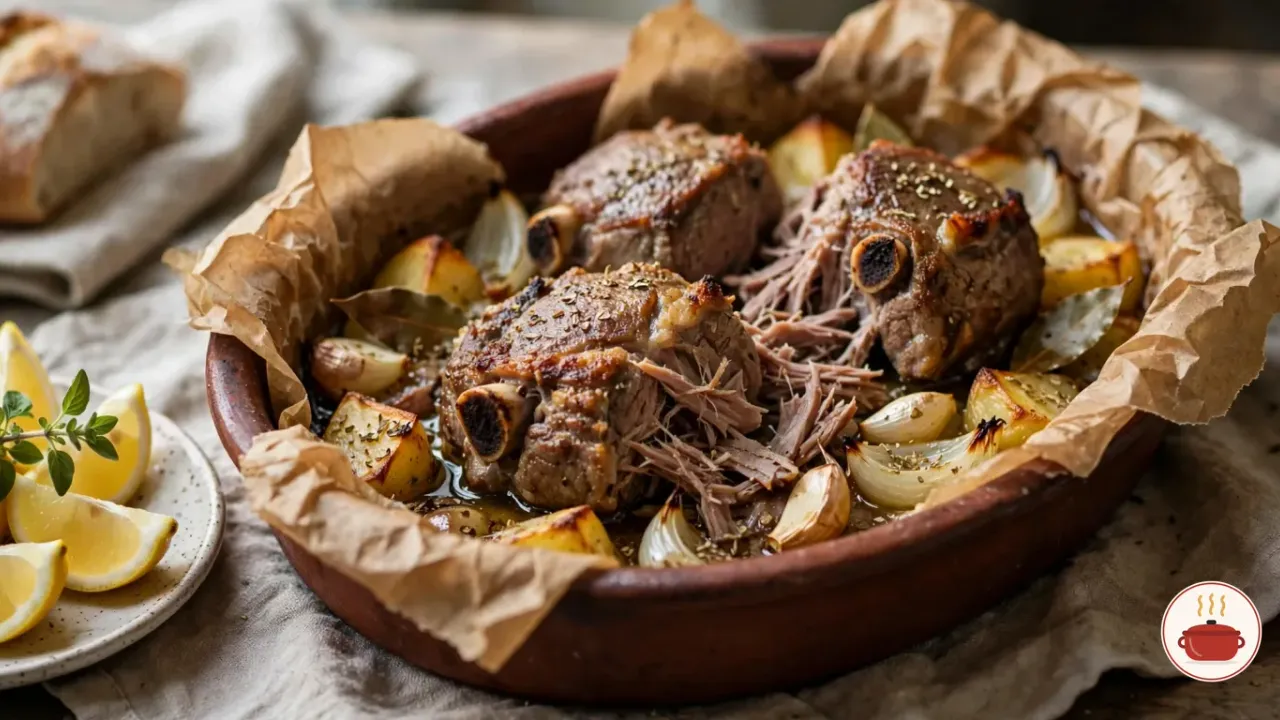
Lamb kleftiko is the slow-roasted lamb of Greece and Cyprus: a shoulder rubbed with lemon, garlic and oregano, sealed over potatoes and baked for 4 hours until it falls from the bone. This version serves 6, takes one roasting pan and needs no attention while it cooks.
What lamb kleftiko is
Kleftiko is lamb, or goat, cooked slowly in a sealed pot or parcel, in its own juices. In Cyprus it is often called ofto kleftiko. Ofto comes from an old Greek word for baked, and kleftiko means stolen, explains the Cypriot cookbook author Ivy Liacopoulou on Kopiaste.
A dish named for thieves
The story usually told goes back to the klephts, bands of Greek fighters who hid in the mountains at the time of the Greek revolution. They stole a lamb or a goat from a hillside flock. Then they cooked it for hours in a pit of hot stones and embers, sealed with soil, so no steam gave them away. Liacopoulou tells it this way.
The Cyprus tourism board’s guide, Flavours of Cyprus, calls it a tradition: bandits cooking stolen meat in sealed underground ovens. Cyprus’s own heritage record gives a plainer origin. The name came from livestock theft, an old custom among Cypriot shepherds, says the Cyprus National Commission for UNESCO. Nobody can prove either story.
Cyprus: a summer dish from the wood oven
Cyprus added traditional ofto kleftiko to its national inventory of intangible heritage in 2019. The record describes meat cooked in outdoor wood-fired ovens, in clay pots or metal trays, for family gatherings. For the last 100 years it has also been the main dish at wedding feasts.
In Cyprus, kleftiko is a summer dish. Its specialist tavernas open after Easter and close in early November, Theo Panayides writes in the Cyprus Mail. The meat cooks for about 7 hours, cut into portions, in an oven fired with olive or lemon wood. Purists add little: some bay leaves at one Nicosia taverna, just meat and salt at another. “In Greece they add vegetables, sometimes even feta cheese – but that’s not kleftiko,” he writes.
Greece: a parcel with potatoes
In Greek homes, kleftiko is usually a parchment parcel with potatoes, and sometimes peppers, tomatoes and cheese. Eli K. Giannopoulos of My Greek Dish strongly recommends cooking the potatoes in the same parcel, to soak up the lamb’s juices.
Diane Kochilas bakes a version from Epirus, in northwest Greece, in a clay dish sealed with a rope of dough. You crack it open before serving, she writes on her site. Liacopoulou’s mother sealed her terracotta pot with a paste of flour and water. Liacopoulou calls kleftiko a lovely Sunday dish, since it cooks without you.
Why cinnamon and bay
In the village of Fyti, in western Cyprus, one family seasons goat with salt, cinnamon, dried oregano and fresh bay leaves. It cooks for about 6 hours in their wood-fired clay oven, National Geographic reported. A pinch of cinnamon is optional in this recipe.
Why lamb kleftiko is on London menus in 2026
London has fallen for Greek food. In 2026 alone, the city saw half a dozen high-profile Greek openings, The Nudge counted in July. In March, Harden’s reported three smart new tavernas: Maza in Mayfair, Jul’s in St James’s and Taverna Ermou in Marylebone.
Kleftiko came with them. Zylia, a Greek-Cypriot taverna in Covent Garden, opened in late spring 2026 with lamb kleftiko on its menu. Restaurant Online described it as slow-roasted lamb with wine, garlic and bay. Its co-founder, Nick Molyviatis, calls kleftiko Cyprus’s national dish. “We couldn’t find a hole in Covent Garden, so we do it in a combi oven,” he told Restaurant Online in July.
Delivery tells the same story. Uber Eats’ own order data showed demand for Greek food in the UK grew 26% last year, the company said in March 2026. In the US, the Greek chain Nick the Greek passed 100 restaurants in the first half of 2026. It reported same-store sales up 18.2%, in a release covered by QSR Magazine.
We found no sales or search figure for kleftiko itself. October has its own pull. In Cyprus, the kleftiko season is ending, after the Meneou Kleftiko Festival on 4 September. Elsewhere, oven season is starting.
What lamb costs in 2026
Lamb is dear this year, almost everywhere. In Australia, several lamb price indicators hit records in winter 2026. The trade lamb indicator reached 1,244 Australian cents a kilo, carcase weight, in the week to 12 July, Meat & Livestock Australia reported. Prices have eased since.
In Britain, the AHDB’s deadweight lamb price reached 944p a kilo in the week to 23 May, 31.8% above 2025, Farmers Guardian reported. In the US, live slaughter lambs averaged $262.40 per hundredweight in April 2026, 53% more than a year earlier. Michigan State University Extension’s analysis was reprinted by Farms.com.
In Cyprus, foot-and-mouth disease cut supply before Easter. Lamb sold for €13.25 to €15.75 a kilo, against €10.50 to €13.65 the Easter before, Politis reported.
What you need for lamb kleftiko
Lamb shoulder, on the bone
Recipes split between leg and shoulder. Shoulder is the best cut, according to the Australian grocer Hill Street Grocer: it is fattier, and it benefits from slow cooking. Use lamb on the bone, in large pieces, for the moistest result, advises the Australian chef Fast Ed. Ask the butcher to cut a 4 lb (1.8 kg) shoulder into 3 or 4 pieces.
Greek oregano
Greek oregano, or rigani, is far stronger than common oregano. Grown side by side in a 2020 study, Greek oregano held 2.75 to 3.36 g of essential oil per 100 g of dried herb. Common oregano held 0.27 to 0.49 g, the researchers reported in Foods. If you only have common oregano, use a little more.
Lemon, garlic and bay
The juice of 1 lemon goes on the lamb, and a second lemon goes to the table in wedges. Peel 10 garlic cloves and leave them whole: they turn soft and sweet in the juices. Bay leaves add the scent of the Cypriot wood oven.
Waxy potatoes
Use waxy or all-purpose potatoes, such as Yukon Gold, in 2-inch (5 cm) chunks. They hold their shape through 4 hours of steam, and soak up the juices.
Parchment, foil and a deep pan
Keep parchment between the food and the foil. Germany’s food safety agency, the BfR, advises against wrapping acidic or salty food in aluminum foil. It names marinated meat and lemon slices, and says a sheet of baking paper in between greatly lowers the aluminum that reaches the food.
A Dutch oven with a tight lid works too. Rick Stein suggests a lidded enameled cast-iron pot in his kleftiko recipe on The Happy Foodie.
Cheese, if you like
Mainland parcels often hold kefalotyri, a salty sheep’s or goat’s milk cheese. Pecorino Romano and Parmesan make good substitutes, notes America’s Test Kitchen. This recipe keeps the cheese out of the oven, and crumbles feta on top at the table. Cypriot purists skip it.
How to make lamb kleftiko tender
We compared 12 recipes, from Akis Petretzikis and Diane Kochilas to Rick Stein and Cypriot home cooks. All of them seal the lamb, and most cook it for 3 to 5 hours.
Low, slow and sealed
Most recipes bake kleftiko at 300 to 350°F (150 to 180°C). Kochilas goes as low as 275°F (135°C) for 3½ to 4 hours. Stein bakes a leg at 375°F (190°C) for about 2½ hours.
This recipe bakes a shoulder at 325°F (160°C) for 4 hours. That is the time the chef Theo Michaels gives lamb shoulder, in a recipe from his Cypriot cookbook shared by Divertimenti. Do not open the parcel early: the steam does the work.
To marinate or not
Many Greek recipes marinate the lamb overnight. Cypriots don’t really use marinades, Molyviatis says: their meat gets salt and very little else. Liacopoulou marinates hers sometimes, though she notes it is not the traditional way.
This recipe seasons the lamb at least 1 hour ahead. Do it in the fridge: the USDA says to marinate lamb roasts there, for up to 5 days.
Brown it at the end
Half the recipes open the parcel for the last 5 to 30 minutes, at about 400 to 450°F (200 to 230°C). That browns the lamb and the top potatoes. Untie the parcel away from your face, as the steam is scalding.
Skim the juices
Shoulder is fatty, and its fat melts into the pan. Tilt the pan and spoon the clear fat off the top before serving. The lemony juices underneath are the sauce.
Variations: leg, goat, clay pot and more
Leg of lamb
Use a 4 lb (1.8 kg) bone-in leg, cut into large pieces. Leg is leaner, so check it after 3 hours. A bone-in leg takes longer than a boneless one, notes Suzy Karadsheh of The Mediterranean Dish.
Goat
Cypriot cooks often use goat. Michaels cooks a kid goat shoulder for 3 hours at the same temperature.
The Cypriot purist’s way
Season the lamb with salt, pepper and bay leaves only, and skip the lemon and garlic. Bake it over the potatoes in a covered clay pot.
The mainland parcel
Add 2 green bell peppers, 2 tomatoes in wedges and 4 oz (115 g) of kefalotyri or pecorino in cubes. Giannopoulos puts 200 g of kefalotyri in his parcels.
Clay pot with a dough seal
Mix 2 cups (250 g) of flour with about ¾ cup (180 ml) of water into a stiff dough. Roll it into a rope, press it around the rim of a lidded clay pot and set the lid on it. Crack it open before serving, as Kochilas does.
Serving and storing lamb kleftiko
Serve lamb kleftiko straight from the dish, with lemon wedges, a Greek salad and bread for the juices. In Cyprus, it comes with bulgur wheat on the side. For another slow Sunday braise, try Jamaican oxtail or a classic pot roast. To start, Paraguay’s vori vori feeds the same 6 people.
Leftovers
Follow the USDA’s advice on leftovers:
- Refrigerate leftovers within 2 hours, cut into smaller portions so they cool quickly.
- Eat them within 3 to 4 days, or freeze them for 3 to 4 months.
- Reheat them to 165°F (74°C).
Take the potatoes out of any foil before you chill them. The CDC lists potatoes baked in foil as a botulism risk, and says to refrigerate them with the foil loosened.
Is the lamb done?
Long before it is tender. The USDA’s safe minimum for lamb roasts is 145°F (63°C), then a rest of 3 minutes. After 4 hours, kleftiko is far beyond that. Never brown or part-cook lamb to finish it later, the USDA adds.
Calories and protein
One serving, a sixth of the dish without feta, has about 870 calories, 51 g of protein and 49 g of fat. It has about 53 g of carbohydrate, 5 g of fiber and 910 mg of sodium. These are estimates from USDA figures for braised lamb shoulder, before you skim the fat from the juices. Trim the fat cap, and the numbers drop.
Allergens
Without the feta, kleftiko holds none of the 9 major food allergens the FDA lists. Feta holds milk.
Fixes for tough, dry, greasy or pale kleftiko
- Still tough: it needs more time. Reseal it and bake it 30 to 60 minutes more.
- Dry: steam escaped. Seal the parchment and foil tighter, and add ¼ cup (60 ml) of water next time.
- Greasy: spoon off the fat, or chill the juices and lift it off.
- Pale: roast it uncovered 10 minutes more, at 425°F (220°C).
- Potatoes broke up: cut them bigger, and use a waxy kind.
- Too salty: go easy on salt when you serve it with feta.
Substitutes for missing ingredients
- Lamb shoulder: bone-in leg of lamb, or goat shoulder.
- Greek oregano: common dried oregano, a little more of it.
- White wine: water or chicken stock.
- Kefalotyri: Pecorino Romano or Parmesan.
- Parchment and foil: a Dutch oven with a tight lid, or a clay pot sealed with dough.
- Yukon Gold potatoes: any waxy potato.
Frequently asked questions
What does kleftiko mean?
Kleftiko means stolen in Greek. The usual story is that thieves cooked stolen lamb in sealed pits, so no smoke gave them away.
Is kleftiko Greek or Cypriot?
Both. Cyprus lists ofto kleftiko in its national heritage inventory, and Greeks make it at home in parcels with potatoes.
Which cut of lamb is best for kleftiko?
Bone-in shoulder, for its fat and its slow-cooked texture. Leg works too, and cooks a little faster.
How long does lamb kleftiko take?
About 4 hours sealed at 325°F (160°C), then 20 to 30 minutes uncovered at 425°F (220°C).
Do you have to marinate lamb kleftiko?
No. Season it at least 1 hour ahead in the fridge. Cypriot cooks often use only salt.
Can I use foil instead of parchment?
Use both: parchment against the lemony lamb, foil over the top. Germany’s BfR advises against acidic food touching aluminum foil.
Can I make lamb kleftiko ahead?
Yes. Cook it fully, chill it within 2 hours and reheat it to 165°F (74°C). Never part-cook it to finish later.
What do you serve with lamb kleftiko?
Lemon wedges, a Greek salad and bread. In Cyprus, bulgur wheat comes on the side.
Can I make kleftiko with goat?
Yes. Goat shoulder takes about 3 hours at 325°F (160°C).