The Sunday Potthesundaypot.com/recipes/molokhia/
Molokhia: Egyptian Green Soup with Garlic and Coriander
By The Sunday Pot Kitchen Updated
- • Use one 14-oz (400 g) pack of frozen minced molokhia to about 4 cups (1 liter) of hot chicken broth
- • Melt the leaves into the broth and keep the lid off
- • Never boil it hard, or the leaves separate from the broth and sink
- • Fry 6 garlic cloves golden in ghee, then add 1 tablespoon of ground coriander
- • Pour the hot tasha in just before serving, with rice and chicken on the side
Ingredients
4 servingsInstructions
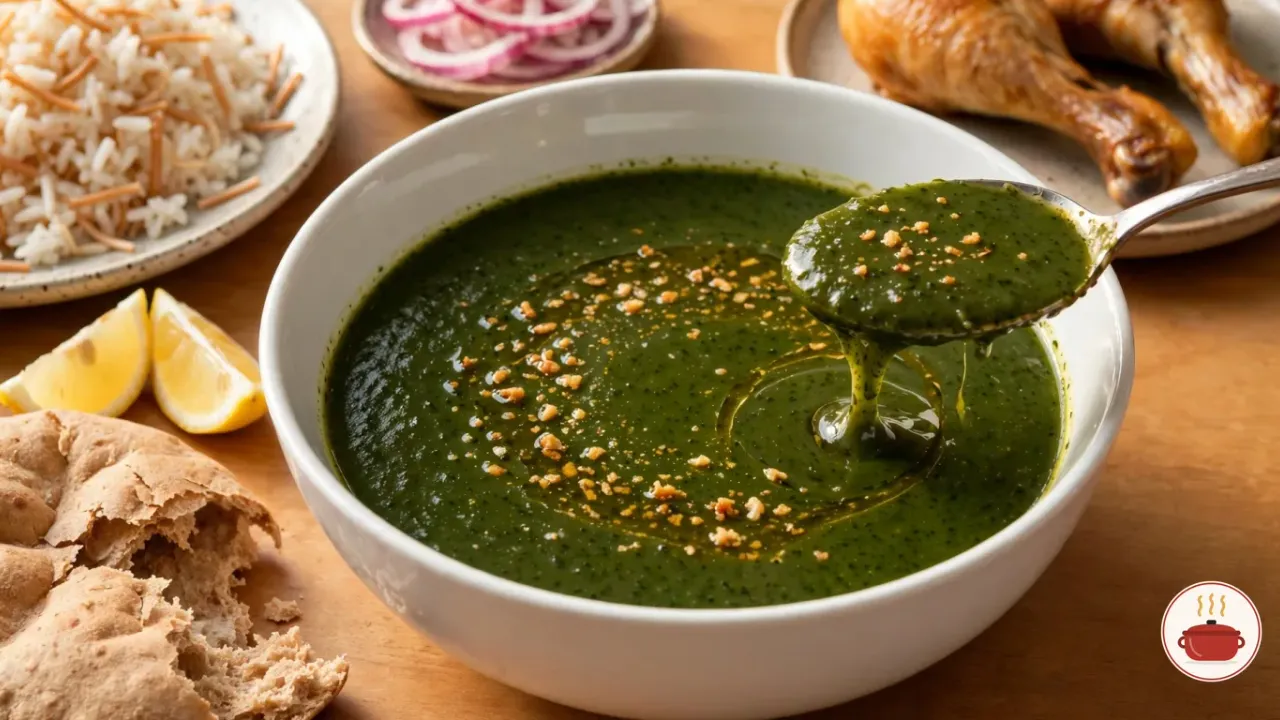
Molokhia is Egypt’s beloved green soup: jute mallow leaves, minced so fine they melt into hot chicken broth, then finished with garlic and coriander sizzled in ghee. It is silky, a little slippery and deeply garlicky. This version serves 4, with the chicken from the broth, in about 1½ hours. With ready broth and a frozen pack, the soup itself takes 20 minutes.
What molokhia is
The leaf
Molokhia is both a plant and a dish. The plant is jute mallow, Corchorus olitorius, a leafy green grown across Africa, the Middle East and Asia. Cooked, the leaves turn soft and slippery. “It looks like spinach because of its colour, but is nothing like it,” wrote the cookbook author Viviane Bowell. The Jewish Food Society shares her Cairo family recipe.
You will see many spellings: molokhia, mulukhiyah, molokheya, all from the Arabic ملوخية.
Egypt’s version
Egyptian cooks mince the leaves very finely, traditionally with a curved, two-handled blade called a makhrata. Lebanese and Syrian cooks leave the leaves whole, says the veteran Lebanese chef Emile Badour in Asharq Al-Awsat, in Arabic. In Tunisia, dried molokhia powder simmers for hours into a near-black stew.
The Egyptian result is a smooth, bright green soup that coats the spoon. One Egyptian diner told BBC Travel that good molokhia “clings to the rice” instead of running off the plate like water.
The gasp
The finishing touch is the tasha: garlic fried golden in ghee with ground coriander, poured into the pot at the last moment. It hits the soup with a loud hiss.
Traditionally, the cook lets out a gasp at the same moment, the shahqa. Sada El Balad, in Arabic, calls this “a traditional folk ritual” said to show the cook’s skill. Some say it keeps the flavour in. That part is folk belief.
Where molokhia comes from
Banned in 1004
The first sure record of molokhia is a ban. In 1004, the Fatimid caliph al-Hakim bi-Amr Allah outlawed it, along with several other foods. The historian Paul Walker worked from the 15th-century chronicler al-Maqrizi. He says the caliph banned it because it “was much loved by Mu’awiya”, the first Umayyad caliph and a foe of the Shi’a. Egyptian Streets quotes the passage. In 1009 and 1014, people were beaten and paraded for selling it.
“The food’s first verified mention is when it was outlawed,” the archaeobotanist Mennat-Allah El Dorry told SceneEats in July 2026. To her, the ban shows that by the 11th century, molokhia “was incredibly widespread and an important staple.”
A 14th-century cookbook
Kanz al-Fawa’id, a cookbook from 14th-century Egypt, has more than one molokhia recipe. In the Arabic edition we read, cooks mince the leaves and cook them in meat broth with garlic pounded with coriander. One version first turns the leaves in ghee. That is close to today’s pot. Nawal Nasrallah translated the book into English in 2017.
The royal story
Many people say the name comes from mulukiyya, “of kings”, and that a pharaoh or a sick ruler was cured by the soup. El Dorry finds “no evidence” for that, or for the idea that the pharaohs ate it. The word more likely comes from the Greek for mallow, malachai, used in Egypt from the first century AD. So enjoy the royal story as a legend. The same goes for the tale that al-Hakim banned the soup as an aphrodisiac.
Molokhia this autumn
A cookbook at the Grand Egyptian Museum
On September 25, 2026, Suzanne Zeidy and Rawah Badrawi launched Egypt: Recipes and Stories from an Ancient Land at the Grand Egyptian Museum, during the fourth Cairo Food Week. EnterpriseAM reported it three days later. Egyptians, the piece says, argue endlessly “about whether or not shrimp belongs in molokheya”. In the book’s own words, the tasha lands on the soup “with a loud whoosh”.
Cheap leaves after the summer crop
Fresh molokhia is a summer crop. In Fayoum it grows from May to August and is ready in under 60 days. By autumn, the price had fallen hard.
At Cairo’s Obour wholesale market, a kilo cost 18 to 22 Egyptian pounds on February 4, 2026, according to the market lists printed by the news site Banker. On October 9 it was 5 to 8 pounds. Two outlets disagreed for October 11, at 5 to 8 and 8 to 11 pounds. These are wholesale ranges collected by the press, not official statistics.
Frozen and dried season
Out of season, Egyptian cooks turn to frozen or dried leaves. The next big date is Ramadan, when molokhia is a staple of the evening meal. Egypt’s astronomy institute expects it to begin on Monday, February 8, 2027, El Watan reports.
What the numbers don’t say
The newest export figure we found is for 2025. Egypt shipped about 5,223 tonnes of molokhia from January to late November that year, most of it dried. Those are Ministry of Agriculture numbers, as reported by Youm7. Nobody has published a 2026 figure for the dish, or for how many bowls Egypt eats.
What 29 molokhia recipes agree on
We worked through 29 molokhia recipes. Sixteen come from Egyptian outlets, in Arabic: from Sada El Balad, El Watan, Youm7, Masrawy, Veto and Cookpad. Thirteen are in English, most by Egyptian or Arab authors, including Suzy Karadsheh of The Mediterranean Dish and Chez Nermine.
One frozen pack, about a liter of broth
Frozen minced leaves are the most common choice, in 15 recipes; 11 use fresh leaves and 5 dried. The standard frozen pack weighs 400 g. Chicken broth is the base in 24 of the 29.
The amounts settle near 500 g of leaves to just under a liter of broth. Several cooks say to keep extra hot broth on hand to adjust the thickness.
Garlic, coriander and ghee
Nearly every recipe finishes with a tasha. The median is 6 garlic cloves, 1 tablespoon of ground coriander and 2 tablespoons of fat. Ghee, samna or butter appear in 26 of the 29; only 3 use oil alone.
Eighteen add the whole tasha at the end. Five split the garlic, putting a little raw into the broth first.
Don’t boil it, don’t cover it
Of the 25 recipes that say how hot to cook it, 13 forbid a hard or long boil after the leaves go in. Boiling makes the soup “go grainy and lose its body”, Sada El Balad warns. The failure even has a name. “SAKTA (means failed): This happens when blended leaves separate from the broth,” writes Nermine Mansour of Chez Nermine.
Five recipes also say never to cover the pot. Suzy Karadsheh, who was born in Port Said, learned this from her mother: “make sure the soup never boils and is never covered.” She admits she isn’t sure why it works.
Small extras
Six recipes add a little tomato, and five a pinch of sugar. Only one puts baking soda in the pot. Rice comes with the soup in 21 of the 22 recipes that say how to serve it. Chicken is the usual meat, but Egyptians also cook it with rabbit, duck or, on the coast, shrimp.
Tips for green, silky molokhia
- Start with good broth. Home-made chicken broth is the base in most Egyptian recipes.
- Mince fresh leaves very finely. Dry them on a cloth first, as Egyptian cooks do.
- Keep the heat low. Once the leaves go in, a few small bubbles at the edge are enough.
- Leave the lid off. It is the rule in many Egyptian kitchens.
- Watch the garlic. Take it off the heat when it turns golden. Brown garlic turns bitter.
- Serve it straight away. Longer cooking dulls the green, so eat it as soon as the tasha goes in.
Serving molokhia
Ladle the soup into deep bowls. Set out a plate of rice, ideally Egyptian rice with toasted vermicelli, and the browned chicken. Spoon the molokhia over the rice, or scoop it up with torn aish baladi. A squeeze of lemon and a few slices of red onion in vinegar cut through the richness.
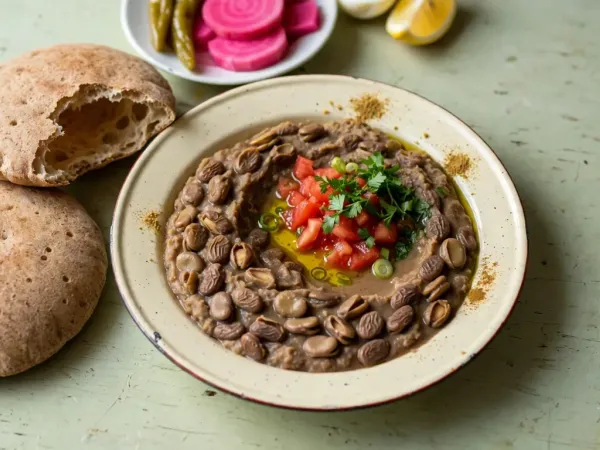
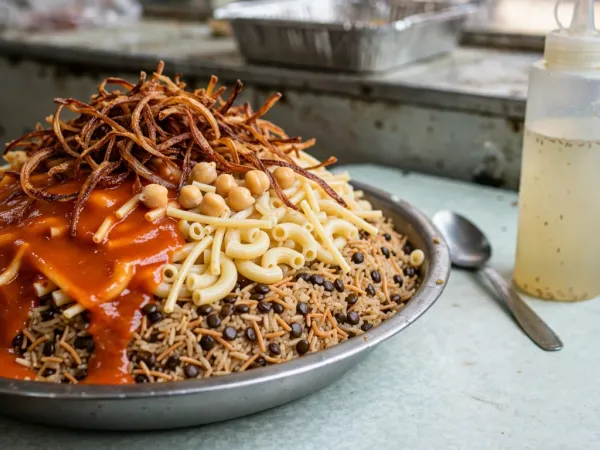
On the coast, in Alexandria, Port Said and Damietta, cooks make it with shrimp instead. In the countryside, rabbit is a favourite. For a fuller Egyptian table, add koshary one day and ful medames for breakfast the next.
Safety, storing and nutrition
Cooking the chicken
Simmer the chicken until it reaches 165°F (74°C), the USDA’s safe minimum for all poultry on its temperature chart. If you use rabbit, the USDA asks for at least 160°F (71°C).
Leaves, not seeds
Only the leaves are eaten. The seeds of jute mallow contain cardiac glycosides, compounds that act on the heart, as a 2022 review in Antioxidants notes. If you grow your own or buy whole stems, strip off the leaves and throw away the stems and any seed pods.
Frozen leaves
Frozen vegetables need cooking, and molokhia always is. Keep the pack frozen until you need it. Thaw it in the fridge rather than on the counter, or drop the block straight into hot broth.
Leftovers and rice
Cool leftovers fast in shallow containers. Britain’s Food Standards Agency says to chill them within an hour or two and eat them inside 48 hours.
Rice needs more care: cool it within an hour if you can, keep it no more than a day and reheat it only once. Reheat molokhia until it is steaming hot all the way through. It may thin a little or separate, which is why Egyptian cooks prefer to make it fresh.
Allergens
Ghee, samna and butter contain milk; use oil to avoid it. Many recipes use stock cubes, which can contain celery or wheat, so check the label. Shrimp versions add shellfish. The soup itself has no gluten, but vermicelli rice and bread do.
Nutrition
A bowl of molokhia with one chicken leg has roughly 560 calories, without rice or bread. That includes 51 g of protein, 31 g of fat, 18 g of carbohydrate and 3 g of fiber. The soup alone is about 200 calories. Our numbers draw on the USDA’s FoodData Central database for boiled jute leaves, home-made chicken stock, roast chicken and ghee. Cooked jute leaves are rich in calcium, with 211 mg per 100 g. Most of the 1,050 mg of sodium comes from the salt in the broth.
Fixes for separated, thin or bitter molokhia
- The leaves sank and the broth is clear on top: it boiled. Serve it anyway, and next time keep it at the faintest bubble.
- It is too thin: add more leaves if you have them, or use less broth next time. Don’t boil it down.
- It is too thick: stir in hot broth, a ladle at a time.
- It tastes bitter: the garlic browned. Make a fresh tasha and pour it in.
- The colour is dull: it cooked too long. Add the leaves later and serve sooner.
Substitutes for missing ingredients
- Frozen molokhia: 500 g fresh leaves, minced. Dried leaves work too, though cooks prefer fresh or frozen for this Egyptian version.
- Chicken broth: beef, lamb, duck or rabbit broth, all used in Egypt.
- Ghee or samna: butter, or olive oil for a dairy-free soup.
- Ground coriander: coriander seeds, toasted and crushed.
- Aish baladi: any warm whole-wheat flatbread.
Frequently asked questions
Is molokhia the same as spinach soup?
No. It looks green like spinach, but the leaves cook into a silky, slippery soup with a strong scent of garlic and coriander from the tasha.
Why is molokhia slimy?
The cooked leaves give the soup its body; no recipe we read adds a thickener. Egyptian cooks like it: Nermine Mansour describes a great bowl as “unapologetically slimy”.
Where can I buy molokhia?
Look for frozen minced molokhia in Middle Eastern, Arab and African grocery stores. Dried leaves are sold there too.
Can I make molokhia ahead?
Make the broth and brown the chicken ahead. Melt in the leaves and add the tasha just before you eat.
Is molokhia vegetarian?
Usually not: Egyptians cook it in meat or poultry broth. Two recipes in our set allow vegetable broth.
What do you eat with molokhia?
Rice, especially vermicelli rice, or bread, with chicken, rabbit or shrimp. Lemon and pickled onion are common extras.