The Sunday Potthesundaypot.com/recipes/bun-cha/
Bún Chả: Hanoi Grilled Pork with Noodles and Dipping Broth
By The Sunday Pot Kitchen Updated
- • Marinate pork belly slices and ground pork shoulder with fish sauce, caramel, shallot and pepper
- • Grill both over glowing coals, or in a grill pan or air fryer, until charred at the edges
- • Warm a broth of fish sauce, sugar, vinegar and water, about 1:1:1:5
- • Drop the hot pork into bowls of broth with pickled papaya and carrot
- • Serve with plain rice noodles and a big plate of herbs for dipping
Ingredients
6 servingsInstructions
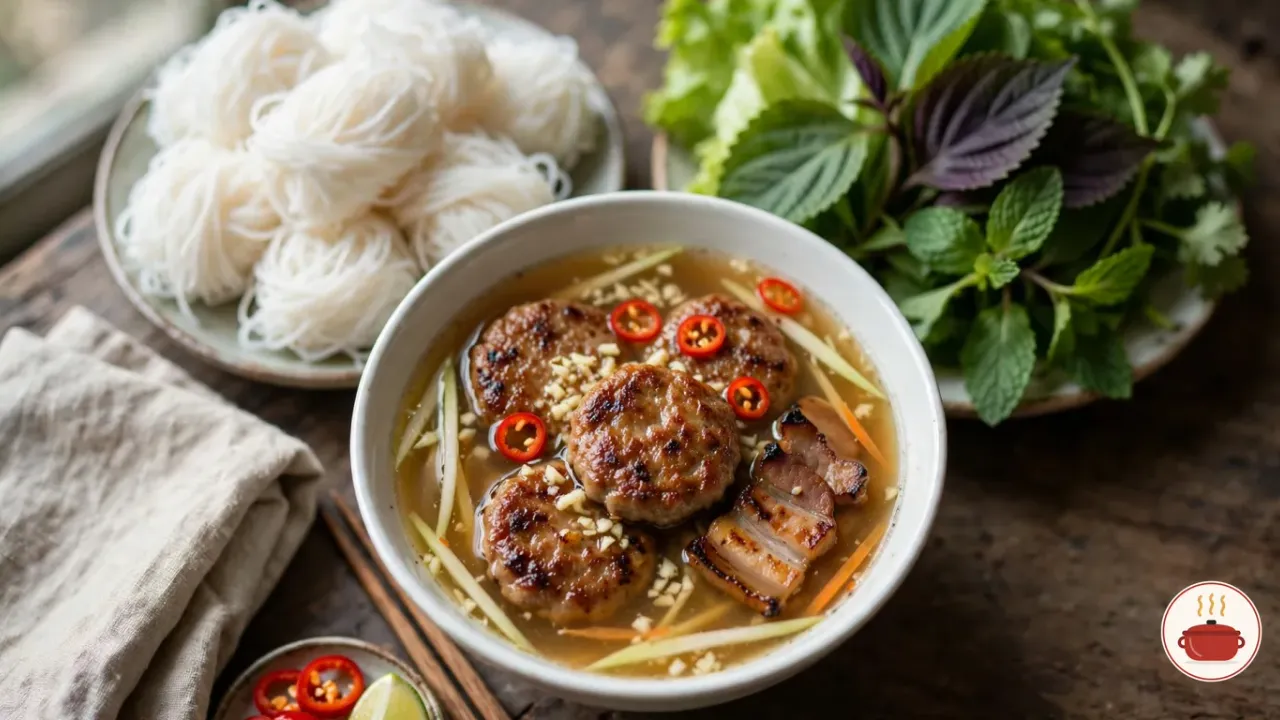
Bún chả is Hanoi’s grilled pork with rice noodles. Small pork patties and slices of pork belly are marinated in fish sauce, caramel and shallot, then grilled. They go straight into a bowl of warm, sweet-sour dipping broth. Plain noodles and fresh herbs come on the side. This recipe serves 6 in about 2 hours.
What bún chả is
Two kinds of pork
Bún are fine rice noodles. Chả here means grilled pork, and Hanoi uses two kinds. One is small patties of chopped or ground shoulder. The other is thin slices of pork belly. All 11 Vietnamese recipes we read grill both.
The writer Vũ Bằng, in his 1950s book of Hanoi food memories Miếng ngon Hà Nội, put it simply: there are two kinds of chả, minced and sliced (our translation). He liked to eat them together in one bowl.
Dip, don’t pour
The pork sits in a small bowl of broth with pickled green papaya and carrot. The noodles and herbs stay on their own plates. You pick up a few noodles and a leaf or two, dip them in the bowl and eat them with the pork. Bún chả is not a noodle salad, though some English recipes turn it into one.
Where bún chả comes from
A Hanoi street food in 1943
The earliest printed praise we could read is by the writer Thạch Lam. His book of Hanoi sketches, Hà Nội băm sáu phố phường, came out in 1943. He calls bún chả the most important and most typical noodle snack of the city (our translation). You can read the chapter on Vietnamese Wikisource.
He describes fat dripping onto hot coals “like a sigh”. The meat had to be pork belly, grilled in clamps of fresh bamboo. A few drops of lime in the sauce, he wrote, made it perfect. Then he asked who first thought of bún chả, and answered that the name of that talented person is lost. So any origin story you read is a guess.
One bite, a whole year
Vũ Bằng began his memories in Hanoi in 1952, and they came out in Saigon in 1960. One bite of good bún chả, he wrote, and you remember it for a year (our translation). He also noticed that home cooks burned the meat over coals that were too hot. Street sellers grilled on a small stove, often a tin biscuit box, fanning a little charcoal to an even glow.
A president’s lunch
On May 23, 2016, Barack Obama ate bún chả with the chef Anthony Bourdain at Bún Chả Hương Liên in Hanoi. The next day, in a speech in Hanoi, he told the audience, “I tried some Bún Chả.” The line is in the White House transcript.
The shop marked ten years in April 2026 with a feature in Thanh Niên. It still sells an “Obama combo” of bún chả, a seafood spring roll and a beer, for about 130,000 đồng.
Why bún chả is worth making now
Hanoi puts it on show
From November 27 to 29, 2026, the Vietnam Exhibition Center in Hanoi hosts an international food festival, Hanoi Firebeat. Organizers announced it on November 6, Giáo dục Việt Nam reported. Its “Hanoi Heritage” zone honors the city through bún chả, grilled fish (chả cá), phở and rice rolls. Visitors can watch artisans grill the pork (our translation).
Five stalls in the MICHELIN Guide
The 2026 MICHELIN Guide for Vietnam, released in June, gives three bún chả shops a Bib Gourmand. They are Tuyết Bún Chả 34, Bún Chả Chan and Bun Cha Ta. At Tuyết, the guide notes, the pork is “chargrilled to order”, says its MICHELIN page. Bún Chả Đắc Kim and Hương Liên are listed too. Đắc Kim has been in the Old Quarter since 1966.
In May 2026, the ratings site TasteAtlas put bún chả fourth in its list of Asia’s best pork dishes, with 4.3 stars. Tuổi Trẻ reported the ranking, which comes from reader votes.
Pork prices in Vietnam
Vietnamese pork got 2.33% cheaper between September and October 2026. Domestic supply rose and cheap imported pork added competition, said Vietnam’s statistics office in its October 28 report. As of October 26, live pigs fetched 47,000 to 53,000 đồng a kilo. Those prices are for Vietnam, not for your butcher.
No one has put a 2026 number on bún chả itself. Its news this autumn is a festival, a guidebook and a famous lunch, not a sales figure.
What 28 bún chả recipes agree on
For this recipe we read 28 versions. Eleven are Vietnamese, from VnExpress, VietNamNet, Báo Văn hóa, Afamily and other outlets. Seventeen more are English-language recipes, from Luke Nguyen, Adam Liaw and Jerry Mai on SBS, RecipeTin Eats, Vicky Pham, Gourmet Traveller and more.
A short marinade
Fish sauce is in 27 of the 28 marinades, shallot in 22 and black pepper in 21. A VnExpress recipe insists that the old seasoning was only fish sauce, sugar, pepper, scallion and shallot. Garlic, lemongrass and oyster sauce, it says, belong to newer versions that look like Saigon’s grilled pork noodles (our translation).
Nine of the 11 Vietnamese recipes make the patties from shoulder. Several want plenty of fat. Gourmet Traveller’s recipe says to “go for pork with 30 per cent fat”.
Caramel for color
Eight of the 11 Vietnamese recipes add nước màu, a dark caramel sauce, to the marinade. Only 3 of the 17 English ones do. It gives the pork its deep amber color. If you can’t find it, use a little more sugar; the pork will be paler.
A thin, warm broth
The broth is fish sauce, sugar, an acid and water. Across all the recipes, the middle values come to about 1 part fish sauce, 1 sugar, just under 1 acid and 3 water. VnExpress uses 1:1:1:5, which we follow here, and warms it in winter. Garlic and chile go in at the table in 27 of 28 recipes.
Carrot is in 24 pickles. Green papaya is in 15, and kohlrabi stands in for it in 7.
Vinegar or lime
Vinegar is the acid in 19 recipes, and lime or lemon in 17. VnExpress argues for vinegar, with lime only at the table. Thạch Lam, back in 1943, liked a few drops of lime. Vũ Bằng praised a sauce with well-judged vinegar. Use whichever you like.
Grilling without charcoal
Fifteen recipes name charcoal. Indoor methods are common too: 10 recipes use a pan or grill pan, 6 an air fryer and 5 the oven. The air-fryer and oven versions are nearly all Vietnamese. A Hanoi cook in Giáo dục & Thời đại runs the air fryer at 180°C for 10 minutes, then 200°C to finish.
Tips for smoky, juicy bún chả
- Use fatty pork. Lean patties turn dry.
- Slice the belly thin, ⅛ to ¼ inch (3 to 5 mm), as most recipes do.
- Grill over embers, not flames. Fat dripping onto charcoal flares up, and the flames “make the meat black and bitter tasting”, warns Jerry Mai on SBS.
- Keep the broth thin. It is a dipping broth, not a sauce.
- Put the pork in the broth while it is hot, straight off the grill.
- Be generous with herbs. Vũ Bằng’s sellers laid them on the same banana-leaf tray as the noodles.
Serving bún chả
Set each place with a bowl of broth and pork, and put the noodles, herbs, garlic and chiles in the middle. Fried spring rolls often come on the side. Iced tea or a cold beer suits it.
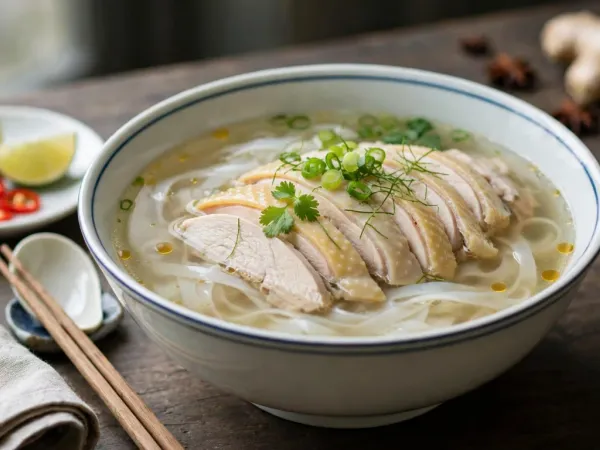
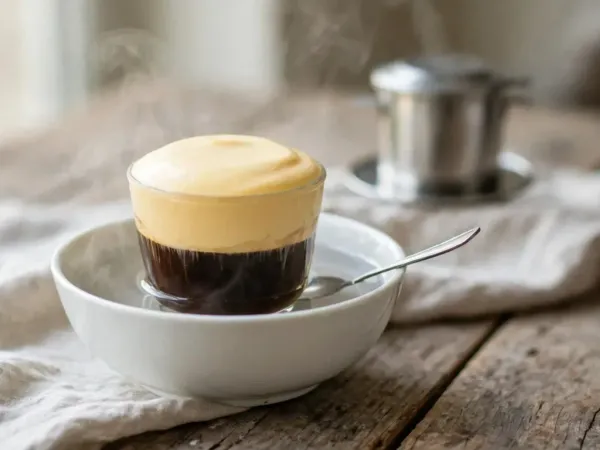
For another Hanoi classic, make chicken phở gà. Finish with a cup of Vietnamese egg coffee, the sweet whipped-egg coffee from the same city.
Safety, leftovers and nutrition
Cook the patties through
Ground pork has to hit 160°F (71°C) in the middle, says the USDA’s table of safe minimum temperatures. Whole cuts such as the belly need 145°F (63°C), then three minutes of resting, and thin slices get there fast. Check the thickest patty with a thermometer.
Charcoal and char
Grill with charcoal outdoors only. “Never burn charcoal indoors,” the CDC warns, because it gives off carbon monoxide. High-heat grilling also forms chemicals called HCAs and PAHs, and cutting off charred parts reduces them, the National Cancer Institute says. Aim for browned edges, not black ones.
Raw herbs
The lettuce and herbs are eaten raw. Rinse them under running water, without soap, and dry them with a clean towel, as the FDA advises. Use a different board from the one you used for raw pork.
Allergens and salt
Fish sauce is made from fish, one of the nine major allergens on the FDA’s list. This recipe has no wheat, soy, nuts or dairy, but check the label of your caramel sauce. It is salty: one serving has about 1,620 mg of sodium if you drink half the broth.
Storing
Keep the pork, broth, pickles, noodles and herbs in separate containers in the fridge. Get them into the fridge within 2 hours; they last 3 to 4 days there. Warm the pork until steaming and warm the broth just before serving.
Nutrition
One serving has up to about 950 calories, with 27 g of protein, 62 g of fat and 69 g of carbohydrate. We calculated this from USDA nutrient values for uncooked belly, ground pork, cooked rice noodles, fish sauce and sugar. It counts all the fat in the raw belly. Some of it drips away on the grill, so the real figure is lower.
Fixes for dry, pale or burnt pork
- The patties are dry: the pork was too lean. Next time use shoulder with more fat.
- The pork is pale: add more caramel sauce, or grill it longer and hotter.
- The pork is burnt but raw inside: the heat was too high. Move it further from the coals.
- The broth is too salty: thin it with water and sweeten it slightly.
- The broth tastes flat: add a squeeze of lime or a little vinegar.
- The noodles stick together: rinse them in cold water and drain them well.
Substitutes for missing ingredients
- Green papaya: kohlrabi, as 5 of the 11 Vietnamese recipes allow.
- Caramel sauce: a little more sugar.
- Vietnamese herbs: more mint and cilantro.
- Pork belly: more ground pork, made into patties only.
- Charcoal grill: a grill pan or an air fryer.
Frequently asked questions
Is bún chả the same as bún thịt nướng?
No. In bún chả, the pork sits in a bowl of broth and the noodles stay on the side. Bún thịt nướng, the southern dish, puts everything in one bowl.
Is the broth served hot?
Warm. Many Hanoi cooks warm it, especially in winter. Some serve it at room temperature.
Where did Obama eat bún chả?
At Bún Chả Hương Liên, on Lê Văn Hưu Street in Hanoi, in May 2016.
Can I make bún chả without a grill?
Yes. Use a grill pan on high heat or an air fryer.
Can I marinate the pork ahead?
Yes. A night in the fridge is fine.
What herbs go with bún chả?
Lettuce, perilla, mint, Vietnamese balm and cilantro.