The Sunday Potthesundaypot.com/recipes/ful-medames/
Ful Medames: Egyptian Slow-Stewed Fava Beans for Breakfast
By The Sunday Pot Kitchen Updated
- • Soak small dried fava beans for 8 to 12 hours, then drain them
- • Cover with boiling water, add a few red lentils, a tomato and half a lemon
- • Stew on the lowest heat for 5 to 6 hours, topping up only with boiling water
- • Salt the pot once the beans are soft, never before
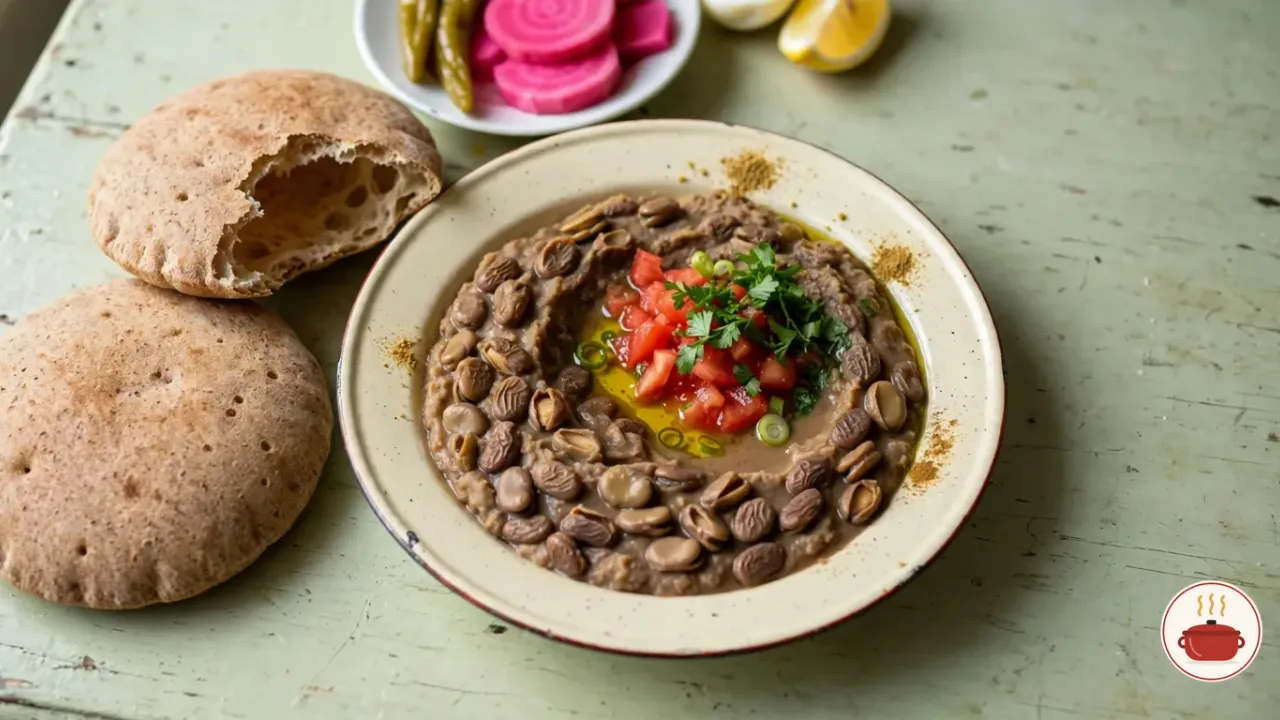
- • Mash about half the beans with garlic, cumin and lemon, then pour oil on top
Ingredients
6 servingsInstructions
Ful medames is Egypt’s everyday breakfast: small dried fava beans stewed slowly for hours, then mashed with garlic, cumin and lemon and finished with a pool of oil. It costs little, keeps you full until lunch and has no meat. This pot makes 6 servings in about 6 hours, almost all of it hands-off, plus an overnight soak.
What ful medames is
Beans first, dressing second
Ful medames is really two dishes. First comes the pot: dried fava beans, in their brown skins, stewed until soft. Then each person dresses a bowl of it at the table. Amira’s Pantry, an Egyptian food blog, puts it simply: “Ful is usually cooked plain and then prepared in many different ways before serving.”
The chef Michael Mina makes the same point in his book My Egypt: “Rich or poor, office worker or farmer, Egyptians eat ful medames, but everyone dresses up their ful differently.” He draws on his Egyptian roots. Fine Dining Lovers printed his version in 2025.
The bean and the name
Ful is Arabic for fava beans, also called broad beans. Medames, or mudammas, is usually explained as “buried” or “stewed in embers”, from the old way of sinking the pot into hot ashes. That reading is the common one, though no dictionary we could check spells it out. The spelling wanders too: ful medames, foul mudammas, ful medammes, all from the Arabic فول مدمس.
A few ways to dress it
The classic bowl has oil, cumin, lemon, garlic and salt. Many Egyptians stir in tahini as well. Alexandria has its own ful iskandarani, cooked with fried onion and garlic, tomatoes and hot green chili, says this Sada El Balad recipe, in Arabic. Others top it with eggs, butter, samna (ghee) or cured basterma.
Where ful medames comes from
Lane’s Cairo, 1836
The clearest early account comes from the English scholar Edward William Lane. His Manners and Customs of the Modern Egyptians, first published in 1836, is on Project Gutenberg. “A very common dish for breakfast is “fool mudemmes"", he writes. The beans were “slowly boiled, during a whole night, in an earthen vessel”. The pot sat buried to its neck “in the hot ashes of an oven or a bath”.
Cairenes ate them with linseed oil or butter and “a little lime-juice”, and bought them in the markets each morning. Linseed oil, made from flaxseed, is still a favourite dressing in Egypt. Egyptians call it zeit har, “hot oil”.
A dictionary and a bathhouse
In 1895 Socrates Spiro’s Cairo dictionary of spoken Egyptian Arabic glossed “fūl midammis” as “baked beans (generally eaten for breakfast by the natives)”. The book is on archive.org.
The writer Ahmad Amin published a dictionary of Egyptian customs in 1953. For the poor, he says, ful takes the place of meat, “yet the rich share it with them”. It was “the usual breakfast” of nearly all Egypt, eaten more in winter and in Ramadan. As a boy, he recalls, the furnace of his local bathhouse stewed the ful pots “for the whole quarter”.
Medieval Cairo and the pharaoh story
A 14th-century Egyptian cookbook, Kanz al-Fawa’id, already treats ful as humble food. Its translator Nawal Nasrallah notes the bread oven was used for “simmering pots of beans in its residual heat”, in Rawi magazine. We could not read a medieval text that uses the name mudammas, though.
You will often read that the dish dates from the pharaohs. Fava beans are ancient in Egypt, but no text ties this dish to them. Herodotus even claimed, in the 5th century BC, that Egyptian priests thought beans “unclean”. Treat both stories with care.
Ful medames this autumn
Winter is ful season
Ful is eaten all year, but Egyptians lean on it most in the cold months and at the pre-dawn meal of Ramadan, as Amin noted. Ramadan begins in early February 2027. Egyptian farmers are sowing the new fava crop right now. Last season, the Ministry of Agriculture set the sowing window from late October to late November, depending on the region.
A bigger import bill
Egypt grows only part of the beans it eats. Its fava imports cost $338.3 million in 2025, up from $297.7 million in 2024, a rise of about 13.7%. Those are figures from CAPMAS, Egypt’s statistics agency, reported by Al-Borsa News on June 17, 2026, in Arabic. Traders in the same article estimate imports at about 600,000 tonnes a year, chiefly from Australia and Britain.
Prices on the shelf
In October 2026, a kilo of packaged dried fava cost 62 to 66 Egyptian pounds. On October 4 it was 66.1 pounds, 12.4% more than a year earlier. By October 22 it was 62.6 pounds, up 3.5%. The figures come from the Egyptian cabinet’s Information and Decision Support Center, published in Arab Finance’s daily price reports.
No number for the dish
Nobody counts the bowls of ful sold each morning, or tracks what a cart charges for one. We found no 2026 figure for ful medames itself, and no 2027 food forecast names it. The numbers above are for the bean. For a date in the diary, the UN’s World Pulses Day falls on February 10.
What 31 ful medames recipes taught us
We read 31 recipes in full. Sixteen are in Arabic: fifteen from Egyptian papers such as Youm7, Masrawy, El Watan, Al-Dostor and Sada El Balad, and one from Jordan. Fifteen are in English, including America’s Test Kitchen, BBC Good Food, SBS, Claudia Roden, Anissa Helou and Michael Mina.
Dried beans in Egypt, cans abroad
Not one of the 16 Arabic recipes starts from a can. Eight of the 15 English ones do. America’s Test Kitchen says so plainly: canned beans skip the “pear-shaped pot” and the hours. They make a quick bowl, but they carry far more salt.
Hours, not minutes
The 11 Egyptian recipes that cook dried beans soak them for a median of 6 hours. They then cook them for a median of 5½ hours, from 3 to 8. A Masrawy recipe asks for at least 7 hours, and 9 is “better”. Six of the 17 dried-bean recipes offer a pressure cooker, which takes about an hour.
More than beans in the pot
Egyptian cooks rarely stew the beans in water alone. Nine of the 11 add a few lentils, ten add tomato, and seven add lemon, often with its peel. A spoon of lentils or rice “keeps the texture cohesive”, the TV chef Noura El Sadat tells El Watan. English recipes mostly skip all of these.
Lemon, lids and boiling water
Three tips come up again and again in the Arabic recipes:
- Lemon in the pot. “It’s the lemon that keeps the beans from going black,” says Elham Fathy of the Egyptian Chefs Association, in a Youm7 recipe.
- Only boiling water. Cold water stops the cooking. Fathy and two other cooks warn against it.
- Keep the lid on. El Sadat leaves it shut for the first 3 hours.
Salt last, and mash only half
Anissa Helou adds salt only once the beans are tender, and so did we. She also asks for small Egyptian beans, not the big ones, and never split favas, which turn to mush. For the dressing, the recipes settle near 5 garlic cloves, 2 teaspoons of cumin and 2 lemons per pot. Garlic appears in 22 of the 31 recipes, lemon in 20 and tahini in 10. Youm7’s 2026 tahini ful is mashed only partly, “to taste”.
Tips for soft skins and creamy beans
- Buy the right bean. Look for small, round brown fava beans sold as ful medames or ful baladi in Middle Eastern shops. Large broad beans and green fresh favas are a different thing.
- Use fresh stock. Very old dried beans may never soften. Buy from a shop that sells a lot of them.
- Keep the heat tiny. A bare tremble is enough. A hard boil splits the beans and scorches the bottom.
- Stir gently and rarely. The beans should stay whole until you mash them.
- Don’t drain away the liquid. It turns thick and starchy, and it makes the mash creamy.
- Dress each bowl hot. Warm the beans until they steam before the garlic and lemon go in.
Serving ful medames
In Egypt, ful comes with aish baladi, the round, puffed bran-flecked flatbread. Next to it go pickles, sliced tomato and cucumber, green onions and often ta’ameya, the Egyptian falafel made from fava beans. Tear the bread and use it as your spoon.
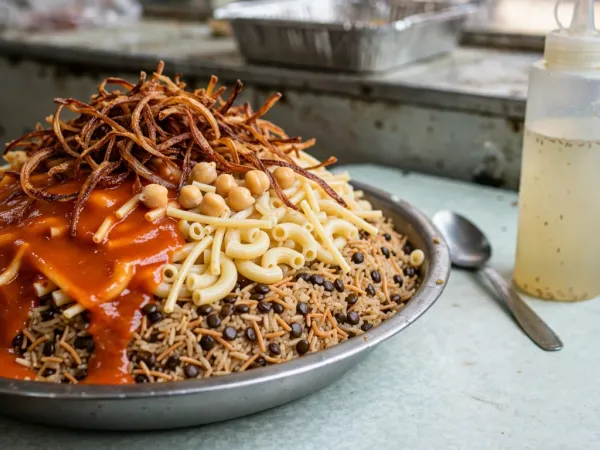
At carts and corner shops, ful is stuffed into bread as a sandwich. Some people still take their own pot to the vendor “to have him fill it with ful”, Helou writes. For a bigger spread, add hard-boiled eggs, white cheese and a bowl of labneh. For lunch, Egypt’s other great bean-and-grain dish is koshary, with rice, lentils and pasta.
The plain bowl is vegan, which makes it right for Lent and the long fasts of Egypt’s Coptic Christians. In the 1830s, Lane saw Copts eat only bread and vegetables, “chiefly beans”, with oil during their Great Fast.
Safety, storing and nutrition
Favism
Fava beans can cause a serious reaction in people with G6PD deficiency, an inherited condition. MedlinePlus, part of the US National Library of Medicine, calls it favism: red blood cells break down faster than the body can replace them. About 400 million people have the condition, most often in parts of Africa, Asia, the Mediterranean and the Middle East. Many don’t know it. If you have it, don’t eat this dish.
Cooling a big pot
The long simmer is safe; the cooling is where care matters. Split the leftovers into small containers so they chill fast. The UK’s Food Standards Agency wants cooked food in the fridge within one to two hours. It gives you two days to eat leftovers, or you can freeze them.
Storing and freezing
Egyptian cooks make a big pot and freeze the rest in bags, portion by portion. Plain cooked beans keep in the freezer for about 3 months. Thaw them in the fridge, then reheat until they bubble, with a splash of water. Add the garlic, lemon and oil only after reheating.
Allergens
The plain pot of beans, lentils, oil, lemon, garlic and cumin contains none of the major allergens. Tahini is made from sesame, which the FDA has counted as a major food allergen since 2023. The bread contains wheat, eggs are an allergen too, and butter or samna adds milk.
Nutrition
Each of the six bowls carries about 440 calories, without bread. That includes roughly 23 g of protein, 13 g of fat, 59 g of carbohydrate and 16 g of fiber. We worked these out from USDA FoodData Central figures for cooked fava beans and the other ingredients, without the tahini. Most of the fat is the oil on top, so pour less for a lighter bowl. Home-cooked beans have far less salt than canned ones: USDA lists 453 mg of sodium per 100 g of canned fava, against 5 mg for beans boiled without salt.
Fixes for hard skins, dark beans and a watery pot
- The skins stay tough: the beans were old. Keep cooking, or finish them in a pressure cooker. Next time, add ½ teaspoon of baking soda to the soaking water and rinse well.
- The beans turned dark: the lid was off too often, or the lemon left out. They are still fine to eat.
- The pot is watery: simmer uncovered for a few minutes, or mash a few more beans into it.
- It caught on the bottom: move the beans to a clean pot without scraping. Use a heat diffuser next time.
- It tastes flat: add more lemon, salt and cumin. Ful needs a firm hand with all three.
Substitutes for missing ingredients
- Small dried fava beans: two 15-oz (400 g) cans of fava beans with their liquid, simmered for 15 minutes. It is the quick version, not the slow one.
- Red lentils: yellow lentils, 2 tablespoons of rice, or leave them out.
- Flaxseed oil: good olive oil alone, or olive oil mixed with a little sunflower oil.
- Aish baladi: whole-wheat pita, warmed.
- Fresh tomato: a few cherry tomatoes, halved.
- Hot green chili: a pinch of chili flakes or cayenne.
Frequently asked questions
Can I make ful medames with canned beans?
Yes. Simmer them in their liquid for 15 minutes, then mash and dress them the same way. Season with care, since canned beans are already salty.
Do I have to peel the fava beans?
No. The small Egyptian beans are cooked and eaten in their skins, which soften over the long cook. Ahmad Amin noted that only the well-off peeled theirs.
Is ful medames vegan?
Yes, with oil and without butter, samna or eggs.
Can I cook ful medames in a slow cooker?
Yes: two of the recipes we read use one. Bring the soaked beans to a boil on the stove first, then cook them on low until the skins are soft.
What is the difference between ful medames and ful iskandarani?
Ful iskandarani, from Alexandria, cooks the stewed beans again with fried onion, garlic, tomato and hot green chili.
Is ful medames healthy?
It is high in fiber and plant protein and low in saturated fat. The oil on top adds most of the calories, so you can use less.