The Sunday Potthesundaypot.com/recipes/sopa-paraguaya/
Sopa Paraguaya: Paraguay's Cheese and Onion Cornbread
By The Sunday Pot Kitchen Updated
- • Use fine yellow cornmeal, not masa harina, cornstarch or pre-cooked arepa flour
- • Use about 1½ parts cornmeal to 1 part fresh cheese by weight, between the Paraguayan and English medians
- • Beat the fat with the eggs until fluffy: traditional sopa paraguaya has no baking powder
- • Simmer the onion in water and add it with its liquid
- • Bake at 400°F (200°C) for 40 to 45 minutes, the median of the recipes
- • Refrigerate leftovers within 2 hours and eat them within 3 to 4 days
Ingredients
12 squaresInstructions
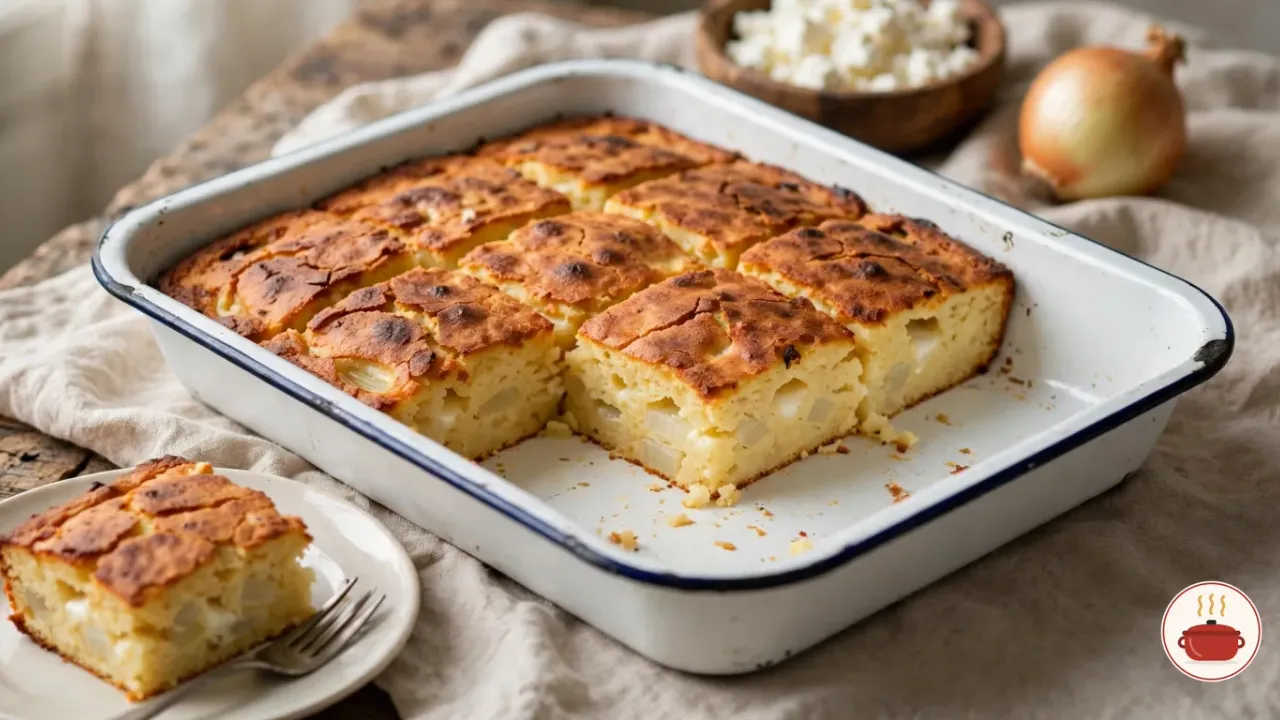
Sopa paraguaya is Paraguay’s national cornbread: a moist, savory bake of cornmeal, fresh cheese, onion, eggs and milk. Its name means “Paraguayan soup”, but it is solid, and you cut it into squares. This recipe makes one 9x13-inch pan, about 12 squares, in under 2 hours.
What sopa paraguaya is
A soup you cut with a knife
Sopa paraguaya is “a salty, spongy sponge cake”, in the words of Paraguay’s national food and nutrition institute, INAN (our translation). It calls it a product of Guaraní and Spanish cooking. The texture sits between a soufflé and a dense cornbread, and it is never sweet.
In Paraguay it is mostly a side dish. Paraguayans serve it with grilled meat, at weddings and at Holy Week. Its fresh-corn cousin, chipa guasu, is softer and wetter.
A president’s cook, or a legend
Every Paraguayan knows the story. President Carlos Antonio López, who died in 1862, loved a white soup of milk, cheese, corn flour and egg. One day his cook added too much corn flour and baked the mix in a clay oven, and a solid “soup” was born.
INAN presents this as oral tradition, passed down through the generations. The earliest printed recipe for the dish is in a 1931 cookbook by Raquel Livieres de Artecona, says the historian Margarita Miró Ibars. The book already tells the kitchen-accident story, about 70 years after López died. A 2024 New York Times article called the tale “apocryphal”, reports SUNY Buffalo State, whose historian helped with it.
Corn from the Guaraní, cheese from Spain
“Sopa paraguaya is a mestizo dish,” writes Miró Ibars in Cocina Rica (our translation). Corn is tied to the Guaraní creation story. Milk, cheese and eggs arrived with the Spanish.
Researchers give the dish older roots than the López story. One has counted “17 varieties of sopa paraguaya” among 500 Paraguayan dishes, Última Hora reported in 2017 (our translation). He traces a corn cake with fat and cheese to a convent recipe from 1621.
The tatakua and the wedding table
In the countryside, sopa paraguaya bakes in a tatakua, a dome-shaped clay oven heated with wood. The oven “is almost certainly a Spanish inheritance”, from 1537 on, the architect Luis Silvio Ríos told ABC Color (our translation). Families still fire it at Holy Week, for chipa first and then for sopa and roast meat.
The dish is so tied to weddings that it is also called “sopa de casamiento”, wedding sopa. Paraguay declared its traditional making national intangible heritage in 2017, under Resolution 592/2017, along with vori vori, locro and jopara, the state news agency IP reported.
Why sopa paraguaya is in the news
A bill for its own national day
On August 31, 2026, two senators from the Yo Creo party filed a bill to make the second Sunday of September the national day of sopa paraguaya. It honors López, called “the involuntary creator of the name” of the dish by ABC Color (our translation).
The bill asks the state to protect the hand milling of corn and the building of tatakua ovens. It also calls for fairs and contests to find “the most delicious and original sopa paraguaya”, Última Hora reported (our translation). The Senate sent it to its education and culture committee on September 2. It has not been passed.
Its neighbors on the table
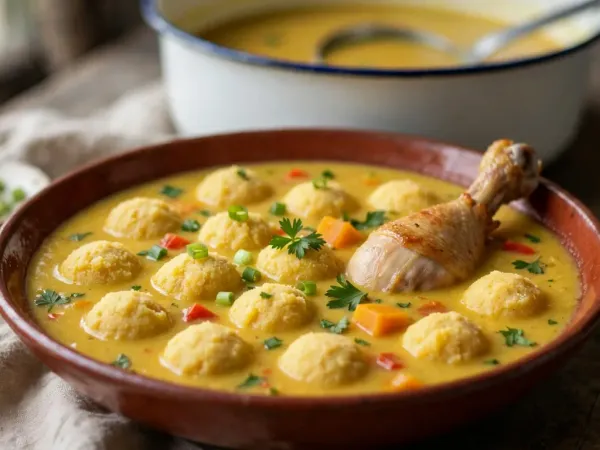
The bill follows vori vori, the corn-and-cheese ball soup. Paraguay’s Congress approved April 14 as its national day on August 11, 2026, Diario HOY reported.
On October 9, 2026, the national culture secretariat declared traditional cocido, a drink of toasted yerba mate, national intangible heritage, says La Nación. Paraguayans drink cocido with sopa or chipa at breakfast and teatime.
We found no 2026 sales or search data for sopa paraguaya, inside Paraguay or abroad. What changed this year is its standing at home.
What goes into sopa paraguaya
We read 34 published recipes and used 30 for the averages. Twenty-one are Paraguayan: from newspapers such as ABC Color and Última Hora, from INAN, and from home cooks on Cookpad’s Paraguay edition. Twenty-two are in Spanish, and 12 are English versions from cooks and sites abroad.
Fine yellow cornmeal
Paraguayan recipes call for harina de maíz: dry, raw, finely ground yellow corn. Abroad, the closest match is fine yellow cornmeal. US law defines cornmeal by sieve size in its food standards, and “corn flour” is ground finer still. Fine cornmeal or Paraguayan corn flour both work.
Three look-alikes are different products. Masa harina is corn cooked with lime, then dried and ground, and none of the recipes we read uses it. Pre-cooked arepa flour is already cooked: one English recipe insists on corn flour that is “not pre-cooked”. British cornflour is cornstarch, a pure starch.
Fresh cheese
Queso Paraguay is a fresh, white cow’s-milk cheese. Farm versions are made from raw milk with “little or no” salt, according to a 2020 university thesis on the cheese (our translation). Recipes abroad use queso fresco, queso panela, farmer’s cheese or mozzarella.
The Paraguayan recipes use about 570 g of cheese per kilo of cornmeal. The English recipes use far more, about 910 g. This recipe sits in between, with 10½ oz (300 g) for 3 cups (450 g) of cornmeal. “What everyone agrees on is that it must have plenty of very fresh queso Paraguay,” writes Alba Acosta in ABC Color (our translation).
Onion, cooked in water
Seventeen of the 30 recipes fry the onion in fat. Several Paraguayan ones simmer it in water or milk instead, so the onion liquid moistens the batter. A 2025 ABC Color recipe boils it in salted water, and the Paraguayan embassy in Tokyo simmers it in the milk. This recipe does the same, which keeps the onion soft and pale. Two Paraguayan recipes leave the onion out.
Lard, eggs and milk
Lard is the traditional fat, beaten with the eggs until creamy. Oil is now the most common single fat in the Paraguayan recipes, and butter is the usual choice abroad. The Paraguayan median is about 8 eggs and 1 liter of milk or other liquid per kilo of cornmeal.
No baking powder
Only 2 of the 18 Paraguayan recipes add baking powder or baking soda. In contrast, 5 of the 11 English ones do. The lift comes from beating the fat and eggs well, and from steam in a hot oven.
How to make sopa paraguaya
Beat the fat and eggs
“One secret is that the eggs and fat must be beaten very well by hand,” writes Miró Ibars (our translation). A wooden spoon works, and a hand mixer is faster. Beat until the mixture turns pale and fluffy, like a cake batter.
Aim for a creamy batter
The batter should be soft but not runny. “It should look like a creamy purée, neither too loose nor too thick,” writes Graciela Cabral on Cookpad Paraguay (our translation). Another cook there puts it simply. “The runnier the batter, the softer the sopa.” (our translation)
Let it rest
Four Paraguayan recipes rest the batter before baking, from 30 minutes to a whole day. Rest it in the fridge if you leave it longer than 30 minutes. A recipe credited to Ana María Gómez Silgueira in ABC Color explains why. “If the batter is left to rest about 24 hours, it comes out softer and spongier.” (our translation)
Bake it hot
The median oven temperature in the Paraguayan recipes is 200°C (400°F), and the median baking time is 45 minutes. Many just say “a very hot oven”. The top should be deep golden, with darker toasted spots.
A knife pushed into the center should come out clean. The USDA lists 160°F (71°C) for egg dishes and 165°F (74°C) for casseroles. A fully set sopa paraguaya passes both easily.
Serving and storing sopa paraguaya
On the table
Serve it warm or at room temperature with grilled meat, roast chicken or a bowl of soup. It belongs beside a pot of vori vori, or a classic pot roast on a Sunday. For breakfast, eat it with a cup of coffee or hot cocido.
Leftovers
Cool it and refrigerate it within 2 hours of baking, as the USDA advises. It keeps for 3 to 4 days in the fridge, or 3 to 4 months in the freezer. Reheat squares in a 350°F (175°C) oven or a dry skillet until hot all the way through.
Paraguayans have their own rule here. Leave out the onion if the sopa must keep for several days, “because people believe it ferments”, Miró Ibars notes (our translation).
The cheese and safety
Fresh cheeses like queso fresco have been linked to listeria outbreaks. The FDA advises cooking them “as part of the dish, to a minimum internal temperature of 165° F (74° C)”. Baking does that here. Buy cheese made from pasteurized milk, and don’t keep the opened leftover cheese.
People who are pregnant, over 65 or have a weak immune system are most at risk, says the CDC. They should eat sopa paraguaya hot from the oven, or reheated until steaming.
Calories, allergens and gluten
A square has about 350 calories, 10 g of protein, 20 g of fat, 33 g of carbohydrate and 2 g of fiber. We added up the USDA FoodData Central values for each ingredient and divided by 12. Butter instead of lard saves about 20 calories a square.
Sopa paraguaya contains milk and eggs, two of the major allergens on the FDA list. It has no wheat, and corn is naturally gluten-free, notes the Celiac Disease Foundation. If you avoid gluten, buy cornmeal labeled gluten-free, to avoid cross-contact with wheat.
Fixes for sopa paraguaya that is dry, gritty, flat or soggy
- Dry and crumbly: the batter was too stiff. Next time add more milk, until it is like a creamy purée.
- Gritty: the cornmeal was coarse. Use a finer grind, or rest the batter longer.
- Flat and dense: the fat and eggs weren’t beaten enough, or the oven was too cool.
- Soggy in the middle: it needed longer. Bake until a knife comes out clean.
- Pale on top: move it to the upper rack for the last 10 minutes.
- Bland: the cheese was unsalted. Add more salt to the batter next time, after tasting.
- Too salty: use a milder cheese, and skip the salt in the onion water.
Substitutes for missing ingredients
- Queso Paraguay: queso fresco, queso panela, farmer’s cheese, or two-thirds fresh cheese and one-third mozzarella.
- Lard: unsalted butter, or ½ cup (120 ml) of sunflower or corn oil.
- Whole milk: buttermilk, or the whey left from making cheese.
- Fine yellow cornmeal: fine polenta, with a batter rest of at least 2 hours.
- Onion: leave it out, as some Paraguayan cooks do.
- Anise: leave it out, which most recipes do.
Frequently asked questions
Why is it called soup if it is a bread?
The usual story is a kitchen mistake: a cook added too much corn flour to a soup and baked it. Historians treat the tale as a legend.
What is the difference between sopa paraguaya and chipa guasu?
Sopa paraguaya uses dry cornmeal. Chipa guasu uses fresh corn kernels, so it is softer and moister.
Is sopa paraguaya the same as cornbread?
No. It has much more cheese, no sugar and usually no baking powder, so it is denser and moister than American cornbread.
Can I use masa harina?
No. Masa harina is made from corn cooked with lime, so it behaves differently. None of the recipes we read uses it. Use fine yellow cornmeal.
Is sopa paraguaya gluten-free?
Yes, when it is made only with cornmeal. Choose cornmeal labeled gluten-free, and don’t flour the pan with wheat.
Can I make it ahead?
Yes. Bake it a day ahead and reheat it, or keep the batter in the fridge overnight and bake it the next day.
Can I freeze sopa paraguaya?
Yes. Wrap the squares well and freeze them for up to 3 months. Reheat them in the oven.
What do Paraguayans eat with it?
Grilled meat, soups such as vori vori, and a cup of cocido or coffee at breakfast.