The Sunday Potthesundaypot.com/recipes/aji-de-gallina/
Ají de Gallina: Peruvian Creamy Chicken in Yellow Chile
By The Sunday Pot Kitchen Updated
- • About 1 hour 25 minutes in one Dutch oven: 20 to 25 minutes to poach, 15 for the ají base, 10 to thicken the sauce
- • 2 lb (900 g) of chicken, ½ cup (120 g) of ají amarillo paste, 6 slices of bread, a 12-ounce can of evaporated milk, ½ cup of pecans and ⅔ cup of Parmesan
- • Cook the ají base until the oil separates: that is where the flavor comes from
- • Once the chicken is in, heat it through and stop; longer cooking makes it stringy
- • Poach chicken to 165°F (74°C), chill leftovers within 2 hours and eat them within 3 to 4 days
Ingredients
6 servingsInstructions
Ají de gallina is Lima’s creamy chicken stew: shredded chicken in a golden sauce of ají amarillo, bread, evaporated milk, pecans and Parmesan. This version uses one Dutch oven. Poach the chicken for about 20 minutes, cook the chile base for 15, then thicken the sauce for 10. It serves 6 in about 1 hour 25 minutes.
What ají de gallina is
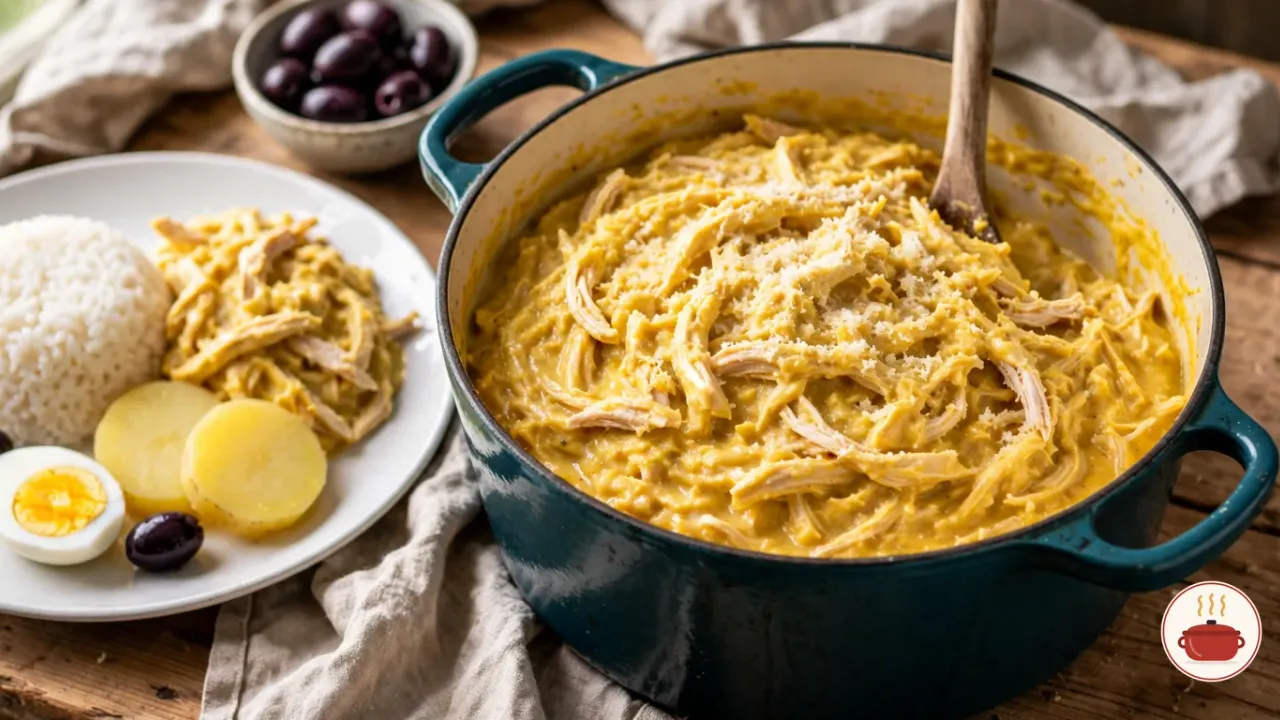
Ají de gallina is shredded chicken in a thick, creamy sauce of yellow chile, bread, milk, nuts and cheese. In Peru it comes with white rice, boiled potatoes, half a hard-boiled egg and a black olive. The name means hen in chile sauce.
Gastón Acurio, Peru’s best-known chef, calls it one of Lima’s most beloved stews in his book Peru: The Cookbook (Phaidon, 2015). He also writes that the chile here is not a spice but the main ingredient. In an interview with NPR about that book, he said that Peru’s chiles give “the flavor, the color, the essence of Peruvian food.”
From a medieval white dish
The dish began as something sweet. In 14th-century Catalonia, cooks served menjar blanc, a white dish of boiled hen breast. It was seasoned with sugar, walnuts and almonds and thickened with flour and rice, as Peru’s official tourism site explains. Menjar blanc appears in the Llibre de Sent Soví, one of Europe’s oldest cookbooks. The writer Javier Masías traced both dishes to it, as Correo recounts.
The dish reached Peru in colonial times, and Lima changed it. Cooks swapped the almonds for pecans, which cost less, and the sugar for ají amarillo. The food historian Isabel Álvarez put it plainly to El Comercio in 2020. Only in Peru, she said, was the Catalan recipe rethought: the sugar came out, and the chile and the milk went in.
Peru kept both children. One is manjar blanco, the sweet milk caramel. The other is the stew.
An 1839 police report
By the 19th century, the stew was a Lima favorite. The researcher Rodolfo Tafur Zevallos dates its spread to 1839. That year, police inspecting the city’s inns reported a dish that customers ate with delight. It held strands of hen in a sauce of onions, garlic, chile and small pieces of bread, served with potatoes.
You may also read that French chefs brought the dish to Lima after the French Revolution. The writer Nicholas Gill looked into it for New World Review. Apart from oral legend, he found no record of it.
Hen, or chicken
Gallina means hen, and the name is a clue to the dish’s past. Acurio has written that it was once made with real hens, before poultry farms, when most families raised their own birds. Chicken then took over little by little, La República reported in 2023, quoting him.
The cook behind Peru Delights gives a practical reason. A hen’s tough flesh took much longer to cook. Peruvian families now prefer chicken for its price and its tender meat, Peru’s tourism site adds. The dish keeps its old name.
Why ají de gallina is having a moment
The world’s food press is about to land in Lima. On 4 November 2026, Lima hosts the awards of The 50 Best Restaurants, the list formerly called The World’s 50 Best Restaurants. It is the first time in 24 years that the ceremony takes place in Peru, The 50 Best announced in July. Michael Guevara, head of Peru’s promotion agency PromPerú, told Andina it is also the first time in South America.
Lima earned the date. Its restaurant Maido was named The World’s Best Restaurant 2025 in June 2025, and Central won in 2023. In the last days of October, PromPerú’s food fair Perú Mucho Gusto also comes to Lima.
Peruvian food is high in the rankings too. The TasteAtlas food guide ranked Peru’s cuisine third in the world in its 2025/26 awards, behind Italy and Greece. It scored an average of 4.54, from 590,228 ratings of 16,357 dishes, as El Popular reported in December 2025. In April 2026, the same guide’s ranking of the world’s best chicken dishes put ají de gallina 18th, RPP reported.
The pepper has its own following. In January 2025, McCormick named ají amarillo its Flavor of the Year. Its announcement forecast 59% growth on menus over four years, from Datassential’s 2024 menu data. In Britain, the wholesaler Bidfood named Peruvian food among the cuisines to watch in 2026, as The Caterer reported.
To be clear, nobody has published a 2026 sales or search figure for ají de gallina itself. The interest is in Peru’s cooking as a whole, and this is one of its best-loved home dishes.
What you need for ají de gallina
Ají amarillo
Ají amarillo means yellow chile, but the pepper turns orange when fully ripe. It tastes fruity, with notes of passion fruit and mango, McCormick says. McCormick and the produce distributor Specialty Produce put its heat at 30,000 to 50,000 Scoville units.
That sounds fierce, but in a pot of milk and bread it is gentle. A 2011 study in the Journal of the Science of Food and Agriculture found ajíes mildly pungent next to a habanero-type pepper. They held 13 to 352 mg of capsaicinoids per kilogram, against 1,605 mg in the habanero type.
Outside Peru, you will most often find it as a paste in jars, at Latin grocers or online. Brands differ in heat and salt, so start with ½ cup (120 g) and taste. For a hotter pot, the Lima chef Flavio Solórzano suggests at least 100 g of whole ají per serving, Correo reports.
Whole ajíes are also sold frozen. In Peru, many cooks make their own paste almost daily, Peru Delights says. They simmer the peppers for 5 to 10 minutes, blend them and freeze the paste for up to 3 months. Dried ají amarillo is called ají mirasol, which means looking at the sun.
Bread and evaporated milk
The sauce is thickened with bread soaked in milk. Most recipes use crustless sandwich bread, called pan de molde in Peru. French rolls or soda crackers work too, La República notes. Six slices make a sauce that is thick but still spoonable.
Evaporated milk is the Peruvian choice, and it makes the creamiest sauce. One 12-ounce (354 ml) can is enough. Acurio uses whole milk instead, which gives a lighter sauce.
Pecans or walnuts
Most Peruvian cooks use pecans, the nut that replaced the almonds in colonial times. Walnuts are a common choice too. Use ½ cup (55 g) of either, blended into the sauce. A 2025 recipe in La República treats the nuts as optional.
Parmesan
Peruvian recipes call for queso parmesano. Here, ⅔ cup (60 g) gives the sauce its salty depth. Some cooks stir in fresh cheese instead.
Chicken
Most Peruvian recipes poach a whole chicken breast. Boneless thighs stay juicier and forgive a few extra minutes. Use 2 lb (900 g) of either, or a mix.
The plate
Set out white rice, yellow potatoes, hard-boiled eggs and black olives. In Peru, the potato is papa amarilla, a yellow potato with a buttery flesh. Yukon Gold is the closest you will find in most stores. The olives are usually purple-black Botija olives, and Kalamata olives are a good stand-in.
How to make ají de gallina in one Dutch oven
Most recipes use a saucepan for the chicken and a frying pan for the sauce. This one does both in a 5½- to 7-quart (5.2 to 6.6 liter) Dutch oven. The poaching water becomes the broth for the sauce.
Poach the chicken gently
Start the chicken in 5 cups (1.2 liters) of cold water with half an onion, celery, carrot, a bay leaf and salt. Bring it to a boil, skim the foam, then turn the heat down until the water barely bubbles. Hard boiling toughens the meat.
Breasts take 15 to 20 minutes and thighs 20 to 25 minutes. Check the thickest piece with a thermometer. The USDA sets the safe temperature for all poultry at 165°F (74°C).
Shred it thin
Let the chicken cool for 10 minutes, then pull it into thin shreds. Fine shreds are the tradition, but some cooks like bigger pieces, Peru Delights notes. Strain the broth and keep 2 cups (480 ml). Freeze the rest for soup.
Cook the ají base until the oil separates
In Peru, the base of onion, garlic and chile is called the aderezo. Cook the onions for 10 minutes, until soft and golden, then the garlic for 1 minute. Then add the ají paste and cook it for 5 minutes. It darkens, and the oil begins to separate at the edges.
That separated oil matters. Correo spoke to Elena Santos, a Lima restaurant cook. She fries the soaked bread in the aderezo until the oil seeps out and the mixture looks split. That, she says, is the sign the bread is cooked.
Blend the bread, or sieve it
Most recipes blend the bread with the milk until smooth. That gives the silkiest sauce. Some Lima chefs disagree, Correo reports. They crumble the soaked bread or press it through a sieve, and never blend it. A sieved sauce has more texture.
Thicken, then stop
Add the bread purée and cook it for 3 minutes. Then add 1½ cups (360 ml) of broth and simmer for 5 to 8 minutes, stirring often. The sauce should coat a spoon and hold a trail. Scrape the bottom as you stir, because bread sauces catch.
The chicken goes in last. Heat it for 3 to 5 minutes, until it is hot all the way through, and then stop. If you cook it longer, the chicken turns stringy, Peru Delights warns.
Variations: with a hen, seafood or tuna
With a real hen
For the old dish, use a stewing hen. Its meat has more flavor and needs more time. The chef Flavio Solórzano cooks a hen for 4 to 5 hours without letting it boil, then cools it in its broth, Correo reports. Isabel Álvarez starts her hen version with 2 kg (4½ lb) of bone-in hen breast.
Shrimp, tuna or eggs
Some Peruvian cooks make the sauce without any chicken. Peru Delights lists versions made with shrimp, eggs or even tuna. Add cooked shrimp or drained tuna in the last 2 minutes.
Leftovers in pastry
Peruvians turn leftover ají de gallina into empanadas, and into tequeños, fried wonton-wrapped rolls. Peru Delights suggests ravioli and sandwiches too.
Cousins on the Peruvian table
Ají amarillo also flavors papa a la huancaína, potatoes in a sauce of chile, fresh cheese and evaporated milk. Infobae thickens that sauce with 4 soda crackers, as this stew uses bread. Causa limeña, a cold dish of mashed yellow potato, takes the same paste.
Serving and storing ají de gallina
Serve the ají de gallina hot, beside a mound of rice, with sliced potatoes, half an egg and 2 olives on each plate. Pass more ají paste at the table for those who like heat.
If you like chicken that simmers in a bold sauce, try Filipino chicken adobo. For another rice dish built on a pepper base, there is Nigerian jollof rice. For a stew from the other side of the Pacific, try kimchi jjigae.
Leftovers
The USDA’s advice on leftovers applies here:
- Refrigerate the stew within 2 hours of cooking.
- Divide it into shallow containers, so it cools quickly. A full pot cools slowly.
- Eat it within 3 to 4 days, or freeze it for 3 to 4 months.
- Reheat it to 165°F (74°C), with a splash of broth or milk to loosen the sauce.
The UK Food Standards Agency is stricter. It advises eating fridge leftovers within 48 hours. Cooked rice keeps no more than 1 day, and should be reheated only once. Keep hard-boiled eggs in the refrigerator for up to 1 week, as the USDA advises.
Calories and protein per serving
One serving, a sixth of the pot, has about 525 calories, 41 g of protein and 26 g of carbohydrate, by USDA figures. It has about 28 g of fat, from the oil, nuts, milk and cheese. Sodium comes to about 870 mg, mostly from the ají paste, Parmesan and bread. Brands of paste differ, so check the jar.
A plate with 1 cup of rice, a potato, half an egg and 2 olives adds about 380 calories.
Allergens
The sauce holds four of the nine major food allergens the FDA lists. They are milk, wheat, tree nuts and egg, the last in the garnish. For a nut-free pot, leave out the pecans. The sauce is a little less rich without them.
Fixes for thin, grainy or bland ají de gallina
- Thin sauce: simmer it 3 to 5 minutes longer before the chicken goes in. Or blend in 1 more slice of soaked bread.
- Thick, stiff sauce: stir in hot broth, 2 tablespoons (30 ml) at a time.
- Grainy sauce: the bread or nuts were not blended long enough. Blend the next batch for a full minute.
- Bland sauce: cook the ají base longer, until the oil separates. Then add salt, Parmesan or more paste.
- Too hot: stir in more evaporated milk, ¼ cup (60 ml) at a time.
- Stringy chicken: it cooked too long in the sauce. Next time, heat it through and stop.
- A scorched bottom: the heat was too high. Stir often, and scrape the bottom of the pot.
Substitutes for missing ingredients
- Ají amarillo paste: ají mirasol paste, at half the amount, as Pantry & Larder advises. Or blend 1 orange bell pepper with ½ habanero or Scotch bonnet, and use it 1:1.
- Fresh or frozen ajíes: seed them, simmer them for 5 to 10 minutes and blend them with a little oil into a paste.
- Evaporated milk: whole milk or half-and-half.
- Pecans: walnuts or almonds, or leave the nuts out.
- Parmesan: any hard, salty cheese, or fresh cheese for a milder sauce.
- Sandwich bread: French rolls without crust, or about 7 soda crackers.
- Chicken: a stewing hen, cooked longer, or cooked shrimp or tuna.
Frequently asked questions
What does ají de gallina taste like?
It tastes creamy, nutty and gently hot. The ají amarillo gives a fruity warmth, the Parmesan adds salt and depth, and the pecans make it rich.
Is ají de gallina spicy?
It is mildly hot. The chile is the main flavor, but the milk, bread and cheese soften its heat. Add more paste for a hotter pot, or more milk for a milder one.
What is the difference between ají de gallina and ají de pollo?
They are the same dish. Gallina means hen, the bird cooks once used. Most cooks now use chicken, pollo in Spanish, and keep the old name.
Can I make ají de gallina without ají amarillo?
Not quite, because the chile is the main ingredient. Ají mirasol paste comes closest. A purée of orange bell pepper and a little habanero gives a similar color and heat, with a different flavor.
Do I need evaporated milk?
No, but it makes the creamiest sauce. Whole milk works, and gives a lighter sauce. Half-and-half sits between the two.
Can I make ají de gallina ahead?
Yes. The sauce thickens as it stands, so loosen it with broth when you reheat it. Chill it within 2 hours of cooking and eat it within 3 to 4 days.
Can I freeze ají de gallina?
Yes, for up to 3 to 4 months. The sauce may look a little grainy after thawing. Whisk in a splash of hot broth or milk as it reheats.
Is ají de gallina gluten-free?
Not as written: the bread contains wheat. Use gluten-free bread or crackers, and the rest of the dish is gluten-free.
What do you serve with ají de gallina?
White rice, boiled yellow potatoes, half a hard-boiled egg and a black olive. A simple salad of sliced onion and lime juice cuts the richness.
Tags: Sunday dinnerchickenDutch ovenone potají amarillomake ahead