Italian Sunday Gravy with Meatballs, Sausage and Pork
By The Sunday Pot Kitchen Updated
- • 30 minutes of prep and about 4 hours of cooking, 3 of them at a gentle simmer
- • About 5 lb (2.3 kg) of meat feeds 8: 24 meatballs, 1½ lb (680 g) Italian sausage and 2 lb (900 g) pork ribs
- • Brown every piece first, in batches, for a darker and deeper sauce
- • Simmer with the lid ajar and stir from the bottom every 20 to 30 minutes
- • It is ready when the rib meat slides off the bone: serve the pasta first, then the meat
Ingredients
8 servingsInstructions
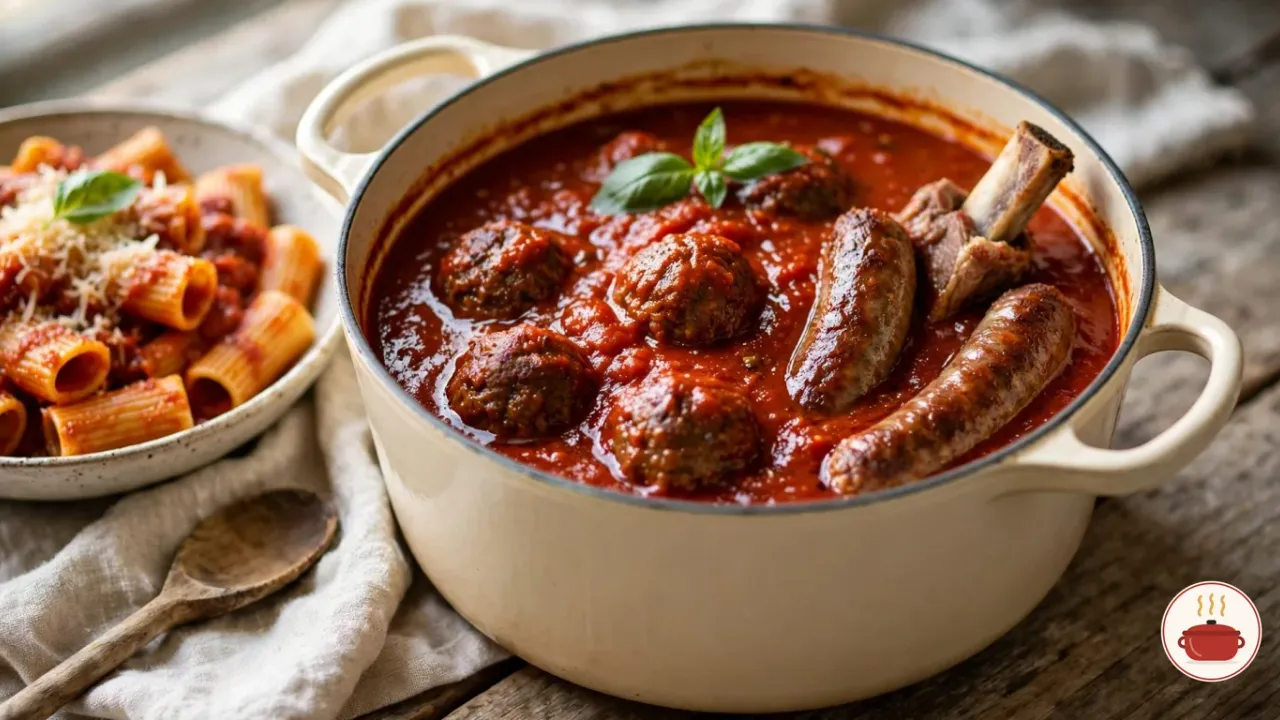
Sunday gravy is the Italian-American tomato sauce that simmers with meat for the Sunday meal. Browned meatballs, Italian sausage and pork ribs cook in crushed tomatoes for about 3 hours. The meat flavors the sauce, and the sauce turns the meat tender. The gravy dresses the pasta first. The meat follows on its own platter.
What Sunday gravy is
Sunday gravy is a slow tomato sauce cooked with several kinds of meat. It comes from the Italian-American kitchen, not from Italy itself. Its roots lie in the ragù of Naples. There, whole pieces of beef and pork simmer for hours in tomato, and the sauce dresses the pasta.
Most Italian immigrants to the United States came from southern Italy, and they brought that ragù with them. In America, meat cost less than it did at home. Meatballs and sausage joined the pot, and the dish became the center of the Sunday meal. In many homes, the pot went on the stove in the morning and fed the whole family by midafternoon.
The name still starts arguments. Many Italian-American families, above all around New York, New Jersey and Philadelphia, call it gravy. Others call it Sunday sauce, or just sauce. Both names mean the same pot. One common explanation is that gravy was simply the nearest English word for ragù, a sauce rich with the juices of meat.
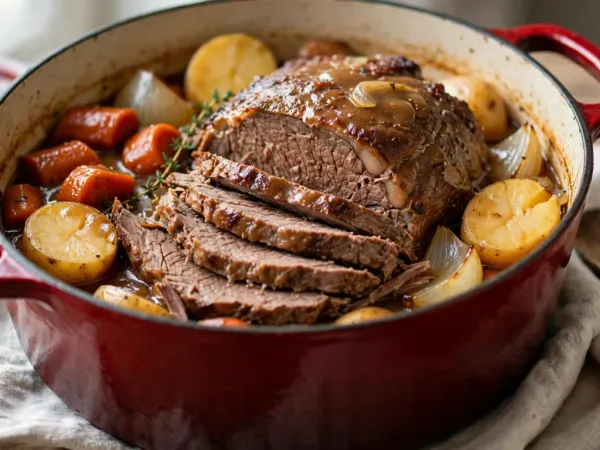
Either way, it has nothing to do with the brown pan gravy of a classic pot roast. The two dishes share one idea, though. Cheap cuts, low heat and time do most of the work.
The meats for Sunday gravy
Every family has its own mix. This recipe uses the three most common meats, about 5 lb (2.3 kg) in all, which feeds 8 people well.
- Meatballs. They mix ground beef and ground pork with Pecorino Romano, parsley and garlic. Breadcrumbs soaked in milk keep them soft through the long simmer. Without the soaked crumbs, they turn dense and dry.
- Italian sausage. Use fresh links, sweet or hot, seasoned with fennel and garlic. They season the whole pot as they cook. Cut them in half to serve, so everyone gets a piece.
- Pork ribs or neck bones. Spareribs, baby back ribs or meaty neck bones give the sauce its body. Their bones and connective tissue melt slowly into the tomato. The meat turns soft enough to slide off the bone.
- Braciole, if you like. These are thin slices of beef rolled around garlic, parsley and cheese, then tied with string. Add 1 lb (450 g) of them with the ribs. Brown them the same way, simmer them for the full 3 hours and snip off the string before serving.
Ask the butcher to cut the ribs between the bones for you. Neck bones carry little meat but plenty of flavor, so they suit a smaller budget. For the sausage, look for a coarse grind with visible fennel seeds.
Browning the meat
Browning builds the deep flavor of the gravy. Each piece of meat leaves brown bits on the bottom of the pot. The wine lifts them off, and the tomatoes carry that flavor through the whole sauce. Meat that goes in unbrowned gives a paler, flatter gravy.
Work in batches. A crowded pot fills with steam, and the meat turns gray instead of brown. Leave space between the pieces, and let each side sit until it lets go of the pot. Turn the meatballs gently with tongs, since they are still soft.
The meatballs and sausages do not need to cook through yet. They go straight back into the sauce and finish cooking there. USDA sets a safe minimum internal temperature of 160°F (71°C) for ground meat. Its advice for fresh sausage made with pork or beef is the same 160°F (71°C). Whole cuts of pork, like the ribs, are safe at 145°F (63°C), with a rest of at least 3 minutes.
A gentle simmer keeps the sauce well above those temperatures, and 3 hours leaves every piece fully cooked. If you want proof, check a large meatball with an instant-read thermometer.
Pour off most of the fat after browning, but keep about 2 tablespoons in the pot. It carries the flavor of the meat into the onion.
How long to simmer Sunday gravy
Plan on about 3 hours at a bare simmer. That gives the rib meat time to slide off the bone and the sauce time to thicken and darken. Shorter cooking leaves the tomato sharp and the ribs chewy. Much longer cooking breaks up the meatballs.
Keep the heat low. Only a few small bubbles should break the surface at a time. A hard boil scorches the thick sauce on the bottom and toughens the meat. Set the lid ajar, so some steam escapes and the sauce reduces slowly.
Stir every 20 to 30 minutes with a wooden spoon. Reach all the way to the bottom and move gently around the meatballs. If the sauce gets too thick before the ribs are done, add a splash of water.
The gravy is ready when:
- the rib meat pulls away from the bone with a fork;
- the sauce has turned from bright red to a deep brick red;
- it coats a spoon, and drops of orange oil gather on top.
In the oven. The oven heats the pot from all sides, so the sauce rarely scorches. Bring the gravy to a simmer on the stove, set the lid ajar and move the pot to a 300°F (150°C) oven. Give it about 3 hours, and stir it from the bottom every 45 minutes.
Serving it the traditional way
In Naples, one pot of ragù makes two courses, and Sunday gravy keeps that habit. The sauce dresses the pasta for the first course. The meat comes after, as the second course.
Toss the pasta with gravy in its own pot before it goes to the table. Rigatoni is a good choice, since its wide, ridged tubes hold the thick sauce. Ziti, penne or spaghetti work too. Pass extra gravy and grated Pecorino at the table.
Then bring out the meat on a warm platter, with a few spoonfuls of sauce over it. Add crusty bread for the plate and a green salad to cut the richness. Many families serve the meat and pasta on one plate instead. That works too.
Finish with something warm and simple, such as a sticky toffee pudding with a pour of cream.
Making it ahead and storing
Sunday gravy often tastes even better the next day, once the flavors settle. That makes it a good dish to cook ahead, like most slow-cooked food, from pot roast to French onion soup. Follow the USDA advice on leftovers:
- Refrigerate the gravy within 2 hours of cooking.
- A full pot cools too slowly, so divide the sauce and meat among shallow containers. Hot food can go straight into the refrigerator.
- Eat it within 3 to 4 days, or freeze it for 3 to 4 months.
- Bring the gravy to a rolling boil when you reheat it, and make sure the meat reaches 165°F (74°C).
Chilled gravy sets a layer of fat on top. Lift it off with a spoon before you reheat the sauce.
Freeze the meat in its sauce, so it stays moist. Thaw it overnight in the refrigerator, then reheat it in a covered pot, stirring often. USDA notes that you can also reheat a soup or stew straight from frozen in a saucepan. It just takes longer. Cook fresh pasta each time you serve it.
Leftover meatballs make a great sandwich. Warm them in their sauce and pile them on a toasted roll with melted provolone.
Substitutes for missing ingredients
- Pork ribs: pork neck bones, country-style ribs or chunks of pork shoulder. Beef short ribs also work and give a richer sauce.
- Italian sausage: mild or hot, links or bulk. For plain pork sausage, add ½ teaspoon (1 g) fennel seeds to the pot for each pound.
- Ground pork: more ground beef, or ground veal for the classic three-meat mix.
- Pecorino Romano: Parmesan, which is milder and less salty.
- Dry breadcrumbs: 1 cup (60 g) fresh crumbs from day-old Italian bread, or ½ cup (30 g) panko.
- Crushed tomatoes: whole peeled tomatoes, crushed by hand or pulsed in a blender, or tomato purée (passata).
- Red wine: leave it out and deglaze with ½ cup (120 ml) water or chicken broth.
- Fresh basil: 1 teaspoon (1 g) dried basil, added with the oregano.
- Kosher salt: brands differ, so go by the weight. Table salt packs more salt into each spoon, so use about half the volume.
- Rigatoni: ziti, penne, spaghetti or any sturdy pasta. For a gluten-free meal, use gluten-free pasta and breadcrumbs, and check the sausage label.
Frequently asked questions
Why do Italian-Americans call tomato sauce gravy?
Many families, above all around New York, New Jersey and Philadelphia, call a tomato sauce cooked with meat gravy. One common explanation is that gravy was the nearest English word for ragù, a sauce rich with the juices of meat. Other families call the same pot Sunday sauce.
What meat goes in Sunday gravy?
Most versions use meatballs, fresh Italian sausage and a bony cut of pork, such as spareribs or neck bones. Some families add braciole, thin rolls of beef tied with string. About 5 lb (2.3 kg) of meat in all feeds 8 people.
How long should Sunday gravy simmer?
About 3 hours, at a bare simmer with the lid ajar. It is ready when the rib meat slides off the bone and the sauce turns a deep brick red. Stir it from the bottom every 20 to 30 minutes so it does not scorch.
Do you have to brown the meatballs first?
Browning is for flavor, not for safety, since the meatballs finish cooking in the sauce. It gives the gravy much of its depth. It also firms the outside of the meatballs, so they hold together through the long simmer.
Can I make Sunday gravy ahead?
Yes, and it often tastes better the next day. Refrigerate it in shallow containers within 2 hours of cooking. It keeps for 3 to 4 days in the refrigerator, or 3 to 4 months in the freezer. Bring it to a rolling boil when you reheat it.
Can I make Sunday gravy in a slow cooker?
Yes. Brown the meat and cook the sauce base on the stove first. Then move everything to a 7-quart (6.6 liter) slow cooker with the tomatoes, and skip the cup of water. For a smaller cooker, halve the recipe. Cook on low for 6 to 8 hours.
USDA advises that you thaw meat fully before it goes in a slow cooker. It also advises that you reheat leftovers on the stove, not in the cooker.
What pasta goes best with Sunday gravy?
A sturdy shape with room for sauce, such as rigatoni, ziti, penne or spaghetti. Cook it until just al dente. Then toss it with the gravy in its pot, so each piece is coated before it reaches the table.