The Sunday Potthesundaypot.com/recipes/southern-baked-mac-and-cheese/
Southern Baked Mac and Cheese with Eggs and Evaporated Milk
By The Sunday Pot Kitchen Updated
- • Use 1½ lb (680 g) of block cheese for 1 lb (454 g) of elbows: 1 lb sharp cheddar and 8 oz Colby Jack
- • Skip the white sauce: 2 eggs, a 12 fl oz can of evaporated milk and 1½ cups of whole milk set the pan
- • Boil the macaroni 1 to 2 minutes short of al dente, because it keeps cooking in the oven
- • Bake uncovered at 350°F (175°C) for 35 to 45 minutes, to 160°F (71°C) in the centre, then rest it 10 to 15 minutes
- • With raw egg in it, an assembled pan can wait in the fridge for 24 hours at most, the USDA says
Ingredients
12 servingsInstructions
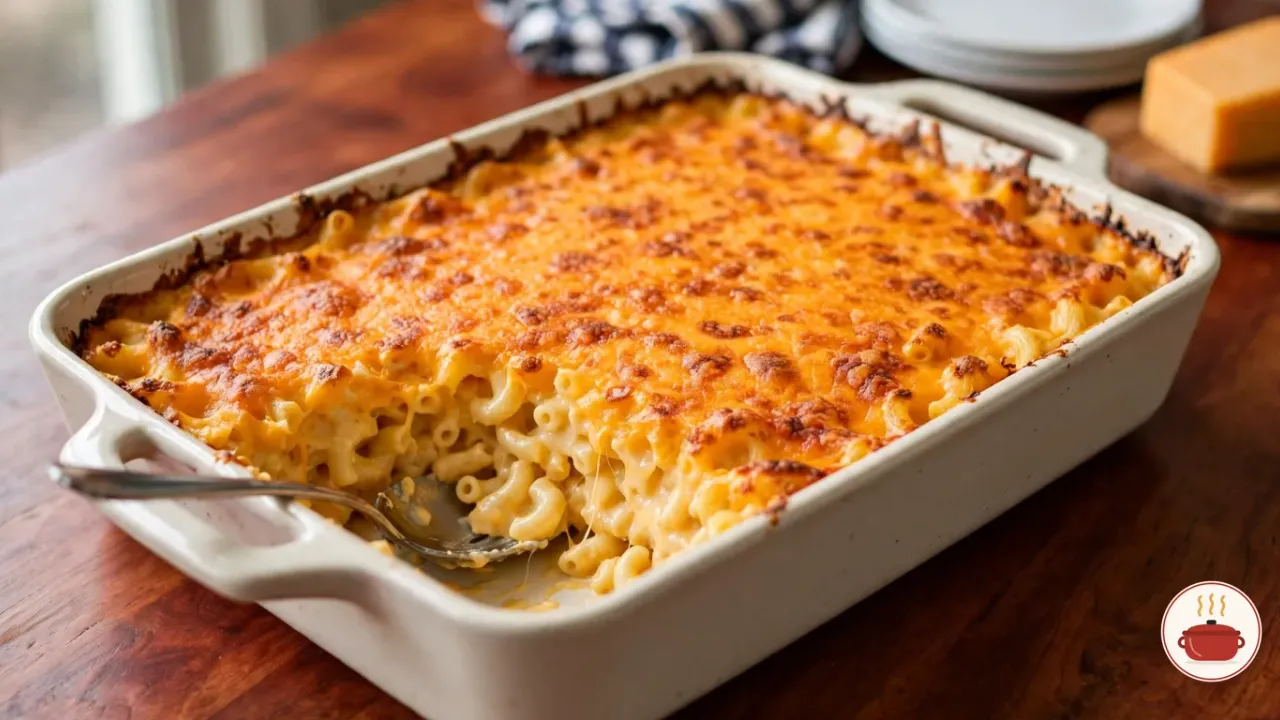
Southern baked mac and cheese is the kind you cut in squares. Elbow macaroni is layered with sharp cheddar and Colby Jack, then set with eggs and evaporated milk instead of a flour-thickened sauce. This recipe fills a 9 x 13-inch (23 x 33 cm) dish, serves 12 as a side and takes about 1 hour 35 minutes.
Two kinds of baked mac and cheese
One name covers two different dishes, and recipe writers rarely say which one they mean. So we counted. We read 24 recipes in full and compared 23 of them; one repeated another’s proportions.
Fifteen are by soul food cooks and writers, from Divas Can Cook to the Bronx restaurant owner Millie Peartree. The other 8 are Southern or national names, among them Paula Deen, Alton Brown and Southern Living.
They split down the middle:
- Custard-style, 10 recipes. Raw eggs and milk go over the pasta and cheese. There is no sauce to cook.
- Roux-style, 10 recipes. Butter and flour cook together, milk goes in, and the cheese melts into that white sauce.
- Both, 2 recipes. Alton Brown and The Pioneer Woman make a roux and add an egg as well.
- Neither, 1 recipe.
What the custard pans share
The 10 custard recipes carry far more cheese. Their median is 2 pounds of cheese for every 1 pound of dry pasta. The roux group’s median is 1.1 pounds.
They also use less liquid: 26 fluid ounces per pound of pasta, against 32. And they bake longer, 40 minutes at the median. A roux pan has no egg to set, and needs about 24 minutes.
The result is firmer. Paula Deen sells hers as a mac and cheese “that cuts like a casserole”. In South Carolina, Mandy Rivers of South Your Mouth says the custard style is “sometimes called ‘macaroni pie’”. It was her grandmother’s way.
What sets the soul food pans apart
It is not the egg. Eggs go into 8 of the 15 soul food recipes and 4 of the other 8, about half of each group.
Three other things differ. Evaporated milk is in 8 of the 15, but only 1 of the other 8. A little Velveeta, American or cream cheese goes into 9 of the 15, against 2 of 8. And the soul food cooks use more cheese: a median 1.58 pounds per pound of pasta, against 1.34.
Even so, there is no single rule. Six of the 15 start from a roux. One of them, Dash of Jazz, says plainly that there is “no one official Black folks’ mac and cheese recipe”.
Our 23 recipes were picked by hand, so read these counts as a pattern, not a survey.
Where nearly everyone agrees
Cheddar is in all 23, and elbow macaroni in 21. The oven is set to 350°F in 17. The top is cheese and nothing else in 19. Only 4 recipes put breadcrumbs or crackers on top, and none of the custard ones does.
How this recipe was built
We chose the custard style, with evaporated milk. Each quantity below comes from the recipes we compared.
A pound and a half of cheese
Our 1½ pounds (680 g) for 1 pound of pasta matches the Peartree recipe and South Your Mouth’s. It sits under the custard median of 2 pounds. For a richer pan, go up to 2 pounds (900 g) and keep everything else the same.
Sharp cheddar gives the flavor. A Jack cheese is the usual partner: Colby Jack, Monterey Jack or pepper jack appears in 12 of the 23 recipes.
Two eggs and one can
Two eggs per pound of pasta is the most common count among the custard recipes. Four cooks use 3, which sets firmer. Use 3 if you want clean, tall squares.
Evaporated milk is in 6 of the 10 custard recipes, often with a second dairy. Our 12 fl oz can plus 1½ cups of whole milk makes 24 fluid ounces, close to the 26-ounce median. Do not confuse the can with its sweet neighbor on the shelf. The ingredient list at Coop Can Cook spells it out: “not condensed milk, baby! EVAPORATED!”
By US law, evaporated milk is milk with part of its water removed. USDA data give it 6.8 g of protein per 100 g, about twice the 3.3 g in whole milk. Recipe writers credit it with a creamier pan. We found no lab study that tests the claim, so take it as kitchen wisdom.
Pasta that is not quite done
Twelve of the 23 recipes stop the pasta early, and none cooks it soft. Soul Food Cooking 101 is the most exact: boil it “for exactly six and a half minutes”. The macaroni keeps cooking in the custard for 40 minutes in the oven.
Layers, not a stir
Peartree’s version is “layered like a casserole — the traditional Southern way to do it”, as Good Morning America put it in 2020. Layers leave seams of melted cheese through the middle of each square.
The jiggle test
The best doneness cue comes from Divas Can Cook: bake “until the edges are set, but the center is still slightly jiggly”. The pan finishes setting on the counter. Nine recipes ask for a rest, and 10 to 15 minutes is the usual wording.
Does bagged cheese ruin baked mac and cheese?
Thirteen of the 23 recipes tell you to grate your own. They all give the same reason: the powder that keeps bagged shreds apart is said to stop them melting. “Ain’t no pre-shredded cheese touching this masterpiece!” writes Meiko Temple of Meiko and the Dish.
What a lab found
The coating is legal and ordinary. The federal standard for grated and shredded cheese allows anticaking agents. Cellulose and potato starch are two of them.
One study has measured what they do. For a 2002 master’s thesis at Virginia Tech, Maureen Lynch Akins coated shredded mozzarella with 6 anti-caking agents. Her melt test found “no significant differences” between plain shreds and shreds coated with cellulose or potato starch. Stretch did not change either.
That study used mozzarella, not cheddar, and a melt test, not a baked custard. Still, it is the only measurement we found, and it does not support the rule. Grate your own if you can, as most of these cooks do. If a bag is what you have, use it. The Soul Food Pot’s recipe allows either.
Why sharp cheddar turns oily
Age is the bigger risk. As cheese ripens, its proteins break into shorter chains. Those have less “water holding capacity and emulsification capacity”, says a University of Guelph textbook on cheese making. In plain words, old cheese is worse at holding on to its own fat.
That passage is about factory cheese, not home ovens. But it explains two habits in our 23 recipes. Cooks pair sharp cheddar with a young, mild cheese. And Velveeta goes into 4 recipes and American cheese into 3. Both are processed cheeses. Their melting salts, the same textbook says, keep the fat blended in.
Why overbaking curdles it
The custard is a net of egg protein. As eggs heat, their proteins link up, and water “is captured and held in the protein web”, the Exploratorium explains. Heat them too long and too many bonds form. The museum is describing a rubbery egg white. An overbaked custard goes the same way.
Who really brought macaroni and cheese to America
Not Jefferson, and not Hemings
You will read that Thomas Jefferson invented this dish, or that his enslaved cook did. The people who run his house disagree. “Jefferson did not invent macaroni and cheese, nor did his enslaved chef James Hemings,” says Monticello’s own encyclopedia.
Pasta baked with cheese was already popular in France when Jefferson arrived in 1784, the same page says.
What James Hemings did
James Hemings was born into slavery in 1765 and sailed to France with Jefferson in 1784. In Paris he trained with a caterer, with pastry chefs and with a cook in a prince’s household. After three years he was head chef at Jefferson’s residence.
He came home in 1789, still enslaved. Jefferson freed him on February 5, 1796, after Hemings had trained his own brother as a replacement. He died in 1801. Monticello says he “would certainly have learned” to bake pasta with cheese in Paris. That is as far as the record goes.
A machine and an unhappy guest
Jefferson did love pasta. In 1789 William Short, at his request, got him a “mould for making maccaroni” in Naples. A recipe for noodles survives in his handwriting. Monticello thinks one of his enslaved chefs most likely dictated it.
In 1802 a guest at the President’s table, Manasseh Cutler, met “a pie called macaroni”. He thought it was full of onions, and that it “tasted very strong, and not agreeable”.
Older than the United States
An English royal cookery roll of about 1390, The Forme of Cury, has a dish named “Macrows”. A thin sheet of dough is cut up and boiled, then served with grated cheese and butter under and over it.
In Virginia, Mary Randolph baked hers. The fourth edition of The Virginia House-Wife, with a preface dated January 1828, boils macaroni “in milk and water, till quite tender”. She layers it with cheese and butter, and a quick oven finishes it in “twenty or thirty minutes”.
None of these old recipes has the egg custard. We could not find who printed that first.
From luxury to Sunday dinner
“Early on macaroni and cheese was a very expensive dish,” the food historian Adrian Miller told the podcast Gastropod in 2018. It needed a special pasta and costly Parmesan. On big plantations, he said, enslaved cooks were the ones who made it. In time, cheddar replaced the Parmesan.
The dish kept its rank after emancipation. Miller says a cook saves the rich version “for a Sunday dinner, a family reunion, or funeral”. The Peartree family made theirs only for events like Christmas and Thanksgiving, the New York Times notes, because of all the cheese. The everyday version came in a box: Kraft Dinner went on sale in 1937.
Thanksgiving 2026: the side people agree on
What Campbell’s survey says
Thanksgiving is on November 26 this year. On October 27, the soup maker Campbell’s published its fifth yearly State of the Sides report. In it, 57% of people call mac and cheese “the dish everyone can agree on”. It is Gen Z’s favorite side for the second year running. And 42% say there are never any leftovers.
The research firm Reputation Leaders asked 5,017 US adults in August and September 2026. Bear in mind who paid: Campbell’s sells cheese soup for this very dish. Its top 5 sides also include stuffing, mashed potatoes, sweet potatoes and green bean casserole. And 86% of those asked will serve at least 4 sides.
What a pan costs
We priced the part of this recipe that the Bureau of Labor Statistics tracks. That covers 1 lb of cheddar, 1 lb of macaroni, 2 eggs, 4 tablespoons of butter and 1½ cups of milk. At October 2026 average prices, they come to about $8.78. In October 2024 they cost $8.85. The agency has no figures for October 2025.
Inside that flat total, two prices moved in opposite ways. Cheddar rose from $5.84 to $6.13 a pound, about 5%. A dozen eggs fell from $3.37 to $2.32, about 31%. The Jack cheese and the evaporated milk are not on the agency’s list, so they are not in our sum.
Cheaper at wholesale, not yet in shops
Wholesale cheese did fall this year. The USDA’s November outlook puts the 2026 average at $1.55 a pound, down from $1.79 in 2025. Shoppers have not seen that yet: October’s cheddar price was still above its level of two years ago.
We found no 2026 search ranking for this dish, and no 2027 food forecast that names it.
Making it ahead for the holiday
The 24-hour limit
Oven space is short on Thanksgiving, so this is the question that matters. Several recipes say an assembled pan can wait 2 days. With raw egg in it, the USDA’s limit is shorter. “Cook dishes containing raw eggs immediately or refrigerate and cook within 24 hours,” says its egg safety guide.
So assemble on Wednesday, cover the dish, chill it, and bake on Thursday. Put the cheese for the top on just before it goes in. A cold pan takes longer than a warm one, so trust the thermometer over the clock.
Keep the parts separate
Cooks with Soul suggests another way. Boil the pasta and whisk the custard ahead, but hold them in separate containers in the fridge. Combine them when the oven is hot. We would still bake within 24 hours of cracking the eggs.
Or bake it first
A fully baked pan reheats well. Dash of Jazz claims that Black Southern mac and cheese “is even better the next day”. I Heart Recipes adds a splash of milk, covers the dish loosely with foil and warms it at 325°F (165°C). Heat it until the middle is at 165°F (74°C), which the USDA asks of all leftovers.
Mind the pan
Stay with a 9 x 13-inch dish. Eden Westbrook of Sweet Tea + Thyme warns that a big aluminum catering pan “will end up overcooking your mac”.
If it comes out oily, grainy or dry
- Oil pools on top: the cheese may have been very aged. Next time, swap part of the sharp cheddar for mild cheddar or more Jack.
- It looks curdled, like scrambled egg: it baked too long or too hot. Pull it while the centre still jiggles.
- It is loose when you cut it: it needed its rest. Give it the full 15 minutes, or use 3 eggs next time.
- It is dry: the pasta was fully cooked before baking, or the pan stayed in too long. Boil the macaroni less.
- It tastes flat: salt the pasta water well. Four of the custard recipes use only salt and pepper, but 10 of the 23 add mustard.
- The top is pale: broil it for 3 to 5 minutes at the end, as Peartree does, and watch it closely.
Swaps the recipes themselves make
- Colby Jack: Monterey Jack, mild cheddar, Muenster or mozzarella. Mozzarella is in 7 of the 23 recipes, and smoked Gouda in 4.
- Evaporated milk: half-and-half. Peartree’s recipe uses 2 cups of whole milk and no can at all.
- Elbow macaroni: cavatappi, as Cooks with Soul and Alton Brown use, or shells.
- Dry mustard: a spoonful of prepared mustard. The 10 mustard recipes use one or the other.
- Smoked paprika: sweet paprika, or leave it out.
- A softer, saucier pan: add a little Velveeta or American cheese, as several of the recipes do.
Serving, storing and nutrition
At the meal
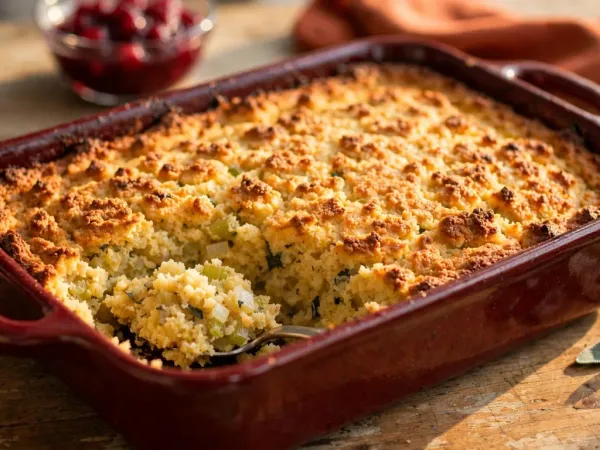
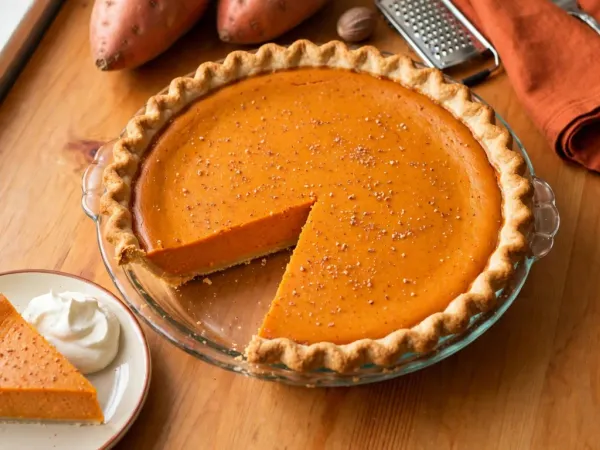
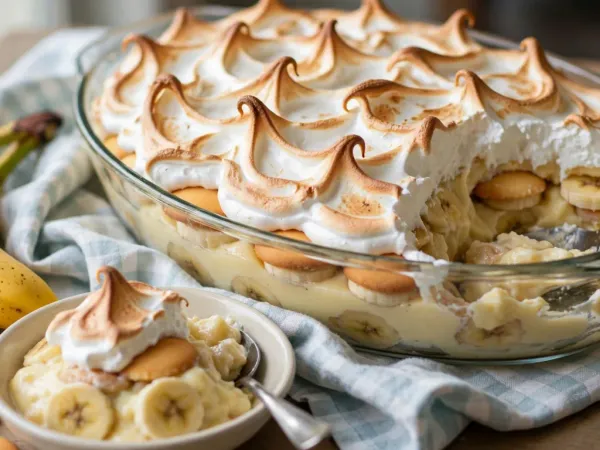
Cut it in squares and bring it out warm. On a Southern holiday table it belongs next to cornbread dressing, with sweet potato pie or banana pudding to follow. On an ordinary Sunday, it turns a classic pot roast into a feast.
Leftovers
Do not leave the dish out for more than 2 hours. Move what is left into shallow containers so it cools fast. The USDA’s leftovers guide allows 3 to 4 days chilled, or 3 to 4 months frozen. A frozen casserole can go straight into the oven without thawing.
Some recipes ask for room-temperature eggs. Take them out shortly before you start: the USDA says eggs should not sit out for more than 2 hours.
Allergens
This dish contains milk, wheat and eggs. All three are on the FDA’s list of major food allergens.
Nutrition
One square, a twelfth of the dish, has about 475 calories. That comes with 23 g of protein, 27 g of fat, 34 g of carbohydrate and 1.2 g of fiber. The numbers are our arithmetic on USDA FoodData Central entries for the pasta, cheeses, milks, eggs and butter.
Sodium is about 640 mg a square. More than half of it comes from the cheese. Salt that the pasta takes up from its water is not counted.
Frequently asked questions
Does Southern mac and cheese have eggs in it?
Often, but not always. Twelve of the 23 recipes we compared use eggs, usually 2 for each pound of pasta. Ten rely on a flour-and-butter white sauce and use none.
Can I use sweetened condensed milk?
No. Condensed milk is full of sugar. Use unsweetened evaporated milk, or replace it with half-and-half.
Should I cover the dish while it bakes?
Most cooks do not: 19 of the 23 recipes bake uncovered. Millie Peartree covers hers with foil for 30 minutes, then adds the top cheese and broils it for 3 to 5 minutes.
What temperature is baked mac and cheese done at?
With eggs in it, the centre should reach 160°F (71°C), the USDA’s figure for casseroles that contain eggs. Reheated leftovers should reach 165°F (74°C).
Can I assemble it the night before?
Yes. Cover it, refrigerate it, and bake it within 24 hours. Add the top layer of cheese just before baking.
Can I freeze it?
Yes, once it is baked and cooled. The USDA gives frozen leftovers 3 to 4 months for best quality. Reheat to 165°F (74°C).
Why is it called macaroni pie?
It is a name for the custard style in her part of the South, says Mandy Rivers of South Your Mouth. The phrase is old: a guest of President Jefferson wrote of “a pie called macaroni” in 1802.
Tags: ThanksgivingChristmassoul foodcheesepastacasserolemake aheadholidayside dish