The Sunday Potthesundaypot.com/recipes/napa-cabbage-kimchi/
Napa Cabbage Kimchi: Classic Korean Baechu-Kimchi at Home
By The Sunday Pot Kitchen Updated
- • Salt a 2.5 kg cabbage in brine plus coarse salt on the stems for 6 to 8 hours, until the stems bend without snapping
- • Rinse three times in cold water and drain for 1 hour
- • Per kilo of cabbage, the recipes we compared use a median 27 g of gochugaru, 26 g of fish sauce and 17 g of salted shrimp
- • Leave the jar at room temperature for 1 to 2 days, then keep it at 40°F (4°C) or below
- • It ripens in about 2 weeks and keeps souring for months
- • Throw it out if you see mold or smell rot rather than sourness
Ingredients
40 servingsInstructions
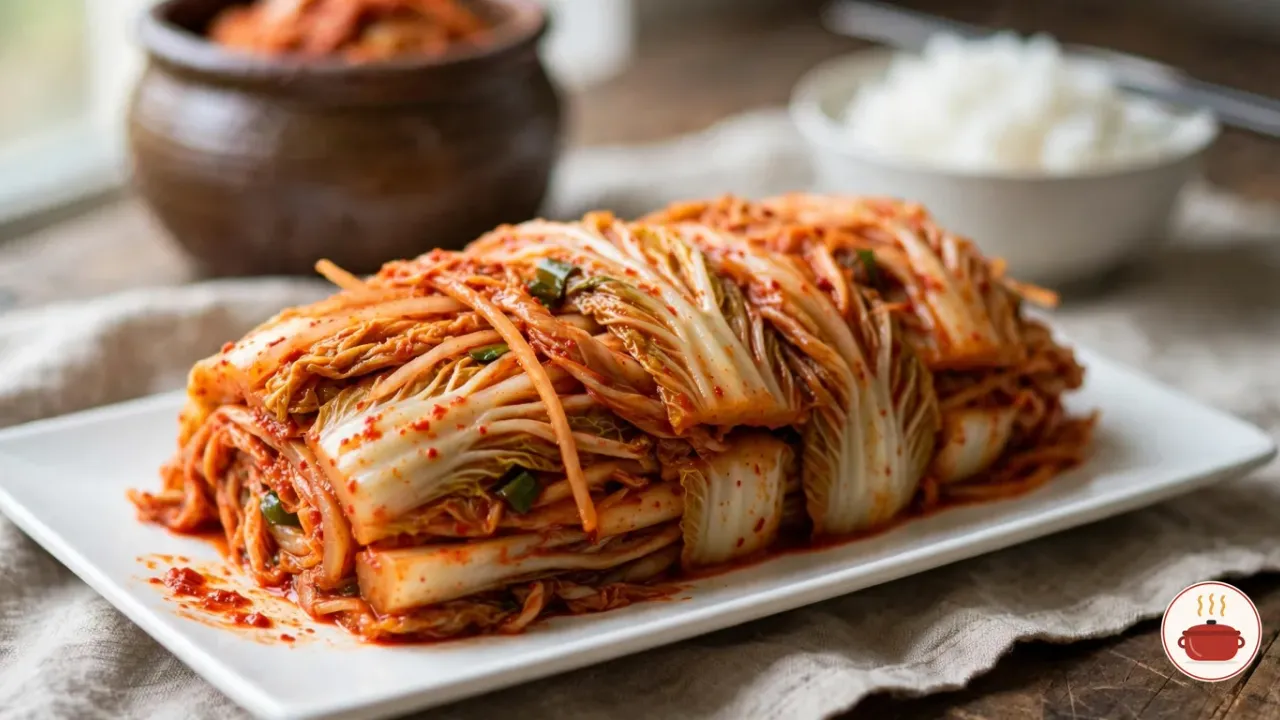
Napa cabbage kimchi, or baechu-kimchi, is the everyday kimchi of Korea. A whole cabbage is salted for hours, then layered leaf by leaf with a red paste of chili flakes, garlic, fish sauce and radish. This recipe makes one head. It takes a day of work, a day or two on the counter and two weeks in the fridge.
What napa cabbage kimchi is
The kimchi most Koreans mean
Korea has more than 200 kinds of kimchi. The napa cabbage kind is the best known, “often addressed as simply kimchi”, a 2023 review in the Journal of Ethnic Foods notes. It is also the most eaten, followed by kkakdugi, the cubed radish kimchi.
It comes in two main forms. In tongbaechu-kimchi, the cabbage stays in halves or quarters and the seasoning goes between its leaves. That is the kind made in bulk at kimjang, when families put up a winter’s supply each autumn. In mak-kimchi, the cabbage is cut into bite-sized pieces first, which is quicker for a small batch.
A young form of an old food
Koreans have pickled vegetables for many centuries, but red cabbage kimchi is recent. Chili peppers came from the Americas and reached Korea around the time of the Japanese invasions of the 1590s. That is the most widely accepted account today. A September 2026 overview in the Korean weekly Weekly Kyunghyang sums up the record.
Chili was rare in Korean cookbooks of the 1600s. A text thought to date from the 1720s gives kimchi made with chili, and a 1766 farm manual seasons cucumbers with chili powder and garlic. Until late in the Joseon era, radish was the main kimchi vegetable. Firm, heading cabbage was grown reliably only in the 19th century. Recipes that stuff the seasoning between cabbage leaves appear clearly only at its end.
In the 20th century, whole-cabbage kimchi became the heart of kimjang. The weekly calls today’s red tongbaechu-kimchi “a relatively late form” in that long history (our translation).
The cabbage itself
Napa cabbage once grew loose, like lettuce. Long selection gave today’s tight heads, according to the Encyclopedia of Korean Culture. A head averages about 3 kg, and the main crop is sown in August and harvested in November, just in time for kimjang.
Kimjang
UNESCO added kimjang in South Korea to its list of the intangible heritage of humanity in 2013, and kimchi-making in North Korea in 2015. Its file describes a year-long cycle. Families buy sea salt in summer and dry and grind red chilies in late summer. In autumn, they watch the weather forecasts to pick the best day.
Why kimchi is in the news this autumn
Cheap cabbage, dear shrimp
This year the cabbage is cheap and the seasonings are not. On October 6, a head of napa cabbage cost 6,256 won at retail, more than 6% less than a year before, YTN reported from government price data. A kilo of salted shrimp cost 18,973 won, up more than 23%.
The Korea Rural Economic Institute expects the autumn cabbage harvest to reach 1,222,000 tonnes, up 19.3%, Asia Today reported on October 19. The agriculture ministry plans to announce its kimjang measures in early November. The official survey of what kimjang costs a family of four usually comes in November too.
Kimchi Day and the kimjang festivals
Kimchi Day falls on November 22, a national day of its own under Korean law since 2020. The city of Iksan holds its kimjang festival on November 21 and 22, with places for 880 teams, MTN reported on October 16. Each kit holds 7 kg of salted cabbage and 3.5 kg of seasoning.
In the US dietary guidelines
In January 2026, the new Dietary Guidelines for Americans named kimchi for the first time. The guidelines list it among fermented foods, with sauerkraut, kefir and miso, that support a diverse gut microbiome, “which may be beneficial for health”. That is a cautious line, not a promise. Korea’s agriculture ministry links that mention to kimchi’s success in North America. The region took about 40% of Korea’s kimchi exports in the first half of 2026, some $31 million.
We found no 2026 figure for how much kimchi people make at home outside Korea.
What goes into napa cabbage kimchi
We compared 31 recipes. Twenty are Korean: a Rural Development Administration video, a 1997 university study that set standard ratios, the magazine Lady Kyunghyang and home cooks on the recipe site 10000recipe. Eleven are in English, from Korean Bapsang, My Korean Kitchen, the Korea Tourism Organization, America’s Test Kitchen, Eric Kim and others.
The ratio per kilo of cabbage
We worked everything out per 1 kg of raw, trimmed cabbage, counting an unweighed head as 2.5 kg. The medians are 27 g of gochugaru, about 4½ tablespoons, and 12 g of garlic. Then come 2 g of ginger, 26 g of fish sauce, 17 g of salted shrimp and 135 g of radish.
For one 2.5 kg head, this recipe uses 65 g of gochugaru, 30 g of garlic, 5 g of ginger and 60 ml of fish sauce. It adds 40 g of salted shrimp and 340 g of radish.
What most cooks add
A cooked starch paste goes into 21 of the 31. Sixteen of those use glutinous rice flour. Twenty-four add a sweetener, and 16 add pear or apple. Fish sauce is in 27, salted shrimp in 22, and 3 use no seafood at all.
Salt and time
Fourteen recipes dip the halves in brine and then sprinkle salt on the stems, the method used here. For whole halves, the median salting time is 7 hours; cut cabbage needs about 2. Most rinse two or three times. Fifteen give a time on the counter before the fridge, with a median of 36 hours.
How to make napa cabbage kimchi
Salt by the bend, not the clock
The time depends on the cabbage, the salt and the room. “Judge the salting by how softly the stems bend, not by the clock,” a home cook advises on 10000recipe (our translation). Korean Bapsang says the cabbage is ready “when the white parts of the leaves are bendable”. A little resistance is fine.
Rinse it gently in cold water
Rinsing washes off the extra salt and the grit between the leaves. The Rural Development Administration’s kimchi video rinses the cabbage two or three times in plenty of cold water, so the leaves don’t bruise (our translation). Then drain it cut side down.
Use coarse salt, and the full amount
Korean cooks use coarse sea salt, cheonilyeom. Korean Bapsang suggests about a quarter less if you use fine salt, since it packs more densely. US preserving guidance from the National Center for Home Food Preservation prefers pickling salt to iodized table salt. It also warns against cutting back the salt in a ferment, because salt matters for safety as well as taste.
Let the chili flakes soak
Mix the seasoning before you start on the cabbage. The flakes soak up the liquid and swell, so the paste clings instead of sliding off, one 10000recipe cook explains. The paste should taste a little too salty on its own.
Pack tight and leave room
Press the kimchi down hard to push out air, and leave 2 inches of space at the top, as America’s Test Kitchen does. Kimchi makes gas, so close the lid loosely. Cookbook author Eric Kim presses the top down every 2 to 3 days at first to let gas escape, or the jar may overflow.
Covering the top with outer leaves cuts the spoilage that comes from contact with air, the Rural Development Administration says. It also keeps the cabbage under its own juice.
How it ripens
Lactic acid bacteria do the work. Below 10°C, a species called Leuconostoc mesenteroides leads the ripening, researchers at the World Institute of Kimchi explain. Later, and faster in warmer rooms, Lactobacillus plantarum takes over and makes the kimchi more and more sour.
Serving and storing kimchi
How to serve it
Cut a quarter into 1½-inch (4 cm) pieces across the leaves just before serving, and set it out with rice at any meal. Young kimchi is crisp and fresh. Old, sour kimchi is best cooked, in kimchi jjigae or fried rice. Fresh kimchi also sits well beside a plate of fiery buldak and rice.
Fermenting safely at home
The University of Georgia Extension’s guide to homemade kimchi gives the steps. Wash your hands and tools, pack the jar tightly and leave it loosely covered at room temperature for the first 48 hours. Then keep it at 41°F (5°C) or below.
Bubbles in the first day or two are normal. By days 5 to 7, the kimchi tastes tangier and softer. After about 2 weeks it reaches a pH below 4.6, acidic enough to hold back most foodborne germs, the guide explains. Mold, an odor unlike its usual sour smell, or a slimy texture are signs of spoilage: throw the batch out.
Kimchi is never cooked, so clean hands matter. In July 2024, norovirus in factory-made kimchi sickened 862 people at 24 schools in a South Korean city, a 2025 study found.
How long it keeps
Kimchi keeps souring in the fridge. Korean Bapsang says it stays delicious for a couple of months. Eric Kim keeps his for up to 6 to 8 months, by then very sour and best for cooking.
Sodium, calories and allergens
A ⅓-cup (60 g) serving has about 20 calories and 600 mg of sodium, about a quarter of the FDA’s daily value of 2,300 mg. We used USDA FoodData Central figures. We counted only the salt the cabbage keeps, about 2% of its brined weight, the middle of what Korean studies measured. USDA lists no salted shrimp, so we counted it as shrimp with a fifth of its weight in salt.
It contains fish and shellfish, two of the major allergens the FDA lists. In May 2026, a US brand of sliced kimchi was recalled because its label left out anchovies.
Fixes for kimchi that is too salty, too bland or too soft
- Too salty right after mixing: it mellows as it ferments. Add a little radish or lightly salted cabbage, and taste again in 3 days.
- Not sour after a week: the fridge is too cold or the kimchi is young. Leave it out for half a day more, or wait another week.
- The stems snap and the kimchi is stiff: it was not salted long enough. Next time, wait for the bend test.
- Soft, mushy kimchi: it was salted too long, or fermented too warm. Move it to the fridge sooner.
- The jar overflows: it was packed too full. Leave 2 inches (5 cm) of space and press it down every few days.
- The top leaves turn dry and pale: press them back under the juice, or cover them with an outer leaf.
Substitutes for hard-to-find ingredients
- Gochugaru: there is no good substitute. Other chili powders are hotter or contain cumin and garlic, so buy Korean flakes online or at an Asian grocer.
- Salted shrimp: 1 more tablespoon of fish sauce.
- Fish sauce and salted shrimp, for a vegan kimchi: soy sauce, with a little kelp stock and grated pear for sweetness.
- Korean radish: daikon.
- Glutinous rice flour: 1 tablespoon of all-purpose flour, or leave the paste out.
- Korean coarse sea salt: kosher salt, weighed, or a quarter less fine salt.
Frequently asked questions
How long does homemade kimchi last?
Kept at 40°F (4°C) or below, it lasts for months, getting more sour. Throw it out if you see mold or it smells rotten rather than sour.
Why is my kimchi not sour yet?
It needs time and some warmth. Leave it at room temperature for 1 to 2 days before the fridge, then give it about 2 weeks.
Can I make kimchi with regular green cabbage?
Yes, but it makes a different kimchi, crunchier and less juicy. Cut it into pieces and salt it like mak-kimchi.
Do I need fish sauce for kimchi?
No. Temple-style and vegan kimchi use soy sauce or soybean paste with kelp broth instead. Three of the 31 recipes we compared use no seafood.
Why do you rinse the cabbage after salting?
To wash off extra salt and grit between the leaves. Rinse two or three times in cold water.
How do I know the cabbage is salted enough?
The thickest white stem bends in half without snapping. In our recipe that takes 6 to 8 hours.
Is it normal for kimchi to bubble?
Yes. Fermentation makes carbon dioxide, so the jar fizzes and the juice rises. Leave space at the top and close the lid loosely.
Do I need the rice paste?
No. Most recipes use it, 21 of the 31 we compared, but kimchi ferments without it.