The Sunday Potthesundaypot.com/recipes/moqueca-baiana/
Moqueca Baiana: Brazilian Fish Stew with Coconut and Dendê
By The Sunday Pot Kitchen Updated
- • Marinate firm white fish in lime, garlic and salt for 20 to 30 minutes
- • Layer raw onion, tomato and pepper rings with the fish in a wide pot
- • Pour over about 400 ml coconut milk and 5 tablespoons of dendê, with no water
- • Simmer covered for 15 to 20 minutes without stirring, until the fish flakes
- • Serve from the pot with rice, farofa and malagueta pepper sauce on the side
Ingredients
6 servingsInstructions
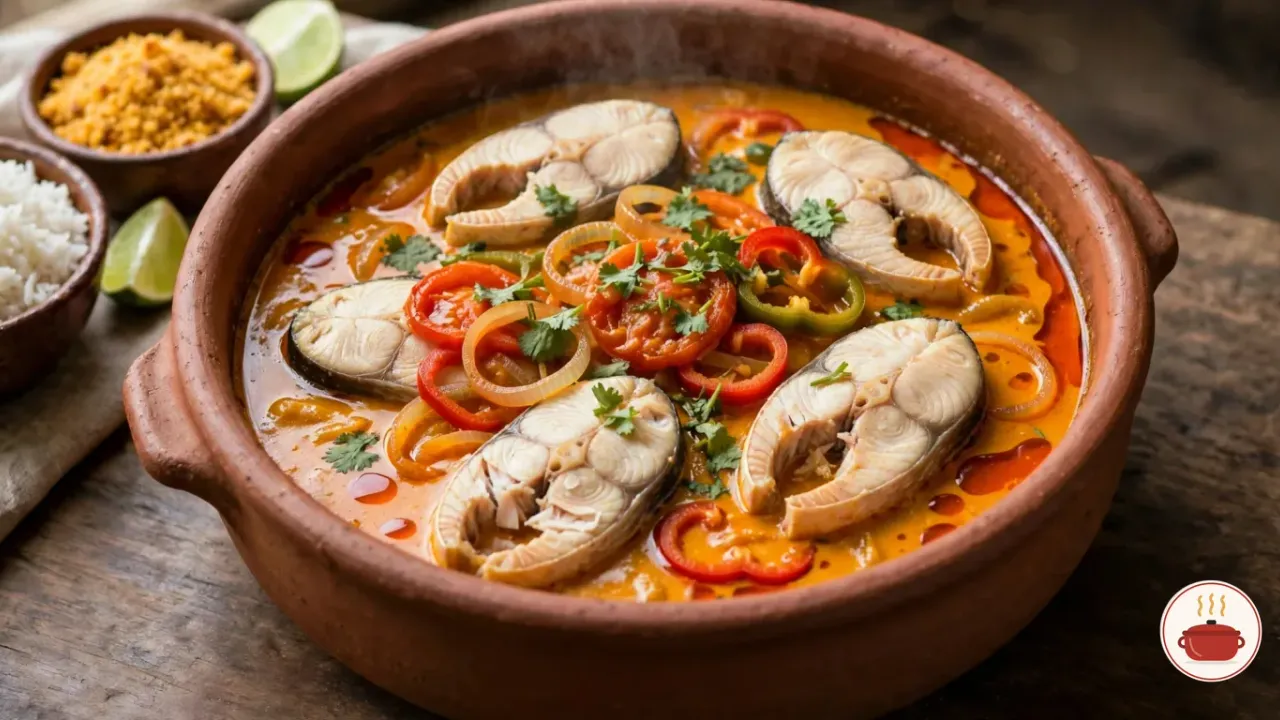
Moqueca baiana is the fish stew of Bahia, in northeastern Brazil. Fish soaked in lime sits on rings of onion, tomato and bell pepper. It simmers in coconut milk and dendê, the red palm oil that turns the broth orange. Cilantro goes on last. It takes about 1 hour for 6 bowls.
What moqueca baiana is
A method as much as a dish
In Bahia, moqueca is a way of cooking, not only a fish dish. “Moqueca baiana is a stew of something,” the Salvador chef Tereza Paim told the newspaper Correio in 2025 (our translation). It is made with dendê and coconut milk, she said, plus onion, tomato, pepper, garlic, cilantro and scallion. Seafood is the best-known kind. At home, she added, people also make it with dried beef, eggs, maxixe gherkins and even oxtail.
The fish version is the classic. It cooks in a wide clay pot and comes to the table in the same pot. For Paim, the clay pot matters for the flavor, “but above all for the scene.”
Orange from palm oil
The color comes from dendê, oil pressed from the fruit of the African oil palm. In its raw state it is deep red-orange, and it smells of flowers and earth. Dendê “acts as the glue that holds this dish together,” writes Yewande Komolafe in NYT Cooking. “There is no substitute for its characteristic floral, smokelike flavor and vibrant orange sheen,” she adds.
Baiana or capixaba: Brazil’s two moquecas
Brazil has two famous moquecas, and their fans argue about which is the real one. The baiana, from Bahia, has dendê and coconut milk. The capixaba, from Espírito Santo, the state just to the south, has neither.
“Milder, the capixaba version contains no dendê or coconut milk,” explains the MICHELIN Guide Brazil (our translation). Instead it uses olive oil and annatto, the seed that tints it red. In all six capixaba recipes we read, annatto and olive oil appear and dendê and coconut milk don’t. Panelinha, Brazil’s best-known recipe site, starts its version by warming annatto seeds in oil.
The rivalry has a famous line. “Moqueca is capixaba, the rest is peixada (fish stew)” is a quip credited to the Espírito Santo journalist Cacau Monjardim. The black clay pots of Goiabeiras, in Vitória, are part of that pride. In 2002, the pot makers’ craft was the first entry in the knowledge register of IPHAN, Brazil’s national heritage institute.
Where moqueca comes from
A word with two possible roots
Nobody agrees where the word comes from. Brazilian dictionaries such as Priberam trace it to mu’keka in Kimbundu, a language of Angola. An older theory points to the Indigenous Tupi language. In 1901, the scholar Teodoro Sampaio wrote that fish roasted wrapped in leaves was called pokeka, meaning “wrapped”, in his book O Tupi na Geographia Nacional.
Câmara Cascudo, the great scholar of Brazilian folklore, followed Sampaio in 1967. In his História da Alimentação no Brasil, he wrote that moqueca began as fish wrapped in leaves and roasted in hot ashes. Coconut milk, dendê, chile, cilantro and onion then gave it its many forms, he wrote.
Leaf-wrapped first, stew later
Old cookbooks show the change. The Cozinheiro Nacional, from the 1800s, has “muquecas” of beef and even tapir. The meat is sliced, wrapped in banana leaves and cooked in hot ashes. The Cozinheiro Imperial, first printed in Rio in 1840, added “moquecas ou moquencas de peixes” only in its fifth edition, its publisher wrote. That came some time after 1859.
The first Bahian recipe we could read
Manuel Querino was a Black Bahian historian, born free in 1851, decades before Brazil ended slavery, the research magazine Pesquisa FAPESP notes. He wrote A Arte Culinária na Bahia in 1922, and it came out after his death in 1923. Its “Moqueca de peixe fresco” is the earliest Bahian moqueca recipe we found (1957 edition, PDF).
Querino washes the fish steaks well with lime and water. He pours over a sauce of salt, malagueta chile, cilantro, lime, tomato and onion, all ground together. Then comes olive oil or azeite de cheiro, his name for dendê, or preferably both. There is no coconut milk in his recipe.
Coconut milk was already part of the Bahian story, though. Querino quotes Dr. L. Pereira Barreto, writing in the newspaper O Estado de S. Paulo in 1922: Bahians are right to be proud of their fish moqueca, and coconut milk and dendê are “two portentous seasonings” of their cooking (our translation).
African oil, Brazilian pot
The oil palm came from West Africa. It reached the coast of Bahia in the 16th century along with enslaved Africans, according to a paper from Embrapa, Brazil’s agricultural research agency. Querino put the change simply: where the Portuguese cook used olive oil, the African cook added dendê. Today, IPHAN’s heritage list for Bahia includes the Baianas de Acarajé, the street cooks whose “comidas de baiana” are made with dendê. It has no entry for moqueca itself.
Why moqueca fits this November
Regional cooking on the 2027 lists
Nestlé USA’s forecast for 2027, out in mid-October, has a trend about regional dishes, not just national ones. Two in three Americans are curious about regional versions of foreign food, it says, citing Mintel, in a statement. It does not mention Brazil. Baiana and capixaba moqueca are a clear case of that idea, two states and two pots.
Black Consciousness Day
On Friday, November 20, Brazil marks the Day of Zumbi and Black Consciousness. It has been a national holiday since a 2023 law. Moqueca isn’t a holiday dish. But its dendê is a lasting mark of the Africans who cooked in Bahia, so it’s a good week to learn its story.
Dearer vegetables, steady fish
In Brazil this year, the vegetables in moqueca went up in price far more than the fish. Over the 12 months to September 2026, onion prices rose 84.98%, lime 54.94% and tomato 39.55%. Fish and seafood rose only 2.49%. The figures come from IBGE, the national statistics office.
IBGE’s 2025 farm survey, released in September, shows another twist. Bahia is dendê’s cultural home, but it grew only 1.3% of Brazil’s palm fruit in 2025. The state of Pará, in the Amazon, grew 97.2%.
On a seafood list, and our honest caveat
In August, the Salvador paper A Tarde reported that the user-rated site TasteAtlas put Tereza Paim’s moqueca baiana among the world’s 100 most iconic seafood dishes. Rankings like that are votes, not measurements. Nobody has published a 2026 count of moqueca sales or searches that we could find.
What 33 moqueca recipes agree on
We compared 33 published moqueca recipes. Nineteen come from Brazil, in Portuguese: Panelinha, Correio, Receiteria, TudoGostoso, Receitas Nestlé and more. Fourteen are in English, including NYT Cooking, America’s Test Kitchen and BBC Good Food.
Coconut milk, cilantro and peppers
All 33 use coconut milk, tomato and onion. Thirty-two use cilantro and 30 use bell pepper. Thirty-one are made with firm white fish. Brazilian recipes name snook, small shark, grouper, corvina and tilapia. English ones use cod, halibut, sea bass and tilapia.
Much more dendê in Brazil
Eighteen of the 19 Brazilian recipes use dendê, but only 10 of the 14 English ones. The Brazilian median is 80 ml per pot, against 30 ml in English. Compared with the coconut milk, Brazilian recipes use about three times as much dendê. This recipe follows the Brazilian balance.
Layered, not fried
This is the clearest split. Thirteen of the 19 Brazilian recipes layer raw onion, tomato, pepper and fish in the pot and pour the liquids over. Only 1 of the 14 English recipes does that; most fry the onions first. “The vegetables will release enough liquid to cook everything perfectly,” says the Brazilian site Receiteria (our translation).
Fish first, shrimp optional
Only 7 of the 19 Brazilian recipes add shrimp, compared with 11 of the 14 English ones. In Brazil, the plain fish moqueca is the everyday one. Fourteen of the 19 Brazilian recipes marinate the fish first, for a median of 30 minutes, mostly with lime, garlic and salt.
Little heat in the pot
Only 6 of the 19 Brazilian recipes put chile in the stew, while all 14 English recipes do. In Bahia the heat usually comes on the side, as a malagueta pepper sauce.
How to keep the fish whole
- Use thick pieces. Steaks or fillets about 1 inch (2.5 cm) thick hold together. Thin fillets fall apart.
- Don’t stir. Shake the pot by its handles instead. “Cook it over low heat and don’t stir too much, so the fish doesn’t fall apart,” advises Estado de Minas (our translation).
- Keep the marinade short. Lime firms the fish, and 20 to 30 minutes is plenty.
- Blend the fats. Whisking the coconut milk and dendê together first helps the sauce stay smooth, a trick from Panelinha.
- Go gently. A slow simmer, not a hard boil, keeps the coconut milk from splitting.
- Clay pot care. Many clay pots need low heat at first and no sudden temperature changes; follow the maker’s instructions.
Ways to vary moqueca
- Moqueca de camarão: all shrimp, cooked for only 5 minutes or so.
- Head and tail in: Panelinha’s recipe from Paloma Jorge Amado puts the fish head and tail in the pot for more flavor.
- Coconut milk at the end: another Panelinha recipe pours it in only 2 minutes before the end, for a fresher coconut taste.
- Capixaba style: annatto and olive oil instead of dendê and coconut milk.
- Egg moqueca: Querino’s book has a moqueca of eggs, a good meatless version.
- Lighter: use less dendê, but keep at least 2 tablespoons for the color and flavor.
Serving moqueca
Set the pot in the middle and let people help themselves. White rice comes with it in 19 of the recipes we read, and farofa, toasted cassava flour, in 9. In Bahia, a farofa made with dendê is common. Some cooks also make pirão, a soft porridge of cassava flour and fish broth.
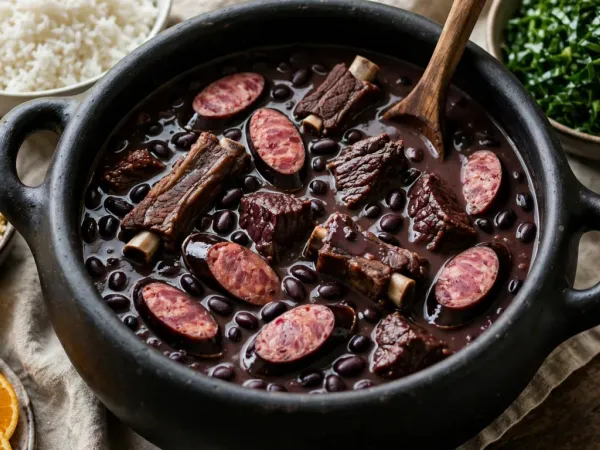
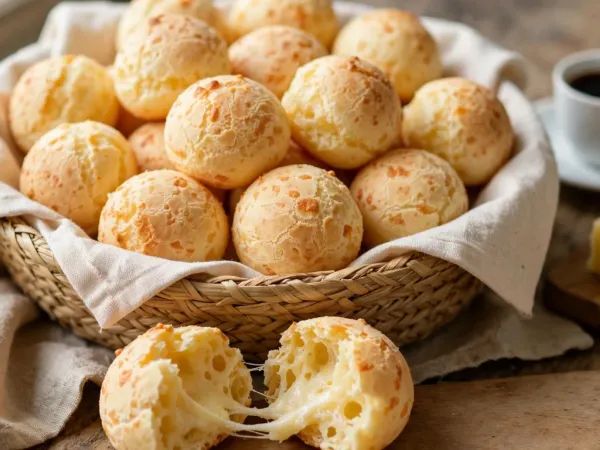
For a Brazilian meal, start with warm pão de queijo, the cheese rolls of Minas Gerais. For a slower Sunday, black-bean feijoada is Brazil’s other great pot.
Safety, storing and nutrition
Cooking fish safely
The FDA says most seafood should reach an internal temperature of 145°F (63°C). Without a thermometer, cook fish until “the flesh is clear and separates easily with a fork,” its guide to fresh and frozen seafood explains. Shrimp turn firm, pearly and opaque.
Buy fish from a fishmonger you trust, keep it at 40°F (4°C) or below, and use it within 2 days. Always marinate in the fridge, never on the counter. In warm seas, reef fish such as grouper and snapper can carry a toxin called ciguatera, the FDA warns. So buy from a good source.
Allergens
Moqueca contains fish, and shrimp if you add it. The FDA counts both fish and shellfish as major food allergens in the US. Coconut is no longer on the FDA’s tree nut list, its labeling guidance says. People can still be allergic to it, so tell your guests. The stew has no gluten or dairy, but check your farofa if you serve it.
Leftovers
Cool leftovers quickly: spread them in shallow boxes and refrigerate them inside 2 hours. The UK’s Food Standards Agency advises eating leftovers within 2 days. Reheat gently until the stew bubbles and reaches 165°F (74°C), the USDA’s figure for leftovers. A slow reheat keeps the fish in pieces. Moqueca doesn’t freeze well, because the fish turns soft.
Nutrition
One bowl, a sixth of the recipe without rice or shrimp, has about 440 calories, with 28 g of fat, 37 g of protein and 13 g of carbs. Add to that about 3 g of fiber and 680 mg of sodium. Our estimate uses USDA FoodData Central figures for snapper, coconut milk, palm oil and the vegetables. USDA has no entry for unrefined red palm oil, so we used plain palm oil.
About 18 g of the fat is saturated, most of it from the coconut milk and dendê. For less, use light coconut milk or 3 tablespoons of dendê. A cup of white rice adds about 200 calories.
Fixes for moqueca that goes wrong
- The fish fell apart: the pieces were thin, or it was stirred. Use thick steaks and shake the pot.
- The broth is pale: too little dendê. Stir in another tablespoon at the end.
- The sauce split: it boiled too hard. Turn the heat down so it barely bubbles.
- It tastes flat: add salt and a squeeze of lime.
- It is watery: the tomatoes were very juicy. Simmer uncovered for 5 minutes after taking the fish out, then return it.
- The shrimp are rubbery: they went in too early. They need only 4 or 5 minutes.
Substitutes for missing ingredients
- Dendê: look in Brazilian, African or Caribbean shops. As a last resort, use a neutral oil with ½ teaspoon of sweet paprika, but it won’t taste the same.
- Firm white fish: snapper, grouper, halibut, cod loin, haddock or monkfish.
- Pimenta-de-cheiro: a mild red chile with the seeds removed, or leave it out.
- Fresh limes: lemon juice works.
- A clay pot: a heavy Dutch oven or a wide, deep skillet with a lid.
- Farofa: toasted breadcrumbs, though cassava flour is the Brazilian way.
Frequently asked questions
Baiana or capixaba: what sets them apart?
Baiana has dendê and coconut milk. Capixaba, from Espírito Santo, uses olive oil and annatto instead.
What fish is best for moqueca?
A firm white fish cut thick, such as snapper, grouper, halibut or cod loin.
What is dendê?
Red palm oil, pressed from the fruit of the African oil palm. It gives moqueca its orange color and floral taste.
Is moqueca spicy?
Not usually. In Bahia, the heat comes from a malagueta pepper sauce on the side.
Can I make moqueca without a clay pot?
Yes. A heavy Dutch oven or a wide pan with a lid works well.
Can I make moqueca ahead?
It is best fresh. You can marinate the fish and slice the vegetables up to a few hours ahead, then cook just before eating.