The Sunday Potthesundaypot.com/recipes/feijoada/
Feijoada: Brazil's Black Bean and Pork Stew, Made at Home
By The Sunday Pot Kitchen Updated
- • Use about 3 parts meat to 1 part dry black beans by weight, as Brazilian recipes do
- • Desalt the carne seca for 12 to 24 hours, changing the water 3 or 4 times
- • Soak the beans, drain them, and boil them hard for 10 minutes before simmering
- • Simmer for about 2½ hours in an open pot, or 2 hours in total by the median recipe
- • Never cook raw dried beans in a slow cooker
- • Add salt only at the end, and split the pot into shallow containers to chill
Ingredients
8 servingsInstructions
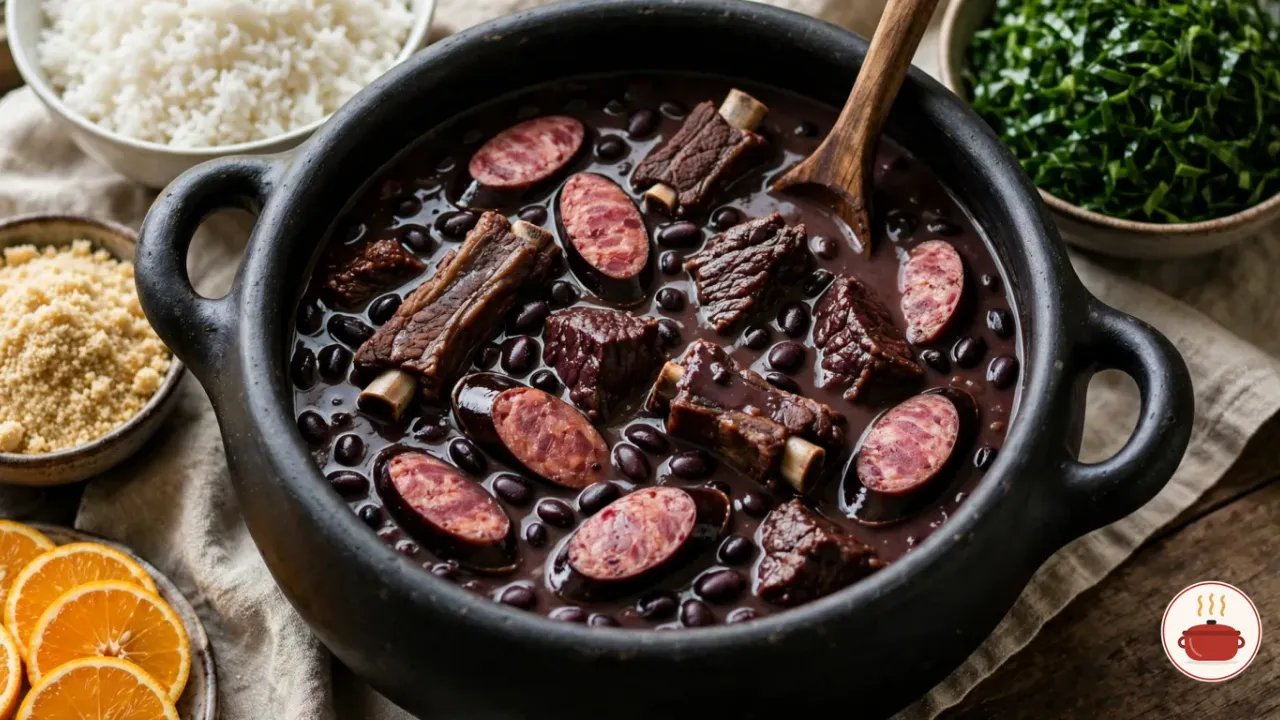
Feijoada is Brazil’s slow stew of black beans with salted beef, pork ribs, smoked sausage and bacon. Served as feijoada completa, it comes with white rice, collard greens, toasted manioc flour and orange slices. This home version serves 8, without ears, feet or tails.
What feijoada is
A stew for a long lunch
“Feijoada is not an everyday dish,” writes the sociologist Carlos Alberto Dória (our translation). It is a meal for a crowd and a long lunch. Which day is feijoada day depends on the city: Friday, Saturday, Wednesday or Sunday.
The full meal has a name of its own, feijoada completa. Then “rice, sautéed kale or collard greens, oranges, and toasted manioc flour accompany the beans”, explains the journal Southern Cultures. Pepper sauce, crackling and a caipirinha often join them.
Black beans in the south and in Rio
Brazil grows many kinds of beans, and feijoada changes with the region. Black beans are the preferred type in Rio Grande do Sul and Rio de Janeiro, says a 2005 study by Brazil’s farm research agency, Embrapa. In Minas Gerais and the center-west, it adds, people eat them “only in special dishes, such as the traditional feijoada” (our translation).
A legend from the slave quarters
Many Brazilians learn that enslaved people invented feijoada from the pork scraps their masters threw away. Historians reject the story. “The oldest references to feijoada have nothing to do with slaves or slave quarters,” wrote the historian Rodrigo Elias (our translation). A 2018 paper from the Federal University of Uberlândia quotes him. They point “to restaurants used by the urban slave-owning elite”.
The paper finds no record of the dish before the 19th century. Enslaved people did eat beans, but watery and rarely with meat. Pig’s feet and tails were eaten in the masters’ houses too.
Portuguese technique, Brazilian beans
The folklorist Luís da Câmara Cascudo called feijoada “Portuguese technique with Brazilian material”, the same paper notes (our translation). Bean stews exist in Portugal too, where feijoada à transmontana is made with red beans and pork.
The earliest mentions are newspaper ads. In 1827, an eating house in Recife served feijoada “always on Thursdays”. By 1849, a Rio eating house offered “feijoada brasileira” at “the request of many customers”. In 1855, another served the “national dish” on Wednesdays and Portuguese feijoada on Saturdays.
Why feijoada is in the news
Black beans cost far more in 2026
Black beans have climbed steeply in price in Brazil this year. In the official inflation index, IPCA, black bean prices rose 27.77% from January to September 2026, and 25.68% over 12 months, according to IBGE’s SIDRA tables.
Poor harvests are behind it. Through May, black beans rose 51.7% at the farm gate and 13.69% in shops, the farm federation CNA reported in June, from the Cepea/CNA index.
A smaller crop on the way
The next crop is late. By October 2, planting of the first 2026/27 bean crop had reached 13.1% of the area, against 16.9% a year earlier, the CNA said on October 13. Growers in Paraná, Santa Catarina and Rio Grande do Sul, the black-bean states, plan to plant less.
The whole dish is a different story. In April 2026, a feijoada for five cost R$94.50 in ingredients, 7.6% less than a year earlier, the data firm Neogrid told IstoÉ Dinheiro. Beans rose 8.4% and pork 9.4%, but the dried, salted and smoked meats fell 12.2%.
Bean stews in a 2027 forecast
In the United States, Whole Foods Market’s trend forecast for 2027, published on October 14, 2026, has a section called “The Bean Boom”. Among the dishes it cites are “heirloom bean stews”, which chefs now treat “more like premium ingredients”. It does not name feijoada.
Nor does any 2026 data. We found no search or sales figure for feijoada itself this year, in Brazil or abroad. What moved was the price of its main ingredient.
What goes into feijoada
We compared 28 published feijoada recipes. Twenty-one are Brazilian and in Portuguese, from Panelinha, TudoGostoso, Receitas Nestlé and Guia da Cozinha. Seven are in English.
About 3 parts meat to 1 part beans
The median recipe uses 2.98 times as much meat as dry beans, by weight. Rita Lobo’s Panelinha states the rule outright: “allow 3 kg of meat for each 1 kg of beans” (our translation). This recipe uses about 3 lb (1.4 kg) of meat for 1 lb 2 oz (500 g) of beans.
Salted, smoked and fresh meats
Most Brazilian recipes mix three kinds of meat. Carne seca, a salted and dried beef, brings depth. Smoked sausages such as paio and linguiça calabresa bring smoke, and pork ribs and bacon bring fat and body.
In 25 recipes out of 28, salted or cured cuts need desalting first. Only 12 include pig’s ears, feet or tails, and neither Panelinha recipe does. The version without them is the mainstream one.
Black beans, soaked or not
Seventeen recipes soak the beans for 2 hours or more. Panelinha soaks them for just 30 minutes, since “if the beans soak too long they can lose their color” (our translation). For safety, this recipe follows the FDA’s longer soak.
Bay leaf and orange
Twenty-five recipes add bay leaves. Eleven put an orange in the pot, often halved, with its peel, and lift it out before serving. Four add a splash of cachaça.
How to make feijoada
Desalt the carne seca
Brazilian carne seca is very salty. Soak it in the fridge for 12 to 24 hours and change the water often. Panelinha changes it “every 3 hours, preferably” (our translation). Thirteen recipes also blanch the meats in boiling water, then throw the water away.
Boil the beans hard first
Dried beans hold a lectin, phytohaemagglutinin, that makes people sick when the beans are undercooked. Ten minutes at a full boil, 100°C, “completely destroyed” it in a study cited by the FDA’s Bad Bug Book. The FDA asks home cooks to soak dried beans 5 hours or longer and discard that water. Then boil them in a new pot of water for half an hour or more.
The FDA adds that “slow cookers should not be used” for these beans, since they may never get hot enough. A feijoada boils first and then simmers for hours, which is far more than enough.
Low and slow
Cooking times have a median of 2 hours: 2½ in an open pot, and 2 in a pressure cooker, which 13 recipes use. Panelinha’s open-pot version simmers for 5 hours. The beans should be soft and creamy, and the broth thick.
Mash a few beans
Mashing a couple of ladles of beans thickens the broth, as Panelinha and several other recipes do. Frying the onion and garlic in a skillet, then mixing in some beans, gives the stew its savory base.
Salt at the end
The meats release salt for the whole cooking time. Taste only once the stew is done, and you may find it needs none.
Serving and storing feijoada
The feijoada completa
Serve it with plain white rice, collards cut in very thin ribbons and sautéed for 1 to 2 minutes, farofa and orange slices. The orange cuts the richness. For another South American table, try sopa paraguaya, Paraguay’s cheese cornbread. For another long pot of beans, try Mexico’s frijoles de la olla, and for pork, sausage and patience, Poland’s bigos.
Better the next day
Panelinha cooks its feijoada ahead, rests it overnight and serves it the next day or the day after. A full pot cools slowly, which lets bacteria grow, warns the USDA. Ladle the stew into shallow containers instead.
Get them into the fridge within 2 hours. The stew keeps 3 to 4 days there, and 3 to 4 months frozen. Reheat it until it bubbles all over.
Meat temperatures
Every meat in feijoada simmers for well over an hour, far past the USDA’s 145°F (63°C) for pork, in its temperature chart. The one to watch is fresh sausage. “Uncooked sausages that contain ground beef, pork, lamb or veal should be cooked to 160 degrees F,” says the USDA.
Calories and salt
A bowl of the stew, without rice or sides, has about 680 calories, 43 g of protein, 37 g of fat and 10 g of fiber. These figures add up USDA FoodData Central values for each ingredient, divided by 8.
The sodium is the high number. Counted before desalting, a bowl holds up to about 1,870 mg. The FDA’s daily value is “less than 2,300 milligrams”. Desalting and blanching lower it, and you can use more fresh pork and less cured meat.
Feijoada has no wheat, so it is naturally gluten-free, but check the labels of the sausages. The farofa contains butter, which is milk.
Fixes for feijoada that is salty, thin, hard or gray
- Too salty: the carne seca needed more soaking. Add unsalted cooked beans or water, and serve with plenty of rice.
- Thin and watery: mash more beans and simmer uncovered for 20 to 30 minutes.
- Beans still hard: they were old, or the simmer was too low. Keep simmering, and add hot water if needed.
- Gray, not black: the beans soaked too long. Panelinha warns that a long soak can fade their color.
- Greasy: skim the fat from the surface, or chill the stew and lift off the fat.
- Bland: fry the onion and garlic longer, and add a little more smoked sausage.
- Meat falling apart: add the sausages later, for the last hour only.
Substitutes for missing ingredients
- Carne seca: corned beef brisket, soaked and blanched like carne seca, or beef chuck if you skip the salted taste.
- Paio and linguiça calabresa: Portuguese linguiça, smoked kielbasa or cured Spanish chorizo, which turns the stew redder.
- Salted pork ribs: fresh or smoked pork spareribs, or a smoked ham hock.
- Black turtle beans: canned black beans, about 7½ cups (five 15-oz cans), rinsed and added for the last 30 minutes only.
- Collard greens: kale, cut into thin ribbons.
- Farinha de mandioca: look in Brazilian or Latin grocers. Tapioca starch is a different product and won’t work.
Frequently asked questions
Did enslaved people invent feijoada?
That is a popular legend, but historians have found no record of it. The first mentions of feijoada are in the menus of 19th-century eating houses in Recife and Rio.
Do I have to use pig’s ears, feet and tails?
No. Most recipes we read leave them out, including Panelinha’s. Use ribs, sausages, bacon and dried beef.
Can I make feijoada in a pressure cooker?
Yes. Nearly half the recipes we read use one. Fill it no more than its maximum line, since beans foam and expand.
Can I make feijoada in a slow cooker?
Not from raw beans. The FDA warns that slow cookers may not get hot enough to destroy the toxin in raw beans. Boil the beans hard first, or use a pot on the stove.
Why put an orange in feijoada?
Eleven of the recipes we read put an orange in the pot, and most serve orange slices on the side. Its sharpness balances the rich, salty meats.
What day do Brazilians eat feijoada?
It depends on the city: many restaurants serve it on Wednesdays or Saturdays, a pairing seen on a Rio menu as early as 1855. In Rio it is also the dish of São Jorge’s Day, April 23, says the news site Terra.
Can I freeze feijoada?
Yes. Freeze it in shallow containers, use it within 4 months, and thaw it in the fridge overnight.
Is feijoada gluten-free?
The stew is, if the sausages are. Check their labels, and serve it with plain rice and farofa.