The Sunday Potthesundaypot.com/recipes/khao-soi/
Khao Soi: Northern Thai Curry Noodle Soup with Chicken
By The Sunday Pot Kitchen Updated
- • Six bowls take 12 chicken drumsticks, 2 cans of coconut milk, 3 cups (720 ml) of water and 1¼ lb (570 g) of fresh egg noodles
- • Black cardamom, coriander seed, dried chilies, shallots, ginger and turmeric make the paste
- • Fry the paste in ½ cup (120 ml) of coconut cream for 8 to 10 minutes, until oil shows
- • Simmer the drumsticks gently, uncovered, for 40 to 45 minutes
- • Fry about a fifth of the noodles at 350°F (175°C) for the crispy topping, and never let the oil smoke
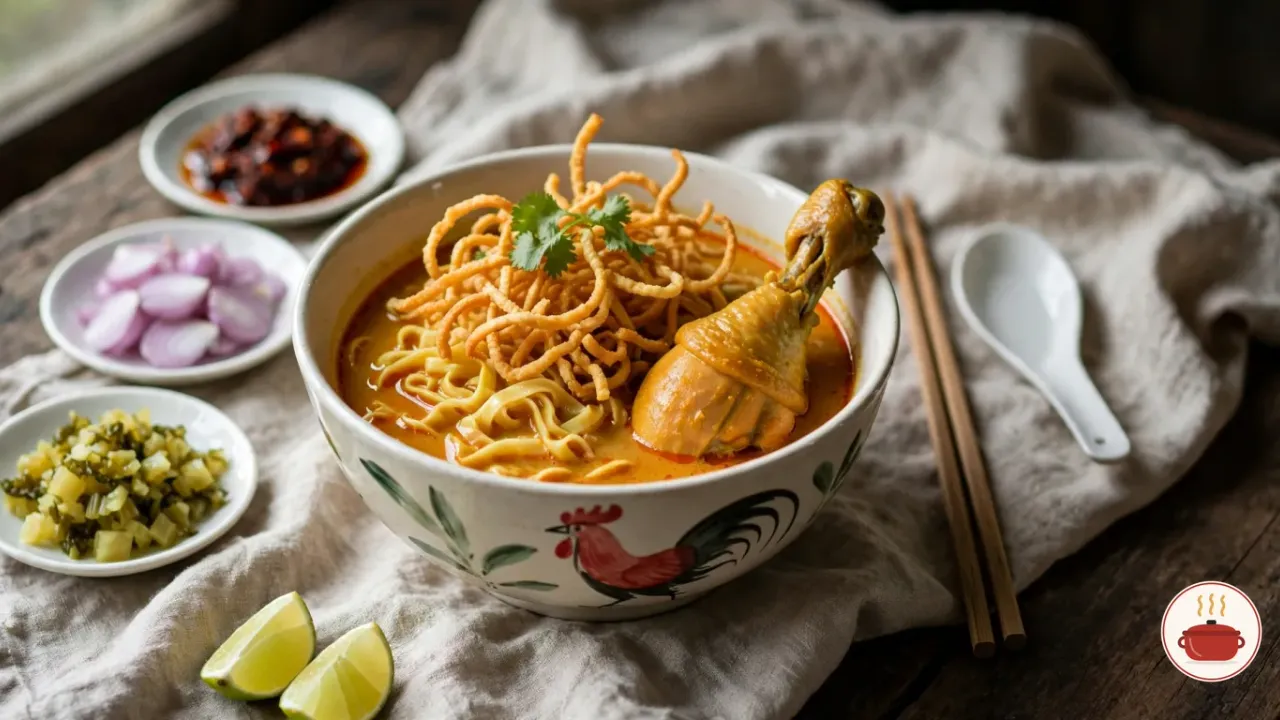
- • Season the curry a little salty, and serve pickled mustard greens, shallots and lime on the side
Ingredients
6 servingsInstructions
Khao soi is northern Thailand’s famous curry noodle soup: chicken simmered in a coconut curry scented with black cardamom, over soft egg noodles, under a nest of crispy ones. This version makes its own paste in about 30 minutes, cooks in one pot, and serves 6.
What khao soi is
Khao soi is a bowl of wheat-and-egg noodles in a mild, rich coconut curry, with chicken or beef. Crispy fried noodles go on top. Pickled mustard greens, raw shallots, lime and chili oil come on the side, so each person seasons their own bowl.
It is often called Chiang Mai noodles in the West. Yet it is eaten all over northern Thailand, and did not begin in Chiang Mai, the Thai-born cook Pailin Chongchitnant explains on Hot Thai Kitchen.
Two stories behind the name
Khao means rice, and soi means to slice thin. The usual story is that the first noodles were cut from sheets of rice dough. The MICHELIN Guide tells it that way. A Haw vendor told the Bangkok magazine THE STANDARD that the first noodles were sliced from pounded sticky rice. Egg noodles and coconut milk came later, he said.
Others hear the Burmese word khauk swè, which simply means noodles. The writer Austin Bush, who lived in Thailand for more than 20 years, thinks the name probably comes from it. Chongchitnant leans the same way.
A dish of the caravan traders
Most writers trace khao soi to the Chin Haw, Chinese Muslims from Yunnan who ran trading caravans through the region. The MICHELIN Guide dates them to the 19th century. Their faith explains why khao soi comes with chicken or beef, and rarely pork.
To reach Thailand, the traders crossed Myanmar. There they would have met ohn no khauk swè, a Burmese coconut noodle soup that looks much the same. The Chiang Mai chef Phubase Chuprakong told SBS Food that the local soup was clear before they came. They added the coconut milk and spices.
Their descendants still live in Chiang Mai, in the Ban Haw community. It grew from Yunnanese Muslims who settled there in the late 19th century, Chiang Mai Citylife writes.
Beef first, then chicken
The dish was originally beef only, the Bangkok Post wrote in 2015. Chicken came later. Today, most shops use drumsticks, because they are easy to handle, THE STANDARD notes.
The same magazine sorts Chiang Mai’s khao soi into 3 kinds: the Haw version, the version of South Asian Muslims, and the local Northern Thai one. Muslim shops follow halal rules for their meat, and many blend their own spice powder.
Not the khao soi of Laos
Across the border, khao soi means something else. In Laos, it is rice noodles in clear broth under a sauce of minced pork, bean paste and tomato, as SBS Food describes it. This recipe is the Chiang Mai curry.
Why khao soi is having a moment
In February 2026, TasteAtlas users rated khao soi the second-best noodle dish in the world, behind Yokohama-style ramen, The Thaiger reported. The list comes from user ratings, not a jury, and TasteAtlas updates it through the year.
Restaurants abroad are building menus around it. In January 2026, OK Chicken & Khao Soi opened in Portland, Oregon, in the old Pok Pok building. Portland Monthly called it “easily the buzziest local opening of the year”. In September, The New York Times named it one of its 50 favorite restaurants in the United States, Your Oregon News reported.
In London, a Chiang Mai noodle bar named Khao-Sō-i opened in Fitzrovia in late 2025. Its 2024 pop-up had served around 400 diners a day, Broadsheet reported. That November, Harden’s counted 3 new Thai restaurants in the city with “khao” in their name.
Trend watchers saw this coming. In August 2025, the menu researchers Datassential found Thai food on 53% of US restaurant menus. They expected more menus to name Northern Thai food, rather than Thai in general.
At home, the best-known khao soi shops keep their crowds. Khao Soi Mae Sai in Chiang Mai holds a Bib Gourmand in the MICHELIN Guide Thailand 2026, for good food at a fair price.
We found no sales or search figure for khao soi itself. The pull is also the weather. In Thailand, the cool season officially begins in late October, and the coldest weeks run from mid-December to early February, the Bangkok Post reported. In the north, that is khao soi weather.
What you need for khao soi
Dried chilies and black cardamom
The paste rests on mild dried chilies, shallots, ginger, turmeric and coriander seed. In Thailand, cooks use dried spur chilies. Abroad, Chongchitnant uses guajillo or puya chilies, which are mild and easy to find.
Black cardamom is the spice that makes khao soi taste like no other curry, she writes. It smells of smoke and leather. Buy it at a Chinese or Indian grocer. If you cannot find it, use 9 green cardamom pods instead: they taste different, but still good.
Chicken drumsticks
Drumsticks are the usual cut in Thailand, because the bones make the broth rich, Chongchitnant notes. Bone-in thighs work too. Do not rinse the raw chicken: the USDA warns that washing poultry spreads bacteria around the kitchen.
Coconut milk
Use full-fat coconut milk, not light. Choose a brand with few ingredients: gums such as guar keep the fat from separating, and the paste fries best when it does. Do not shake the cans, so the thick cream stays on top.
Fresh egg noodles
Look for fresh, flat wheat-and-egg noodles in the refrigerated section of an Asian grocer. They are often sold as wonton noodles. Round ones work too.
Pickled mustard greens and the condiments
Thai pickled mustard greens are sour and crunchy, and they cut the richness of the curry. Buy them in bags at an Asian grocer, and rinse them before chopping. Raw shallots, lime and chili oil do the same job.
How to make khao soi taste like Chiang Mai
We compared 15 published recipes, 8 of them by Thai cooks. They agree on more than they differ.
Fry the paste until the oil shows
Nine of the 15 recipes fry the paste in a first splash of coconut milk or cream, until the oil separates. Store pastes need 2 to 3 minutes. A raw paste made from scratch needs longer: about 8 minutes for Andy Ricker in Pok Pok, and 10 to 15 for Bush. This recipe gives it 8 to 10.
Black cardamom and curry powder
Ten recipes use some cardamom, and 8 name black cardamom. Ten add curry powder, usually 1 teaspoon to 1 tablespoon. Only 3 use shrimp paste, so this recipe leaves it out.
Simmer gently for 40 to 45 minutes
Bone-in chicken legs simmer for 30 to 60 minutes across the recipes, most often 40 to 45. Ricker’s rule is a gentle simmer, never a boil, until the meat comes easily from the bone but is not falling off.
About 1 cup of rich broth per bowl
The recipes use 90 to 375 ml of coconut milk per bowl, with a median of 150 ml. Most thin it with water. This one uses about 135 ml of coconut milk and 120 ml of water per bowl. Chongchitnant serves about 1 cup (250 ml) of broth per bowl, because it is rich.
Season it a little salty
Half the recipes season with soy sauce, half with fish sauce. Chongchitnant links the soy sauce to the dish’s Chinese Muslim roots. This recipe uses both. Make the curry a little saltier than you like, she advises, because the noodles dilute it.
Fry the noodles at 350°F, never smoking
The recipes use 75 to 115 g of fresh noodles per bowl, and fry about a fifth of them. Ricker and Chongchitnant heat the oil to 350°F (175°C), Bush to 325°F (160°C). Two older recipes heat the oil until it smokes.
Do not: smoke means the oil is too hot, and fire safety agencies say to turn off the burner. Keep a lid beside the pan, as the U.S. Fire Administration advises.
Variations: beef, a quick paste, boneless chicken
Khao soi nuea, with beef
Use 2 lb (900 g) of beef shank or chuck in 1½-inch (4 cm) chunks. Simmer it covered for 1 hour, then with the lid ajar for 1 to 1½ hours more, until very tender, as Bush does. Add water as the curry reduces.
A quick paste
On weeknights, Chongchitnant doctors store-bought red curry paste. Use 6 tablespoons of red curry paste with 1 tablespoon of curry powder and the turmeric, and simmer 3 cracked black cardamom pods in the curry. Many red curry pastes contain shrimp paste, so check the label.
Boneless chicken
Use 2 lb (900 g) of boneless thighs in large pieces, and simmer them for 20 to 25 minutes. Use low-sodium chicken stock instead of water, for a richer broth.
Less rich
Use 1 can of coconut milk and 4½ cups (1.1 liters) of water. The broth will be thinner, closer to the local Northern Thai style.
Serving and storing khao soi
Serve khao soi hot, with the condiments on the table, so each person adds sour, sharp and hot to taste. For another coconut curry, try Indonesian beef rendang, which cooks down until almost dry. For another chicken braise from Southeast Asia, there is Filipino chicken adobo. A glass of Vietnamese iced coffee suits it afterward.
Make it ahead
The curry tastes even better the next day. Make it up to 2 days ahead, and cook the noodles fresh. Kept airtight, the crispy noodles stay crisp for 1 to 2 days.
Leftovers
Follow the USDA’s advice on leftovers:
- Divide the curry into smaller containers, so it cools quickly, and refrigerate it within 2 hours.
- Eat it within 3 to 4 days, or freeze it for 3 to 4 months.
- Reheat it to a rolling boil.
Keep the curry and chicken apart from the noodles, which turn soft in the broth.
Is the chicken done?
After 40 minutes of simmering, it will be. The USDA’s safe minimum for all poultry is 165°F (74°C), checked with a food thermometer.
Calories and protein
One bowl, with 2 drumsticks, has about 910 calories, 45 g of protein and 52 g of fat. It has about 67 g of carbohydrate, 5 g of fiber and 1,700 mg of sodium. These are estimates from USDA figures. Most of the sodium comes from the soy sauce, fish sauce and pickles. For a lighter bowl, serve 1 drumstick and less crispy noodles.
Allergens
The noodles hold wheat and egg, the fish sauce holds fish, and the soy sauce holds soy. All are among the major food allergens the FDA lists. A store curry paste may add shellfish. Some people also react to coconut, so ask your guests.
Fixes for flat, thin or greasy khao soi
- The paste will not release its oil: the coconut milk has gums in it. Keep frying until the paste is very thick and smells cooked, then move on.
- The curry tastes raw or flat: the paste was not fried long enough. Next time, give it the full 8 to 10 minutes.
- The bowl tastes bland: season the curry saltier, and use the condiments. They are part of the dish.
- The curry is too thick or salty: it reduced too much. Stir in hot water, ½ cup (120 ml) at a time.
- The crispy noodles are soft: they came out too soon. Fry until the bubbling almost stops.
- The crispy noodles brown before they crisp: the oil is too hot. Lower the heat.
- The chicken is falling apart: the curry boiled. Keep it at a gentle simmer.
Substitutes for missing ingredients
- Black cardamom: 9 green cardamom pods.
- Guajillo or puya chilies: dried spur chilies, or another mild dried red chili.
- Fresh turmeric: 1½ teaspoons ground turmeric.
- Fresh egg noodles: dried flat egg noodles, or fettuccine, with store-bought crispy chow mein noodles on top.
- Pickled mustard greens: another crunchy, sour pickle, such as pickled carrots.
- Palm sugar: light brown sugar.
- Dark soy sauce: 1 more tablespoon of light soy sauce and a pinch of sugar.
Frequently asked questions
What does khao soi mean?
Khao means rice and soi means to slice. Many writers think the name comes from khauk swè, the Burmese word for noodles.
Is khao soi spicy?
It is mild. The dried chilies in the paste give color more than heat. Each person adds chili oil at the table.
What is the difference between khao soi and laksa?
Both are coconut curry noodle soups, and some restaurants abroad sell khao soi as curry laksa. Khao soi is the northern Thai dish: it always uses egg noodles, it is seasoned with fish sauce or soy sauce, and it wears a nest of crispy noodles.
Can I use store-bought curry paste for khao soi?
Yes. Doctor red curry paste with curry powder, turmeric and black cardamom, and check the label for shrimp paste.
What noodles are used in khao soi?
Fresh, flat wheat-and-egg noodles, often sold as wonton noodles. About a fifth of them are deep-fried for the topping.
Can I make khao soi ahead?
Yes. The curry keeps 3 to 4 days in the fridge and tastes better the next day. Cook the noodles when you serve it.
Can I freeze khao soi?
Freeze the curry and chicken for 3 to 4 months. Cook fresh noodles when you reheat it.
What do you serve with khao soi?
Pickled mustard greens, sliced shallots, lime wedges and chili oil. Fish sauce at the table is optional.