The Sunday Potthesundaypot.com/recipes/mango-sticky-rice/
Mango Sticky Rice: Thai Khao Niao Mamuang Made at Home
By The Sunday Pot Kitchen Updated
- • Four servings take 1½ cups (300 g) of glutinous rice, 1½ cups (360 ml) of coconut milk and 2 ripe mangoes
- • Soak the rice for at least 4 hours, then steam it on cloth for 20 to 25 minutes; never boil it
- • Pour steaming-hot, never boiling, sweet coconut milk over the rice the moment it leaves the steamer
- • The ratio per 100 g of raw rice: 80 ml of coconut milk, 33 g of sugar and 1.5 g of salt
- • Thicken the salty topping with 1 teaspoon of rice flour and spoon it on at serving
- • Eat it within 2 hours of steaming; chill leftovers within an hour and eat them within 24 hours
Ingredients
4 servingsInstructions
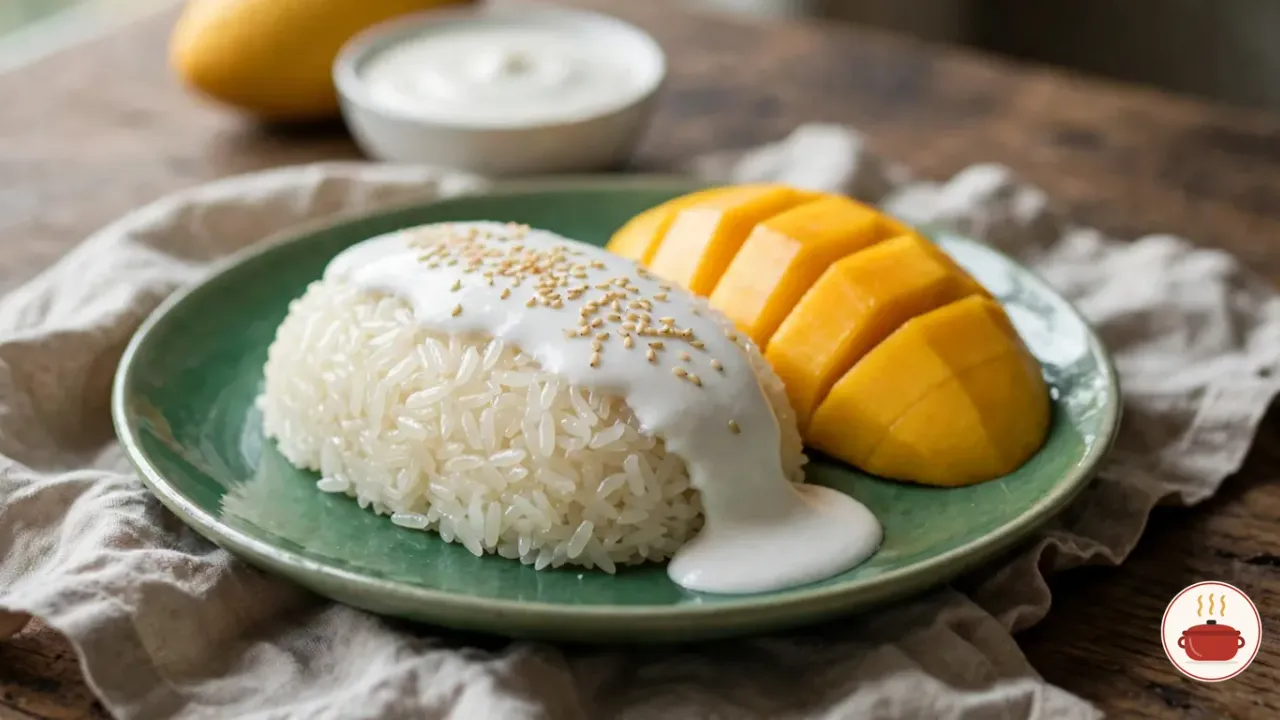
Mango sticky rice is Thailand’s best-loved dessert: glutinous rice steamed, soaked in sweet, salty coconut milk, and served with slices of ripe mango and a spoonful of salted coconut cream. This recipe serves 4. It takes about 50 minutes after a 4-hour soak, and it is vegan and gluten-free.
What mango sticky rice is
In Thai it is khao niao mamuang. Khao niao means sticky rice and mamuang means mango, Thai PBS World explains. The rice on its own, cooked with sweet coconut milk, is khao niao mun. The mango is served beside it, cool and ripe, so each bite has warm, chewy rice and soft fruit.
Rice from the north
Sticky rice is the everyday grain of northern and northeastern Thailand and of Laos. It is seen as the “staff of life” in Isan and the North, the MICHELIN Guide notes. Laos eats 171 kg of it per person a year, the most in the world, according to the Rice Science Center at Kasetsart University. In Thailand’s north and northeast, people eat 125 to 155 kg a year.
How old is it?
Less is known than you might think. King Rama II wrote a poem, Kap He Chom Khrueang Khao Wan, that praises royal food. A 2023 study in a Thai nutrition journal shows that it lists sticky rice with coconut custard among its sweets, and mango among its fruits. It does not pair them.
Thai PBS and The Nation say the pairing was first recorded under King Rama V, who reigned from 1868 to 1910. Neither names the record. Chumpol Jangprai, the chef of R-Haan, a two-star restaurant in Bangkok, has given two dates. In one interview, he traced the dish to the late Ayutthaya period, and in another to the reign of Rama II. So treat any exact date with care.
Nam dok mai and ok rong
Thai cooks use two mangoes. Nam dok mai, “water of the flower”, is the most popular, sweet and smooth. Ok rong is older and pale yellow, and fans find it far more aromatic, though more fibrous. The writer Suthon Sukphisit says only ok rong was once used for the dish. The season is March to May, Thailand’s hot months, around the Songkran new year.
Why mango sticky rice is everywhere in 2026
On 7 October 2026, the menu researchers Datassential named mango one of five “late-stage” foods making a comeback, in a press release on its 2027 trends report. Operators are using these old favorites “in next-level applications and as flavors”, said the trendologist Jaclyn Marks: “think banana coffee and cocktails or mango sticky rice ice cream and pies.”
From Trader Joe’s to the state fair
The dish is already in the freezer aisle. Trader Joe’s frozen Mango Sticky Rice, made in Thailand, reached its stores in the first week of August 2026, at $4.69 for two servings, Chowhound reported. At the Minnesota State Fair, Chan’s Eatery sold a mango milk drink “inspired by the flavors of mango sticky rice”. The station WCCO rated it 4 in its ranking of new fair foods.
In Los Angeles, MadLab Coffee and Sidecar Doughnuts both added mango sticky rice treats in July. Product makers are following. Launches of mango-flavored foods and drinks grew by 10% a year from July 2021 to June 2026. Frozen desserts grew fastest, at 33%, according to Innova Market Insights in Food Ingredients First. Those figures count new products, not sales.
What we could not find
Nobody has published a 2026 sales, search or menu figure for mango sticky rice itself. The dish’s last big spike came in April 2022, when the rapper Milli ate it on stage at Coachella.
That spring, Thailand’s culture department said it was collecting material to push the dish for UNESCO’s heritage list. We found no sign that a bid followed. Thailand’s food entry was tom yum kung, inscribed by UNESCO in December 2024, and its 2026 file is for Thai national dress.
What you need for mango sticky rice
We compared 21 published recipes, at least 11 of them by cooks of Thai heritage. This recipe sits close to their medians.
Glutinous rice
Buy Thai long-grain glutinous rice. It may be labeled “sweet rice” or “glutinous rice”. Check that it is “a product of Thailand”, says the Thai cook Pailin Chongchitnant of Hot Thai Kitchen. The raw grains should be opaque and bright white. “Sticky rice is NOT sushi rice,” she adds. Japanese short-grain sweet rice is also glutinous, but Thai cooks don’t use it for this dish.
Despite its name, glutinous rice has no gluten. “Glutinous” here means sticky, the Gluten Intolerance Group explains. All rice is gluten-free.
Coconut milk
Use full-fat coconut milk, never “light”. Chongchitnant prefers a carton to a can, and the brand with the fewest added ingredients. Guar gum makes coconut milk “artificially thicker, and is not my preference”, she writes in her guide to coconut milk. She also says not to use coconut cream for this dish, though 5 of the 21 recipes do. Never use sweetened cream of coconut, the cocktail mixer: it is about half sugar by weight.
Sugar and salt
White sugar keeps the rice white, Chongchitnant explains. Palm sugar turns the dessert darker, Rachel Cooks Thai warns, though Leela Punyaratabandhu of SheSimmers calls a palm sugar version very good. Don’t skip the salt: every recipe we compared puts some in the rice.
Mangoes in October
Thai mangoes are out of season now. In the US this fall, Brazil is the main supplier, Ecuador’s crop is forecast down about 52%, and prices passed $10 a box by mid-September, FreshFruitPortal reported. In Europe, most mangoes come from Brazil and Peru.
Abroad, Thai cooks pick Ataulfo mangoes, also sold as honey, Manila or champagne mangoes. Avoid fibrous varieties, Chongchitnant advises: large, round, reddish mangoes rarely work. If you can’t find Ataulfo, a soft, ripe Kent or Keitt has few fibers.
Judge ripeness by feel, not color: a ripe mango gives slightly when squeezed, says the National Mango Board. Chongchitnant waits for the skin to wrinkle.
Pandan and the crunchy topping
Pandan leaf, in 11 of the recipes, scents the coconut milk. Asian grocers sell it frozen. For crunch, 8 recipes use toasted sesame alone, 3 use crispy split mung beans, and 6 offer either. Four use nothing.
How to make mango sticky rice that stays chewy
The method is simple, but each step has a reason.
Soak for at least 4 hours
The median soak is 4 hours. Sticky rice can’t absorb much water while it cooks, Chongchitnant explains. So cooks soak it until it is “completely saturated”, then steam it out of the water. That way “there is no chance that it can overcook”, she writes. For an overnight soak, keep the bowl in the fridge.
Steam it, never boil it
Ten of the recipes steam the rice on a cloth in a basket, and only one simmers it in liquid. Boiling “would break the delicate grains apart and render them mushy”, America’s Test Kitchen notes. Glutinous rice “cannot be appropriately done in an ordinary automatic rice cooker”, the Kasetsart rice scientists write. Chongchitnant agrees: “Do not use any other method to cook the rice.”
Hot rice, hot coconut milk
Fourteen recipes pour the coconut milk hot, and six pour it cool. All agree on one thing: the rice must be hot. The rice must be “piping hot”, writes the chef David Thompson, “so it will more completely absorb the coconut cream and become rich and glistening”. This recipe pours both hot, as Hot Thai Kitchen does.
Don’t boil the coconut milk
Five recipes warn against boiling the sweet coconut milk. “Hard boiled coconut milk will curdle,” the Thai cook Natty Netsuwan of ThaiTable writes. Warm it only until the sugar dissolves and it steams.
The salty topping
The topping is a little coconut milk, salted and barely thickened. Eight recipes thicken it with rice flour, four with tapioca starch, and eight don’t thicken it at all. Ten make it sweet and salty, as this one does. Spoon it on just before serving.
The ratios
Per 100 g of raw rice, the medians are 84 ml of coconut milk for the rice, 35 g of sugar and 1.5 g of salt. This recipe uses 80 ml, 33 g and 1.5 g. The sugar varies more than anything else: from 8 g to 100 g per 100 g of rice.
Serving and storing mango sticky rice
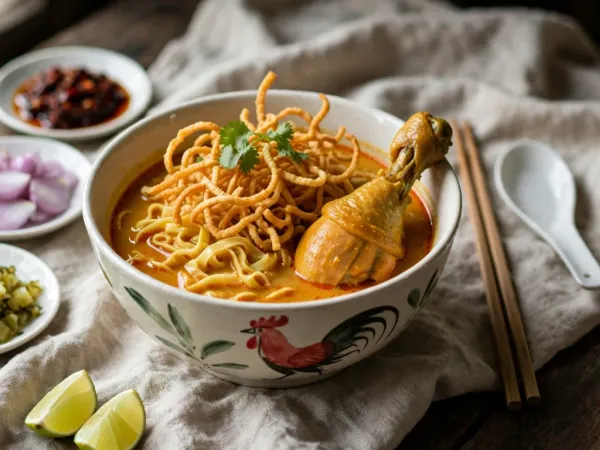
Serve the rice warm or at room temperature, with the mango cool. For a savory Thai meal before it, make the curry noodle soup khao soi. For another Asian dessert built on rice, try Hong Kong-style black sesame soup, thickened with ground rice.
Eat it within 2 hours
Some Thai cooks say sweet sticky rice keeps at room temperature all day. We don’t advise that. Never leave cooked food out for more than 2 hours, or 1 hour above 90°F (32°C), says the CDC.
Rice is a special case. Raw rice can carry spores of Bacillus cereus, and the spores can survive cooking. Left warm, they grow and can make a toxin. Cooking “might not disable the toxin”, the FDA’s Bad Bug Book warns.
Leftovers
Chill leftover rice “ideally within one hour”, eat it within 24 hours, and never reheat it more than once, the UK’s Food Standards Agency advises. Keep the rice and the cut mango apart.
The rice turns hard in the fridge. Glutinous rice starch is more than 98% amylopectin, which stales slowly, but it still stales. Rice starch gels “retrograded substantially” when stored at 4°C (39°F) for 5 days, a 2013 Kasetsart University study found. Reheat the rice until steaming hot to soften it, then let it cool a little before serving.
Mango skin
Mango is in the same plant family as poison ivy. Its skin and sap contain urushiol, the oil behind the poison ivy rash. Its flesh does not, the American College of Allergy, Asthma and Immunology explains. If poison ivy gives you a rash, ask someone else to peel the mango.
Calories and allergens
One plate has about 620 calories, 20 g of fat and 106 g of carbohydrate. Most of the fat is saturated fat from the coconut milk. The dish is vegan and gluten-free.
Sesame is a major food allergen in the US and the UK. Coconut is no longer on the FDA’s list of tree nuts, since a January 2025 FDA guidance, but some people are allergic to it.
Fixes for sticky rice that is hard, mushy or bland
- It has hard, chalky centers: it was not soaked long enough, or not steamed long enough. Soak it for 4 hours and steam until every grain is translucent.
- It is mushy: it was boiled, cooked in a rice cooker, or soaked in too much liquid. Steam it on cloth, out of the water.
- The coconut milk did not soak in: the rice had cooled. Pour the coconut milk over it the moment it leaves the steamer.
- The coconut milk curdled: it boiled. Warm it only until it steams.
- It tastes flat: it needs salt. Add a pinch to the topping.
- It is too sweet: cut the sugar to ⅓ cup (65 g). Some recipes use far less.
- It went hard overnight: cold rice stales. Reheat it once until steaming hot.
Substitutes for missing ingredients
- Thai glutinous rice: Japanese short-grain sweet rice is the nearest thing, though none of the recipes we compared uses it.
- Ataulfo mangoes: soft, ripe Kent or Keitt. Avoid fibrous Tommy Atkins.
- Pandan leaf: leave it out, or add a drop of pandan extract to the coconut milk.
- Rice flour: cornstarch or tapioca starch.
- Sesame seeds: crispy split mung beans, or nothing at all.
- A bamboo steamer: any steamer basket, or a sieve set over simmering water, lined with damp cheesecloth.
Frequently asked questions
What is mango sticky rice called in Thai?
Khao niao mamuang. Khao niao means sticky rice, and mamuang means mango.
Is mango sticky rice gluten-free?
Yes. Glutinous rice is sticky, not glutinous in the sense of gluten. All rice is gluten-free, and this recipe is vegan too.
Do I have to soak the rice?
Yes. Soak it for at least 4 hours, or overnight in the fridge. Sticky rice can’t take up much water while it cooks, so the soak is what lets it steam through.
Can I make mango sticky rice in a rice cooker?
Thai cooks advise against it: the rice comes out softer and can turn mushy once the coconut milk goes in. Steam it instead.
Which mango is best for mango sticky rice?
In Thailand, nam dok mai or ok rong. Abroad, use soft, ripe Ataulfo mangoes, also called honey or champagne mangoes.
Can I make it ahead?
Soak the rice the night before. Steam it and add the coconut milk no more than 2 hours before serving, and cut the mango at the last minute.
Why is my sticky rice hard the next day?
Its starch stiffens as it cools, especially in the fridge. Reheat it once until steaming hot, and eat refrigerated rice within 24 hours.
Should I use coconut milk or coconut cream?
Coconut milk. Hot Thai Kitchen says not to use cream for this dish, though a few cooks do.