The Sunday Potthesundaypot.com/recipes/beef-rendang/
Indonesian Beef Rendang, Slow-Cooked in Coconut Milk
By The Sunday Pot Kitchen Updated
- • About 3½ hours in one Dutch oven: 30 minutes of prep, 2 to 2½ hours of gentle simmering, then 20 to 30 minutes of stirring
- • 3 lb (1.4 kg) of beef chuck in 2-inch (5 cm) cubes to 2 cans (13.5 oz / 400 ml each) of full-fat coconut milk and 1½ cups (360 ml) of water
- • No browning first and no lid: the beef goes in raw, and it browns at the end in the coconut oil
- • The sauce passes through three stages: thin gulai, thick and oily kalio, then dry, dark rendang
- • Stir every 20 minutes during the simmer, and almost constantly for the last 20 to 30 minutes
- • It tastes better the next day; refrigerate it within 2 hours and freeze what you will not eat in 2 days
Ingredients
8 servingsInstructions
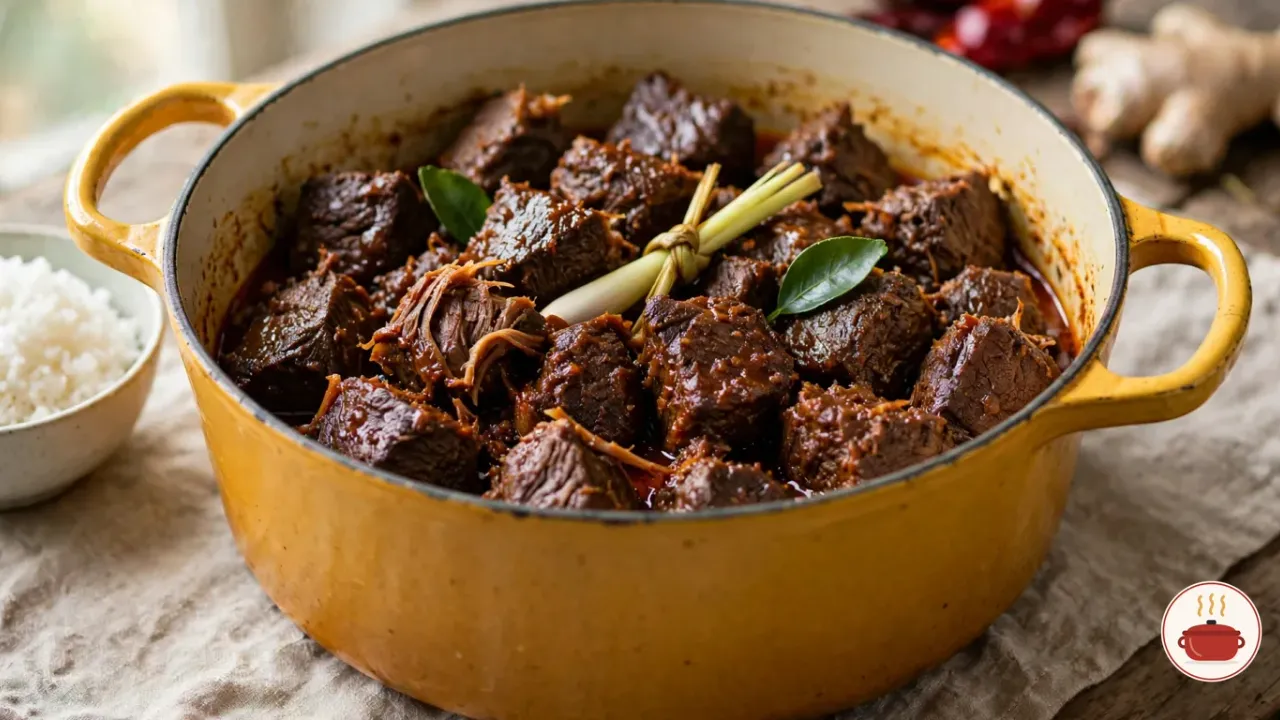
Beef rendang is West Sumatra’s great slow dish. Beef simmers in coconut milk and a chile spice paste until the sauce is gone and the meat fries dark in coconut oil. This version cooks uncovered in one Dutch oven, with no browning first. It takes about 3½ hours and serves 8.
What beef rendang is
Rendang is the best-known dish of the Minangkabau people of West Sumatra, in Indonesia. Cooks simmer meat in coconut milk with chiles, shallots, garlic, ginger, galangal and turmeric. They keep going long after a curry would be done. The liquid boils away, the coconut oil comes out, and the meat browns in it.
The name is a verb before it is a dish. The food historian Fadly Rahman explains the word merandang in the Journal of Ethnic Foods. It means to cook meat with coconut milk and spices until the sauce seeps in and the meat turns dry and dark.
Beef is the usual meat today. Cooks in West Sumatra also make rendang with buffalo, chicken, eggs or tempeh.
Three stages: gulai, kalio, rendang
One pot passes through three dishes. Indonesia’s tourism ministry describes them in order:
- Gulai: the first stage, with plenty of thin sauce, much like a curry.
- Kalio: the middle stage. The sauce is thick and golden brown, and the oil starts to seep out. People often call it wet rendang.
- Rendang: the last stage. The sauce is almost dry and the color is dark. This is the version that keeps longest.
Kalio is a dish in its own right. Many people in Java prefer their rendang at that stage. Reno Andam Suri, who has written three books on rendang, said so to The Jakarta Post in 2018.
A dish made to travel
Rendang was built to last. Minangkabau society passes property from mother to daughter, and young men traditionally left home to make their own way. They carried a tin of rendang with them, as America’s Test Kitchen recounts. Pilgrims from West Sumatra took it as far as Mecca, Rahman writes.
The habit is alive. In December 2025, after floods and landslides in Sumatra, IPB University and a Minangkabau student association cooked rendang for the victims. With 150 volunteers, they made one ton of it.
What the four ingredients stand for
In Minangkabau tradition, each part of the dish stands for a part of society. The tourism ministry lists them:
- The meat stands for the elders, who lead the community.
- The coconut milk stands for the intellectuals, who advise.
- The chile stands for the religious leaders, and its heat for firmness.
- The seasoning stands for the whole Minangkabau community.
The poll that made it famous
In 2011, CNN asked its readers to vote for the world’s most delicious food. After more than 35,000 votes, rendang came first. CNN republished the list in 2017, which is why many sources give that year.
In 2018, Indonesia’s tourism ministry chose rendang as one of five national dishes. The others are soto, nasi goreng, satay and gado-gado, The Jakarta Post reported.
Indonesia, Malaysia and a crispy chicken
Rendang crossed the Strait of Malacca with Minangkabau migrants, and Malaysia made it its own. Each Malaysian state is said to have its own version. Many add kerisik, a paste of toasted coconut. The scholar Gaik Cheng Khoo calls it the Malaysian claim to innovation, in The Conversation.
The dish made headlines in 2018. A judge on MasterChef UK complained that a Malaysian-born contestant’s chicken rendang had no crispy skin. The BBC reported the fury that followed among Malaysians online.
The late Indonesian food writer Bondan Winarno took a calmer view. Rendang, he said, is a shared heritage of Indonesia and Malaysia, as Rahman records.
Why Indonesian food is having a moment
Forecasters keep naming Indonesian cooking. In September 2026, The Food Institute put Indonesian cuisine on its list of 27 food trends to watch in 2027. An industry consultant, Kathryn Read, praised its flavor, its healthy ingredients and the variety of more than 17,000 islands.
Guides and rankings point the same way. The TasteAtlas awards for 2025/26 ranked Indonesian cuisine 10th in the world, as Politis reported in December 2025. In Jakarta, the restaurant August placed 42nd among Asia’s 50 Best Restaurants for 2026.
CNN Travel profiled the city’s new fine-dining kitchens in August 2026. One of them, at the Fairmont Jakarta, serves a wagyu beef rendang. Its chef, Yopi Tumeru, told CNN that rendang is not simply beef cooked in coconut milk. It takes patience and careful control of the heat.
London has new tables too. Le Nusa, an Indonesian restaurant with branches in Paris and Jakarta, opened on the Strand in January 2026, Hot Dinners reported. A month later, a critic for Hyphen called the rendang at the restaurant Toba a mandatory order.
The government is pushing as well. In August 2025, six Indonesian ministries launched a program called S’RASA. It promotes the country’s cooking through Indonesian restaurants abroad, the Ministry of Creative Economy announced.
More news is due in December. UNESCO’s heritage committee meets in Xiamen, China, from November 30 to December 5, 2026. Indonesia’s file on the culture of tempe is among the nominations for 2026.
One caution. Nobody has published a sales or search figure for rendang itself this year. The interest is in the cuisine, and rendang is its most famous dish.
What you need: beef, coconut milk and a spice paste
Beef
Use chuck, cut into 2-inch (5 cm) cubes. America’s Test Kitchen recommends well-marbled cuts rich in collagen, such as shin or chuck. Their connective tissue melts into gelatin over the long cook.
Big cubes matter. Small ones fall to shreds during the last half hour of stirring. Trim off the thick outer fat and leave the rest.
Coconut milk
Use 2 cans (13.5 oz / 400 ml each) of full-fat coconut milk, with 1½ cups (360 ml) of water. Light coconut milk will not do, because the fat is what fries the beef at the end.
How much oil comes out depends on the brand. It can be a thin film or a pool, as Lara Lee notes in her recipe for NYT Cooking. Indonesian cooks often start with more liquid still. Daily Cooking Quest adds 1.2 liters of water to 800 ml of coconut milk, and cooks its rendang for 4 hours.
The spice paste
The paste holds six fresh things: red chiles, shallots, garlic, ginger, galangal and turmeric. Blend them smooth with ½ cup (120 ml) of the coconut milk.
Indonesian recipes use fresh red chiles, and a lot of them. The Jakarta chef William Wongso uses 150 g for 1 kg of beef, in a recipe he gave The Jakarta Post. This recipe is milder. It takes 9 long red chiles, about 5 oz (140 g), for 3 lb (1.4 kg) of beef. Seed them for a gentler pot.
Small Asian shallots weigh about 1 oz (25 g) each. If yours are the long banana kind, use 4.
Lemongrass, lime leaves and a turmeric leaf
Three whole aromatics simmer with the beef. Bruise each lemongrass stalk with the back of a knife and tie it in a knot, so it holds together. Makrut lime leaves go in whole.
A turmeric leaf is traditional, and hard to find outside Asia. Use 2 bay leaves, or leave it out. Lara Lee’s recipe uses bay leaves too.
Tamarind
Cooks in West Sumatra add asam kandis, a dried sour fruit. Daily Cooking Quest suggests about 2 teaspoons of tamarind in its place. The sour note is optional, and Lara Lee leaves it out.
A wide, heavy pot
A 5½- to 7-quart (5.2 to 6.6 liter) enameled Dutch oven is ideal. It is wide, so the liquid evaporates, and heavy, so the paste browns without scorching. Leave the lid in the cupboard. Rendang cooks uncovered from start to finish.
How to make beef rendang in a Dutch oven
No browning first
Most Western braises begin by browning the meat. Rendang does it the other way round. The raw beef goes straight into the coconut milk, and the browning comes at the end. America’s Test Kitchen found that the bits browned at the end add more flavor than an early sear.
Gulai: the first boil
Put everything in the pot and bring it to a boil over medium-high heat. Stir now and then, so the coconut milk does not catch. At this point the sauce is thin and pale orange.
The beef is safe to eat long before it is tender. The USDA sets the safe minimum for beef at 145°F (63°C), and a simmering pot passes that early. The hours that follow are for texture and flavor.
Kalio: the long simmer
Lower the heat until the surface bubbles gently and steadily, and leave the lid off. Stir every 20 minutes, scraping the bottom, for 2 to 2½ hours. Lara Lee’s recipe keeps the same rhythm.
Watch the sauce change. It thickens, darkens from orange to caramel brown, and then splits. Reddish oil rises to the top. That is not a fault.
Coconut milk is an emulsion of oil in water, held together by proteins. A 2022 paper in Food Science & Nutrition notes that it coagulates readily when heated to 80°C (176°F), as those proteins denature.
If the pot looks dry before the beef is tender, stir in ½ cup (120 ml) of hot water and carry on.
Rendang: the last half hour
Now raise the heat to medium and stay at the stove. For 20 to 30 minutes, stir and scrape almost without stopping. The last of the water cooks off, and the beef and paste begin to fry in the oil. The sound changes from a bubble to a sizzle.
This is where the flavor forms. Once the water has gone, the sugars from the coconut milk brown along with the meat, America’s Test Kitchen explains. Stop when the paste is deep brown and clings to the beef. Some pieces will shred, and they should.
How dry to take it
You choose where to stop. This recipe stops at a moist, dark rendang with a little oil left in the pot. For a drier, blacker rendang, keep stirring over low heat until no moisture is left. The traditional version cooks for 4 to 8 hours, the tourism ministry notes.
Rest before serving
Let the pot rest off the heat for 5 minutes. Steam loosens the browned layer on the bottom, and it scrapes up easily. America’s Test Kitchen rests its rendang the same way.
Variations: kalio, the oven and Malaysian style
Stop at kalio
For a saucier dish, serve the pot after the long simmer, in its thick brown gravy. It takes about 2½ hours of cooking, and it is milder and wetter than rendang.
The oven method
America’s Test Kitchen brings its Dutch oven to a simmer, then moves it, uncovered, to a 300°F (150°C) oven. The pot stays there for 2 to 2¼ hours and needs only one stir. It finishes on the stove, with 15 to 20 minutes of stirring.
Malaysian style, with toasted coconut
Malaysian recipes add kerisik and whole spices. RecipeTin Eats uses ⅓ cup of desiccated coconut, with cinnamon, cloves, star anise and cardamom. It also offers 12 dried chiles in place of fresh ones.
Coriander and cumin
Lara Lee adds 2 teaspoons of ground coriander and 1 teaspoon of ground cumin to her paste. Wongso uses neither.
Serving and storing
Serve rendang with plain steamed white rice. Raw cucumber, a sambal and prawn crackers often share the table, to cut the richness.
For another long, slow beef pot, see the classic pot roast. Filipino chicken adobo is a quicker braise from the same part of the world. For a pot without meat, cook mujadara, the Lebanese lentils and rice.
Better the next day
Rendang deepens overnight, and many cooks make it a day ahead. Lara Lee reheats hers under foil in a 300°F (150°C) oven for about 25 minutes, until piping hot.
Leftovers
Fully dried rendang has a name for keeping. The tourism ministry says it lasts for months without a refrigerator. Do not treat a home pot that way. This rendang still holds moisture, and it belongs in the refrigerator.
Refrigerate it within 2 hours. The USDA says cooked leftovers keep 3 to 4 days in the refrigerator and 3 to 4 months in the freezer. The UK’s Food Standards Agency is stricter, and says to eat leftovers within 48 hours.
Reheat rendang in a covered pan with a splash of water, until steaming hot. Cool any leftover rice fast, and eat it within 1 day.
Calories and saturated fat per serving
One serving, an eighth of the pot without rice, has about 640 calories, 36 g of protein and 51 g of fat, by USDA figures. It has about 11 g of carbohydrate and 700 mg of sodium.
Those numbers count every drop of oil in the pot. Each tablespoon (15 ml) of oil you leave behind takes about 15 calories off every serving.
Coconut milk and beef chuck are both rich in saturated fat. A serving has about 30 g, if you eat all the oil. The NHS advises no more than 30 g a day for the average man, and 20 g for the average woman. Rendang is feast food. Serve small portions, with plenty of rice and raw vegetables.
Fixes for tough, pale or scorched rendang
- Tough beef: it needs more time. Stir in ½ cup (120 ml) of water and simmer for 20 to 30 minutes more before you fry it dry.
- Pale rendang: it stopped at kalio. Keep stirring over medium heat until the paste turns deep brown.
- A scorched bottom: the heat was too high at the end. Lower it, add 2 tablespoons (30 ml) of water and scrape. Leave any black bits in the pot.
- No oil in the pot: the coconut milk was light, or low in fat. Add 2 tablespoons (30 ml) of coconut oil for the last stage.
- Too hot: serve it with more rice and cucumber. Next time, seed the chiles.
- Shredded beef: the cubes were small, or the stirring was rough. It still tastes right.
Substitutes for missing ingredients
- Galangal: more ginger and a grind of black pepper, as RecipeTin Eats suggests.
- Makrut lime leaves: dried leaves. Lara Lee marks them optional.
- Turmeric leaf: 2 bay leaves, or leave it out.
- Fresh turmeric: 1 teaspoon of ground turmeric.
- Fresh red chiles: about 12 dried red chiles, soaked in boiling water until soft.
- Tamarind paste: 2 teaspoons (10 ml) of lime juice or vinegar.
- Beef chuck: shin, brisket or boneless short rib.
- Asian shallots: 4 banana shallots, or 1 medium onion.
- Dutch oven: any wide, heavy pot. A thin pot scorches the paste.
Frequently asked questions
What does beef rendang taste like?
It tastes rich, savory and deeply spiced, with the sweetness of browned coconut. Lemongrass and lime leaf add a citrus scent. The heat depends on the chiles, and this version is medium.
Is beef rendang a curry?
It starts as one. The first stage, gulai, is a thin coconut curry. Rendang keeps cooking until the sauce is gone and the meat browns in the oil.
What is the best cut of beef for rendang?
Chuck is the best choice in most stores. Shin, brisket and boneless short rib also work. All are rich in collagen, which melts over the long cook. Lean cuts turn dry.
Why is my rendang not dark?
It has not cooked long enough. The dark color comes in the last stage, when the liquid is gone and the paste fries in the oil. Keep stirring over medium heat.
Can I cook rendang with the lid on?
No. The liquid has to evaporate, so the pot stays uncovered. A lid traps the steam and leaves you with a stew.
Is rendang Indonesian or Malaysian?
It comes from the Minangkabau of West Sumatra, in Indonesia. Migrants took it to Malaysia, where cooks developed their own versions, often with toasted coconut.
How spicy is beef rendang?
This one is medium. For a mild pot, seed the 9 chiles or use 5. For a hot one, add a few small bird’s eye chiles to the paste.
How long does beef rendang keep?
Refrigerate it within 2 hours. The USDA allows 3 to 4 days for leftovers, and the UK’s Food Standards Agency 48 hours. It freezes well for 3 to 4 months.
What do you serve with beef rendang?
Plain steamed white rice, always. Sliced cucumber, a sambal and prawn crackers are common sides. A simple green vegetable balances the richness.
Tags: Sunday dinnerbeefbraisedDutch ovenone potmake aheadfreezer friendly