The Sunday Potthesundaypot.com/recipes/vietnamese-coffee/
Vietnamese Coffee with a Phin Filter (Cà Phê Sữa Đá)
By The Sunday Pot Kitchen Updated
- • One phin makes one glass: 2 tablespoons (14 g) of coffee, ½ cup (120 ml) of water and 2 tablespoons (38 g) of condensed milk
- • Use water just off the boil, about 200°F (93°C)
- • Bloom the grounds for 45 seconds, then let the coffee drip: first drop within 2 minutes, last drop at about 5 minutes
- • Stir before you pour it over ice: the condensed milk sits at the bottom of the glass
- • About 125 calories a glass, nearly all of them from the condensed milk

Ingredients
1 servingInstructions
Vietnamese coffee is dark-roast coffee, mostly Robusta, brewed one cup at a time in a small metal drip filter called a phin. It drips onto sweetened condensed milk. Poured over ice, it becomes cà phê sữa đá, Vietnam’s iced milk coffee. One glass takes 2 tablespoons of coffee, 2 tablespoons of condensed milk and 5 minutes of dripping.
What Vietnamese coffee is
Vietnamese coffee is a way of brewing and a way of drinking. The coffee is dark, strong and a little smoky. It drips slowly through a phin straight into the glass, then meets a spoonful of thick, sweet condensed milk. The result tastes of dark chocolate and caramel, with far less bitterness than you would expect.
Coffee came late to Vietnam. National Geographic dates it to 1857, when French missionaries brought the first plants. Arabica did poorly in the climate, so growers moved to Robusta. It now thrives in the Central Highlands and the south.
Today Vietnam grows more coffee than any country except Brazil. The USDA forecasts Vietnam’s 2026/27 crop at 32.5 million bags of 60 kilograms (132 pounds) each. Robusta makes up 31.4 million of those bags. Most of it grows in the provinces of the Central Highlands, such as Đắk Lắk, Gia Lai and Lâm Đồng.
Why condensed milk
Fresh milk was hard to find in Vietnam when the coffee habit began, and it spoiled fast in the heat. Condensed milk, Sprudge explains, “lasted longer in the tropical climate and didn’t need to be refrigerated,” so it became the easy choice. Fresh milk became easy to buy later, but the pairing stayed. The sweet, creamy milk softens the bitter edge of dark Robusta.
What to order in Vietnam
Menus in Vietnam use a few simple words. Cà phê means coffee, sữa means milk, đá means ice and nóng means hot. So you can read most menus once you know them:
- Cà phê sữa đá: coffee with condensed milk, over ice. This is the recipe below.
- Cà phê sữa nóng: the same coffee, served hot.
- Cà phê đen đá: black coffee over ice, often with sugar.
- Bạc xỉu: a milky glass from Saigon, with more milk than coffee.
Why Vietnamese coffee is everywhere right now
Vietnamese coffee has been moving from Vietnamese restaurants onto mainstream menus. In Yelp’s 2025 trend report, searches for Vietnamese coconut coffee rose 254% in the 12 months to August 2024, compared with the year before. In 2024, CNN Travel reported that TikTok users were swapping tips on ordering a Starbucks drink that tastes like Vietnamese iced coffee.
The interest has not faded. In August 2026, Tasting Table listed Vietnamese iced coffee among the year’s biggest coffee trends, as part of a move toward faster cold coffee.
There is also something older in its appeal. The phin is “a slow-drip brewing method that reflects Vietnam’s unhurried coffee ritual,” in the words of the Vietnam National Authority of Tourism. It is the right drink for a slow Sunday.
What you need: a phin, dark coffee and condensed milk
The phin filter
A phin is a small stainless steel or aluminum drip filter that sits on top of the glass. It has 4 parts:
- The filter plate: a flat, round base with holes in the middle that rests on the rim of the glass.
- The chamber: a short metal cup with a perforated bottom that holds the ground coffee.
- The press: a thin, perforated disc that sits on the coffee. Most are gravity presses, which rest on top. Some screw down.
- The lid: it keeps the heat in while the coffee drips, then turns over to hold the wet phin.
Asian grocers and online shops sell phins in several sizes. A standard one holds 2 tablespoons (14 g) of coffee and about ½ cup (120 ml) of water.
Which coffee to buy
Buy a dark roast made from Robusta beans, or a blend of Robusta and Arabica. Robusta gives the thick body and deep bitterness that stands up to condensed milk. It also carries more caffeine. A study of coffee beans in the journal Planta found 50% more caffeine in ripe Robusta beans than in Arabica.
Grind it medium-coarse, about as coarse as fine sea salt. A fine grind clogs the phin, and a coarse grind lets the water run straight through. Trung Nguyên, from Vietnam, and Nguyen Coffee Supply, a Vietnamese American brand, both sell ground coffee made for the phin.
Many Vietnamese American families use Café Du Monde coffee and chicory from New Orleans. Country Roads Magazine tells the story: the company noticed that its Vietnamese American employees were sharing the coffee with family and friends. So it began stocking Vietnamese grocery stores. Its mellow, slightly woody flavor is a classic in the US.
Sweetened condensed milk
Use sweetened condensed milk, not evaporated milk, which has no sugar added. Two tablespoons (38 g) make a sweet glass, close to what a Saigon street stall serves. Start with 1 tablespoon (19 g) if you like your coffee less sweet.
How to make Vietnamese coffee with a phin
Heat the water first, and warm the phin and the glass with a splash of it. Cold metal and glass pull heat from the coffee. Spoon the condensed milk into the glass, then set the phin on top and add the coffee. Shake the phin to level the grounds, so the water flows through them evenly.
Lay the press on the coffee without pressing. Then pour in just 2 tablespoons (30 ml) of hot water and wait 45 seconds. This is the bloom: the grounds swell and release gas, so the rest of the water can soak through them evenly. Fill the chamber to the top, put on the lid and leave it alone.
Getting the drip speed right
Nguyen Coffee Supply’s phin brew guide gives two checkpoints: the first drop should fall within 2 minutes, and the last one at about 5 minutes. Slow drips make a strong, thick coffee. If yours is off, change one thing at a time:
- The coffee pours out in a stream, or finishes in under 3 minutes: grind it finer, or add 1 more teaspoon of coffee.
- No drops after 3 minutes: grind it coarser next time. With a screw-down press, loosen it by half a turn.
- It tastes thin: use 1 more teaspoon of coffee, or 2 tablespoons (30 ml) less water.
- It tastes harsh or burnt: let the boiled water rest for 1 minute, until it is closer to 195°F (90°C).
Iced or hot
For cà phê sữa đá, stir the coffee into the condensed milk as soon as the drip stops. Then pour it over a tall glass of ice, and stir again as the ice melts a little. The ice waters the coffee down on purpose, so do not brew it weaker.
For cà phê sữa nóng, drink it hot from the short glass. Cafés in Vietnam often stand the glass in a small bowl of hot water while the coffee drips, so it stays hot. At home, a mug warmed with boiling water does the same job.
How strong it is
The FDA puts a 12-ounce (355 ml) cup of brewed coffee at 113 to 247 mg of caffeine. For most adults, it cites 400 mg a day as an amount not generally tied to negative effects. One glass of Vietnamese coffee uses a little less ground coffee than that cup. Robusta has more caffeine, though, so count each glass as at least one full cup.
Variations: bạc xỉu, salt coffee, egg coffee and coconut coffee
Bạc xỉu
This is the milkiest glass on the menu, and a good start for anyone new to strong coffee. Stir 2 tablespoons (38 g) of condensed milk with ¼ cup (60 ml) of whole milk. Pour it over ice, then add only half the coffee from the phin.
Salt coffee (cà phê muối)
Salt coffee began in the old imperial city of Huế. Its creators told CNN they first served it in 2010, when they opened their first shop. To make it, whisk 3 tablespoons (45 ml) of heavy cream with 1 teaspoon of condensed milk and ⅛ teaspoon of fine salt, until it thickens to soft peaks. Spoon it over a glass of iced coffee, sip through the cream, then stir it in. The salt makes the coffee taste rounder and less bitter.
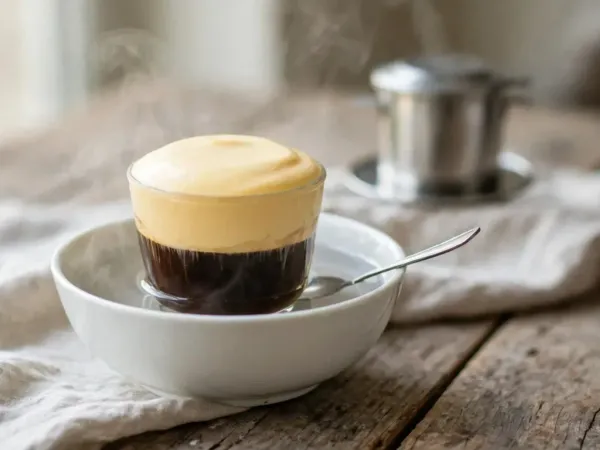
Egg coffee (cà phê trứng)
Egg coffee comes from Hanoi. As VICE tells it, Nguyen Giang whisked egg into coffee at his Café Giang in the late 1940s, during a shortage of fresh milk. To make it, whisk 1 egg yolk with 1 tablespoon of condensed milk and 1 teaspoon of sugar for 3 to 5 minutes, until pale and thick. Spoon it over hot black phin coffee.
The yolk stays raw, so use a pasteurized egg. The FDA advises pasteurized eggs for any dish served with raw or undercooked egg.
Coconut coffee (cà phê cốt dừa)
Blend ¼ cup (60 ml) of coconut cream, 1 tablespoon of condensed milk and 1 cup (140 g) of ice until smooth and slushy. Spoon it into a glass and pour the hot black coffee from the phin over it.
Serving Vietnamese coffee after a Sunday meal
In Vietnam, a coffee is less a quick fix than a reason to sit down. The phin sets the pace: nobody can rush 5 minutes of dripping. That makes it a good end to a long Sunday lunch, after a classic pot roast or next to a slice of sticky toffee pudding. A cold, sweet glass is also welcome after the warm spice of a chicken biryani.
For a crowd, set out 1 phin per guest and let everyone brew their own glass. Or brew phin after phin into a jar and chill the black coffee. Then add condensed milk and ice to each glass as you serve it. It tastes best within a day.
Substitutes for missing ingredients and equipment
- No phin: make a small, strong pot in a moka pot and use ¼ cup (60 ml) of it per glass. Or steep 3 tablespoons (21 g) of coffee in ½ cup (120 ml) of hot water in a French press for 4 minutes. A double shot of espresso works too.
- No Robusta: a dark French or Italian roast, or Café Du Monde coffee and chicory.
- Dairy-free: sweetened condensed coconut milk, in the same amount.
- No condensed milk: stir 2 teaspoons of sugar into 2 tablespoons (30 ml) of half-and-half. The glass will be thinner and less rich.
- Less caffeine: a dark-roast decaf, ground medium-coarse.
Frequently asked questions
What is Vietnamese coffee called in Vietnam?
Iced coffee with condensed milk is cà phê sữa đá, and the hot version is cà phê sữa nóng. Black iced coffee is cà phê đen đá. In Hanoi, milk coffee often goes by another name: cà phê nâu, or brown coffee.
Is Vietnamese coffee stronger than regular coffee?
Usually, yes. It uses a lot of coffee for very little water, and Robusta beans have about 50% more caffeine than Arabica. For most adults, the FDA cites 400 mg of caffeine a day as an amount not generally tied to negative effects. Count each glass as at least one full cup of coffee.
How long does a phin take to drip?
About 5 minutes. The first drop should fall within 2 minutes of filling the chamber. If it finishes in under 3 minutes, grind the coffee finer next time.
Why is my phin dripping too fast?
The grind is probably too coarse, or there is too little coffee in the chamber. Use a medium-coarse grind, like fine sea salt, and 2 tablespoons (14 g) of coffee. Bloom the grounds for 45 seconds before you fill the chamber.
Can I make Vietnamese coffee without a phin?
Yes. A moka pot, a French press or an espresso machine all make coffee strong enough. Use ¼ cup (60 ml) of strong coffee per glass, stirred into 2 tablespoons of condensed milk.
Does Vietnamese coffee contain chicory?
Coffee in Vietnam usually does not. The chicory comes from Café Du Monde, a New Orleans coffee that many Vietnamese American families adopted. Both kinds make good Vietnamese coffee.
How many calories are in Vietnamese coffee?
About 125 calories a glass, with 2 tablespoons of condensed milk. By USDA figures, sweetened condensed milk has about 61 calories per tablespoon, and black coffee has almost none. Use 1 tablespoon for a lighter glass of about 65 calories.