The Sunday Potthesundaypot.com/recipes/filipino-chicken-adobo/
Filipino Chicken Adobo, Braised in Vinegar and Soy Sauce
By The Sunday Pot Kitchen Updated
- • About 1 hour 25 minutes in one Dutch oven: 15 minutes of browning, 30 minutes under a lid, 12 to 15 minutes to reduce the sauce
- • 3 lb (1.4 kg) of bone-in chicken to ½ cup (120 ml) of vinegar, ⅓ cup (80 ml) of soy sauce and 1 cup (240 ml) of water
- • Boil the vinegar, uncovered, for 2 to 3 minutes before the soy sauce goes in, so its sharp edge cooks off
- • Reduce the sauce by about half, until it coats the back of a spoon
- • The chicken is done at 165°F (74°C) in the thickest thigh
- • It tastes even better the next day; refrigerate leftovers within 2 hours and eat them within 3 to 4 days
Ingredients
6 servingsInstructions
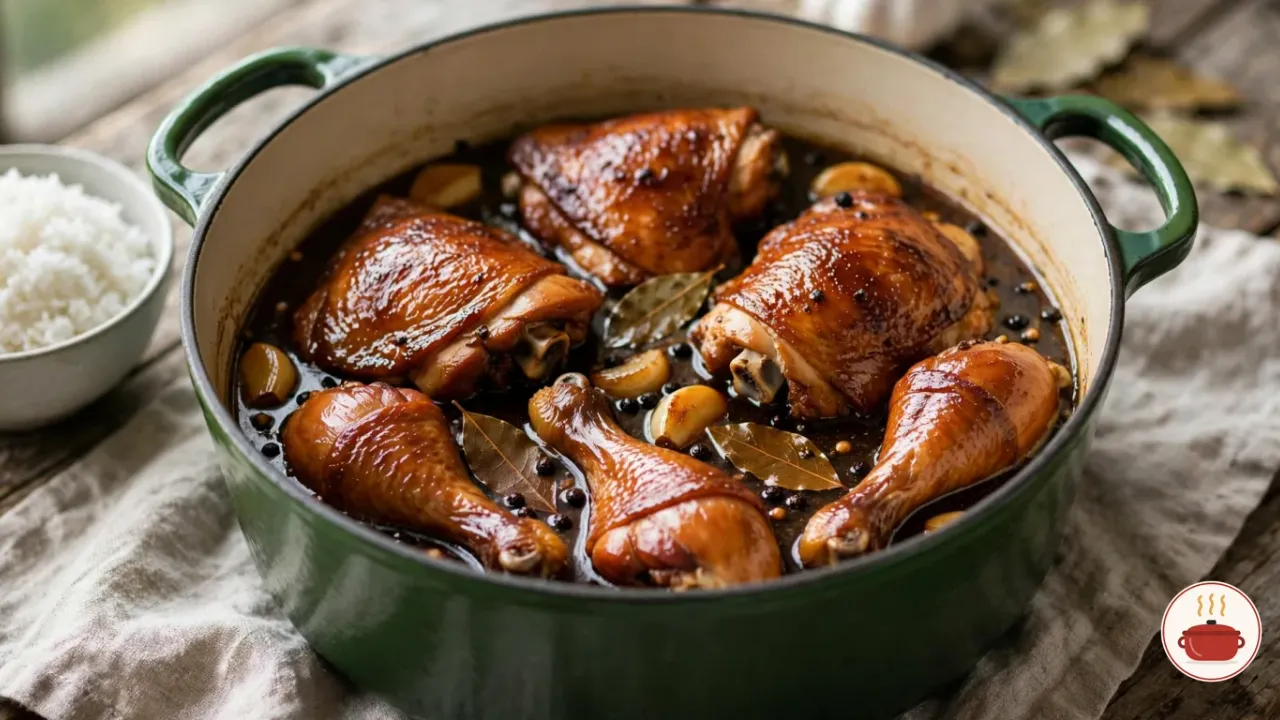
Chicken adobo is the best-known dish of the Philippines: bone-in chicken braised in vinegar, soy sauce, garlic, bay leaves and black peppercorns. This version cooks in one Dutch oven. Brown the chicken, boil the vinegar, simmer for 30 minutes, then reduce the sauce to a dark glaze. It takes about 1 hour 25 minutes and serves 6.
What chicken adobo is
Adobo is a way of cooking before it is a recipe. The food writer Claude Tayag defines it as a cooking method with vinegar as its main liquid, as The Philippine Star reports. Cooks use it for pork, squid, greens and more. Chicken adobo, or adobong manok, is the version most of the world knows.
People often call adobo the national dish. Officially, the Philippines has none, as Tayag points out. The MICHELIN Guide calls it the unofficial national dish, and gives a good reason. No region, restaurant or household can dictate the one best way to make it.
Older than its Spanish name
The method is native to the islands. The Filipino food historian Doreen Fernandez wrote for the Smithsonian Folklife Festival that adobo is indigenous but bears a Spanish name. She described food cooked in vinegar, which keeps without refrigeration.
The name comes from the Spanish word adobar, to marinate. In 1613, the Franciscan missionary Pedro de San Buenaventura published a Tagalog dictionary. In it he wrote of the adobo of the native people, their dishes with vinegar, as ANCX recounts. Soy sauce arrived later, with Chinese merchants.
Mexican and Spanish adobo are different things. Tasting Table explains that adobo in Spain is a vinegar marinade with spices. In Mexico it is a chile paste, or the sauce around canned chiles.
A hundred ways to cook it
Ask 10 Filipinos for the recipe and you get 11 answers, as the MICHELIN Guide jokes. Vinegar is the one thing no cook leaves out. A few regional versions show the range:
- Adobong puti: white adobo, with vinegar and no soy sauce. Google notes that some consider it the original style.
- Adobo sa gata: adobo with coconut milk, popular in Southern Luzon.
- Adobong dilaw: yellow adobo, seasoned with turmeric. Tayag ties it to the town of Taal, in PhilSTAR Life.
- Adobong pula: red adobo, cooked in annatto oil in Batangas, Cavite and Iloilo, as VERA Files describes.
Filipinos guard that freedom. In 2021, the country’s trade department set out to write a national standard for adobo. Arab News reported the protest that followed, under the hashtag #donttouchmyadobo. The department soon said the standard was meant only for promotion abroad.
Sunday lunch, and Monday’s too
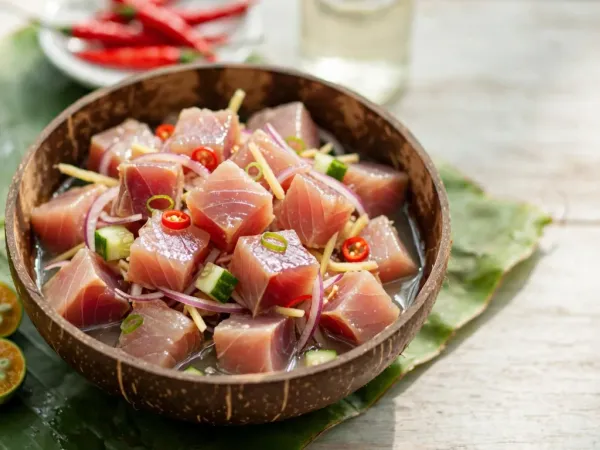
Adobo is home cooking. The cookbook author Amy Besa counts adobo, sinigang and kinilaw as the holy trinity of native Filipino foods. All classes of society cook and eat them, she told National Geographic.
It is also a Sunday dish. In Tayag’s PhilSTAR Life article, the chef Robby Goco recalls yellow adobo at his family’s Sunday lunches. Most cooks agree that adobo tastes better on the second day. So make the whole pot, even for a small table.
Why chicken adobo is having a moment
Filipino food has had a strong year. At the end of October 2025, the MICHELIN Guide announced its first selection in the Philippines. It lists 108 restaurants in and around Manila and in Cebu. One of them, Helm, holds two stars. Two months later, Michelin named the Philippines one of its 16 food destinations for 2026. It counted adobo among the staples at the heart of Manila’s cooking.
The dish itself made news in 2026. In April, TasteAtlas ranked adobong manok 40th among the 50 best chicken dishes in the world, Interaksyon reported. In July, Penguin published Kamayan, a Filipino cookbook by the London chef Rex De Guzman. Chicken adobo is among its recipes.
Trend watchers expect more. In September 2026, The Food Institute put Filipino food on its list of 27 trends to watch in 2027. It credited strong flavors and dishes based on vinegar. Vinegar is in fashion too: Whole Foods Market named it one of its eight trends for 2026.
October gives one more reason. In the United States, it is Filipino American History Month. The Filipino American National Historical Society explains that the month marks October 18, 1587. On that day, the first recorded Filipinos came ashore at what is now Morro Bay, California.
What you need: vinegar, soy sauce and a heavy pot
Chicken on the bone
Use bone-in, skin-on thighs and drumsticks. Dark meat stays juicy through a long simmer, and the bones and skin give the sauce body. A 3 lb (1.4 kg) pack holds about 4 thighs and 4 drumsticks, enough for 6 people.
Vinegar
Filipino cane vinegar, sukang maasim, is the everyday choice. Brands such as Datu Puti sell it in Asian grocers. Panlasang Pinoy calls cane vinegar the dependable starting point for adobo. Coconut vinegar also works, with a stronger fermented taste.
Distilled white vinegar is the easiest substitute. It is a little sharper: bottles in the US are usually labeled 5% acidity. The FDA sets the floor for any vinegar at 4 g of acetic acid per 100 ml. Rice vinegar is milder, and cider vinegar works as well. Skip balsamic.
Soy sauce
Filipino soy sauce is called toyo. Silver Swan and Datu Puti are the common brands. The Filipino food writer Iankewks describes toyo as thin, and a little saltier and sharper than Japanese soy sauce.
Any regular soy sauce will do. A Japanese one gives a slightly lighter sauce. Do not use thick, sweet dark soy sauce here.
How much vinegar to soy sauce
Many recipes use equal parts of the two. This one leans toward the vinegar: ½ cup (120 ml) to ⅓ cup (80 ml) of soy sauce. The sauce reduces by half at the end, and soy sauce tastes saltier as it cooks down. A cup of water keeps the braise gentle.
Garlic, bay leaves and peppercorns
Adobo takes a lot of garlic. A whole head, about 12 cloves, is right for one pot. Smash the cloves and leave them whole, and they turn soft and sweet in the sauce. Three dried bay leaves and a teaspoon of whole black peppercorns finish the seasoning.
A pot that does not react
Vinegar is acidic, so choose the pot with care. Cook’s Illustrated found that acidic food can pick up a metallic taste in aluminum or unseasoned cast iron. Enameled cast iron and stainless steel do not react. A 5½- to 7-quart (5.2 to 6.6 liter) enameled Dutch oven holds the chicken in one snug layer.
How to make chicken adobo in a Dutch oven
Brown the chicken first
Pat the chicken dry, and do not rinse it. The UK Food Standards Agency warns that washing raw poultry splashes bacteria around the kitchen.
Then brown it in two batches. Give each batch 5 to 6 minutes skin-side down, until deep golden, and 2 minutes on the other side. Browning adds flavor, and it melts fat out of the skin. Pour off all but 2 tablespoons (30 ml) of that fat before you go on.
Boil the vinegar before anything else
Filipino grandmothers have a rule: do not stir the pot right after the vinegar goes in. Stir too soon, they say, and the dish tastes of raw vinegar. PEP.ph reported in 2025 that two Filipino food vloggers tested the rule and tasted no difference.
The stirring may not matter, but the boiling does. In his recipe for BBC Good Food, Rex De Guzman boils the vinegar until it smells fragrant and slightly sweet, not raw and acrid. Here the vinegar boils alone for 2 to 3 minutes, uncovered. Then the soy sauce and water go in.
Simmer under a lid
Return the chicken to the pot, skin-side up, with the bay leaves and peppercorns. Cover it and simmer on low heat for 30 minutes. Turn the pieces once, halfway through.
Check the thickest thigh with a thermometer. It should read at least 165°F (74°C), the USDA’s safe minimum for poultry. Thighs stay tender well past that point, so the next step does them no harm.
Reduce the sauce to a glaze
Take off the lid and raise the heat. Boil the sauce for 12 to 15 minutes, turning the chicken twice and spooning the sauce over it. It is ready when it has lost about half its volume and coats the back of a spoon.
Taste it now. If the sauce seems sharp, stir in 2 teaspoons (8 g) of brown sugar. Many recipes add a little sugar, from a pinch to 2 tablespoons.
To marinate or not
About half of the well-known recipes marinate the chicken, and half do not. This one skips the step, because the braise seasons the meat on its own.
If you have time, marinate the chicken in the soy sauce and garlic for 1 to 8 hours. The FDA says always to marinate food in the refrigerator. Pat the chicken dry before you brown it, and add the marinade to the pot with the water. The simmer boils it, which makes it safe to eat.
Variations: white, coconut and crisp adobo
Adobong puti, without soy sauce
Leave out the soy sauce. Use ¾ cup (180 ml) of vinegar and 1½ teaspoons (9 g) of fine salt. Foxy Folksy seasons hers with 3 tablespoons (45 ml) of fish sauce instead. The sauce stays pale and tastes brighter.
Adobo sa gata, with coconut milk
Stir in 1 cup (240 ml) of coconut milk when you take off the lid. Reduce the sauce for 15 to 20 minutes, until it is thick and creamy. A few slices of fresh chile suit this version.
Crisp-skinned adobo
For crisp skin, finish the chicken under the broiler. Lift the cooked pieces onto a sheet pan, skin-side up, and broil them for 5 to 7 minutes. Reduce the sauce on the stove in the meantime. A recipe from the Purple Yam restaurant, published by NYT Cooking, browns its adobo this way.
Serving and storing
Serve adobo over plain steamed white rice, which soaks up the sharp, salty sauce. A plate of sliced tomato or cucumber on the side cuts the richness.
For another chicken and rice pot, try Nigerian jollof rice. If you like a slow braise, the classic pot roast is next. Finish the meal with a warm bowl of black sesame soup.
Leftovers
Tradition says adobo keeps without a refrigerator, because of the vinegar. Do not rely on that. The FDA says to refrigerate cooked food within 2 hours. The USDA says most cooked leftovers keep 3 to 4 days in the refrigerator.
Reheat adobo in a covered pan with a splash of water, until steaming hot. The flavor deepens overnight. Many Filipino cooks fry leftover adobo until the edges crisp, and eat it with garlic rice.
Calories and sodium per serving
One serving, without rice, has about 325 calories and 30 g of protein, by USDA figures. A cup of cooked white rice adds about 205 calories.
Soy sauce brings most of the salt. USDA lists 878 mg of sodium in 1 tablespoon. One serving of this adobo has up to 880 mg, if you eat all of your sauce. The FDA sets the Daily Value for sodium at less than 2,300 mg a day. For less salt, use a low-sodium soy sauce, which USDA lists at 511 mg per tablespoon.
Fixes for sour, salty or thin adobo
- Too sour: the vinegar did not cook long enough. Simmer the sauce uncovered for 5 minutes more, then add 1 to 2 teaspoons of brown sugar.
- Too salty: the sauce reduced too far. Stir in ¼ cup (60 ml) of water and serve it with more rice.
- Thin sauce: lift out the chicken and boil the sauce for 3 to 5 minutes more.
- Pale chicken: the pot was crowded, or the heat was too low. Brown in two batches, and leave each piece alone until it releases.
- Burnt garlic: the pot was too hot after browning. Lower the heat to medium before the garlic goes in.
Substitutes for missing ingredients
- Cane vinegar: distilled white vinegar in the same amount, rice vinegar or cider vinegar.
- Filipino soy sauce: any regular soy sauce, Chinese light or Japanese.
- Soy sauce, for less salt: low-sodium soy sauce.
- Bone-in chicken: boneless, skinless thighs. Simmer them for 15 minutes, then reduce the sauce.
- Chicken: pork shoulder in 1½-inch (4 cm) cubes. Simmer it for 60 minutes, until tender.
- Whole peppercorns: ½ teaspoon of coarsely ground black pepper.
- Dried bay leaves: fresh bay leaves, in the same number.
- Brown sugar: white sugar or honey, or leave it out.
- Dutch oven: a deep stainless-steel skillet or pot with a lid.
Frequently asked questions
What does chicken adobo taste like?
It tastes tangy, salty and deeply savory, with a lot of soft garlic. The vinegar mellows as it cooks, and the reduced sauce has a faint sweetness. It is not spicy.
What is the best vinegar for chicken adobo?
Filipino cane vinegar is the everyday choice. Distilled white vinegar works in the same amount and tastes a little sharper. Rice vinegar and cider vinegar also work.
Do I need to marinate chicken adobo?
No. About half of the well-known recipes skip the marinade, and the braise seasons the meat well. If you want to, marinate the chicken in the soy sauce and garlic for 1 to 8 hours in the refrigerator.
Why should I not stir after adding the vinegar?
It is an old kitchen rule, meant to avoid a raw vinegar taste. Tests by Filipino cooks found no difference. What matters is that the vinegar boils, uncovered, for 2 to 3 minutes.
Is Filipino adobo the same as Mexican adobo?
No. Filipino adobo is a dish braised in vinegar. Mexican adobo is a chile paste or sauce, and Spanish adobo is a vinegar marinade. They share only the Spanish name.
Can I use chicken breast?
You can, but it dries out easily. Use bone-in breasts cut in half, and simmer them for 20 to 25 minutes, until they read 165°F (74°C). Thighs and drumsticks give a better adobo.
Why is my adobo too sour or too salty?
Too sour means the vinegar needs more cooking, so simmer it uncovered for 5 minutes more. Too salty means the sauce reduced too far. Stir in ¼ cup (60 ml) of water.
How long does chicken adobo keep?
Refrigerate it within 2 hours, and eat it within 3 to 4 days. It tastes even better the next day. Reheat it with a splash of water until steaming hot.
What do you serve with chicken adobo?
Plain steamed white rice, always. Sliced tomato, cucumber or lightly cooked greens go well on the side. The next day, fry the leftovers and serve them with garlic rice.
Tags: Sunday dinnerchickenbraisedDutch ovenone potmake ahead