The Sunday Potthesundaypot.com/recipes/cocido-quemado/
Cocido Quemado: Paraguay's Burnt-Sugar Yerba Mate Drink
By The Sunday Pot Kitchen Updated
- • Melt the sugar to a reddish amber, not dark brown, then toast the yerba in it for under a minute
- • Use about 3 tablespoons of sugar and 3 heaped tablespoons of plain yerba per quart (liter) of water
- • Pour the boiling water in slowly and stand back: it spits and steams
- • Rest it for 5 minutes, then strain through a fine sieve
- • The traditional live-coal method belongs outdoors, by a grill that is already lit
Ingredients
6 cupsInstructions
Cocido quemado is Paraguay’s hot yerba mate drink with burnt sugar. Sugar is caramelized, traditionally with a glowing coal, yerba is toasted in it, and boiling water goes in. Strained, it is drunk black as cocido negro or with milk. This stovetop version makes 6 cups in about 20 minutes.
What cocido quemado is
Paraguay’s breakfast cup
In Paraguay, cocido means a hot drink of yerba mate. It is the same dried leaf people sip from a gourd as mate or drink cold as tereré. A paper from the National University of Asunción gives a plain definition. Cocido is “the traditional drink made with hot water and toasted yerba mate leaves, sweetened with sugar or honey” (our translation).
Quemado means burnt. For this version, the sugar is burnt before any water goes in, which gives the drink its caramel color and a faint smoky taste. Ana Aguilar Rabito is a nutritionist at Paraguay’s national food institute. “The aim is for the sugar to burn a little, to give it a very particular flavor,” she told ABC Color in 2022 (our translation).
Black or with milk
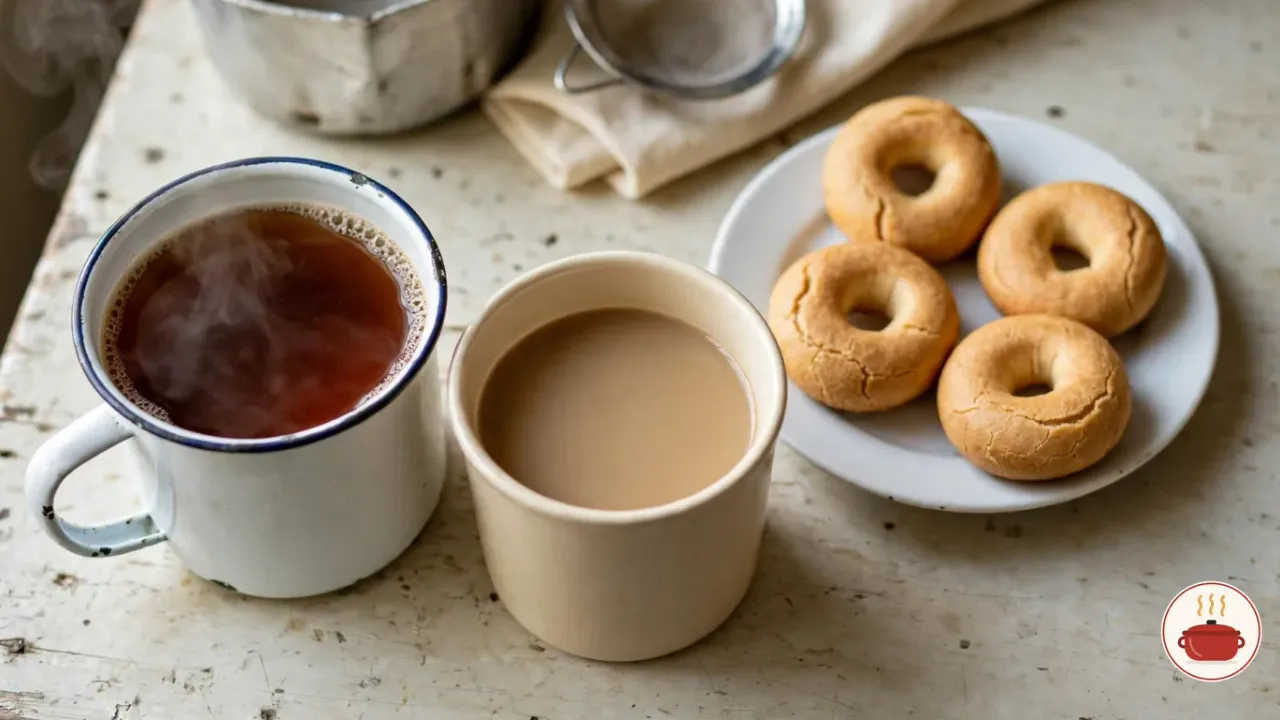
Drunk plain, it is cocido negro, a clear, amber-brown drink. With hot milk it becomes cocido con leche, the color of milky coffee. Paraguayans drink it at breakfast and in the late afternoon, with chipa, the ring-shaped cheese bread, or with mbeju, a flat cheese and cassava-starch cake.
Not Argentine mate cocido
Across the border, “mate cocido” usually means yerba steeped like tea, often from a tea bag, with no burnt sugar. Argentina’s northeast, next to Paraguay, does make a burnt version too. A Spanish cocido is something else again: a chickpea and meat stew. The word just means “cooked”.
Where cocido quemado comes from
A coal from the fire
The old way is to drop a live coal onto the sugar. In 2009, the writer Sanra Ritten described a family in rural Paraguay making it for their children in Gastronomica. Equal parts of sugar and yerba went into a metal bowl with a piece of hot charcoal. “The resulting cocido negro resembles coffee,” she wrote.
Many families use the embers left over from Sunday’s asado, the grilled meat lunch. A reader quoted by the newspaper Última Hora in July 2026 put it this way: in her family it was a ritual after the Sunday asado, “making use of the charcoal” (our translation).
In Concepción, in the north, cocido quemado has a nickname: asado de Concepción. It refers to the smoke rising from kitchens early in the morning, the culture minister explained in October.
What we can and cannot date
Yerba mate itself is very old in the region. In 1784, the Jesuit missionary Martin Dobrizhoffer described how people in the region took it. They stirred a spoonful of the herb with sugar and cold water, then poured hot water on it, and many added lemon juice. That is sweet mate in a gourd, though, not cocido, and he never mentions a coal.
We found no early printed description of burning the sugar with an ember. The chef and writer Vidal Domínguez has said Franciscan accounts of a yerba drink date from before 1580. He gave that view to ABC Revista in 2022, but we could not trace his source, so treat it as his account.
A drink of the countryside
Yerba was not always respectable. The historian Margarita Miró Ibars wrote for Paraguay’s culture secretariat about President Eligio Ayala, who governed before the Chaco War. He tried to win over an elite that saw yerba as a drink of the poor, “especially cocido” (our translation). Today it is an everyday drink: in a 2019 survey, 60.3% of people who answered drank yerba as cocido. In 2018, Paraguay’s intellectual property office put “cocido quemado paraguayo” on a list of 51 dishes of national culinary heritage, as item 43.
Why cocido quemado is in the news
National heritage since October 9
On Friday, October 9, 2026, Paraguay’s National Secretariat of Culture declared traditional Paraguayan cocido intangible cultural heritage. The secretariat’s announcement says it covers “the knowledge, techniques and traditional practices” of making and drinking it (our translation). The ceremony in Asunción ended with a tasting of cocido quemado.
The newspaper HOY reported that the recognition reaches “in a special way” the making of the burnt version (our translation). It came two days before Paraguay’s National Yerba Mate Day, on October 11.
The same secretariat named caña, the country’s sugarcane spirit, on August 1. It also sent chipa to UNESCO as a candidate earlier in 2026, it said in a later update.
A summer video with a coal in it
In July, the food guide TasteAtlas posted a video about the drink, made with the Paraguayan content creator Guido Penayo. In it, “a glowing charcoal ember is placed directly onto a plate containing sugar and citrus peels,” the state news agency IP reported. Paraguay’s big papers all picked it up.
No number for the cup itself
We found no 2026 sales or price figure for cocido. Paraguay has no official statistics on how people drink yerba, the university researchers note. The news is about recognition, not a boom. In the northern half of the world it arrives just in time for cold mornings.
What 26 cocido recipes agree on
We read 26 published recipes in full. Seventeen are Paraguayan, 14 of them in Spanish, from ABC Color, Cocina Rica, recipe sites and cooks on Cookpad. Seven are from Argentina, mostly from Misiones and the northeast. The last two are an English blog of Paraguayan cooking and one recipe of unclear origin.
The sugar always burns first
All 26 caramelize the sugar before the water goes in. Eighteen describe the live-coal method, including 13 of the 17 Paraguayan recipes. Fifteen give a stovetop method, and seven give both. Two Paraguayan recipe sites say plainly that the stovetop version “is not the same” (our translation).
About 3 spoons of each
Per quart (liter) of water, the median is 3 tablespoons of sugar and 3 tablespoons of yerba, about one to one. ABC Revista asks for “3 heaped spoons” of yerba. The Gastronomica family also used “equal parts”. Two Cookpad recipes go much sweeter, at about 10 tablespoons per quart.
Strained, almost always
Twenty-three strain the drink through a sieve or a cloth. The other three don’t say. Several insist on plain yerba “with no flavorings”, because many Paraguayan brands mix in mint or other herbs.
Peel is a variant, not the rule
Only 5 of the 26 add orange or lemon peel, and 3 of those make it optional. The TasteAtlas video made the peel famous, so this recipe lists it as an option.
How cooks really do it
In a 2019 online survey by researchers at the National University of Asunción, published in a 2023 paper, 241 people answered. Of those who make cocido, 40.8% toasted the yerba with a lit coal and sugar. Another 39.7% bought cocido already toasted, and 16.9% toasted it in a frying pan. The sample was self-selected, so take it as a sketch.
The traditional coal method
If you have a charcoal grill going outdoors, you can try the old way. Do it outside, by the grill, never in the kitchen.
- Put the 3 tablespoons (40 g) of sugar on one half of an enamel or metal plate and the yerba on the other half. Don’t use glass, which can crack.
- With metal tongs, take 1 or 2 clean, glowing lumps of hardwood charcoal from the grill. Use coals with no lighter fluid and no meat fat dripped on them.
- Press the coal into the sugar and stir it through the sugar and yerba. After 10 seconds to 2 minutes, the sugar melts and white smoke rises.
- Tip everything, coal included, into a pot of just-boiled water, still outdoors. The coal floats, and the water puts it out. Lift it out with the tongs, then rest and strain the cocido as in the recipe.
Use lump charcoal or a wood ember only. Briquettes and self-lighting charcoal contain binders and other additives, so keep them out of your drink.
Tips for a clear, sweet cocido
- Watch the color. Pull the sugar at reddish amber. Paraguayan recipes warn against letting it go dark.
- Toast briefly. Under a minute in the caramel is enough. Longer, and the yerba turns bitter.
- Use a big pan. The water foams up when it hits the caramel.
- Don’t boil it hard. Stop at the first boil, then rest it.
- Make a dry mix. Burn a bigger batch of sugar and yerba, cool it, and keep it in a clean, airtight jar. Add hot water and strain when you want a cup.
Serving cocido quemado
Serve it in plain mugs, with chipa, mbeju or buttered toast. For a Brazilian cousin of chipa, bake a tray of pão de queijo. For a Paraguayan lunch, it follows a bowl of vori vori or a square of sopa paraguaya, the cornbread that is not a soup.
Several of the recipes also serve it cold over ice in summer. For another slow, spiced hot drink, try Mexican champurrado.
Safety, caffeine and storing
Charcoal means carbon monoxide
A glowing coal gives off carbon monoxide, a gas you can’t see or smell. “Never burn charcoal indoors,” the CDC warns. So the coal method belongs outside, by a grill that is already lit. Never light charcoal or carry a burning coal into the house to make cocido. The stovetop method in this recipe needs no charcoal at all.
Steam and caramel burns
Melted sugar is far hotter than boiling water and sticks to skin. Pour the water in slowly, away from your face, and keep children out of the way. If you are burned, hold the burn under cool running water for 20 minutes, the NHS advises.
Let it cool a little
Drinking very hot drinks “probably causes cancer of the oesophagus,” says the World Health Organization’s cancer agency, IARC. It means drinks above 65°C (149°F). Wait a few minutes, or add milk, before you drink.
How much caffeine
Yerba mate has caffeine, about 1 to 2% of the dry leaf, a 2021 review reports. That is about 80 mg in a 150 ml cup of mate tea. This recipe is milder. Our rough estimate is 30 to 60 mg in each cup with milk, if all the caffeine came out of the leaves. For most adults, the FDA cites 400 milligrams a day as an amount not usually linked to harm, says its caffeine guide. It is not a drink for small children.
Allergens and diet
Cocido negro is free of the major allergens and vegan. Cocido con leche contains milk. For a dairy-free version with milk, use oat or soy milk.
Storing
Cool leftover cocido, cover it and put it in the fridge within 2 hours. The UK’s food agency says to eat leftovers within 48 hours. Reheat it gently and don’t boil it again, or it turns bitter. The dry burnt mix keeps in a clean, airtight jar.
Nutrition
One cup of cocido con leche, a sixth of the recipe, has about 75 calories. It has 3 g of protein, 3 g of fat, 11 g of carbohydrate and 40 mg of sodium. A cup of cocido negro has about 30 calories, all from the sugar. USDA FoodData Central has no entry for yerba mate, so we counted it as brewed tea, which has almost no calories. The sugar and whole milk come from USDA values. Some sugar stays behind in the sieve, so the real figures may be a little lower.
Fixes for bitter or weak cocido
- It tastes bitter or acrid: the sugar went too dark, or the yerba toasted too long. Pull the pan off at reddish amber next time.
- It is weak and pale: use heaped spoons of yerba, or rest it a few minutes longer.
- It tastes of mint or chamomile: the yerba was a herb blend. Look for plain yerba.
- It boiled over: the pan was too small or the heat too high. Use a deep pan and stop at the first boil.
- It is gritty: strain it again through a cloth or a paper coffee filter.
- The caramel stuck to the pan: soak the pan in hot water, and it dissolves.
Substitutes for missing ingredients
- Yerba mate: there is no real substitute. Look for it at Latin American shops or online.
- White sugar: brown sugar, which two of the recipes use. It burns faster, so watch it.
- Whole milk: any milk, or oat or soy milk.
- Orange peel: lemon peel, or leave it out.
- Charcoal: none needed. The stovetop method is how many Paraguayans make it every day.
Frequently asked questions
What does cocido quemado taste like?
Like a smoky, toffee-sweet herbal tea, with the grassy bitterness of yerba softened by the caramel.
Is cocido the same as mate?
Both use yerba mate. You sip mate from a gourd through a metal straw, pouring in hot water again and again. Cocido boils in a pot, and you strain it and drink it from a cup.
How is it different from Argentine mate cocido?
Argentine mate cocido is usually yerba steeped like tea, often from a tea bag, with no burnt sugar.
Do I need charcoal?
No. The stovetop caramel gives a very similar drink. Save the coal for when a grill is lit outdoors.
Can I make it without sugar?
You can steep plain yerba, but then it isn’t cocido quemado. The burnt sugar is the point.
What do Paraguayans eat with cocido?
Chipa, mbeju, galletas, or buttered bread, at breakfast or in the late afternoon.