The Sunday Potthesundaypot.com/recipes/falooda/
Falooda: Rose Milk with Basil Seeds, Noodles and Ice Cream
By The Sunday Pot Kitchen Updated
- • Soak basil seeds for 20 to 30 minutes, until each one is coated in gel, and never eat them dry
- • Per glass, about 1 cup (240 ml) of cold milk, 1½ tablespoons of rose syrup and 1 teaspoon of dry seeds
- • Cook falooda sev until soft, then rinse it in cold water to stop it going mushy
- • Layer syrup, seeds and noodles, then pour the milk in slowly to keep the bands
- • Add the ice cream last and serve at once
- • Rose syrup is very sweet, so the milk needs no sugar
Ingredients
2 tall glassesInstructions
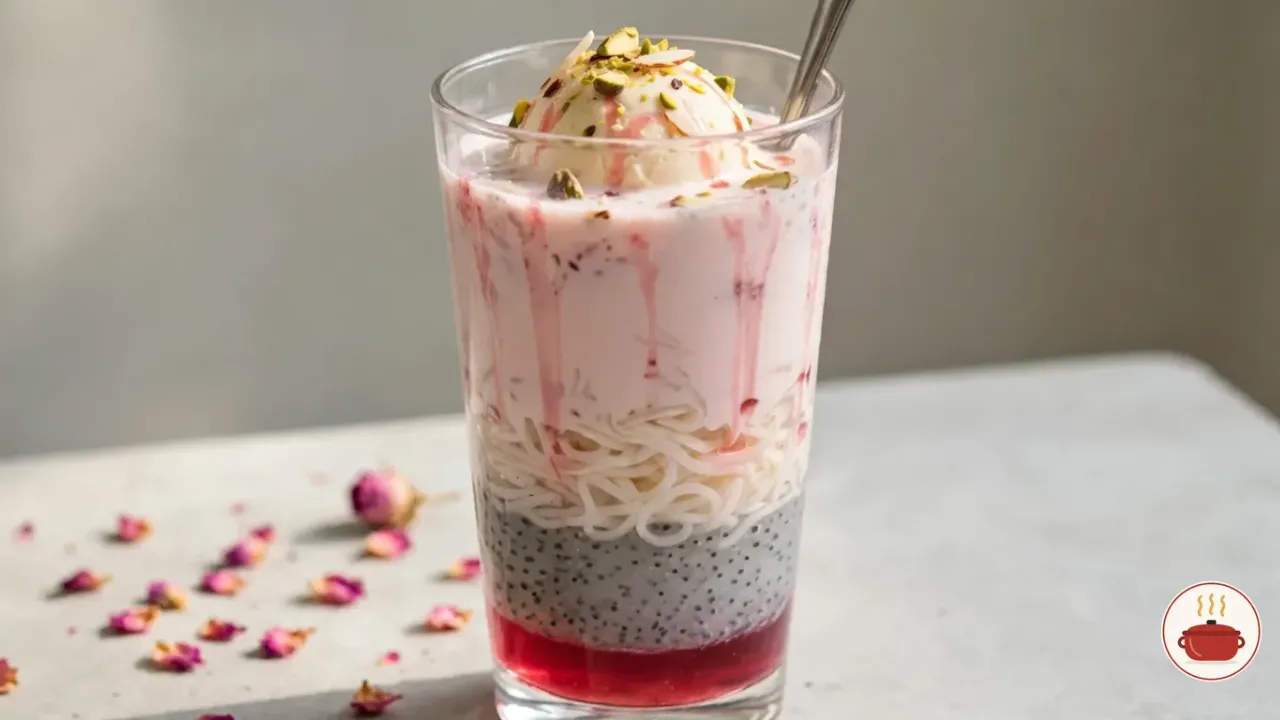
Falooda is a South Asian dessert you drink with a spoon: rose syrup, soaked basil seeds and soft noodles in a tall glass, with cold milk poured over and ice cream or kulfi on top. This is the Mumbai café version. It takes about 35 minutes, mostly soaking time, and makes two glasses.
What falooda is
One name, three desserts
The name covers more than one dish. “Faludeh in Iran is a frozen dessert of wheat-starch noodles in a pre-scented syrup,” wrote the Parsi cook Niloufer Ichaporia King for NPR. In northern India, falooda means kulfi with starch noodles. “Falooda in Bombay is a glorious milk-shakey affair in a tall glass,” she added.
This recipe makes the Bombay glass. Pakistan has its own styles too. Lahore’s Kasuri faluda comes in a bowl, in layers of syrup, vermicelli, a block of kulfi, crushed ice and rabri, a thickened milk.
A Persian ancestor
Iran’s faloodeh is a granita of thin starch noodles in a rosewater syrup, eaten with lime juice. In August 2023, Iran added the faloodeh of Yazd to its national list of intangible heritage, the Tehran Times reported. That was Iran’s own list, not UNESCO’s.
How the dish reached India nobody has documented. “It is believed to have been brought to the Indian subcontinent during the Mughal era,” wrote the Pakistani newspaper Dawn. One story makes the Mughal emperor Jahangir, who reigned from 1605 to 1627, a fan of falooda with cream and fruit.
Irani cafés and Navroz
In Mumbai, falooda belongs to the Irani cafés and to the Parsi community. King noted that it is “supposed to be eaten on March 21, Navroz”, the Persian New Year. The restaurant group Dishoom repeats a story that an Irani café, Kyani and Co., invented the tall glass. Even Dishoom hedges it with “apparently”.
Badshah, opposite Crawford Market, says it has served its Royal Falooda since 1905. In Kerala it is a fixture of juice counters and bakeries, and Pakistan and Bangladesh have their own versions.
Basil seeds, not chia
The seeds are sweet basil seeds, from Ocimum basilicum, sold as sabja, tukmaria or falooda seeds. A 2021 review in the journal Foods notes that in Iran and India they go into “drinks (Sharbat) and frozen desserts (Faloodeh)”. Soaked in water, each seed swells into a slippery gel with a crunchy black center. Chia comes from a different plant, Salvia hispanica, though it swells in a similar way.
Why falooda is in the news
On a 2027 watch list
On October 7, 2026, Datassential, a US firm that tracks restaurant menus, published its trend predictions for 2027. Falooda made its list of ten foods and flavors to watch beyond 2027. The press release sums it up as “a South Asian dessert of rose syrup, vermicelli, and basil seeds topped with ice cream or kulfi”.
The release puts falooda on a watch list of emerging foods, not among its “new classics”, and gives no figure for it. Nobody has published a 2026 count of falooda sales, menus or searches that we could find. None of the other 2027 forecasts published this month, from Whole Foods, Nestlé USA or Innova, mentions it.
A Ramadan favorite in the Gulf
In Dubai, the 2026 Ramadan Street Food Festival ran from February 19 to March 18 with more than 130 restaurants. One stall, Falooda Nation, offered “over 35 varieties of falooda”, says the festival brochure. In India, the delivery app Swiggy said falooda orders rose about 58% over normal days during Ramadan 2024. That is the latest figure we could find, and it is two years old.
What goes into falooda
We compared 39 recipes: 14 from India, 6 from Pakistan, 1 from Bangladesh, 11 from South Asian cooks abroad and 7 from international publishers such as BBC Good Food, Dishoom and SBS.
The ratio
Per glass, the classic rose-milk recipes use a median of 240 ml of milk, 1 cup. Across all of them, the median is 22.5 ml of rose syrup, or 1½ tablespoons, and just under 1 teaspoon of dry basil seeds. Recipes that weigh the noodles use about 7 g of dry falooda sev a glass. Nearly all add 1 scoop of ice cream.
This recipe uses those figures, with 1 teaspoon of seeds and 2 tablespoons of syrup a glass, counting the drizzle on top.
Noodles, ice cream and syrup
Twenty-four recipes use packet falooda sev, 7 make their own from cornflour, and 4 use rice vermicelli. Thirty top the glass with ice cream, mostly vanilla, and 8 prefer kulfi. Nine name Rooh Afza, a rose-red herbal syrup that Hamdard first made in Delhi in 1907. Twenty use a plain rose syrup.
Jelly, milk and sugar
Twenty-one recipes add cubes of jelly, a common extra in Indian and Pakistani versions. Eighteen reduce the milk first, for a richer drink, while 13 pour it straight from the fridge. Thirteen add no sugar beyond the syrup. “No need to any sugar or any other sweetener as the rose syrup itself is very sweet,” writes Dassana Amit of Veg Recipes of India.
How to make falooda
Soak the seeds fully
Basil seeds need water before you eat them. Most recipes soak them for 20 to 30 minutes, with a median of 25. Use about 16 times their volume in water, roughly 1 tablespoon of seeds to 1 cup (240 ml). They are ready when each seed sits in a thick, grey-white coat and the black center looks small.
Rinse them in a tea strainer and drain them well. Indian basil seeds can be sandy, King warned, and undrained seeds thin the milk.
Keep the noodles soft, not mushy
Falooda sev cooks in 1 to 7 minutes, depending on the brand. It is done when you can cut it with a spoon. Rinse it under cold water straight away to stop the cooking. Dishoom then leaves the noodles in cold water for 10 minutes, so they stay separate.
Make the milk cold
Cold milk keeps the layers sharp and the ice cream firm. For a richer glass, simmer the milk for 10 minutes until it thickens slightly, as Hebbar’s Kitchen does. Then cool it, cover it and chill it for at least 2 hours.
Layer, then pour slowly
There is no fixed order, and recipes say so. The common one goes syrup, seeds, noodles, milk, ice cream and nuts. Pour the milk slowly down the side of the glass so it floats over the syrup.
King did it the other way round. She poured the milk first and the syrup after, because “specific gravity will cause the syrup to sink below the milk in a neat band”. Either way, add the ice cream last.
Homemade falooda sev
Seven recipes make the noodles.
Whisk 1 part cornflour into 3 parts cold water and cook it over low heat, stirring, for 2 to 5 minutes, until thick, glossy and see-through. Press it while hot through a sev press, a piping bag or a squeeze bottle into a bowl of ice water. The strands set at once. Leave them in the water for a few minutes, then drain.
Serving and storing falooda
When to serve it
Serve falooda after a spicy meal, such as chicken biryani, or on its own on a hot afternoon. In South Asia and the Gulf it is a favorite after the Ramadan fast. For a winter Indian dessert, try gajar ka halwa instead.
Seeds that swell
No food agency has issued advice on basil seeds in particular. They swell like chia seeds, though, and the American College of Gastroenterology has a firm rule for those: “Patients should never consume dry chia seeds.” Its doctors treated a man whose esophagus was blocked by dry chia seeds. Soak basil seeds fully, and take extra care with small children and anyone who has trouble swallowing.
Treat falooda as a treat, too. Hong Kong’s Centre for Food Safety advises people to “restrict their intake” of basil seeds, because they contain estragole. Its concern is a daily habit, not an occasional glass.
Bright red syrups
Some rose syrups and packet falooda mixes owe their color to synthetic dyes such as carmoisine, E122. British and European labels must warn about it. Under UK law, the label says it “may have an adverse effect on activity and attention in children”. Check the label, or color a homemade syrup with a little beet juice.
Keeping it cold
Make each part ahead and keep them apart in the fridge: the milk, the drained seeds, and the noodles in cold water. Assemble the glasses only when you serve them. Perishable food shouldn’t sit out for 2 hours or more, or 1 hour above 90°F (32°C), the FDA warns.
Calories and allergens
A glass has about 480 calories, 12 g of protein, 20 g of fat and 65 g of carbohydrate, about 53 g of it sugars. Those numbers come from USDA nutrient data, ingredient by ingredient. USDA lists no basil seeds, so chia seeds stand in for them.
Milk and tree nuts are both on the FDA list of major allergens, and falooda has both. Some falooda sev and vermicelli contain wheat, so check the packet. Rice vermicelli is wheat-free.
Fixes for watery, gritty or mushy falooda
- Watery glass: the seeds or noodles weren’t drained well. Drain both in a sieve for a few minutes.
- Hard, gritty seeds: they didn’t soak long enough. Give them the full 20 to 30 minutes, and rinse them.
- Mushy noodles: they cooked too long. Take them off as soon as a spoon cuts them, and rinse them cold.
- Long, tangled noodles: break the sev into 2- to 3-inch (5 to 8 cm) pieces before cooking.
- The layers blur: pour the milk more slowly, or pour it first and add the syrup after.
- The ice cream melts over the rim: chill the glasses and leave more space at the top.
- Too sweet: use less syrup, and never add sugar to the milk.
Substitutes for missing ingredients
- Sweet basil seeds: chia seeds, soaked for at least 20 minutes. The texture is a little different.
- Falooda sev: thin rice vermicelli or glass noodles, or homemade cornflour noodles.
- Rooh Afza: any rose syrup, or sugar syrup flavored with a few drops of rosewater.
- Kulfi: vanilla, pistachio or saffron ice cream.
- Whole milk: oat or soy milk with a dairy-free ice cream. Almond milk works, but it adds another tree nut.
- Pistachios and almonds: leave them out for a nut-free glass, or use toasted sunflower seeds.
Frequently asked questions
What is falooda made of?
Rose syrup, soaked sweet basil seeds, soft starch noodles called falooda sev, cold milk and a scoop of ice cream or kulfi, topped with nuts.
Are sabja seeds the same as chia seeds?
No. Sabja are seeds of sweet basil, Ocimum basilicum. Chia comes from Salvia hispanica. Both form a gel in water, and chia works as a substitute.
How long should I soak basil seeds?
About 20 to 30 minutes in plenty of cold water, until each seed has a thick coat of gel. Never eat them dry.
How is falooda different from faloodeh?
Faloodeh is Iran’s frozen granita of starch noodles in rosewater syrup with lime. Falooda in Mumbai is a milk drink with rose syrup, seeds, noodles and ice cream.
Is falooda a drink or a dessert?
Both. It comes in a tall glass with a straw, but it is too thick to drink alone. You eat it with a long spoon.
Can I make falooda ahead?
The seeds, noodles and milk will keep, chilled and apart, for up to a day. Assemble each glass just before serving.
Is falooda gluten-free?
It can be. Use rice vermicelli or homemade cornflour noodles, and check that your ice cream and syrup are gluten-free.
What is falooda sev made from?
It varies by brand: corn, sago, arrowroot or wheat starch. Check the packet if you avoid wheat.