The Sunday Potthesundaypot.com/recipes/christmas-pudding/
Christmas Pudding: A Six-Hour Steam for Stir-up Sunday
By The Sunday Pot Kitchen Updated
- • One 2-pint (1.2-liter) basin serves 8; the fruit soaks in stout and brandy the night before
- • Steam it for 6 hours on the day you make it, then for 2 hours on Christmas Day
- • In 27 recipes the first steam runs from 3½ to 8 hours; more time gives a darker pudding
- • Keep boiling water halfway up the basin and check the level every 30 minutes
- • Stir-up Sunday falls on November 22 in 2026, 33 days before Christmas
Ingredients
8 servingsInstructions
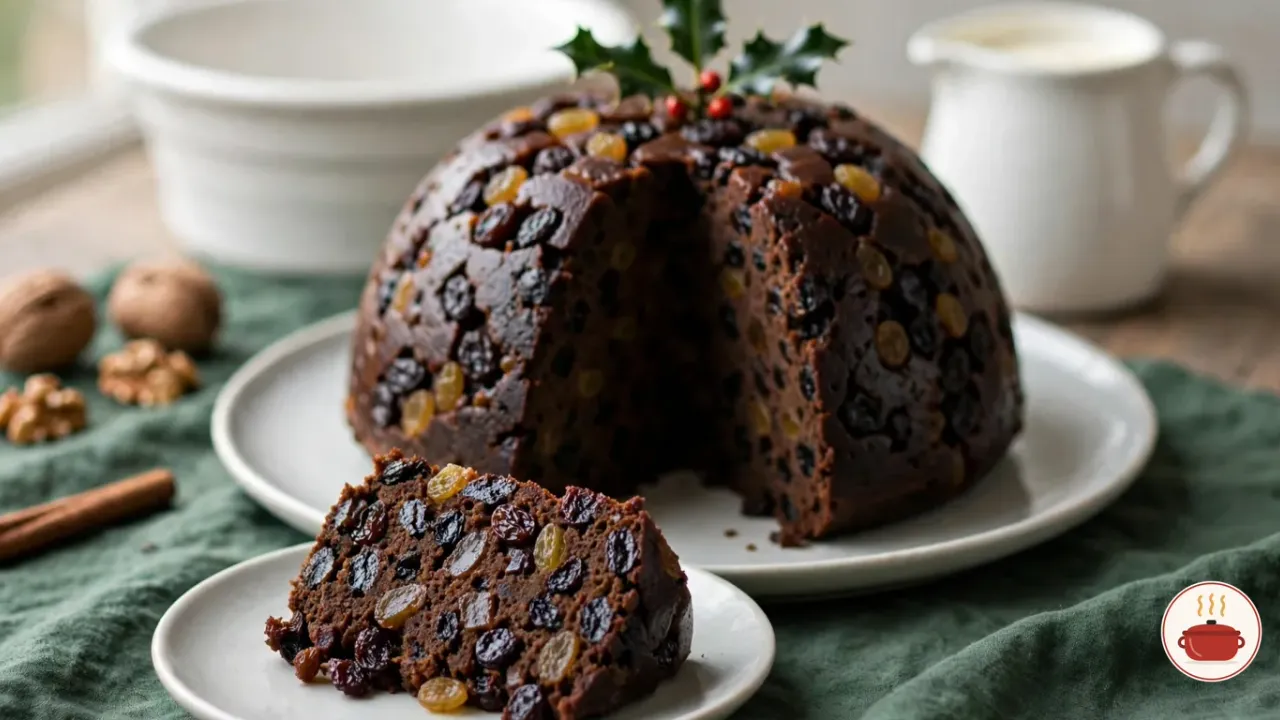
Christmas pudding is Britain’s steamed Christmas dessert: dried fruit, suet, breadcrumbs, dark sugar, stout and brandy, cooked in a basin for hours and kept for weeks. This one fills a 2-pint (1.2-liter) basin. It steams for 6 hours now and 2 more on Christmas Day, and it serves 8.
A timetable for Stir-up Sunday, November 22
Stir-up Sunday is the Sunday before Advent, and by custom the day to mix the pudding. In 2026 that is November 22, which leaves 33 days until Christmas. Advent begins a week later, on November 29.
A pudding takes little work and a lot of clock. Here is how the day can run:
- Saturday evening, 5 minutes. Soak the fruit in the stout and brandy.
- Sunday, 10:00 am. Grate the apple, add everything else and stir. Everyone takes a turn.
- 10:40 am. Fill the basin, cover it and tie it.
- 11:00 am. Into the pot. Set a timer for every 30 minutes and top up the water.
- 5:00 pm. Lift it out and leave it to cool overnight.
- Monday. Wrap it in fresh paper and foil and put it in a cool cupboard.
- Christmas Day. Two hours before dessert, steam it again.
Where the name comes from
The name is from a prayer. The Book of Common Prayer sets a collect for this Sunday that opens with the words “Stir up”. It asks that the faithful, “plenteously bringing forth the fruit of good works”, may be “plenteously rewarded”. The Church of England’s text adds a rule: this collect is always used on “the Sunday next before Advent”.
The pudding came to the prayer late. The food historian Neil Buttery wrote in Country Life in 2023 that the custom “didn’t become well known until the 1920s”. Before that, he says, the day was for stirring up feelings ahead of Advent. He credits the late Victorians with turning it toward the kitchen.
If you miss the Sunday
Nothing in the recipes ties you to the date. We read 27 of them, and only 5 name Stir-up Sunday at all. Their advice on timing runs from 2 weeks ahead to a year or more.
Mrs Beeton, in 1861, did not wait a month either. Her puddings were “usually made a few days before they are required for table”. So a pudding made in December still counts.
Four hours or eight: what 27 Christmas pudding recipes say
The first steaming is where cooks split. Our 27 recipes are British and Irish: the BBC, Delia Smith, Nigella Lawson, Mary Berry, the Guardian, Good Housekeeping, the Royal Household and others. Twenty-five give a time for a pot or an oven.
- 3½ to 4 hours: 8 recipes.
- 4½ to 5½ hours: 7 recipes.
- 6 to 7 hours: 6 recipes.
- 8 hours: 4 recipes.
The middle value is 5 hours. Size explains only part of the spread. Seven recipes use the same 2-pint (1.2-liter) basin as ours, and they give 4, 4, 4, 5½, 5½, 8 and 8 hours.
The two camps
Delia Smith steams hers for 8 hours and tells first-timers not to be put off: the pudding “just sits happily on its own”. Mary Berry’s recipe for the BBC says 8 hours too.
Felicity Cloake tested the question for the Guardian in 2016. One recipe she tried asked for as much as 8 hours. She judged that another’s 4 hours “is sufficient to cook them through”.
What the extra hours buy
Both camps can be right, because 4 hours cooks a pudding and more hours change it. The Irish baking brand Odlums says that the longer the pudding cooks, “the richer and darker it becomes”. Thane Prince, in a BBC Food recipe, says 8 hours or so “makes a huge difference to the colour and taste”.
Recipe writers often call this caramelizing. Harold McGee’s On Food and Cooking points to something slower. Browning reactions mostly need heat above the boil, he writes, but long cooking in moist food can produce the same colors and aromas. His example is persimmon pudding, which “turns nearly black” after hours of cooking.
McGee does not mention our pudding, so the link is our reading, not his. But the conditions match: plenty of sugar, eggs and flour, held near the boil for hours.
Steam also forgives. Boiling water and its steam stay at 100°C (212°F), the chemist Nathan Kilah wrote in The Conversation in December 2025. So there is “no danger of burning” the sugary mixture.
Why we chose 6 hours
Six hours sits between the camps and fits inside one Sunday. If your day is short, stop at 4: the pudding will be cooked. If you have the time, go to 8.
The second steaming is less disputed. Of 24 recipes that give one, 13 say 2 hours. Nigella Lawson’s team notes that a pudding which looks light after its first steam “darkens and mellows on the second”.
What goes into the basin
Each amount in the list above started from the 27 recipes. We scaled 22 of them to one 2-pint (1.2-liter) basin and took the middle values.
Suet, or cold butter
Suet is the old fat: 17 recipes use it, and 10 use butter. BBC Food describes suet as cooking fat from around the kidneys and loins of beef or mutton. The shredded kind in British shops is not pure fat. The maker Atora lists its beef suet as 85% beef fat and the rest wheat flour.
Three recipes ask for vegetarian suet, which Atora makes from palm and sunflower oils. Five grate in cold or frozen butter. Olive magazine says you can use whichever you like, as long as the weight stays the same. The middle amount is about 3½ oz (100 g).
A pound of fruit
The middle recipe packs 1 lb (450 g) of dried fruit into the basin. That is about 2½ times the weight of the breadcrumbs and flour together. We split it evenly among raisins, sultanas and currants.
More breadcrumbs than flour
Breadcrumbs, not flour, do most of the binding. They match or outweigh the flour in 19 of 25 recipes, and the middle amounts are 3½ oz (100 g) of crumbs to 2⅓ oz (67 g) of flour. Fifteen recipes use self-raising flour.
Stout and brandy
All 27 recipes contain alcohol. Brandy is named in 17 and rum in 13. Stout is in 11, and a dark beer of some kind in 13. Sherry appears in 6. We use stout and brandy.
The Royal Household’s own recipe, posted in November 2020, uses beer, dark rum and brandy together. It makes two puddings of 1 kg each.
Apple, almonds and peel
Grated apple goes into 18 of the 27, almonds into 22 and candied peel into 19. Carrot is in only 4. Black treacle is in 4 as well.
An overnight soak
Sixteen recipes soak the fruit in the alcohol first, 9 of them overnight. Kilah gives the reason: soaked fruit will not draw moisture out of the mixture later.
Six recipes rest the whole raw mixture, for anything from a night to a week. Nigella Lawson’s team is stricter. They give raw batter 3 hours at room temperature, or a day in the fridge. Our method avoids the question. Only fruit and alcohol wait overnight, and the eggs and flour go in on the day.
Wrapping the basin and minding the pot
The pleat and the handle
The cover has two jobs: keep water out and let the pudding rise. The pleat gives it room. Good Housekeeping folds one of 4 cm, about 1½ inches, across a sheet of foil laid on parchment.
Tie the string under the lip of the basin, then loop it over the top. That loop is the handle that lifts a hot basin out of the pot.
Water halfway up
Halfway up the basin is the most common level. The recipes range from a quarter of the way to three quarters. Good Housekeeping’s steaming guide explains the limit: the water must not get “inside the foil/parchment lid”.
The same guide wants a saucer under the basin. Direct heat from the base of the pan “may cause your basin to crack”, it says. It also asks you not to lift the lid for the first 30 minutes, then to check regularly.
A gentle simmer is enough. Marks & Spencer’s recipe checks the water every 30 minutes and tops it up with boiling water.
Oven, slow cooker or pressure cooker
- Oven. Odlums stands the basin in a roasting tin of boiling water and seals the tin in foil. It goes into a 300°F (150°C) oven for the same time as on the stove. “There is no need to top up”, the page says.
- Slow cooker. BBC Good Food cooks a 1-liter pudding on low for 10 hours, with water halfway up, and reheats it on low for 4 hours.
- Pressure cooker. Three sources agree on the pattern: 15 to 30 minutes of plain steaming, then 2 hours at high pressure. Reheating takes 30 to 40 minutes at pressure.
A basin with a clip-on plastic lid works on the stove. Olive says to keep to ceramic or metal in the oven. Under pressure, Lawson’s page warns, a clip-on lid “will pop off”.
Will it keep until Christmas, or for a year?
No agency has a rule
We looked for advice on storing a home-made pudding from the UK’s Food Standards Agency, Food Standards Scotland and Ireland’s food safety authority. We found none. The storage times in print are the recipe writers’ own.
They vary widely. One recipe says 2 weeks in the fridge. Others say 6 weeks, 2 months, 3 months, 6 months, a year, and in one case 2 years. Fifteen of the 27 give no figure and say only “until Christmas”, or nothing.
What keeps it
Lawson’s team explains the spread in an answer to a reader: “sugar and alcohol are preservatives”. The more a pudding holds, the longer it may last. For her own recipe they suggest 6 weeks, or up to a year in the freezer.
Kilah agrees on the alcohol, which “inhibits the growth of microbes”. A cooked pudding, he writes, can be stored “for weeks or even longer”.
Our recipe has about half the sugar of the sweetest ones we read. So this is our own cautious line, not an official one: keep it for the 33 days to Christmas, and freeze it if you want it for longer.
Where to keep it
Twenty-four recipes say a cool place: a cupboard, somewhere dry and dark. Eleven tell you to change the wet paper and foil for fresh ones first.
Heat and damp are the risk. In “a warm and humid environment (such as a steamy kitchen)”, Lawson’s team warns, mold may develop. Their answer for a warm or humid climate is the fridge or the freezer. Look at the pudding before you steam it again. If you see mold, throw it out.
Leftovers
Here there is official advice. The Food Standards Agency’s chilling guide says to put cooked food in the fridge within one to two hours. Leftovers get two days there, or go into the freezer. Its cooking guide adds that leftovers should be reheated only once, until steaming hot.
Christmas Day: the second steam, the flame and the sixpence
Hot through
Two hours of steaming brings a cold pudding back. Good Housekeeping suggests a probe thermometer: the middle should read about 65 to 70°C, or 149 to 158°F.
A microwave is faster. Mary Berry’s method swaps the foil for cling film with a hole in it. It runs 3 to 4 minutes on full power, a 3-minute rest, 7 minutes on low and a 5-minute rest. Do not go further: Olive warns that overheated fruit caramelizes.
Why the brandy must be warm
Twelve of the 27 recipes flame the pudding, and 7 warm the spirit first. The reason is physics. It is the vapor that burns, not the liquid, BBC Science Focus explains. Without warming there is no vapor to light.
Lighting it safely
Few recipes print a warning. Mary Berry’s does: keep your face and hair away from the flames, and do not leave them unattended.
Olive gives the fullest method. Heat only the brandy you need, to just below boiling, with a lid nearby to put out a flame. Pour it over, light it straight away with a long match, and do not lean over it. Do not carry it around either.
Kilah explains the danger. Burning alcohol has a blue flame that can be almost invisible. His rule gave his article its title: “Never move around a flaming dessert”. He adds that “more fuel isn’t always better”.
We found no fire service page with step-by-step advice. Humberside Fire and Rescue has one line in its Christmas tips: “Don’t overdo the brandy!”
The holly
The sprig is as old as the flame. In A Christmas Carol, in 1843, Mrs Cratchit’s pudding arrives “blazing” in brandy, with “Christmas holly stuck into the top”. Mrs Beeton, in 1861, says a sprig “is usually placed in the middle”. It is decoration only. Lift it off before you cut.
A coin in the pudding
The Royal Mint traces the Christmas sixpence to the Victorian era. Whoever found it was promised wealth and luck. The Mint says the custom is “believed to” have come with Prince Albert, and it gives no source for that.
Four of our 27 recipes still mention a coin. Good Housekeeping says to sterilize it in boiling water. Nigella Lawson adds a caveat: if you fear choking at the table, “do leave out the hardware”. We found no warning from a safety body. We leave the coin out of our recipe.
If you add one, tell everyone before they eat. Keep it away from small children. And never microwave a pudding with metal in it.
How much alcohol is left in a slice
What goes in
The stout and brandy in the mixture carry about 18 g of pure alcohol. That is our sum from USDA figures for regular beer and for 80-proof spirits. Shared among 8 servings, it comes to a little over 2 g each before any cooking.
What the steam takes
The USDA’s table of retention factors is the usual guide. A dish with alcohol stirred in keeps 25% of it after 1 hour of baking or simmering. It keeps 10% after 2 hours and 5% after 2½ hours, which is where the table ends.
The table was built for open and covered pans, not for a sealed basin. No study we found measured a pudding. Still, 8 hours of steaming is more than three times the table’s longest row. Very little of the 18 g is likely to be left.
What the flame adds
The brandy you light is another matter. A flamed dish keeps 75% of its alcohol, the same table says. Our 3 tablespoons hold about 14 g, so about 10 g may stay on the pudding. That is a little over 1 g a serving.
Brandy butter is not cooked at all. Nor is any brandy you spoon over the pudding in storage, a habit cooks call feeding. Only 5 of the 27 recipes feed theirs, and ours does not.
Children, pregnancy and a version without alcohol
The NHS advises against drinking any alcohol in pregnancy. Its page says nothing about food cooked with alcohol, and we found no NHS line on puddings. If in doubt, make the pudding without it and skip the flame.
The royal recipe allows for that. Good Housekeeping reports that it lets cooks replace the alcohol with orange juice or cold tea. Swap our stout and brandy for the same volume of either. Without alcohol the pudding loses one of its preservatives. We would keep that version in the fridge or the freezer.
Stories that don’t stand up, and what is on paper
Cromwell did not ban it
The historian Robert Hume went through the pudding legends for the Irish Examiner in 2019. The Puritans did pass laws against Christmas, he writes, but those laws stopped church services and kept shops open. They did not ban foods. In his words, “plum puddings were never singled out”.
The Pudding King left no record
George I is said to have asked for plum pudding at his first Christmas feast, in 1714. The Old Royal Naval College in Greenwich checked the claim. It reports “no written records in the 18th and 19th centuries” to support it.
Thirteen ingredients
A pudding is supposed to hold 13 ingredients, for Christ and the apostles. Hume finds “absolutely no evidence” for the rule. By chance, the Royal Household’s 2020 list has exactly 13 items. Ours has more.
East to west
Families are said to stir from east to west, for the journey of the Three Wise Men. Hume reports the custom from Victorian times. Nobody has shown where it began.
What the books show
A simple plum pudding is in a London cookbook of 1723, the Greenwich historians note. The “plum” was dried fruit: Hume says the Victorians used the word for a raisin or currant.
In 1845 Eliza Acton’s Modern Cookery printed “The Author’s Christmas Pudding”. It is one of the earliest recipes we could read under that name. She used 3 ounces each of flour and breadcrumbs to 6 ounces each of suet, raisins and currants. Her pudding boiled in a floured cloth for 3½ hours.
Mrs Beeton’s 1861 version had no flour, no sugar and no spice. It boiled for 5 or 6 hours, and for at least 2 more on the day.
On Christmas Day 1927, George V ate an “Empire Christmas Pudding”. The royal chef made it from ingredients grown across the British Empire, as part of a campaign to sell Empire goods.
Is the pudding fading? The numbers we could date
For 2026 itself the record is blank. We looked for pudding sales or search numbers from the supermarkets and the market researchers and found nothing dated this autumn. Three older or narrower numbers frame the picture.
- 2025. The meal-kit company Gousto surveyed British eaters. Retail Times reported the results that December: 38% do not eat the pudding, yet 31% still call it their favorite festive dessert.
- 2024. A Royal Mint survey found that 77% of UK adults had not heard of Stir-up Sunday, and only 4% kept it. The Mint sells sixpences, so it has an interest.
- 2026. The consumer group Which? had 70 tasters rate 10 supermarket puddings. Its three Best Buys for this Christmas cost £9 to £14 for 800 g. The page was updated on November 16.
Food prices are calm, at least. UK food inflation was 0.9% in the year to October 2026, the Office for National Statistics said on November 18. That is the lowest rate since September 2021. The bulletin has no line for dried fruit.
So the honest reason to make one this week is the calendar, not a trend.
Dogs, allergens and nutrition
Keep it away from the dog
Dried grapes are the main ingredient, and they are dangerous to dogs. The Royal Kennel Club names this dessert in its Christmas list. Raisins, currants and sultanas “are known to be toxic to dogs”, it says.
The vet charity PDSA warns of kidney failure in serious cases. It says the toxic dose “can be very small”. So store the pudding out of reach, and clear the plates after dinner.
Allergens
The pudding contains wheat, in the flour, the breadcrumbs and the coating of the suet. It contains eggs and almonds. The stout is brewed from barley. With butter in place of suet, it contains milk too.
Dried fruit and candied peel are often preserved with sulfites, so read the packs. All of these are on the Food Standards Agency’s list of 14 allergens.
Raw mixture
The stirring is for everyone. The tasting is not. The Food Standards Agency says not to eat or taste uncooked flour or batter. Flour is not usually treated to kill bacteria, and young children are among those most at risk. Wash hands after the stir.
Nutrition
One wedge, an eighth of the pudding, has about 485 calories. It has 7 g of protein, 15 g of fat, 82 g of carbohydrate and 4 g of fiber. Most of the carbohydrate comes from the dried fruit.
The arithmetic is ours, on USDA FoodData Central values. We counted the suet as 85% beef fat and 15% flour. The alcohol is counted in full, so the true figure is a little lower. Cream, custard and brandy butter are extra.
When a pudding goes wrong
- Wet and soggy on top. Water got under the cover. Lawson’s team says to mop it up with paper towel, press on fresh parchment and seal the basin again.
- Pale after the first steam. Wait. It darkens on the second steaming. Next year, steam it longer.
- White flecks inside. The suet has not melted in. Lawson’s team has seen this after very gentle heat, such as a slow cooker.
- Mold in storage. The spot was too warm or too damp. Jamie Oliver’s storage note is blunt: “A hot steamy kitchen is not ideal!”
- The brandy will not light. It was too cold. Good Housekeeping also asks for a spirit of 40% alcohol or more.
- Stuck in the basin. Delia Smith slides a palette knife all the way around before she turns it out.
- Sunk in the middle. Good Housekeeping warns that lifting the lid in the first 30 minutes can make a pudding collapse.
Swaps outside Britain
- Shredded suet: cold butter, coarsely grated, in the same weight. Nigella Lawson’s American measures use vegetable shortening, frozen overnight and then grated.
- Sultanas: golden raisins.
- Currants: Zante currants. They are small dried grapes, not blackcurrants.
- Mixed peel: candied orange and lemon peel, chopped.
- Mixed spice: BBC Food describes it as cinnamon, nutmeg and ginger with cloves or allspice. Mix your own to taste.
- Dark muscovado: dark brown sugar.
- Self-raising flour: all-purpose flour with baking powder. Lawson’s recipe uses 1 teaspoon to 100 g, so ours needs a rounded ½ teaspoon.
- Stout: any dark beer or brown ale.
- Pudding basin: a deep heatproof bowl of about 1¼ quarts with a lip for the string. No source we read covers glass bowls. Use one sold as heatproof and keep the saucer under it.
Serving it
Cut the pudding into wedges at the table. The usual partners are brandy butter, custard, cream or, as Felicity Cloake prefers, ice cream. The palace kitchens name brandy sauce and cream.
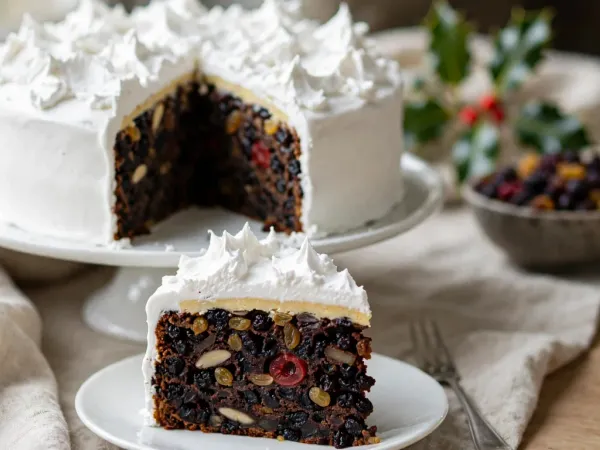
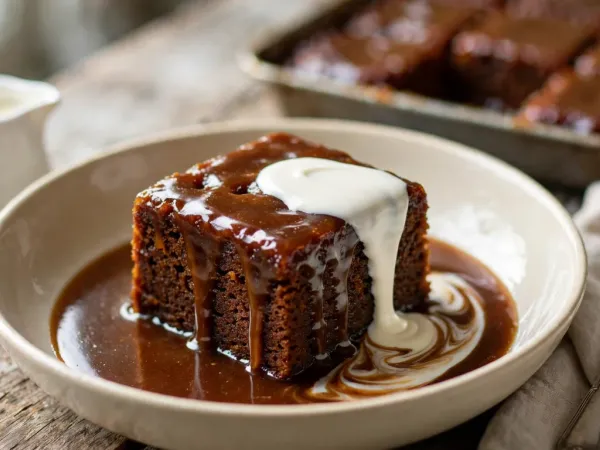
It belongs to a family of dark fruit bakes. The British Christmas cake is baked, not steamed, and wears marzipan and icing. Jamaican black cake grinds its soaked fruit to a paste. For a quicker British dessert, sticky toffee pudding takes about an hour. A pan of vin chaud suits the afternoon of stirring.
Frequently asked questions
When is Stir-up Sunday in 2026?
It is Sunday, November 22, the last Sunday before Advent. That gives the pudding 33 days before Christmas.
How long do you steam a Christmas pudding?
Recipes say anything from 3½ to 8 hours for the first steam, with 5 as the middle value. We give ours 6 hours. On Christmas Day it needs about 2 hours more.
Can I make it without suet?
Yes. Ten of the 27 recipes we read use butter. Grate very cold butter into the bowl and use the same weight.
How long does a home-made pudding keep?
No food agency gives a figure. Recipe writers say from 2 weeks to 2 years. We suggest a cool, dry cupboard until Christmas, and the freezer for anything longer.
Can I reheat it in the microwave?
Yes, once it has had its first long steam. Take off the foil, cover the basin loosely and heat it in short bursts with rests. Never microwave a pudding that hides a coin.
Can I make it without alcohol?
Yes. Use orange juice or cold tea in place of the stout and brandy, and do not flame it. Store that version in the fridge or freezer.
Is it safe for dogs?
No. Raisins, currants and sultanas are toxic to dogs, and a small amount can be enough. Call a vet if a dog eats any.
Why is it called plum pudding?
There are no plums in it. “Plum” was an old word for a raisin or currant.
Can I cook it in a slow cooker or a pressure cooker?
Yes. A slow cooker takes about 10 hours on low. A pressure cooker takes about 2 hours at high pressure after a short plain steam.
Tags: Christmasholidaysteamed puddingmake aheaddried fruitsuetdessert