The Sunday Potthesundaypot.com/recipes/jamaican-black-cake/
Jamaican Black Cake: Rum-Soaked Christmas Fruit Cake
By The Sunday Pot Kitchen Updated
- • Soak 21 oz (600 g) of dried fruit in 1½ cups (350 ml) of sweet red wine and ⅔ cup (150 ml) of white rum for 3 days or more
- • Grind the soaked fruit to a paste, as 13 of the 18 Jamaican recipes we read do
- • Use ½ lb (225 g) each of butter, dark brown sugar and flour, with 5 eggs, for one 9-inch (23 cm) cake
- • Add browning 1 tablespoon at a time, 2 to 3 tablespoons in all: too much turns the cake bitter
- • Bake at 300°F (150°C) for 2 to 2½ hours over a pan of water, then spoon ½ cup (120 ml) of wine and rum over the hot cake
Ingredients
16 slicesInstructions
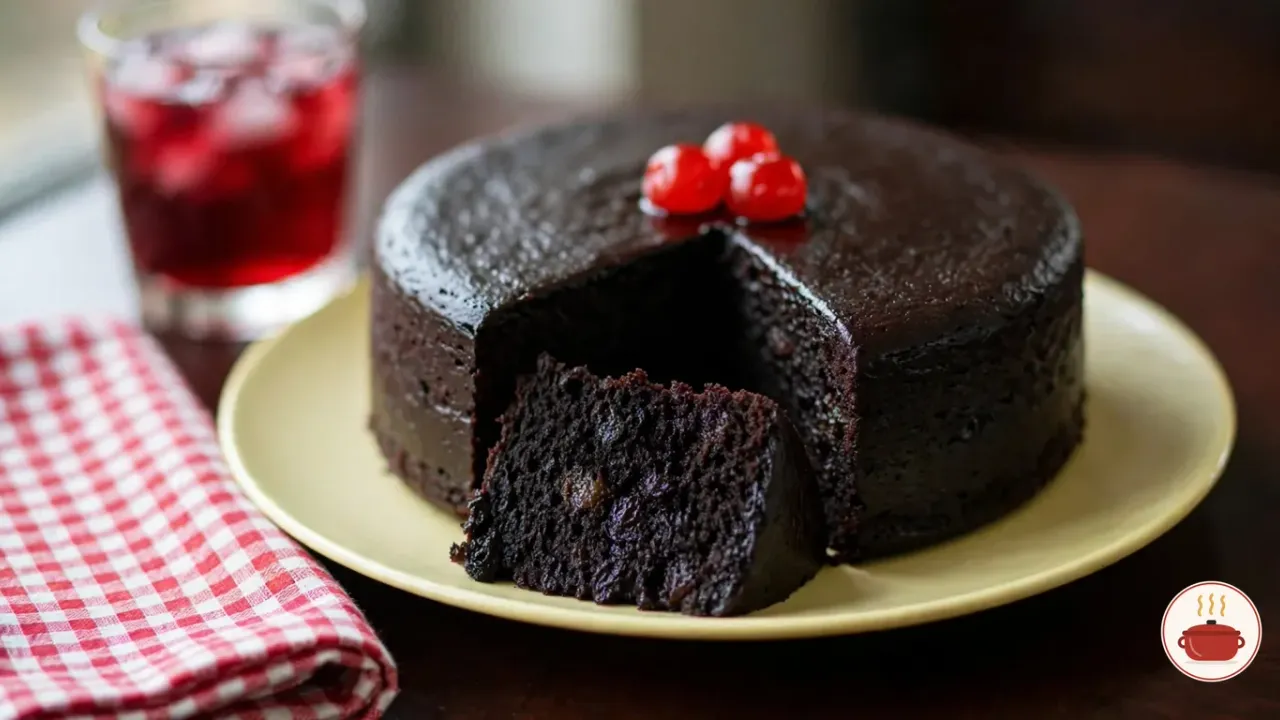
Jamaican black cake is the island’s Christmas fruit cake. Raisins, prunes and currants steep in red wine and white rum, then go into the batter as a paste. The result is a soft, near-black butter cake. This recipe makes one 9-inch (23 cm) cake of 16 slices. Start the fruit at least 3 days ahead.
A Jamaican black cake calendar for Christmas 2026
Christmas Day falls on Friday, December 25, this year. From November 17 that leaves 38 days, or 5 weeks and 3 days. It is enough for a real soak, an unhurried bake and a week of feeding.
- By November 22: put the fruit in the wine and rum.
- December 12 to 18: grind the fruit and bake. The fruit will have had 3 to 4 weeks.
- Every few days after baking: brush the cake with a little wine and rum.
- December 25: cut it.
What Jamaican cooks call early
By island standards, the middle of November is late. Many people start soaking the fruit “months in advance”, says the Jamaica Information Service, a government agency. A 2014 food page in the Gleaner, a Jamaican daily, says cooks usually soak fruit “a year in advance”.
At the baked-goods company Honey Bun, the fruit sits in rum for up to 12 months, a manager told the Gleaner in 2019. Across the English-speaking Caribbean, preparations for next year’s cake “often start on New Year’s Day”, a Washington State University article notes.
If you start later
The long soak is an ideal, not a rule. Of the 18 Jamaican recipes we read, 6 print a same-day method. The baker Suejen Edwards-Haynes gave the Gleaner her recipe in 2014. Soak the fruit “for as long as possible”, she says. Then she lets everyone off: “Overnight, or at least three hours, is fine.”
Grace Foods skips the soak altogether. Its recipe, printed in the Jamaica Star in 2023, steams the raisins and prunes in red wine, cools them and blends them smooth. A second Gleaner recipe steams the fruit with the wine for 40 minutes.
So with a week in hand, soak the fruit cold. With a day, cook it in the wine first, let it cool, then add the rum.
Three names, one cake
Christmas cake, fruit cake, black cake
“In Jamaica we simply call it fruit cake, or Christmas cake,” says a family recipe on the site Real Jamaica Vacations. In the recipes we read, the newspapers and the government page use those two names. “Black cake” leads mostly on blogs written abroad. The Gleaner shrugged at the question in 2017: “Some say fruit cake, black cake or Christmas cake, its all the same.”
Nobody bakes just one. “A single fruit cake is hardly ever made in Jamaica,” the family recipe goes on, because every Christmas visitor expects a slice. Baking is “a whole-day family activity”, the Jamaica Information Service says. Children line the tins while “older men cream the butter and sugar”, and neighbours swap finished cakes.
What makes it black
None of the 18 Jamaican recipes we read contains cocoa. Even so, “its appearance is close to that of a chocolate cake”, the Jamaica Observer wrote in 2022. The color comes from dark fruit, red wine and browning.
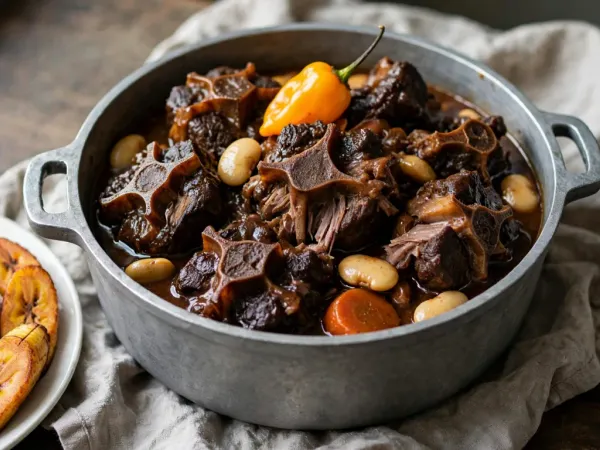
Browning is “caramelised brown sugar, which is either homemade or store-bought”, explains Lesa of Jamaican Foods and Recipes. Our Jamaican oxtail is darkened the same way.
A cousin of plum pudding
Black cake “has been described as something between an English plum pudding and a pound cake”, says Candice Goucher. She is professor emerita of history at Washington State University. It “is derived from the English plum pudding”, the Observer agrees. NPR dated the pudding’s arrival in the West Indies to the 18th century, with a careful “likely”.
We give no first date for the cake in Jamaica. The oldest island cookbook we looked for, Caroline Sullivan’s Jamaica Cookery Book of 1893, is not open to read online.
Its modern British cousin went another way. A British Christmas cake keeps its fruit whole and wears marzipan and white icing. In Jamaica the fruit is usually ground into the batter.
At weddings
The same cake is Jamaica’s wedding cake. For a wedding it is covered in a firm white “English icing”, the Observer explains. Tradition asks for at least three tiers. The couple cut the bottom one. The top tier goes into the freezer for the first anniversary or the birth of a first child.
Not Emily Dickinson’s black cake
The poet’s recipe, written out in 1883, sits in Harvard’s Houghton Library. It makes “a 20-pound cake darkened by molasses”, with 8 pounds of raisins, currants and citron. The Caribbean cake “typically calls for rum and burnt sugar, yet her recipe features brandy and molasses”, Harvard Library noted in 2024. The two are still related, by Harvard’s account: black cake reached New England from the Caribbean.
The name travelled further with Charmaine Wilkerson’s 2022 novel Black Cake, which became a Hulu series in November 2023.
What 24 black cake recipes agree on
We read 24 published recipes from start to finish. Eighteen come from Jamaican sources: the Gleaner and the Star, the Jamaica Information Service, Grace Foods, and Jamaican cooks at home and abroad. Six come from British, American and Canadian outlets. The counts below are for the 18.
A half-pound mixture
The middle recipe for a 9-inch cake uses 227 g of butter, 227 g of sugar and 227 g of flour, with 5 eggs. That is half a pound of each. A columnist in the Jamaica Star asks for “at least 10 eggs for each pound of butter and sugar”.
Ground fruit, and a lot of it
Thirteen of the 18 blend, grind or pulse the fruit. Only one leaves it whole. Where recipes weigh the fruit dry, the middle one uses 2.8 times as much fruit as flour. The range is wide, from 0.9 to 5.3.
Texture is a choice. Some cakes are “more cake-like, with actual whole or cut dried fruits”, writes Tanya Harris of My Forking Life. Others are well blended, with “a more pudding-like consistency”.
Red Label Wine and white rum
Twelve of the 18 name Red Label Wine, a sweet red wine from the rum maker J. Wray & Nephew. Thirteen add white rum, and none uses dark rum. Outside Jamaica the bottles change: 5 of the 6 other recipes pour port, and 3 use dark rum.
Wray & Nephew’s white overproof rum is 63% alcohol, by the maker’s figure. We could not find the maker’s figure for the wine, so we print none.
Browning by the spoonful
Sixteen of the 18 add browning, at a median of 4 tablespoons a recipe. That works out at about 5 tablespoons for each pound of flour, so this half-pound cake uses 2 to 3. “The amount of browning added is based on colour preference,” says the Grace Foods recipe.
Two ovens
Here the recipes split. Nine bake at 350°F (180°C) for 60 to 90 minutes. Seven bake at 300°F (150°C) or lower for 2 to 4½ hours. Six put a pan of water in the oven.
Bake at 250°F (120°C) “if you like the softer pudding-like cake”, Harris advises. Taneisha Morris of The Seasoned Skillet bakes at 300°F with a pan of water underneath “to ensure the cake does not dry out”. Our recipe follows her.
Breadcrumbs, lime and rose water
Seven of the 18 fold in breadcrumbs or cracker crumbs. They “keep this cake super moist”, Harris writes. Every recipe uses vanilla. Fifteen add lime or lemon, 14 cinnamon, 14 nutmeg, 9 almond essence and 6 rose water. The zest is there to get rid of the “eggy” smell, says the Things Jamaican site.
Wine on the hot cake
Eleven of the 18 pour, brush or spray alcohol over the baked cake, a median of ½ cup (118 ml). Chef Noel Cunningham wets his with extra rum and wine the moment it leaves the oven. Edwards-Haynes has a firm view on how: “Spray or brush cakes with rum instead of sprinkling.”
How much rum is left in a slice
What the oven removes
Baking does not remove all the alcohol. The USDA’s Table of Nutrient Retention Factors lists what stays when alcohol is stirred into a dish and baked or simmered. After 1½ hours, 20% is left. After 2 hours it is 10%, and after 2½ hours 5%.
Alcohol added with no heat fares differently. Stored overnight, it keeps 70%. These are averages from the dishes the USDA tested, not measurements of this cake.
Our sums for this cake
The soak holds about 130 g of pure alcohol. We assumed the wine is as strong as the sweet dessert wine in USDA data. A bake of 2 to 2½ hours should leave 7 to 13 g of it. The ½ cup spooned over the hot cake adds 29 g more, and about 20 g of that stays.
That makes roughly 30 g in the whole cake, or about 2 g a slice. For scale, one UK unit of alcohol is 8 g, the NHS says. Two-thirds of what is left comes from the feeding, not the soak.
Every spritz counts
Each extra tablespoon (15 ml) of overproof rum brushed on later adds about 5 g to the cake. A cake fed for a month is a stronger cake.
So it is not alcohol-free. “Do not serve to children,” the British-Jamaican cooks at Original Flava tell their readers. Anyone pregnant or planning a pregnancy “should not drink alcohol”, the NHS advises. For them, bake the grape juice version listed under Swaps.
What a black cake costs to bake this year
Nobody has priced the cake
No 2026 survey of Christmas cake prices in Jamaica turned up in our search. Neither did one for cake fruit, rum or wine. The island’s statistics office, STATIN, put inflation at 8.2% for the year to October 2026. That figure covers all items, not baking goods alone.
The fruit and the bottles are the big spend. For the wedding version, “the cost of the alcohol and pounds of fruit are the largest costs”, the Observer wrote.
The half-pound mixture is cheaper
For readers in the United States, the plain part of the cake costs less than it did. The Bureau of Labor Statistics publishes average city prices each month. In October 2026, butter averaged $3.98 a pound and large eggs $2.32 a dozen.
At those prices, half a pound each of butter, flour and white sugar plus 5 eggs comes to about $3.72. At October 2024 prices the same basket cost $4.66. That is 20% less in two years. The bureau has no October 2025 prices to compare. These sums leave out the fruit, the wine and the rum.
Fruitcake mix in the supermarket
One sign of the season is a box. On November 11, the Observer reported that Paris Ruby, a Montego Bay food brand, had launched a line of Jamaican fruitcake mixes. The mixes are due in selected supermarkets across Jamaica. The article gives no prices.
Fixes for a black cake that is bitter, pale, loose or dry
- Bitter: too much bottled browning. Brands differ in strength, Morris warns, so add it a spoonful at a time.
- Pale batter: add browning by the teaspoon. Don’t chase true black, since the cake darkens as it bakes, Harris notes.
- Loose batter: stand a wooden spoon in the middle. If it will not stand, fold in a little more flour until it does, as Real Jamaica Vacations advises.
- Smells of egg: add the lime zest, and don’t leave beaten eggs waiting. Sift the dry ingredients first, the Gleaner’s baker says.
- Air pockets: lift the filled tin and drop it on the table before baking. This is another Gleaner tip.
- Dry cake: bake at 300°F (150°C) with the pan of water, which Morris uses to stop the cake drying out. Wet it while it is hot.
Storing, feeding and safety
The jar of fruit
Keep the soaking fruit in a glass jar with a tight lid, in a cool, dry cupboard. Label and date it. The fruit swells, so check the jar and top it up to “keep the fruit covered in liquor”, says The Jamaican Foodie.
We found no food-safety agency advice on how long fruit keeps this way. The year-long soak is custom, not a tested limit.
How long the cake keeps
The recipes disagree wildly. Harris stores hers at room temperature “for a few days”. Lesa says a well-stored cake “can last for years”, in a cool place or the fridge.
The US government’s FoodKeeper database, searched for “fruit cake”, gives the shop-bought kind 6 months in the pantry. It allows 12 months in the fridge once opened, or 12 months in the freezer. No agency gives a time for a homemade, wine-fed cake.
Our own advice is cautious. Keep the wrapped cake cool through the Christmas weeks. Beyond that, move it to the fridge or freezer. To freeze slices, wrap them in several layers of plastic wrap and pack them in an airtight box, Honey Bun advises.
Raw batter
Don’t taste the batter. “Uncooked flour and raw eggs can contain germs that can make you sick,” the CDC warns. Breaking each egg into a cup first has a point too. A spoilt egg, or a piece of shell, never reaches the bowl.
Homemade browning
Four of the 18 recipes offer homemade burnt sugar in place of the bottle. It means cooking sugar until it is nearly black. If hot sugar splashes you, cool the burn under cold running water for at least 20 minutes, the British Red Cross says.
Allergens
The cake contains wheat, eggs and milk, from the butter. Wine and dried fruit often contain sulfites. US food labels must declare them at 10 parts per million or more, under federal labeling rules. Check the bottle of almond extract as well.
Nutrition
One slice, a sixteenth of the cake, has about 370 calories. It has 59 g of carbohydrate, 40 g of it sugars, with 13 g of fat and 4.6 g of protein. Fiber is 2.2 g and sodium about 220 mg. Those numbers are our arithmetic on USDA nutrient data, with salted butter and the alcohol left after baking counted in.
Serving black cake
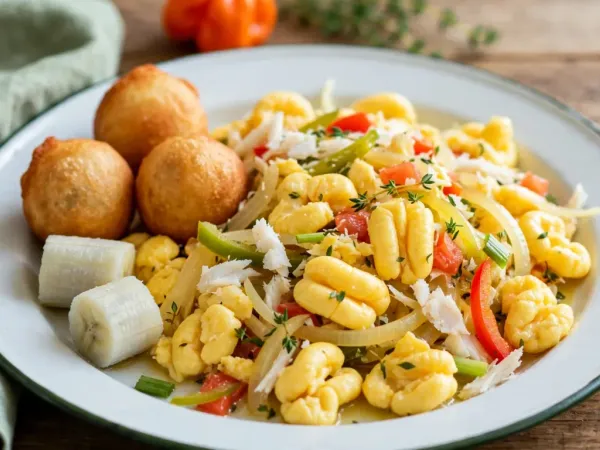
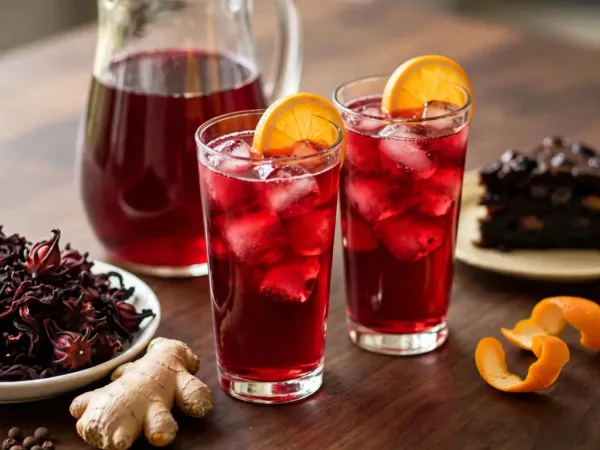
Serve small wedges at room temperature. “Match this with sorrell for an incredible combo!” Original Flava writes, so pour a glass of Jamaican sorrel beside it. For more from the island, try ackee and saltfish.
It travels well as a gift. Honey Bun suggests red plastic wrap and a green bow.
Swaps for the wine, the rum and the browning
- Red Label Wine: a sweet red dessert wine, Morris says. Harris uses Manischewitz. Recipes written outside Jamaica mostly use port.
- White overproof rum: ordinary white rum, at 40% alcohol. A recipe on Jamaicans.com allows “rum of your choice”.
- Browning: molasses, which Lesa uses to darken her cake.
- Mixed spice: pumpkin pie spice, or extra cinnamon and nutmeg.
- Butter: margarine, as in the Grace Foods recipe.
- Wine and rum: red grape juice. That Girl Cooks Healthy simmers the fruit in it for 15 minutes for a cake with no alcohol.
Frequently asked questions
How long should I soak the fruit for Jamaican black cake?
Anything from 3 hours to a year. Jamaican cooks prize a soak of months, but a third of the Jamaican recipes we read print a same-day method. A week is a good minimum, Lesa of Jamaican Foods and Recipes says.
Is Jamaican black cake the same as Christmas cake or rum cake?
In Jamaica, yes. Fruit cake, Christmas cake, rum cake and black cake are names for the same dark cake of ground, soaked fruit.
Does the alcohol cook out of black cake?
Most of the soaking alcohol does. USDA data suggest 5% to 10% survives a bake of 2 to 2½ hours. The wine and rum poured on afterwards are never heated, so most of that stays.
What can I use instead of Red Label Wine?
Use another sweet red dessert wine. Port is the usual choice in recipes written outside Jamaica.
Why is my black cake bitter?
Too much bottled browning is the usual cause. Add it 1 tablespoon at a time and stop at a very dark brown.
Can I freeze black cake?
Yes. By tradition, the top tier of a Jamaican wedding cake goes into the freezer until the first anniversary. The FoodKeeper database gives shop-bought fruit cake 12 months in the freezer.
Do I have to grind the fruit?
No, but most Jamaican recipes do. Ground fruit gives the smooth, pudding-like crumb. Chopped fruit gives a more cake-like one.