The Sunday Potthesundaypot.com/recipes/nigerian-jollof-rice/
Nigerian Jollof Rice with Chicken, Smoky Party Style
By The Sunday Pot Kitchen Updated
- • About 2½ hours in all, most of it hands-off: the chicken and stock first, then 30 minutes of steaming under foil
- • 3 cups (555 g) of parboiled rice to about 4 cups of liquid: 2 cups of reduced pepper base and 2 cups of stock
- • Cook the pepper base down for 20 to 25 minutes, until a film of oil floats on top
- • Seal the pot with foil and the lid, and steam the rice on the lowest heat without stirring
- • 3 to 5 minutes on medium-high heat at the end toasts the prized bottom-pot crust
- • The chicken is done at 165°F (74°C) in the thickest thigh
Ingredients
6 servingsInstructions
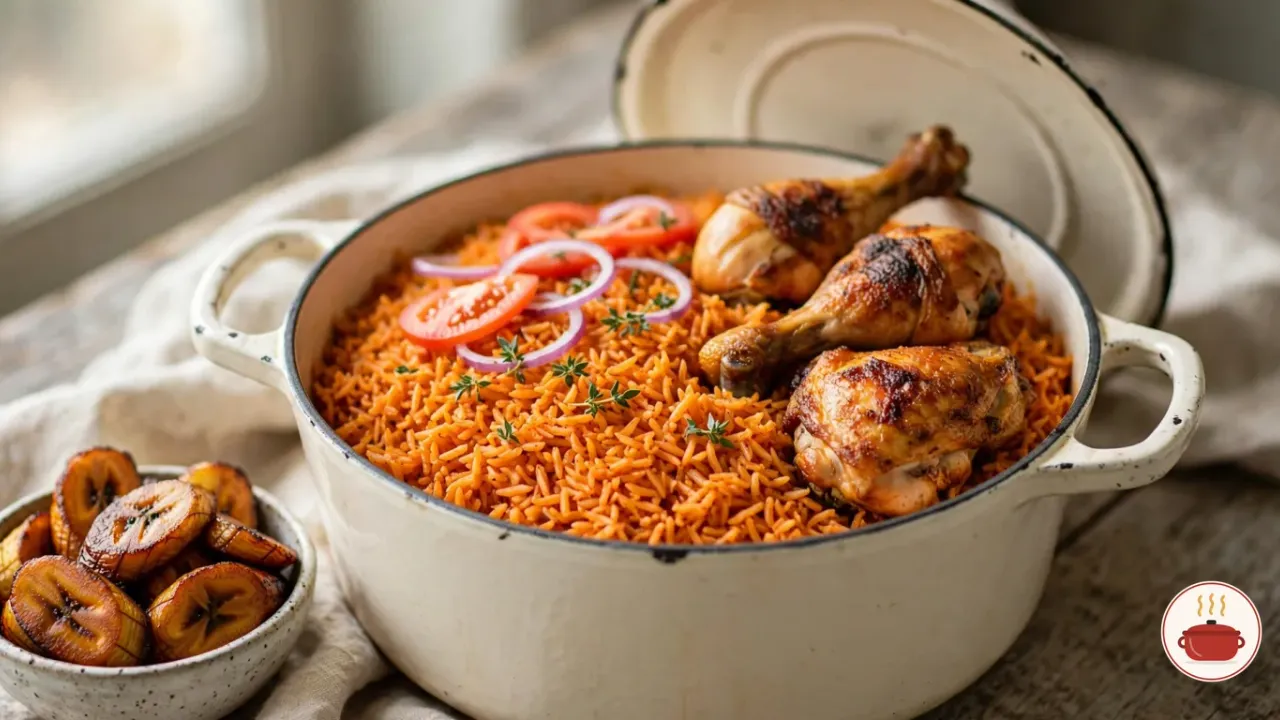
Jollof rice is West Africa’s party dish: long-grain rice steamed in a fried pepper and tomato base until every grain turns orange-red. This Nigerian version cooks in one Dutch oven. Make a chicken stock and fry the base until the oil rises. Then steam the rice under foil for 30 minutes, and let the bottom toast.
What jollof rice is
Jollof rice is rice cooked in a spiced base of tomatoes, red peppers, onions and chiles. The rice drinks up the base as it steams, so each grain turns orange-red and tastes of it. Cooks make it all across West Africa, from Senegal and The Gambia to Ghana, Sierra Leone, Liberia and Nigeria.
Its roots lie with the Wolof people of Senegambia. Britannica traces the dish to the Wolof empire, in today’s Senegal, in the 14th century. Its Senegalese cousin, thieboudienne or ceebu jën, cooks rice with fish and vegetables. UNESCO added ceebu jën to its list of the world’s intangible cultural heritage in 2021.
Tomatoes and chiles came to Africa from the Americas, so the red jollof we know is much younger than that empire. Each country now cooks its own version. NPR counts at least 10 of them.
The jollof wars
Which country makes the best jollof is a fierce, friendly argument, above all between Nigeria and Ghana. NPR described it in 2016 as a war of words from Senegal to Nigeria. In 2021, CNN noted that Twitter’s choice of Ghana for its Africa office reignited the rivalry, known as the jollof wars.
Rice is one clear difference. Nigerians favor parboiled long-grain rice, while Ghanaians often cook with jasmine rice. This recipe is Nigerian, so it uses parboiled rice.
Party jollof and the bottom pot
Nigerians save their best jollof for weddings, birthdays and big family Sundays. Party jollof cooks in large iron pots over firewood. Google Arts & Culture describes the smoky flavor the fire gives it.
The fire also crisps a layer of rice on the bottom of the pot. Nigerians call it the bottom pot, and many think it the best part. Ozoz Sokoh of Kitchen Butterfly compares it to socarrat, the crust at the bottom of a Spanish paella.
A home stove has no firewood, but a heavy Dutch oven gets close. After the rice has steamed, a few minutes on higher heat toasts the bottom on purpose.
Sunday rice
In many Nigerian homes, Sunday lunch means rice. BellaNaija describes Sunday rice as the special rice meal many families cook after church, when everyone is home. The classic plate is white rice with tomato stew. As Daily Times Nigeria notes, some families serve jollof instead.
Jollof suits a slow Sunday. The pot needs about 2½ hours, and most of that time it cooks on its own.
Why jollof rice is having a moment
Jollof is traveling far beyond West Africa. In the UK, the Uber Eats Hottest Bites 2026 report found searches for Nigerian food up more than 100%. It also put the jollof rice from Enish, a Nigerian restaurant, on its list of the year’s hottest dishes.
In the US, DoorDash reported that orders of African food rose 61% in October 2025, compared with a year earlier. In August 2026, 2,000 people lined up near Union Market in Washington, D.C., for a blind jollof tasting, NPR reported. Chefs came from five West African countries and, for the first time, from the United States.
Cookbooks have noticed too. In June 2026, Ozoz Sokoh’s Chop Chop: Cooking the Food of Nigeria won the James Beard Foundation award for an emerging voice in books. BellaNaija calls her the first Nigerian cookbook author to win a James Beard Award.
What you need: rice, peppers and a heavy pot
Parboiled rice
Nigerian jollof uses long-grain parboiled rice. US stores sell it as converted rice, such as Ben’s Original, and UK stores as easy-cook rice. The UK Rice Association explains that millers steam this rice under pressure before milling. That hardens the grain and keeps the grains separate.
It is just what jollof needs. The grains soak up a thick, oily base without turning to mush. Wash the rice in cold water 3 or 4 times, until the water runs nearly clear, then drain it well.
The pepper base
Yoruba cooks call the base obe ata. It is a purée of red bell peppers, plum tomatoes, onion and Scotch bonnet chiles. The bell peppers, tatashe in Nigeria, bring sweetness and color. The Scotch bonnets bring heat and a fruity scent.
Go carefully with the chiles. The Chile Pepper Institute at New Mexico State University rates the Scotch bonnet at 350,000 Scoville heat units. One chile makes a warm pot, and two make a hot one. The National Center for Home Food Preservation advises gloves for cutting hot peppers, and warns you not to touch your face.
Tomato paste deepens the color, but too much spoils the pot. Sisi Jemimah warns that it gives jollof a sharp, almost sour taste of raw tomato. A quarter cup (65 g), fried well, is plenty.
Curry powder, thyme and stock cubes
Three pantry seasonings give Nigerian jollof its taste. Nigerian-style curry powder is mild and yellow with turmeric. Dried thyme adds a woodsy note. Stock cubes, most often Maggi or Knorr, season both the stock and the rice.
Kitchen Butterfly lists curry powder and dried thyme, with onion, ginger and garlic, as the heart of a Nigerian stock. Here they flavor the chicken first, then the rice.
A heavy Dutch oven
Use a heavy 6- to 7-quart (5.7 to 6.6 liter) Dutch oven with a tight lid. Its thick base spreads the heat, so the rice steams evenly and the bottom toasts instead of burning. You also need foil, a blender, a sheet pan with a wire rack and an instant-read thermometer.
How to make jollof rice in a Dutch oven
Cook the chicken first
The chicken does two jobs. First it simmers with onion, ginger, garlic, thyme, curry powder and stock cubes, and that liquid becomes the stock for the rice. Then it browns in a hot oven, and you serve it with the jollof.
Many Nigerian recipes start by washing the chicken. Skip that step. The UK Food Standards Agency says never to wash raw poultry, because the splashes spread campylobacter bacteria around the kitchen.
Simmer the pieces for 20 to 25 minutes, until the thickest thigh reads 165°F (74°C). That is the USDA’s safe minimum for poultry. Then roast them at 425°F (220°C) for 15 to 20 minutes, until deep golden.
Fry the base until the oil rises
This step makes or breaks jollof. First, fry the tomato paste in the oil for about 5 minutes, until it darkens to brick red. Then add the blended peppers and cook them down for 20 to 25 minutes, stirring every few minutes.
The base is ready when it has thickened and lost about a third of its volume. A film of red oil floats on top. Sisi Jemimah gives the same test: fry it until the oil begins to float. An underdone base leaves the rice tasting of raw tomato.
Less liquid than you think
Jollof steams; it does not boil. The rice needs far less liquid than plain rice, and the base counts as part of it. Chef Lola’s Kitchen puts it at 1 to 1¼ cups of liquid for each cup of rice, base and stock together. Yewande Komolafe’s recipe for NYT Cooking uses about 1⅓ cups.
This pot takes the upper end: 3 cups of rice with about 4 cups of liquid. That is roughly 2 cups of reduced base and 2 cups of stock. The liquid should sit level with the rice, never more than ⅓ inch (1 cm) above it. Keep ½ cup (120 ml) of hot stock in reserve, in case the top needs it.
Seal it and leave it alone
Lay a sheet of foil over the pot, press the lid on and turn the heat to its lowest setting. Cook for 30 minutes without lifting the lid. The foil traps the steam, and the steam cooks the rice. Stirring breaks the grains and turns jollof mushy.
After 30 minutes, taste a few grains from the top. If they are still firm, sprinkle ¼ cup (60 ml) of hot stock over them. Fold the rice once from the bottom with a wooden spoon, and seal the pot for 5 to 10 minutes more.
Toast the bottom on purpose
For the smoky party taste, dot the rice with butter and lay tomato and onion slices on top. Seal the pot again and raise the heat to medium-high. Leave it for 3 to 5 minutes, without stirring, until you smell toasting rice. Stop before it smells acrid.
9jafoodie leaves the pot on high heat for 5 to 8 minutes. A heavy Dutch oven holds more heat, so start with less. Then turn off the heat and let the pot rest, covered, for 10 minutes.
A little char is the point, but only a little. Chef Lola’s rule is a slight toasting at the base, never charcoal. If you want no crust at all, add ¼ teaspoon of smoked paprika to the base for a gentle smoky note instead.
The oven method
You can also steam the rice in the oven. Once the rice comes back to a boil, seal the pot and bake it at 350°F (175°C) for 35 minutes, as the NYT Cooking recipe does. Let it rest, covered, for 15 minutes. The oven cooks the rice more evenly, but it makes no crust. For a bottom pot, finish it on the stove for 3 to 5 minutes.
Fixes for mushy, hard or sour jollof
- Mushy rice: too much liquid, too much stirring or the wrong rice. Cook the base down further, use parboiled rice and keep the lid on.
- Hard grains on top: steam escaped, or the liquid ran short. Sprinkle ¼ cup (60 ml) of hot stock over the top, reseal the pot and cook for 5 to 10 minutes more.
- A sour, raw tomato taste: too much tomato paste, or a base that did not cook long enough. Fry the paste until brick red, and cook the base until the oil floats.
- Pale rice: the paste did not fry long enough, or the base was too thin. Next time, give the paste its full 5 minutes.
- A burnt, bitter bottom: the heat ran too high or too long. Serve only the rice above it, and leave the black layer in the pot.
Serving and storing
Bring the pot to the table with the browned chicken on top. Fried ripe plantain, called dodo, is the classic side, with a crunchy coleslaw or a green salad. Moi moi, a steamed bean pudding, often joins jollof at Nigerian parties, as All Nigerian Recipes notes.
Jollof shares a method with chicken biryani: spiced rice that finishes in steam under a sealed lid. After a plate of it, a mug of hojicha latte makes a gentle end to the meal. For a proper Sunday dessert, serve sticky toffee pudding.
Storing leftovers
Cooked rice needs care. The UK Food Standards Agency explains that rice can hold spores of Bacillus cereus, and the spores can survive cooking. Its advice for leftover rice:
- Spoon it out of the pot into small, shallow containers. Never leave rice to cool in the pan.
- Chill it as fast as you can, ideally within 1 hour.
- Keep it in the refrigerator for no more than 1 day.
- Reheat it only once, until it is steaming hot all the way through.
The chicken keeps longer. The USDA says most cooked leftovers keep 3 to 4 days in the refrigerator.
Calories per serving
One serving, with the chicken skin, has about 930 calories by USDA figures. Without the skin, it has about 730. Most of the 1,060 mg of sodium comes from the stock cubes, so taste the pot before you add more salt.
Substitutes for missing ingredients
- Parboiled rice: US converted rice or UK easy-cook rice is the same thing. Basmati also works, as in the NYT Cooking recipe.
- Scotch bonnet: habanero. The Chile Pepper Institute rates it at 250,000 Scoville units, close to the Scotch bonnet. For a mild pot, use half a chile.
- Red bell peppers: any sweet red peppers.
- Fresh plum tomatoes: 1 cup (250 g) of canned whole plum tomatoes.
- Nigerian curry powder: a mild curry powder with an extra pinch of turmeric. Avoid hot blends.
- Stock cubes: 1 tablespoon of chicken bouillon powder for 3 cubes.
- Dried thyme: about 5 sprigs of fresh thyme in all.
- White pepper: black pepper.
- Butter: 2 more tablespoons of oil, for a dairy-free pot.
- Firewood smoke: ¼ teaspoon of smoked paprika in the base.
- Bone-in chicken: boneless, skinless thighs. Simmer them for about 15 minutes, until they read 165°F (74°C).
Frequently asked questions
What rice is best for jollof rice?
Long-grain parboiled rice, sold as converted or easy-cook rice. Its firm grains stay separate as they soak up the base. Ghanaian cooks often use jasmine rice, and basmati also works.
Why is my jollof rice mushy?
It usually has too much liquid, too much stirring or the wrong rice. Cook the base down until the oil floats, use about 1⅓ cups of liquid per cup of rice, and leave the lid on while it steams.
Why is my jollof rice still hard?
The steam escaped, or the liquid ran short. Sprinkle ¼ cup (60 ml) of hot stock over the top, and seal the pot with foil and the lid. Cook it on low for 5 to 10 minutes more.
Is it OK if the bottom of the pot burns?
A little toasting is the goal. Nigerians call it the bottom pot and prize its smoky taste. Stop when you smell toasting rice, before it turns acrid, and leave any black layer in the pot.
What is the difference between Nigerian and Ghanaian jollof?
The rice is the clearest difference. Nigerian jollof uses parboiled long-grain rice, while Ghanaian jollof often uses jasmine rice. Every family has its own spices too, and both countries claim the best jollof.
Is jollof rice spicy?
It is as hot as you make it. The Scotch bonnets bring the heat, so use 1 for a warm pot, 2 for a hot one, or half a chile for a mild one. Nigerian-style curry powder is mild.
What do you serve with jollof rice?
Fried chicken or browned chicken, fried ripe plantain and a crunchy coleslaw or salad. At Nigerian parties, moi moi, a steamed bean pudding, often comes with it too.
How long do jollof rice leftovers keep?
The UK Food Standards Agency advises chilling cooked rice within 1 hour and keeping it for no more than 1 day. Reheat it only once, until it is steaming hot all the way through.
Can I make jollof rice in the oven?
Yes. Once the rice comes back to a boil, seal the pot with foil and the lid, and bake it at 350°F (175°C) for 35 minutes. Rest it, covered, for 15 minutes. The oven version makes no bottom crust.