The Sunday Potthesundaypot.com/recipes/tempe-bacem/
Tempe Bacem: Javanese Sweet Tempeh Braised in Palm Sugar
By The Sunday Pot Kitchen Updated
- • Per 1.1 lb (500 g) of tempeh, use about 3⅓ cups (800 ml) of coconut water and 3½ oz (100 g) of palm sugar
- • Cut the tempeh ⅔ inch (1.5 cm) thick, so it doesn't break during the 40-minute simmer
- • Simmer uncovered until the liquid becomes a sticky glaze, then lower the heat: the sugar burns fast at the end
- • Fry for only 1 to 2 minutes a side; frying is optional, and some cooks grill the tempeh instead
- • Salam leaves, galangal and coriander carry the flavor; kecap manis is optional and mostly adds color
- • Braised tempeh keeps 3 to 4 days in the fridge, so make it ahead and fry it just before serving
Ingredients
6 servingsInstructions
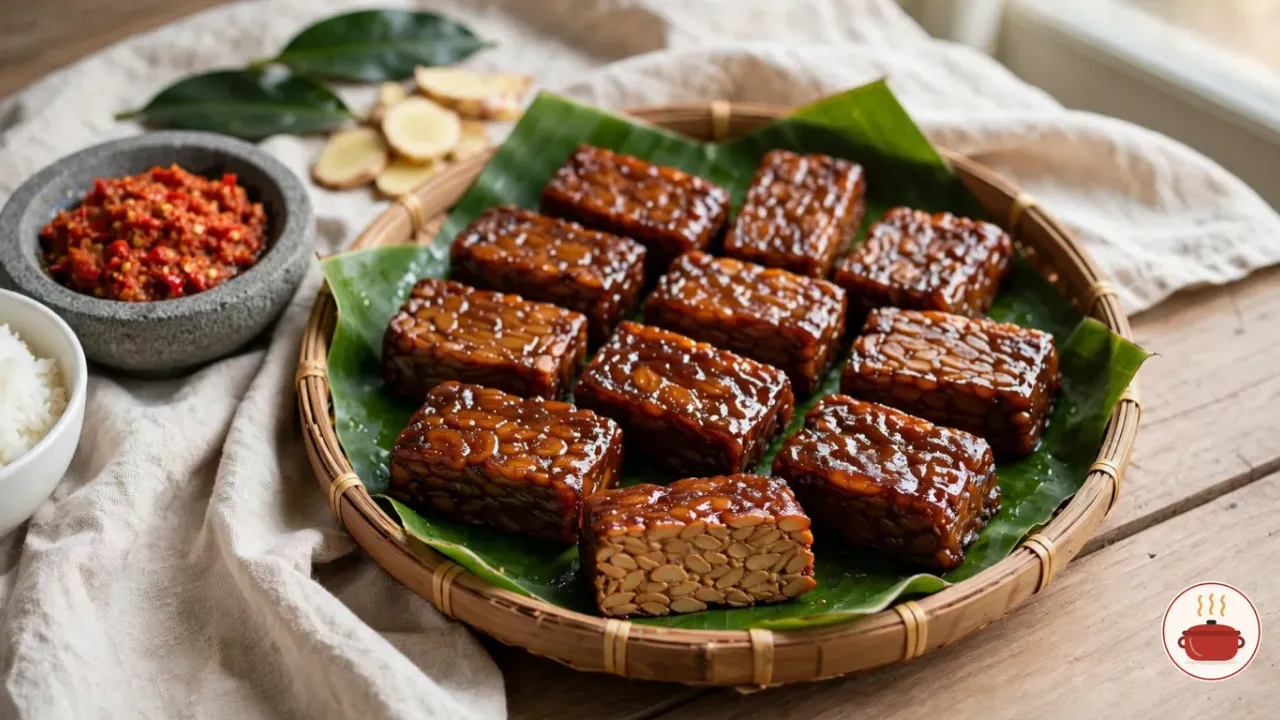
Tempe bacem is tempeh cooked the Javanese way: simmered in coconut water with palm sugar, galangal, coriander and salam leaves until the pan is almost dry, then fried for a minute or two. This recipe serves 6 as a side dish. It takes about 1½ hours, mostly hands-off, and it is vegan.
What tempe bacem is
Bacem is a cooking method, not a single dish. Indonesia’s official dictionary, the KBBI, puts it simply. You soak tofu or tempeh in spices, then boil them in a covered pan until the water is gone.
Nunuk Sri Rahayu, a cook from Solo in Central Java, explains it on Cook Me Indonesian. “This technique involves boiling a main ingredient – in this case tempe – with a spice paste, and reducing it until all the liquid evaporates,” she writes. Then the tempeh is deep-fried or grilled.
Javanese cooks use the same braise for tofu and chicken. Tahu tempe bacem, tofu and tempeh in one pan, is common. Of the 30 recipes we compared, 14 braise tofu alongside the tempeh.
A Central Javanese side dish
Tempe bacem belongs to Central Java and Yogyakarta. Rahayu calls it “a popular Central Javanese dish, eaten either as a snack or with steamed rice”. In Yogyakarta, it often sits beside gudeg, the sweet stew of young jackfruit. It also turns up at the city’s angkringan food carts, next to small packets of rice.
Many cooks say bacem began as a way to make food keep longer. It is a nice idea, but we found no historical record behind it.
How old is tempeh?
Tempeh comes from Java. Its earliest known written mention is in the Serat Centhini, a Javanese manuscript “probably written around A.D. 1815”, according to William Shurtleff and Akiko Aoyagi of the Soyinfo Center. The line mentions “onions and uncooked témpé”. The story itself is set in the 1600s, so tempeh may be older still.
Tempeh is cooked soybeans bound into a firm cake by a white mold, Rhizopus. Makers once fermented the beans in banana or hibiscus leaves. Plastic bags took over from the late 1960s, the Soyinfo authors write. Indonesia added tempe to its national register of intangible heritage in 2017.
Why tempeh is in the news this autumn
UNESCO decides in December
Indonesia has asked UNESCO to add the “Culture of Tempe” to its list of the world’s intangible heritage. The file, number 1970, goes before UNESCO’s heritage committee this year. The committee meets in Xiamen, China, from November 30 to December 5, 2026, its session page shows.
Culture Minister Fadli Zon hopes for a yes. In May he told Kompas he expected the decision “at the end of the year, usually November, December”. Earlier, in December 2025, he said Indonesians should drop the idea that tempeh is cheap, second-rate food.
Nothing is decided yet. On October 13, 2026, UNESCO had not yet published its experts’ advice on the file. One Indonesian travel site ran a December 2025 headline saying UNESCO had already recognized tempe. It had not.
Soybeans cost more
Most of Indonesia’s soybeans are imported, and tempeh makers feel every price rise. Tofu and tempe makers account for over 90% of the country’s soybean demand, the National Food Agency said in April 2026.
On October 6, the trade minister, Budi Santoso, told reporters that soybean prices had risen and a subsidy was under discussion. The Jakarta Post put annual demand at about 2.74 million tonnes, against home-grown output of just 311,000 tonnes.
From street carts to fine dining
Tempeh is moving up the menu at home. In April, The Jakarta Post found it at fine-dining restaurants in dishes such as tempe bacem, “braised in palm sugar”. Abroad, forecasters expect Indonesian cooking to keep rising in 2027, as our beef rendang recipe explains.
No one has published a 2026 sales, menu or search number for tempe bacem itself. The news is about tempeh, its beans and its UNESCO bid.
What you need for tempe bacem
We compared 30 published recipes, 27 of them from Indonesian cooks or Indonesian food outlets. Most are in Indonesian, from cookbook authors such as Sisca Soewitomo and Fatmah Bahalwan. This recipe sits on their medians.
Tempeh
Buy 1.1 lb (500 g) of firm tempeh. Indonesian cooks ask for dense, young tempeh, because old tempeh can taste sour. Cut it thick, about ⅔ inch (1.5 cm), as Indonesian cooks advise, so it doesn’t fall apart in the pan.
Most tempeh in shops is pasteurized and tan. Fresh Indonesian tempeh is white and creamy, says the cookbook author Lara Lee on SBS Food. Either works here. Tempeh “acts as a wonderful sponge”, Lee says, and bacem relies on that.
Coconut water
Coconut water is in 26 of the 30 recipes, alone or mixed with water. The median is about 3½ cups (833 ml) of liquid per 1.1 lb (500 g) of tempeh, and this recipe uses 3⅓ cups (800 ml). Buy it unsweetened.
Plain water works too. “If coconut water is available, using it instead of plain water will improve the flavour significantly, but otherwise it’s still delicious,” Rahayu notes.
Palm sugar
Palm sugar is in 29 of the 30 recipes. Indonesian shops sell it in hard brown cakes as gula jawa, gula merah or gula aren. The median is 3½ oz (100 g) per 1.1 lb (500 g) of tempeh. It gives the tempeh its deep brown color. Chop it before it goes in, so it melts evenly.
Salam, galangal and coriander
Salam leaves are in all 30 recipes. Salam is sometimes called Indonesian bay leaf, but it is a different plant, Syzygium polyanthum. Its flavor “develops only gradually”, says PROSEA, a plant reference for South-East Asia, so the leaves go in at the start.
Shallots and galangal are in 29 recipes each, garlic and coriander in 27. Indonesian food writers often call coriander and palm sugar the heart of the braise.
Tamarind and kecap manis
Tamarind is in 21 recipes, for a little sourness against the sugar. Kecap manis, Indonesia’s thick sweet soy sauce, is in only 15. Several Indonesian sources treat it as a shortcut for color.
The secret is “not kecap manis”, writes the Indonesian food magazine Sajian Sedap, but coconut water and palm sugar. Here it is optional.
How to make tempe bacem sticky, not burnt
Simmer until almost dry
Nearly every recipe cooks the tempeh until the liquid is absorbed or nearly gone. Twelve give a time: from 20 to 60 minutes, with a median of 45. Keep the pan uncovered so the liquid can reduce, and turn the slabs once or twice.
Watch the last 10 minutes
As the liquid boils down, the sugar turns to a thick syrup, and it can scorch in a minute. “Take care that the contents of the pan do not burn,” Sri Owen warned in Indonesian Food and Cookery in 1980. Turn the heat to low and keep the slabs moving.
Some cooks lift the tempeh out while a little syrup is left. Less paste sticks to it, so the frying oil stays clean.
Fry it briefly
Of the 30 recipes, 23 fry the tempeh after braising, and 2 grill it. Frying keeps the slabs whole and makes them more fragrant, says Kompas. Keep it short, because the palm sugar makes the tempeh burn quickly. One to 2 minutes a side in hot oil is enough.
To grill instead, brush the slabs with a little oil and cook them over a medium grill for 2 to 3 minutes a side.
Serving and storing tempe bacem
Serve it warm or at room temperature with steamed rice and sambal. “When eaten as a snack, Indonesians like to pair tempe bacem with a whole fresh chilli,” Rahayu writes. It goes well beside beef rendang, or with a bowl of mapo tofu for a soy-lover’s dinner.
Make it ahead
The braised tempeh keeps well before frying. Rahayu suggests keeping it in the fridge “for a few days” before frying, so the flavors soak in. Cool it, cover it and get it into the fridge within 2 hours.
The USDA gives cooked leftovers 3 to 4 days in the fridge, so finish it by then. You can also freeze the unfried tempeh for up to 3 months. Thaw it in the fridge, then fry.
Don’t leave it out
Cooked tempeh is perishable. The CDC sets 2 hours at room temperature as the most, and just 1 hour on days hotter than 90°F (32°C).
Indonesia had a reminder in August 2026. After a suspected food poisoning linked to a free-meals kitchen in Jayapura, officials pointed to tempe bacem “cooked too early”, Kompas reported. Lab results were still pending.
Cook raw tempeh through
Most tempeh is pasteurized, but not all. In 2012, unpasteurized tempeh made 89 people ill with Salmonella in North Carolina and four other states, a CDC journal reported. Tempeh is “usually pasteurized and cooked before consumption”, its authors note.
Bacem simmers the tempeh for most of an hour, so it is well cooked. Keep raw tempeh apart from ready-to-eat food, and wash your hands after handling it.
Don’t confuse soybean tempeh with tempe bongkrek, made from coconut. That product can carry a deadly toxin that “cannot be destroyed by washing or cooking”, warns the Singapore Food Agency. Tempe bacem uses ordinary soybean tempeh.
Calories and allergens
One serving, 2 pieces, has about 300 calories, 18 g of protein, 14 g of fat and 30 g of carbohydrate, much of it sugar. Those figures are our estimate, built from USDA data for tempeh, brown sugar and coconut water plus 2 tablespoons of the frying oil.
Soy is on the FDA’s list of 9 major US food allergens, and tempeh is made from soybeans. Kecap manis often contains wheat too. In 2024, Australia’s food regulator recalled packs of ABC Kecap Manis for undeclared gluten and wheat. Leave it out if you avoid gluten.
Fixes for tempe bacem that is pale, burnt or broken
- It is pale: the liquid boiled off too fast. Add ½ cup (120 ml) of water and 1 tablespoon of sugar, and simmer again.
- It burned at the end: the heat was too high once the syrup thickened. Next time, lift the tempeh out while a spoonful of syrup is left.
- It burned in the oil: fry for less time, at medium heat, in fresh oil.
- It tastes sour: the tempeh was old. Buy firm, young tempeh with no gray patches.
- It is too sweet: add a little more tamarind or salt, and serve it with a hot sambal.
- It broke apart: the slabs were too thin, or you stirred too hard. Cut them thicker and turn them with a spatula.
Substitutes for missing ingredients
- Palm sugar: ½ cup packed dark brown sugar or dark muscovado.
- Coconut water: plain water. Four of the 30 recipes use only water.
- Salam leaves: leave them out. A bay leaf is a common stand-in, though it tastes different.
- Fresh galangal: dried galangal slices, soaked in warm water first. Ginger works but tastes sharper.
- Tamarind: 2 teaspoons of lime juice.
- Tempeh: firm tofu, pressed and cut thick. That makes tahu bacem.
Frequently asked questions
What does bacem mean?
It is a Javanese way of cooking food slowly in spiced, sweetened liquid until the liquid is gone. Tofu, tempeh and chicken are the most common.
Is tempe bacem sweet?
Yes, sweet and savory. Palm sugar and coconut water make it sweet, while salt, tamarind, garlic and coriander balance it.
Is tempe bacem vegan?
Yes. Tempeh, coconut water, palm sugar and spices are all plant-based.
Do I have to fry tempe bacem?
No. You can eat it straight from the braise, or grill it. Frying gives crisp edges and helps the pieces hold together.
Can I make it with tofu?
Yes. Use firm tofu, pressed and cut thick, and braise it in the same pan as the tempeh.
How long does tempe bacem keep?
Up to 3 to 4 days in the fridge, or 3 months in the freezer before frying.
Is tempe bacem gluten-free?
Without kecap manis, yes. Most kecap manis contains wheat, so check the label or leave it out.
Is tempeh on UNESCO’s heritage list?
Not yet. UNESCO’s committee will consider Indonesia’s “Culture of Tempe” file at its meeting from November 30 to December 5, 2026.