The Sunday Potthesundaypot.com/recipes/moi-moi/
Moi Moi: Nigerian Steamed Bean Pudding with Egg and Fish
By The Sunday Pot Kitchen Updated
- • Soak black-eyed peas briefly, then rub or pulse off every skin
- • Blend the beans with red bell pepper, Scotch bonnet and onion until completely smooth
- • Stir in oil, crayfish and stock, thin to a yogurt-like batter and beat in air
- • Steam it in ramekins, foil or banana leaves, never plastic bags, for 45 to 60 minutes
- • It is done when a skewer comes out clean; rest it for 10 minutes
Ingredients
6 servingsInstructions
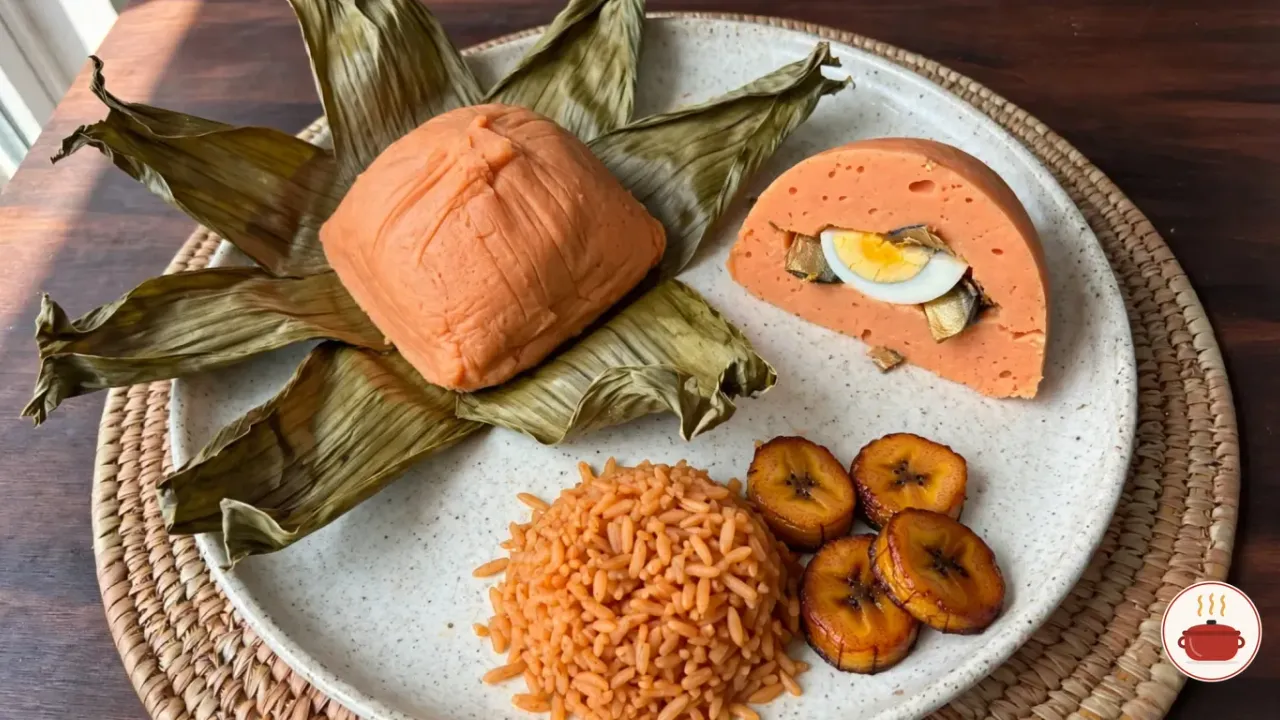
Moi moi is a Nigerian steamed bean pudding. Skinned black-eyed peas are blended with red bell pepper, Scotch bonnet and onion. The seasoned batter steams in leaves or ramekins, with boiled egg and fish inside. It sets soft, smooth and coral-orange. This recipe makes 6 portions in about 2½ hours, mostly soaking and steaming.
What moi moi is
A pudding of beans
Moi moi, also spelled moin moin, is made from cowpeas, the family that includes black-eyed peas and Nigeria’s sweet honey beans. Food scientists describe it as “a steamed cowpea seed‐based pudding native to Nigeria”, in a 2018 paper in Food Science & Nutrition. The beans lose their skins, so the pudding comes out fine and even, like a firm savory custard.
Its color comes from the red pepper. “Bell pepper (This determines the colour),” one Nigerian recipe notes, and palm oil deepens it to orange.
Seven lives
Cooks hide extras in each portion: boiled egg, fish, prawns or corned beef. A moi moi with many fillings is called elemi meje, “seven lives”. “Jokingly, we refer to Moi Moi as ‘elemi meje,’” writes Lola Osinkolu of Chef Lola’s Kitchen. The Nigerian Tribune once called the full version “moin-moin with seven souls”, a home dish rather than a party one.
Party plate and Saturday breakfast
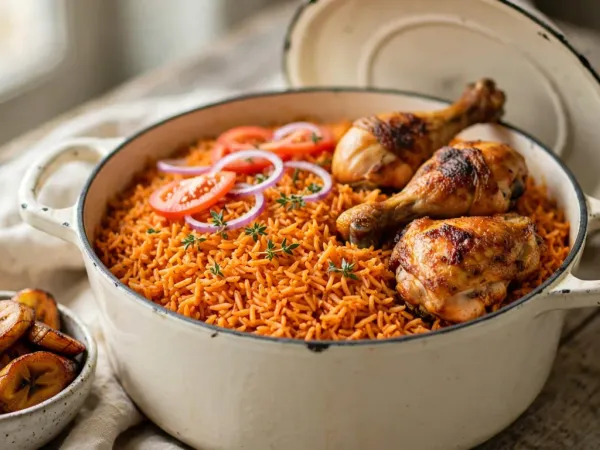
At Nigerian parties and weddings, moi moi sits on the plate beside jollof rice, fried rice and fried plantain. At home it is breakfast too, often with pap, a smooth fermented corn porridge. Writing in The Guardian Nigeria, one cook remembered moi moi as “a Saturday breakfast, paired with pap, sugar and some milk”.
Where moi moi comes from
A Yoruba cake in 1852
Moi moi is linked with the Yoruba of southwest Nigeria, though no one can date its birth. The word shows up early in print. Samuel Crowther, later a bishop, listed “Moi-Moi, s. a kind of cake” in his Vocabulary of the Yoruba Language, printed in London in 1852. He also lists olele, another name that is still used.
T. J. Bowen gave the same words in a dictionary that the Smithsonian published in 1858. Under “cake”, he lists “akara, moimoi, olele”. Akara are fried bean fritters made from much the same batter. Neither book says what moi moi was made of, so we can only say the name is old.
Crowther’s first edition came out in 1843. We could not find a copy to check, so 1852 is the earliest mention we can show you.
Many names
The business paper BusinessDay lists other names from across Nigeria, including mai-mai in the southeast and alele in Hausa. Its writer remembers the word olele from the early 1990s, when it “rang like a bell in the streets of Lagos”.
The dish also crossed the Atlantic. In Salvador, Brazil, it is called abará. A 2022 study in Food Science and Technology says the baianas de acarajé sell it on the city’s streets every day. There it is cooked with palm oil and dried shrimp and wrapped in banana leaves.
The leaf
The traditional wrapper is the broad, papery leaf of Thaumatococcus daniellii, called ewe eran in Yoruba. It belongs to the prayer-plant family. The FAO notes that “Its leafs are used for wrapping food and meat”, and that its fruit gives thaumatin, a sweet protein. Some cooks say the leaf adds a faint sweetness. Banana leaves are the usual stand-in outside West Africa.
Why moi moi is worth making now
Beans cost less in Nigeria
Nigeria’s National Bureau of Statistics tracks food prices. In April 2026, a kilo of brown beans averaged ₦1,338.93, down 44.89% from April 2025, ThisDay reported in June. The southwest, moi moi’s home region, paid the most, at ₦1,787.09 a kilo, Legit.ng found in the same figures.
Food inflation is cooling too. It stood at 19.59% in September 2026, down from 20.16% a year earlier, the bureau said in October, as reported by Voice of Nigeria.
The new crop and the festive season
The new bean crop is reaching Lagos. In September 2026, a bag of oloyin, or honey beans, fell 8.54% to ₦75,000 in four big Lagos markets, says a Nairametrics survey. Traders also told its reporters that wholesalers were buying in bulk “ahead of the festive season”. That season fills up with Christmas parties, weddings and New Year’s Day lunches, and moi moi is at most of them.
A recipe for a crowd
In March 2026, NYT Cooking published Yewande Komolafe’s Moin-Moin for a Gathering, one big pudding baked in a water bath. She explains that its garnishes “can range from three to seven add-ons”.
Still, there is no 2026 number for moi moi as a dish, and the 2027 forecasts we checked leave it out. What is new this year is cheaper beans and a full party calendar.
What 29 moi moi recipes agree on
We compared 29 recipes, each one read in full. Twenty-three are by Nigerian cooks or Nigerian newspapers, including All Nigerian Recipes, Kitchen Butterfly, Sisi Jemimah, 9jafoodie and the Nigerian Tribune. The rest come from cooks in Cameroon, Britain, Canada and the US.
Skins off, always
Every recipe that starts from whole beans removes the skins first. Twelve rub them off by hand, nine pulse the beans briefly in a blender, and four buy them already peeled. “Remember we are peeling the beans and not blending them,” Osinkolu warns.
Pepper, onion and chile
Twenty-five of the 29 blend in onion, and 25 add Scotch bonnet or another hot chile. Twenty use red bell pepper, called tatashe in Nigeria. Eighteen add ground crayfish, and 20 hide eggs inside. The median recipe starts with about 12 oz (334 g) of dried beans.
As smooth as you can get it
Every recipe blends the batter as fine as possible. “Grainy moi moi isn’t nearly as tasty,” writes Imma of Immaculate Bites. The batter should be “like store-bought yogurt”, says Ozoz Sokoh of Kitchen Butterfly, and “semi fluid but definitely not watery”, says Sisi Jemimah.
About 50 minutes in steam
The median stovetop steam is 51 minutes. Small leaf cones cook fastest, then foil, then bowls. “You are steaming the moimoi and not boiling it,” 9jafoodie reminds readers: the parcels sit above the water, not in it.
The splits: oil and containers
Twenty-six use vegetable oil, and 13 use or offer palm oil, usually warmed and cooled first. One cook recalls her mother used palm oil at home, while party moi moi was made with vegetable oil. We give you the choice.
Containers split widely. Fourteen recipes mention leaves, eight foil, eight ramekins and nine tins or cake pans. Six use plastic bags, cups or bowls. Not one of the 29 warns against plastic, so we do, below.
Leaves, ramekins or one big pan
Banana leaves
Leaves give moi moi its classic slanted pyramid shape. Soften banana leaves over a flame or in hot water. Fold each into a cone, ladle in about ¾ cup (180 ml) of batter with a piece of egg and fold the top over. Stand the parcels upright and close together in the pot. Check them after 40 minutes. “The tastiest part of the moinmoin is usually the bits stuck between the leaves,” says Sokoh.
Ramekins or foil cups
Ramekins are the easiest way to start. They give neat, round portions and are simple to check. Foil cups, folded from double sheets, work the same way.
One big pudding
For a crowd, bake the batter in a deep pan inside a larger pan of hot water, as Komolafe does. Expect it to take longer, and test the center with a skewer.
Tips for smooth, tender moi moi
- Get every skin off. Dark flecks of skin make the pudding grainy and gray.
- Blend longer than you think. Three minutes in a strong blender is a good start.
- Add water slowly. Too much water is the most common reason moi moi won’t set.
- Beat in air. Five minutes with a wooden spoon makes it lighter.
- Warm, then cool, palm oil. Cold palm oil won’t mix in, and hot oil should never go into the batter.
- Never let the pot boil dry. Top it up with boiling water, not cold.
Serving moi moi
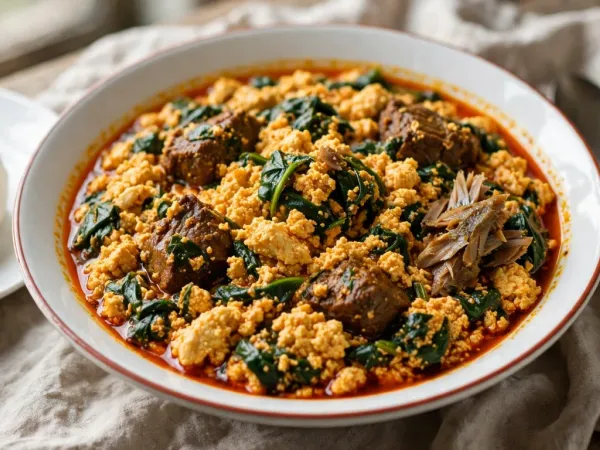
Serve it warm, on its own or beside jollof rice, fried plantain and a green salad. For breakfast, pair it with pap or warm custard. Moi moi also fits a West African table with egusi soup and pounded yam.
For a bean feast from other parts of the world, try Mexican frijoles de la olla or Levantine mujadara.
Safety, storing and nutrition
Don’t cook it in plastic bags
Many Nigerian cooks steam moi moi in nylon or sandwich bags. We don’t recommend it. Grocery bags “are not intended or formulated for cooking foods,” says the USDA, and chemicals from them can move into the food. The same page warns against heating food in margarine tubs. In 2016, Nigeria’s agriculture minister also urged cooks to use leaves instead of bags, Vanguard reported. Use leaves, foil, ramekins or metal tins.
Clean beans
Buy beans from a seller you trust, and pick out any stones. In October 2026, Nigeria’s food regulator, NAFDAC, restricted small packs of the pesticide dichlorvos. It cited misuse on farm produce, the News Agency of Nigeria reported.
Eggs and steam
A raw egg in the batter needs full cooking. Egg dishes should reach 160°F (71°C), according to a USDA chart. Lift foil and leaves away from you, because the trapped steam scalds.
Allergens
Moi moi often contains three major allergens: eggs, fish and crustaceans. Ground crayfish is a crustacean, even though you can’t see it in the batter. The FDA lists all three among the major food allergens. Stock cubes can contain others, so read the label.
Storing
Cool leftovers quickly and put them in the fridge within 2 hours. The NHS says to eat chilled leftovers within 2 days and to reheat food only once. Moi moi freezes well, wrapped. Reheat it covered, with a splash of water, until it is steaming hot in the middle.
Nutrition
One ramekin, a sixth of the recipe with egg and mackerel, has about 400 calories. It has about 23 g of protein, 20 g of fat, 34 g of carbohydrate and 6 g of fiber. We built these numbers from USDA data for cowpeas, peppers, onion, oil, eggs and Atlantic mackerel, the closest match to smoked. Without the stock cube, each portion has roughly 460 mg of sodium; your stock cube adds more.
Fixes for runny, grainy or dry moi moi
- It won’t set: the batter was too thin. Steam it longer, and next time add less water.
- It is grainy: the beans needed a longer soak or a longer blend.
- It is gray or speckled: some skins stayed on. Wash the beans once more next time.
- It is dense and hard: the batter was too thick, or it needed more beating.
- It is dry or scorched at the base: the pot ran dry. Keep the water topped up.
Substitutes for missing ingredients
- Black-eyed peas: honey beans or brown beans, or store-bought peeled beans.
- Red bell pepper: 2 tablespoons tomato paste, for color.
- Scotch bonnet: a habanero, or chile flakes.
- Ground crayfish: dried shrimp powder, or leave it out.
- Smoked mackerel: canned sardines, corned beef or cooked prawns.
- Ewe eran leaves: banana leaves, foil or ramekins.
Frequently asked questions
Is it moi moi or moin moin?
Both. Each spelling is common in Nigeria, along with olele.
Do I have to peel the beans?
Yes. The skins make it grainy and gray.
Can I use a food processor?
Yes, but blend in batches and for longer. It should feel silky.
How do I know moi moi is cooked?
A skewer comes out clean, and the top feels firm.
Is moi moi gluten-free?
The beans and vegetables are. Check your stock cube for wheat.
What is the difference between moi moi and akara?
Both start with the same bean batter. Akara is fried in round fritters; moi moi is steamed.