The Sunday Potthesundaypot.com/recipes/egusi-soup/
Egusi Soup: Nigerian Melon Seed Soup with Beef and Spinach
By The Sunday Pot Kitchen Updated
- • Six bowls take 1½ cups (180 g) of ground egusi, ½ cup (120 ml) of red palm oil and 1½ lb (680 g) of beef or goat
- • Mix the egusi with only 5 to 6 tablespoons of water: a thick paste is what makes lumps
- • Warm the palm oil for 1 to 2 minutes only, and never bleach it until it smokes
- • Fry the pepper base for 10 to 15 minutes, until the oil rises
- • Drop the paste in by the teaspoon, cover it and leave it unstirred for 15 minutes
- • Cook the egusi 25 to 30 minutes in all, add the spinach for the last 3 to 5, and salt at the end
Ingredients
6 servingsInstructions
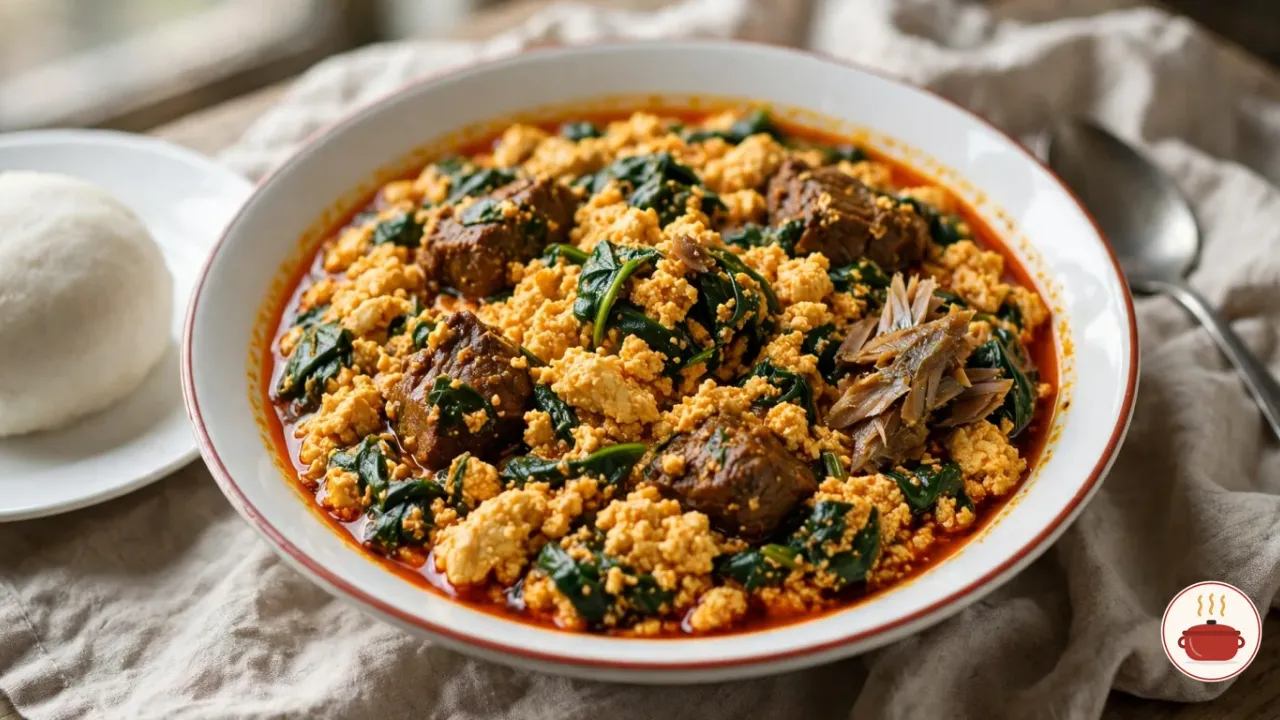
Egusi soup is one of Nigeria’s best-loved soups: ground melon seeds cooked into soft lumps in a palm oil and pepper base, with beef, smoked fish and greens. This version serves 6 and takes about 2¼ hours, most of it hands-off. Serve it with pounded yam, eba or fufu for scooping.
What egusi soup is
Egusi soup is a thick, rich stew of ground melon seeds, red palm oil, peppers, meat or fish, and leafy greens. In Nigeria, it comes with a swallow: a soft dough of pounded yam, cassava (eba) or yam flour (amala). You pinch off a piece and use it to scoop up the soup.
Google Arts & Culture, in a story by Nigeria’s Centenary Project, calls it arguably the most popular soup in Nigeria. People often eat it with their hands. The Hausa call it miyan gushi, the Igbo ofe egusi, and the Yoruba efo elegusi.
The seed behind the name
Egusi is not one plant. The name covers the seeds of several West African melons and gourds, the US National Academies explain in Lost Crops of Africa. The main one is a seed-type watermelon. Its flesh is white, dry and bitter, so farmers grow it only for its seeds. Another is the white-seed melon, Cucumeropsis mannii.
Botanists still disagree about the right Latin names, a 2025 review in Frontiers in Plant Science notes. What matters in the pot is the kernel: about 50% oil and 30% protein, by the National Academies’ figures. That is why the soup is so rich.
Lumps or smooth
Cooks split into two camps. Yoruba and Edo cooks drop the paste into the stock as balls, which cook through and turn orange, Ozoz Sokoh writes on Kitchen Butterfly. Igbo cooks often grind it finer and disperse it in the stock for a smoother soup.
That is a habit, not a rule. Flo Chinyere, the Igbo cook behind All Nigerian Recipes, gives three methods, one with egusi balls you eat “like meat”. This recipe makes lumps, like 10 of the 15 recipes we compared.
Beyond Nigeria
Farmers grow egusi from Mali to Cameroon, and almost every big market in the region sells it, the National Academies note. In Ghana, palaver sauce often includes agushi, as The Ghana Cookbook calls it. In Cameroon, they steam it with fish and meat in banana leaves as egusi pudding.
Why egusi soup is having a moment
We found no sales or search figure for egusi soup itself. The signs are on menus, in books and in prices.
In September 2026, The Food Institute named egusi soup among the West African dishes reaching “a growing list of Western restaurants”. Its list of trends for 2027 gives no figure.
In London, the MICHELIN Guide kept its stars for Akoko and Chishuru, two restaurants that cook West African food, on 9 February 2026 (full list). Akoko has served an egusi sauce with monkfish and yam fufu, Hyphen reported in 2025.
Books have noticed too. In June 2026, Ozoz Sokoh’s Chop Chop: Cooking the Food of Nigeria won a James Beard award, and it includes an egusi soup recipe, Streets of Toronto notes. In March 2026, a US picture book, Emeka, Eat Egusi!, told of a boy who helps his mother make the soup. Kirkus Reviews called it “a delicious introduction to new food and old traditions”.
Social media spreads it further. When a Nigerian restaurant opened in Canberra in August 2026, customers came in wanting egusi they had seen in videos online, Region Canberra reported.
At home, egusi has grown expensive. In September 2026, a big bag cost 480,000 naira in Lagos markets, 118% more than a year earlier, according to a survey of four markets by Nairametrics.
What you need for egusi soup
Ground egusi
Buy egusi whole or ground at an African grocer or online. The oil in the seeds turns rancid easily, so keep them in the freezer, where they last for months, Chef Lola’s Kitchen advises. Whole seeds keep better than ground ones.
Buy sealed, in-date packs from a shop that sells a lot of it. A 2016 study found aflatoxin, a mold toxin, in every egusi sample it tested from shops and homes in the UK and Ireland. Today, Great Britain checks half of all egusi shipments from Nigeria for it, under a 2024 regulation. Throw out seeds that smell musty or taste bitter.
Red palm oil
Red palm oil gives the soup its color and much of its flavor. Buy a sealed, labelled bottle from a shop you trust, and never choose it by how red it looks.
Some sellers add Sudan IV, an illegal red dye, to make the oil look redder, Ghana’s Food and Drugs Authority warns. No reliable quick test can spot it. In England, a court fined an importer in 2024 over palm oil with Sudan dyes in it, Thurrock Council reported.
Crayfish, iru and smoked fish
Nigerian crayfish is really dried shrimp, ground to a powder, All Nigerian Recipes explains. Iru is fermented locust beans. It smells strong, so first-timers should start with a little.
Smoked fish and stockfish, which is Norwegian dried cod, add depth. Buy gutted fish: the FDA treats ungutted dried or smoked fish as a botulism hazard. Soak it in hot water for 10 minutes, then rinse it, to get rid of any grit.
Beef or goat
Use boneless beef chuck, goat, or both. Many Nigerian cooks add tripe (shaki) and cow skin (ponmo) too. Cooks almost always stew adult goat because it is tough, the USDA notes. Simmer it until tender, however long that takes.
Greens
The most popular greens for egusi are ugu, spinach and bitterleaf, says Sisi Jemimah. Ugu is the leaf of the fluted pumpkin. Spinach is easy to find anywhere, so this recipe uses it. Kale and collard greens work too.
How to make egusi soup with soft lumps
We compared 15 published recipes, 10 of them by cooks of Nigerian birth or heritage. All 15 use palm oil, 13 use ground crayfish, and 11 use stock cubes.
A thick paste, then hands off
Lumps start with a stiff paste. Mix the egusi with very little water, into an “almost dough-like paste”, as Kiki of KikiFoodies puts it. Then drop it in small spoonfuls, cover the pot, and leave it alone for 10 to 20 minutes.
Five recipes say it plainly: do not stir. On NYT Cooking, Yewande Komolafe waits until the egusi absorbs the stock and congeals into lumps, about 10 minutes.
Fry the pepper base until the oil rises
Nine recipes cook down a pepper purée before the egusi goes in, usually red bell pepper, Scotch bonnet and onion. Most give it 10 to 15 minutes. It is ready when it has thickened and the oil floats on top.
Warm the palm oil, but don’t bleach it
Some cooks heat palm oil until it smokes and turns pale, which Nigerians call bleaching. None of the 15 recipes does that, and 3 warn against it. In a 2025 study, Nigerian researchers estimated that egusi soup loses 78% of its carotenoids, the source of palm oil’s vitamin A, mostly through pre-heating the oil.
Give the egusi 25 to 30 minutes
The egusi cooks for 15 to 55 minutes across the recipes, with a median of about 24. Two Nigerian cooks want 30 or more. Flo writes that “it takes 30 minutes to cook egusi properly”, and Chef Lola asks for 30 to 40. This recipe gives it 25 to 30. The sign that it is done: red oil rises to the surface.
Greens and salt go in last
Thirteen recipes add the greens in the last 2 to 10 minutes, so they stay green. Stock cubes, crayfish and smoked fish all bring salt. Taste the pot before you add any more.
How much per bowl
Our amounts sit near the middle of the 15 recipes. Each bowl holds about ¼ cup (30 g) of ground egusi, 4 teaspoons (18 g) of palm oil and 4 oz (113 g) of raw meat. The recipes use about 1 tablespoon of crayfish and 1½ cups (360 ml) of stock per cup of egusi.
Variations: smooth, vegetarian, fish only
Smooth egusi
Stir the paste into the simmering stock instead of dropping it in lumps. Cook it covered for 25 to 30 minutes, stirring now and then so it does not stick.
Vegetarian egusi
Komolafe’s recipe uses roasted mushrooms and vegetable stock, with no meat, fish or crayfish. Roast 1 lb (450 g) of mixed mushrooms at 425°F (220°C) for 25 to 35 minutes, and add them with the greens. Check that your stock cubes are vegetarian.
Fish only
Use 1 lb (450 g) of smoked mackerel, smoked catfish and soaked stockfish in place of the meat, with fish or vegetable stock. Add the fish with the greens, so it stays in large flakes.
Less oil
Flo’s “caking” method skips frying, and she notes it needs less oil. You can cut the palm oil to ¼ cup (60 ml). The soup will be paler and a little less rich.
Serving and storing egusi soup
Serve egusi soup hot, with pounded yam, eba, amala or fufu. Some Nigerian cooks serve it over rice. Its pepper base is a close cousin of the one in Nigerian jollof rice. For another slow Sunday pot of tender meat, try Jamaican oxtail.
Make it ahead
Cook the soup up to 3 days ahead, but stop before the greens. Reheat it and add the spinach just before serving, so it stays bright.
Leftovers
Follow the USDA’s advice on leftovers:
- Divide a big pot into smaller containers, so it cools quickly, and refrigerate it within 2 hours.
- Eat it within 3 to 4 days, or freeze it for 3 to 4 months.
- Reheat it to a rolling boil.
Is the meat done?
After an hour or more of simmering, beef and goat go far past the USDA’s safe minimum of 145°F (63°C) for whole cuts. Tender is the real test: a knife should slide in easily.
Calories and protein
One bowl has about 540 calories, 41 g of protein and 38 g of fat, 14 g of it saturated. It has about 14 g of carbohydrate, 5 g of fiber and 900 mg of sodium. These are estimates from USDA figures, without the swallow. A 9-oz (250 g) ball of pounded yam adds about 290 calories.
Palm oil is about half saturated fat. The NHS advises no more than 30 g of saturated fat a day for men and 20 g for women.
Allergens
Crayfish is a crustacean shellfish, and smoked fish is fish. Both are major allergens on the FDA’s list. Egusi is a seed and not on that list. Still, doctors have reported egusi allergy in a child who was allergic to other seeds and nuts (Pediatric Allergy and Immunology). Ask your guests first.
Fixes for egusi soup that won’t lump, burns or tastes bitter
- The egusi will not form lumps: the paste was too wet, or you stirred too soon. Use less water, and leave the pot covered for the full 15 minutes.
- It sticks or burns: the heat is too high. Turn it to low, shake the pot instead of stirring, and keep hot stock nearby. Egusi soaks up liquid fast.
- It tastes raw or grainy: it needs more time. Cook it until red oil rises to the top, 25 to 30 minutes in all.
- It tastes bitter: stale seeds, unwashed bitterleaf, or the seeds and white ribs of the bell peppers, KikiFoodies notes. Taste a pinch of egusi before you cook it.
- It is too thick: stir in hot stock, ½ cup (120 ml) at a time.
- It is too oily: spoon some oil off the top, and use less next time.
- It is too salty: add a little water and more greens. Next time, salt only at the end.
- It is gritty: soak and rinse the dried fish well, and wash the greens 2 or 3 times.
Substitutes for missing ingredients
- Ground egusi: ground pine nuts or peeled raw pumpkin seeds, as Komolafe suggests.
- Red palm oil: vegetable or peanut oil with 1 teaspoon of paprika for color, as Sokoh suggests. The taste will differ.
- Iru: 1 teaspoon of red miso, as in Komolafe’s recipe, or a few Chinese fermented black beans, Sokoh’s idea.
- Ugu or bitterleaf: spinach, kale or collard greens.
- Scotch bonnet: habanero. Both are very hot: about 350,000 and 250,000 Scoville heat units, by the Chile Pepper Institute’s figures.
- Crayfish: leave it out for a shellfish allergy, and use mushroom powder or vegetable bouillon, as Chef Lola’s team suggests.
- Smoked fish: smoked mackerel, or leave it out.
- Pounded yam: eba, fufu or plain rice.
Frequently asked questions
What is egusi made of?
Egusi is the ground seed of a few West African melons and gourds, mostly a seed-type watermelon. The seeds are about half oil, which makes the soup rich.
What does egusi soup taste like?
It is rich and savory, with a mild nutty taste from the seeds, heat from the Scotch bonnet and smoke from the fish.
Is egusi soup spicy?
It can be. Use 1 Scotch bonnet for medium heat. For a mild pot, add the chile whole and lift it out before serving.
What do you eat with egusi soup?
A swallow: pounded yam, eba, amala, semolina or fufu. Pinch off a piece, dent it with your thumb, and scoop up the soup. Rice works too.
How do you make egusi soup lumpy?
Mix the egusi into a thick paste with very little water. Drop it in by the teaspoon, cover the pot, and do not stir for 15 minutes.
Can I freeze egusi soup?
Yes. It keeps 3 to 4 months in the freezer. Add fresh greens when you reheat it.
Can I make egusi soup without palm oil?
Yes. Use vegetable oil with a little paprika for color. It will taste different, and less traditional.
Is egusi the same as watermelon seeds?
Not quite. Most egusi comes from a seed-type watermelon with white, bitter flesh, not the sweet red one. The shelled seeds look like large white melon seeds.
Tags: Sunday dinnerbeefsoupstewone potmake aheadfreezer friendly