The Sunday Potthesundaypot.com/recipes/mujadara/
Mujadara: Lebanese Lentils and Rice with Fried Onions
By The Sunday Pot Kitchen Updated
- • About 1 hour 40 minutes in one Dutch oven: 35 to 45 minutes for the onions, 15 minutes for the lentils, 18 minutes with the rice, 10 minutes of rest
- • 1 cup (200 g) of brown or green lentils to 1 cup (190 g) of basmati rice, 3 large onions and 4 cups (950 ml) of water
- • Brown the onions to a deep chestnut color: they season the whole pot, and half of them stay crisp for the top
- • Do not drain the lentils: the rice cooks in their water for 18 minutes under a tight lid
- • Use brown or green lentils; split red lentils cook in 5 to 7 minutes and fall apart
- • Chill leftovers within 1 hour, eat them within 1 day and reheat them only once
Ingredients
6 servingsInstructions
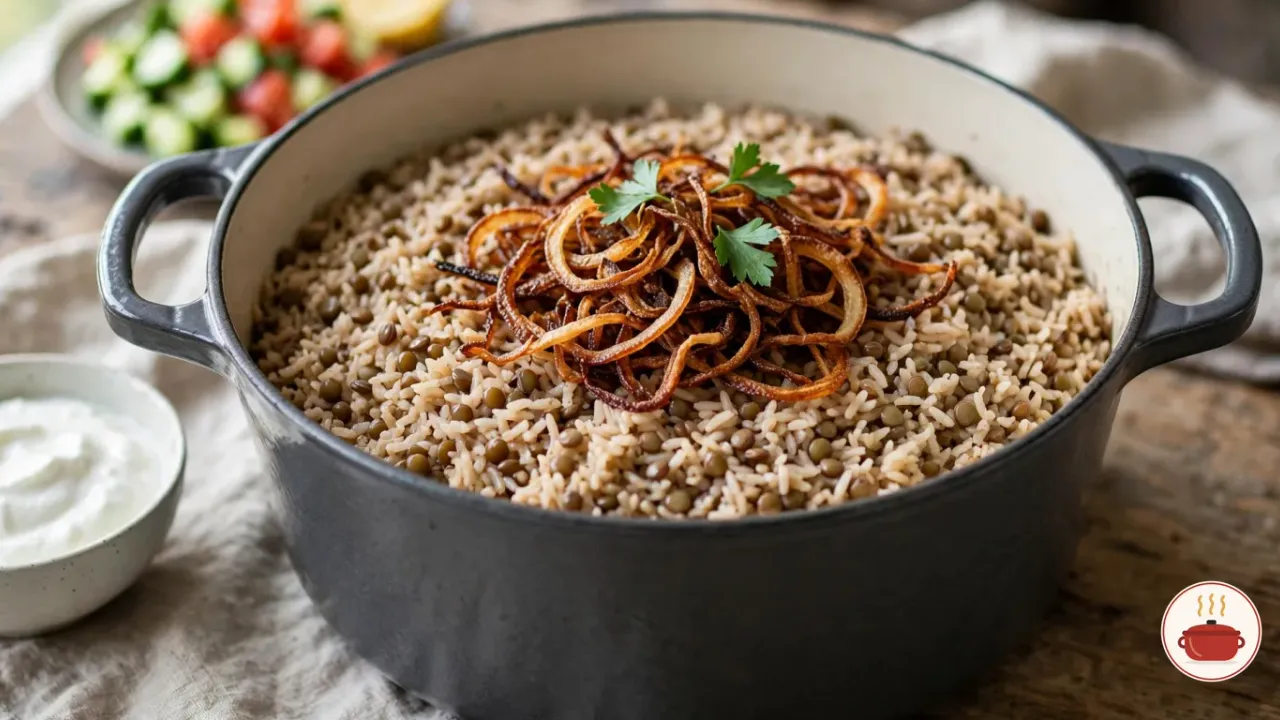
Mujadara is the Lebanese pot of lentils and rice under a pile of dark fried onions. This version cooks in one Dutch oven. Brown 3 onions for about 40 minutes, simmer the lentils for 15, then steam them with the rice for 18. It takes about 1 hour 40 minutes and serves 6.
What mujadara is
Mujadara is a dish of lentils, rice and onions from the Levant. Cooks make it in Lebanon, Syria, Palestine and Jordan. The lentils and rice cook together in one pot, and the onions fry in olive oil until dark and sweet. It has no meat, no stock and no dairy, so it is vegan as it stands.
You will see the name spelled many ways, such as mujaddara, mjadra, mejadra and megadarra. They all stand for the same Arabic word.
A name that means pockmarked
The Arabic name means pockmarked. Daniel Newman, a professor of Arabic at Durham University, traces it to judari, the word for smallpox. The lentils dot the rice like marks on skin, he explains on Eat Like a Sultan.
The earliest written recipe is in the Kitab al-Tabikh, an Arab cookbook written in Iraq in 1226, as the Jewish Food Society notes. That medieval dish was not the one we know. Newman writes that it held rice, lentils and meat, and was a little soupier than today’s.
Food of the poor, and of Esau
The meatless dish became known as poor people’s food. In her New Book of Middle Eastern Food, Claudia Roden tells of an aunt who served it to guests. She always apologized for the food of the poor. Her guests always gave the same answer. She could keep the food of kings, and give them this every day.
Roden also records its old nickname, Esau’s favourite. Some traditions hold that this was the red pottage for which Esau sold his birthright in Genesis. The Nosher adds that opinion is divided. The pottage may have been another of the region’s old lentil dishes.
Damascus has a rhyme for it. Mujaddara akal muqaddara, people say there, which means that mujadara is a fine meal. The writer Dellair Youssef quotes it in SyriaUntold.
Mujadara or mudardara
In Lebanon itself, the name splits in two. The cookbook author Anissa Helou explains that mujaddara there is the mushy version, almost like a dip. The dry one, with whole lentils and separate grains of rice, is mudardara. Beirut’s Food Heritage Foundation draws the same line between a purée and a dish of whole grains.
Outside Lebanon, most cooks call the dry version mujadara, and it is the one in this recipe. In southern Lebanon, the lentils are more likely to cook with bulgur than with rice. The Associated Press noted the difference in 2026.
A dish for Lent, Thursdays and wash days
Mujadara is everyday food with a calendar. For Eastern Christians in Lebanon, Lent begins on Ash Monday. Many cook mujadara and mudardara that day, the Food Heritage Foundation writes. All of Lebanon’s religious communities eat both through the year, it adds, often with a cabbage salad.
In Jewish communities of the Middle East, it was Thursday’s dinner. The culinary scholar Gil Marks wrote that cooks made it on Thursdays to leave time to prepare for Shabbat, as the Jewish Food Society recounts. It was also popular on laundry days.
Cousins in Egypt and India
Egypt’s koshari adds pasta to the rice, lentils and fried onions. In 2025, UNESCO put koshari on its list of the intangible cultural heritage of humanity. India’s khichdi, rice and lentils cooked in one pot, is another relative.
Why mujadara is having a moment
Lebanese food is gaining ground. In September 2026, The Food Institute listed Lebanese cuisine among its 27 food trends to watch in 2027. The same list expects legumes to gain prominence, and fiber to become a sought-after benefit.
Menus already show it. Technomic’s menu data for the first quarter of 2026 put Lebanese among the five fastest-growing global cuisines on US menus, up 4.3%. Nation’s Restaurant News published the figures in May, in an article sponsored by a supplier. In September, the Lebanese fast-casual chain NAYA opened its 50th restaurant, in Brooklyn, as Hoodline reported.
Lebanese home cooking had a strong year in print too. In March 2026, Ecco published Anissa Helou’s book Lebanon, on the foods of her homeland. In June, Britain’s Guild of Food Writers gave her its Lifetime Achievement Award. The Associated Press report quoted above is about that book, and it names mujadara among the dishes of the south.
Then there are the lentils. In Great Britain, shoppers bought 23% more packs of dried lentils in the first half of 2026 than a year before. The figure comes from NielsenIQ data analysed by the campaign group Madre Brava, as Asian Trader reported in August.
Fiber is the reason most often given. In its trends report for 2026, Datassential called fiber the new protein. In February 2026, the Johns Hopkins Center for a Livable Future wrote that fiber may pass protein in popularity this year. Lentils bring both.
What you need: lentils, rice, onions and olive oil
Lentils
Use brown or green lentils, the ordinary kind sold in bags at any grocery store. They turn tender and still hold their shape. America’s Test Kitchen prefers them here, because their softer texture suits the tender rice.
Small French green lentils, also called Puy lentils, stay firmer. Milk Street advises against them for this dish. If they are all you have, simmer them for 20 to 25 minutes before the rice goes in.
Do not use split red lentils. They cook in 5 to 7 minutes and suit soups and purées, as Lentils.org explains. Lentils need no soaking. Pick them over for small stones, then rinse them.
Rice
Basmati or another long-grain white rice gives separate, fluffy grains. Rinse 1 cup (190 g) in a sieve until the water runs clear, which washes off the loose starch.
In Lebanon, cooks traditionally used short-grain rice, because it was the most common kind. The Lebanese cook behind Zaatar and Zaytoun says so, and still offers it as a choice. It works here too, and gives a softer pot.
Onions and olive oil
Three large yellow onions look like too many. They weigh about 1½ lb (680 g) raw, and they shrink to a fraction of that in the pot. Yellow onions are the usual choice, and red onions work as well.
The oil matters as much. Use ⅓ cup (80 ml) of extra-virgin olive oil, and pour none of it away. Once the onions have fried in it, it seasons the lentils and the rice.
Spices
Cumin is the one spice that nearly every recipe shares. This pot takes 1½ teaspoons, with ½ teaspoon of black pepper. Many Lebanese cooks add allspice or seven-spice, a blend of allspice, pepper, cinnamon and other warm spices. Half a teaspoon is enough.
A heavy pot with a tight lid
A 5½- to 7-quart (5.2 to 6.6 liter) enameled Dutch oven does every step. Its wide base gives the onions room to brown, and its heavy lid keeps the steam in while the rice cooks. You also need a slotted spoon, a sieve and a plate lined with paper towels.
How to make mujadara in one Dutch oven
Most recipes use two or three pans. This one borrows their timings and keeps to a single pot. The onions go first, then the lentils, then the rice.
Brown the onions slowly
Slice the onions into thin half-moons, about ⅛ inch (3 mm) thick. Heat the oil over medium heat, add the onions with ¼ teaspoon of salt, and cover the pot. For the first 10 minutes, they steam in their own juice and soften.
Bon Appétit starts its onions under a lid for the same reason. Onions that steam first brown more evenly later, with less chance of burning.
Then take off the lid. Cook the onions for 25 to 35 minutes more, stirring every few minutes and scraping the bottom. They turn gold, then amber, then a deep chestnut brown. If the edges darken before the onions soften, lower the heat.
Why the onions go so dark
The onions are the seasoning. NYT Cooking calls deeply browned onions the star and foundation of the dish. Milk Street fries its onions until they are almost burnt, for a savory, bittersweet taste. Stop at dark brown. Black onions taste bitter.
Lift the onions out with a slotted spoon, and let the oil drip back into the pot. Spread half of them on paper towels, where they crisp as they cool. The other half goes back into the pot later, with the rice.
Simmer the lentils first
Lentils take longer than rice, so they get a head start. Stir the cumin and pepper into the hot oil for 30 seconds. Then add the lentils and 4 cups (950 ml) of water. Scrape up the brown layer that the onions left on the bottom. It colors the water, and later the rice.
Simmer the lentils for 15 minutes with the lid ajar. They should be tender outside and still firm in the middle. Do not drain them.
Cook the rice in the lentil water
The lentil water is the stock for the rice, so keep all of it. The NYT Cooking recipe cooks its rice the same way. Stir in the rice, 1 teaspoon of salt and the soft half of the onions. Bring the pot back to a boil, cover it tightly and turn the heat to low.
Cook for 18 minutes, and do not lift the lid. Steam does the work, and every look lets some out.
Rest, then fluff
Turn off the heat and wait 10 minutes with the lid on. The rest lets the grains firm up, so they do not break when you stir. Then fluff the pot gently with a fork, and pile the crisp onions on top.
Variations: a purée, bulgur and crisper onions
The Lebanese purée
For the mujaddara of Lebanon, the proportions change. Anissa Helou uses 200 g of lentils to just 25 g of short-grain rice. She boils the lentils for 1 hour in 2 liters of water. The pot sets soft, almost like a dip.
Mujadara hamra, with bulgur
In southern Lebanon, mujadara hamra swaps the rice for bulgur. Hamra means red, as Plant Based Folk explains. Its onions fry darker than they do for the rice version. Simply Lebanese cooks them for 15 to 20 minutes, until very deeply browned and almost burned.
Crisper onions for the top
The onions in this recipe turn half crisp and half chewy. For a topping that shatters, deep-fry one more sliced onion on its own. NYT Cooking fries it in oil at 350°F (175°C), for about 2 minutes a batch.
Serving and storing
Serve mujadara hot, warm or at room temperature. Plain yogurt is the usual partner, with a salad of cucumber and tomato or a Lebanese cabbage salad. One pot serves 4 as a main dish, or 6 with yogurt and salad.
For another pot of legumes, try frijoles de la olla, the Mexican pot beans. Chicken biryani crowns its rice with fried onions too. If you like onions cooked low and slow, French onion soup is next.
Leftovers
Cooked rice needs care. The UK Food Standards Agency explains that rice can hold spores of Bacillus cereus, and the spores can survive cooking. Its advice for leftover rice:
- Spoon it out of the pot into small, shallow containers. Never leave rice to cool in the pan.
- Chill it as fast as you can, ideally within 1 hour.
- Keep it in the refrigerator for no more than 1 day.
- Reheat it only once, until it is steaming hot all the way through.
- To keep it longer, get it into the freezer within 1 hour of cooking.
Store the crisp onions apart, in a covered jar, and add them at the table.
Calories, protein and fiber per serving
One serving, a sixth of the pot, has about 380 calories, 12 g of protein and 56 g of carbohydrate, by USDA figures. It also has about 13 g of fat, nearly all from the olive oil. The salt in the recipe gives each serving about 460 mg of sodium.
Fiber is harder to pin down, because USDA’s own figures for lentils differ. By its figure for raw lentils, a serving has about 5 g of fiber. By its figure for cooked lentils, 15.6 g a cup, a serving has about 9 g. The FDA sets the Daily Value for fiber at 28 g. The NHS says adults in the UK should aim for 30 g a day.
Lentils and rice also suit each other. Lentil protein is low in one amino acid, methionine, and rice protein is low in another, lysine. A 2019 review in the journal Foods says that pairing the two kinds of protein may balance them.
Fixes for mushy, hard or pale mujadara
- Mushy rice: the pot held too much water. Uncover it and cook on low for 3 to 5 minutes. Next time, leave the lid further ajar while the lentils simmer.
- Hard rice in a dry pot: steam escaped. Sprinkle on 3 tablespoons (45 ml) of hot water, cover the pot and cook for 5 minutes more.
- Hard lentils: old lentils cook slowly. Simmer them for 5 to 10 minutes longer before you add the rice.
- Pale, limp onions: they needed more time. Keep cooking, and raise the heat a little for the last 10 minutes.
- Bitter onions: they went black. Pick out the black strands, and keep the heat at medium next time.
- A stuck, scorched bottom: the heat was too high under the rice. Use your smallest burner at its lowest setting.
Substitutes for missing ingredients
- Brown or green lentils: black or Puy lentils, simmered for 20 to 25 minutes before the rice goes in.
- Dried lentils: a 14-ounce (400 g) can, drained. RecipeTin Eats cooks one with 1 cup of rice and 1¼ cups (315 ml) of water for 10 to 12 minutes.
- Basmati rice: any long-grain white rice, or short-grain rice for a softer pot.
- Olive oil: a neutral oil fries the onions as well, with less flavor.
- Cumin: ground coriander, or only salt and pepper.
- Allspice or seven-spice: a pinch of ground cinnamon, or leave it out.
- Yogurt: a plant-based yogurt or lemon wedges, to keep the meal vegan.
- Dutch oven: any wide, heavy pot with a tight lid.
Frequently asked questions
What does mujadara taste like?
It tastes earthy, sweet and savory. The lentils are nutty, the rice carries cumin and olive oil, and the dark onions add a sweet, slightly bitter edge.
Is mujadara vegan and gluten-free?
Yes, as written. It holds only lentils, rice, onions, olive oil, spices and salt. Serve it with a plant-based yogurt to keep the meal vegan. The bulgur version, mujadara hamra, contains wheat.
Which lentils are best for mujadara?
Brown or green lentils are best. They turn tender and keep their shape. Black and Puy lentils need 20 to 25 minutes before the rice goes in. Split red lentils fall apart.
Do I need to soak the lentils or the rice?
No. Lentils need no soaking, only a rinse. Rinse the rice until the water runs clear. This recipe’s 4 cups (950 ml) of water are measured for rice that has not soaked.
What is the difference between mujadara and mudardara?
In Lebanon, mujadara is a soft purée of lentils with a little rice. Mudardara is the dry dish of whole lentils and rice with fried onions. Outside Lebanon, most cooks call the dry dish mujadara.
Is mujadara the same as koshari?
No, but they are related. Egyptian koshari adds pasta to the rice, lentils and fried onions. Mujadara has no pasta and no sauce.
Can I make mujadara ahead?
Yes. It is good warm or at room temperature, so you can cook it up to 1 hour before the meal. For a longer wait, chill it within 1 hour and reheat it once, until steaming hot.
How long does mujadara keep?
Chill it within 1 hour and eat it within 1 day, as the UK Food Standards Agency advises for cooked rice. To keep it longer, freeze it within 1 hour of cooking.
What do you serve with mujadara?
Plain yogurt and a salad of cucumber and tomato, or a Lebanese cabbage salad. Warm flatbread and lemon wedges go well with it too.
Tags: Sunday dinnerlentilsriceveganDutch ovenone potmake ahead