The Sunday Potthesundaypot.com/recipes/kinilaw/
Kinilaw: Filipino Raw Fish Cured in Vinegar and Calamansi
By The Sunday Pot Kitchen Updated
- • Six servings take 1½ lb (680 g) of yellowfin tuna, ⅓ cup (80 ml) of coconut or cane vinegar and 2 tablespoons (30 ml) of calamansi juice
- • Let the onion, ginger and chili sit in the dressing for 10 minutes before the fish goes in
- • Cure the cubes in the fridge for 10 to 15 minutes, until opaque outside and translucent inside
- • Vinegar does not kill parasites: buy yellowfin sold for raw eating, or fish the seller froze for raw use
- • Never use freshwater fish, and keep the fish at 40°F (4°C) or colder
- • Eat it the same day; pregnant women, young children, older adults and people with weak immune systems should skip it
Ingredients
6 servingsInstructions
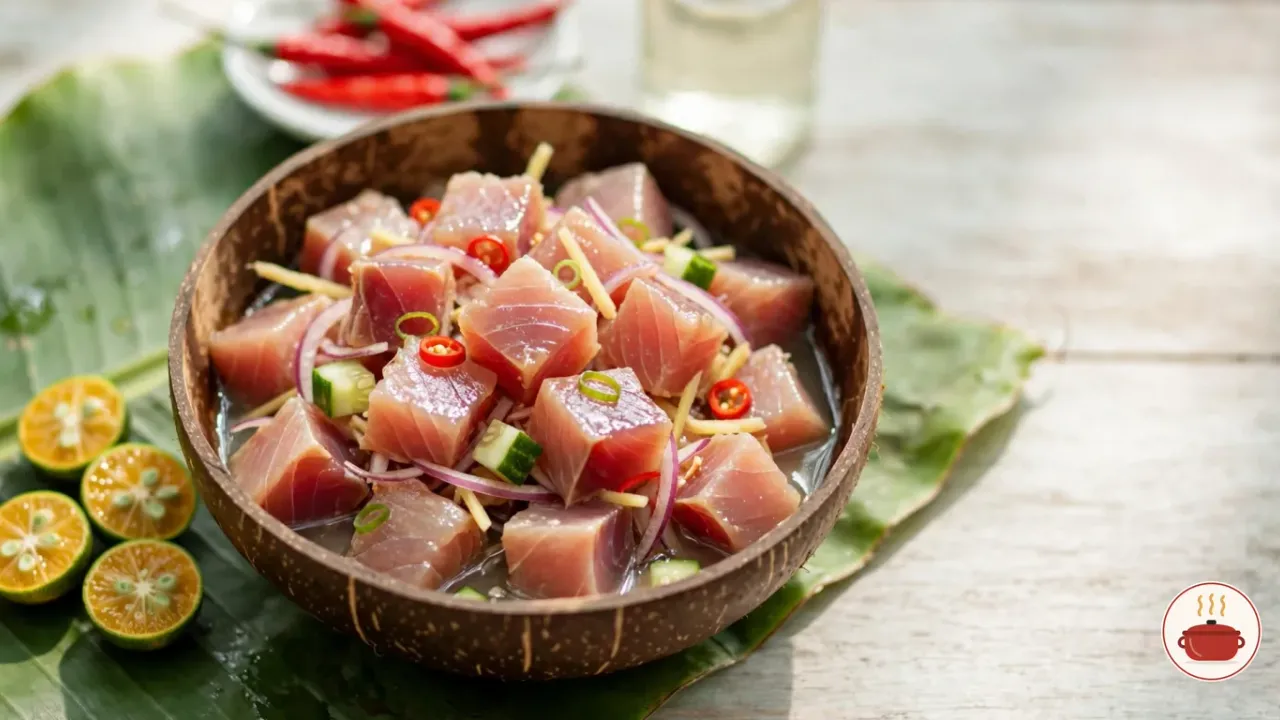
Kinilaw is the Philippines’ raw fish dish: cubes of fresh fish “cooked” briefly in vinegar with calamansi, ginger, onion and chili. This version uses yellowfin tuna and coconut vinegar. The fish sits in the dressing for 10 to 15 minutes, so it turns opaque outside and stays tender within. It serves 6 as a starter in 40 minutes.
What kinilaw is
The word comes from kilaw, a Cebuano verb for eating something raw, as John Wolff’s 1972 Dictionary of Cebuano Visayan records. Kinilaw is the dish. The dictionary’s example sentence says a lot about how people eat it: “Raw seafood goes well with palm toddy.” That toddy is tuba, coconut wine, and kinilaw is still a classic pulutan, or drinking snack.
Vinegar is the heart of it. The food historian Doreen Fernandez called it “liquid fire”, the MICHELIN Guide notes. She saw kinilaw as “a technique more than a dish”, Yasmin Newman writes for SBS Food. Its versions run from octopus to seaweed and from goat to green mango.
Kinilaw, kilawin and ceviche
In Tagalog, the dish often goes by kilawin. A Spanish-Tagalog dictionary first printed in 1754 lists “Quilao” for meat or fish in vinegar. Today, kilawin often means meat that is blanched or grilled first, then dressed with vinegar. The Ilocano version, of goat or beef, adds bitter bile, the MICHELIN Guide explains.
Kinilaw is often called Filipino ceviche. The difference is the acid. Kinilaw is “traditionally prepared with vinegar, not citrus juices”, which ceviche uses, the Freeman notes. Some writers claim kinilaw shaped ceviche through the galleon trade between Manila and Mexico. We found no scholarly source for that.
How old is kinilaw?
Kinilaw is often called 1,000 years old. The claim comes from Edilberto Alegre and Doreen Fernandez’s 1991 book, Kinilaw: A Philippine Cuisine of Freshness. They cite fish bones and remains of tabon-tabon fruit from around 1200 AD, TASTE reports. Later accounts place the find at Butuan, in Mindanao. We found no excavation report that mentions it, so treat the date with care.
Tabon-tabon is still in use. In Cagayan de Oro, cooks make “Kinilaw de Oro” with this Mindanao fruit, Atuna racemosa, the Freeman reports. Mixed with vinegar, it strips the fish of its fishy smell, TASTE explains.
Regional styles
Coconut milk is common, especially in Mindanao, and 11 of the 17 recipes we compared use it. On Siargao, the chef David del Rosario serves kinilaw “in a delicious pool of coconut vinegar and coconut milk”, SBS reports. Sinuglaw, from the Visayas and Mindanao, puts grilled pork beside the raw fish. Its name joins sinugba, grilled, and kinilaw.
Why kinilaw is on the 2027 trend lists
We found no sales or menu figure for kinilaw. The signs are a trend list and restaurant menus.
On 7 October 2026, the research firm Datassential put kinilaw on its list of “Foods and Flavors to Know for 2027 and Beyond”. It named the list in a press release on its trends report. Korean buldak and South Asian falooda made the same list. It gave no figure for kinilaw.
At home, the MICHELIN Guide made its Philippine debut on 30 October 2025. Lasa, in Cebu, won a Bib Gourmand for dishes such as “shrimp kinilaw with kimchi”, the Guide wrote. Its second Philippine selection comes out on 29 October 2026.
Abroad, kinilaw is a first course at Naides, which the San Francisco Chronicle called one of 2026’s best new restaurants. In May 2026, the Four Seasons at Park Lane in London held a guest dinner with the Filipino restaurant Donia. It served “Scallop kinilaw, dressed with coconut vinegar”. Bunso, opening in north London in October 2026, lists kinilaw on its menu, according to Hot Dinners.
What you need for kinilaw
Fish you can eat raw
Tambakol, or yellowfin tuna, and tanigue, a Spanish mackerel, are the most common fish for kinilaw, writes Bebs of Foxy Folksy. This recipe uses yellowfin for a safety reason, explained below: it is exempt from the US rule that fish served raw must be frozen first. Tanigue, skipjack and grouper are not.
“Sushi-grade” on a label has no legal meaning in the US, America’s Test Kitchen explains. So buy from a fishmonger who sells fish for eating raw, and tell them what you are making. Vanjo Merano gives that advice in Panlasang Pinoy’s vinegar guide. Never use freshwater fish.
Plan on about 4 oz (113 g) of fish a person. That is the median across the recipes we compared.
Vinegar
Coconut sap vinegar, sukang tuba, is the traditional choice. It “does not taste like coconut at all”, Merano writes. Many bottles abroad just say “coconut vinegar”, and some are made from coconut water instead, a milder product. Look for “coconut sap” on the label. Cane vinegar works too. Of the 17 recipes, 7 use coconut vinegar and 3 use cane.
Philippine vinegar must have at least 4% acidity, or 3% for nipa palm vinegar, under a 1970 health department order quoted in a government brochure. The recipes use a median of about 12 ml of vinegar per 100 g of fish. This one uses ⅓ cup (80 ml) for 1½ lb (680 g).
Calamansi, ginger, onion and chili
Calamansi is a small, round citrus with orange pulp that is “very juicy, highly acid”, the botanist Julia Morton wrote in Fruits of Warm Climates. It became the main citrus juice of the Philippines. Abroad, use lime, or lime with a squeeze of mandarin, which comes close to calamansi’s floral edge.
Ginger is in all 17 recipes, and red onion in 14. Bird’s eye chili, siling labuyo, is the most common chili. Leave out garlic. “Never use garlic,” the Bacolod kinilaw master Enting Lobaton told the Inquirer.
How to make kinilaw that stays tender
We compared 17 published kinilaw recipes, 14 of them by cooks of Filipino birth or heritage. They agree on ginger, onion and vinegar. They split on time.
Minutes, not hours
The median time in the acid is 17.5 minutes, but the recipes fall into two camps. Eight cure the fish for 15 minutes or less, and 5 for an hour or more. Most kinilaw dishes “count their curing time in seconds or minutes”, Lobaton said.
Long soaking ruins the texture. “If the fish soaks in the vinegar too long it gets rubbery and tough,” warns the food blogger Marketman of Market Manila. The Manila magazine Pepper.ph calls 5 to 15 minutes “the sweet spot”, and says never to let it sit past 2 hours.
Here is what happens. The acid makes the muscle proteins clump together, so the fish turns firm and opaque, America’s Test Kitchen explains. After a short soak, only the surface changes and the center stays translucent. This recipe stops there, at 10 to 15 minutes.
Tame the onion first
Pepper.ph lets the onion, ginger and chili sit in the vinegar for about 10 minutes, “to tame the sharpness of the aromatics”. The fish then goes into a dressing that is already balanced, and it spends less time in the acid.
Is the vinegar wash a safety step?
Seven of the 17 recipes rinse the fish in vinegar first and throw that vinegar away. The reason they give is smell. It is meant to “reduce the fishy smell”, writes Aileen Adalid, or it “removes the fishiness”, says Pepper.ph. It does not make raw fish safer. With very fresh tuna, you can skip it.
Use a glass or ceramic bowl. Marianne de Leon Hudson of Masarap.ph warns that vinegar can react with stainless steel or aluminum.
Is kinilaw safe? What vinegar can and cannot do
Kinilaw is raw fish. “Even after the vinegar and calamansi turn the fish opaque and firm, kinilaw is still raw,” Merano writes. Acid does kill some germs, but far less well than heat.
In a 2022 study in Foods, a 30-minute lime marinade cut the bacteria on fish only from 5.2 to 4.4 log units. Most Listeria cells survived it. Parasites do even better. Vinegar and salt “do not eliminate” the risk from the Anisakis worm, the European Food Safety Authority concluded in a 2010 opinion. In southern Chile, 21.8% of 78 restaurant ceviche portions held worm larvae, a 2014 study found.
Freezing, and why yellowfin
Freezing kills parasites. The FDA’s 2026 Food Code, released on 17 September 2026, covers “raw-marinated” fish such as kinilaw. Before it is served raw, the fish must be frozen at -4°F (-20°C) or colder for 7 days. Freezing it solid at -31°F (-35°C) and holding it there for 15 hours also works.
A home freezer is set to about 0°F (-18°C), the FDA says. That is not cold enough to meet the rule. The Food Code exempts yellowfin and several other tunas, which the FDA does not consider prone to these parasites. For any other fish, buy it already frozen by the seller for raw use. In the UK and the EU, food businesses must freeze fish for raw eating to -20°C at the core for 24 hours.
Never freshwater fish
In the Philippines, the documented danger is kinilaw made with river fish. Researchers studied intestinal capillariasis, a worm infection, in western Mindanao. In one town, 14 of the 24 people they interviewed had eaten “kinilaw (raw freshwater fish soaked in vinegar…)”. The CDC journal Emerging Infectious Diseases published it in 2010. Use saltwater fish only.
Keep it cold
Tuna, mackerel and marlin can build up histamine when they warm. Once it forms, it “cannot be eliminated by heat… or freezing”, the FDA’s guidance for seafood processors says. A tingling or burning mouth is one symptom. Keep the fish at 40°F (4°C) or colder until it goes in the bowl.
Who should skip it
The FDA advises pregnant women, children, older adults and people with weakened immune systems to avoid raw fish, including ceviche. Don’t make kinilaw from raw oysters or other shellfish either. The CDC says to cook them, because of Vibrio bacteria.
The FDA says not to leave seafood out of the fridge for more than 2 hours. We go further: eat kinilaw the same day, and don’t keep leftovers.
Serving kinilaw
Serve kinilaw cold, as a starter or a pulutan with cold beer. It goes well with steamed rice, or with grilled pork, sinuglaw-style. For a cooked dish built on the same vinegar, make Filipino chicken adobo. For another no-cook small plate, try Lebanese labneh.
Calories and protein
One serving has about 140 calories, 28 g of protein and 1 g of fat. Yellowfin is lean, with 0.49 g of fat per 100 g, by USDA figures. Coconut milk adds about 40 calories and 4 g of fat a serving.
Yellowfin is a “Good Choice” on the FDA and EPA’s advice about eating fish, which rates fish by mercury. Fish is one of the FDA’s major food allergens. The FDA no longer lists coconut as a tree nut.
Fixes for kinilaw that is rubbery, mushy or too sharp
- It is rubbery or tough: it sat in the acid too long. Next time, serve it after 10 to 15 minutes.
- It is mushy: it sat too long, or the fish was not firm. Choose a firm loin and cut neat cubes.
- It is too sharp: stir in a little coconut milk, or a pinch of sugar, as 3 of the 17 recipes do.
- It is bland: add salt and calamansi, a little at a time.
- It is watery: pat the fish dry before you cube it, and spoon off extra liquid before serving.
- The fish smells fishy before you start: it is not fresh enough to eat raw. Cook it instead.
- Your mouth tingles or burns: stop eating it. That can be histamine from fish that got warm.
Substitutes for missing ingredients
- Yellowfin tuna: albacore tuna sold for raw eating, which the Food Code also exempts. Tanigue, mackerel or salmon only if the seller froze it for raw use.
- Coconut sap vinegar: cane vinegar, coconut water vinegar or rice vinegar.
- Calamansi: lime juice, or lime with a squeeze of mandarin.
- Siling labuyo: Thai bird’s eye chilies.
- Red onion: shallots, as 3 of the recipes use.
- Coconut milk: leave it out for the classic Visayan style.
Frequently asked questions
Is kinilaw raw?
Yes. The vinegar makes the outside of the fish firm and opaque, but it does not cook it. Treat it as raw fish.
What is the difference between kinilaw and ceviche?
Kinilaw is cured mainly in vinegar, often with calamansi. Ceviche uses citrus juice. Both are raw fish dishes.
Does the vinegar kill bacteria and parasites?
Only some bacteria, and not parasites. Freezing at -4°F (-20°C) for 7 days kills parasites. Yellowfin tuna is exempt from that rule.
What fish is best for kinilaw?
Yellowfin tuna and tanigue are the classics. Abroad, yellowfin sold for raw eating is the simplest choice. Never use freshwater fish.
How long should kinilaw marinate?
About 10 to 15 minutes in the fridge, until the cubes are opaque outside and still translucent inside. Longer makes it rubbery.
What is the difference between kinilaw and kilawin?
Kinilaw is usually raw fish. Kilawin is the Tagalog name, and it often means meat that is grilled or blanched first, then dressed with vinegar.
Can I make kinilaw ahead?
Make the dressing ahead, but add the fish only 10 to 15 minutes before serving. Eat it the same day.
Is kinilaw safe in pregnancy?
No. The FDA advises pregnant women to avoid raw fish, including ceviche.