The Sunday Potthesundaypot.com/recipes/ube-halaya/
Ube Halaya: Filipino Purple Yam Jam with Coconut Milk
By The Sunday Pot Kitchen Updated
- • Start from 1 lb (454 g) of grated cooked ube, fresh or frozen
- • Boil fresh ube in its skin for 30 to 40 minutes, then peel it warm, with gloves
- • Stir over medium-low heat for 40 to 50 minutes, without stopping
- • It is done when it pulls from the pan as one mass
- • Only 6 of the 33 recipes we compared need extract; natural ube can be lavender
- • Keep it in the fridge for up to 4 days, or freeze it
Ingredients
12 servingsInstructions
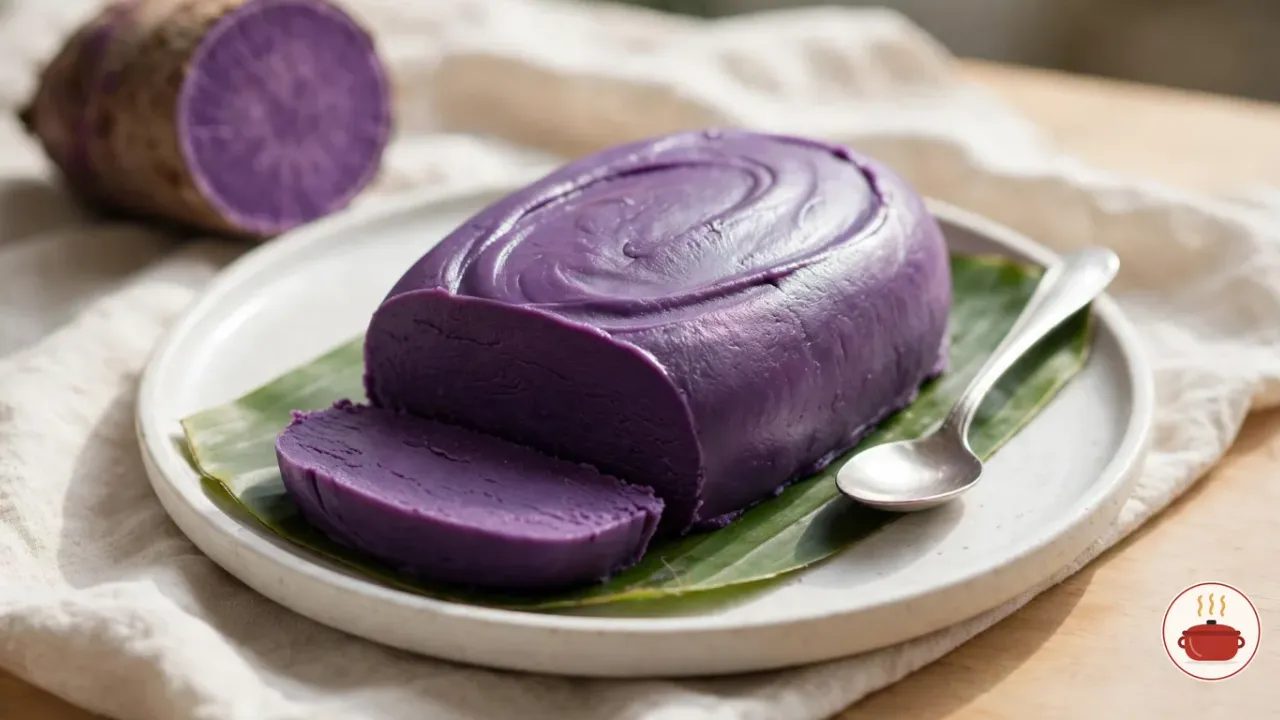
Ube halaya is the Filipino purple yam jam. Cooks mash boiled ube and stir it for about 40 minutes with condensed milk, coconut milk and butter, until it pulls away from the pan. Set in an oval mold, it slices like soft fudge. Families make it for Christmas and fiestas, and bakers use it in many ube sweets.
What ube halaya is
Ube is a yam
Ube is the purple yam, Dioscorea alata. It is not a sweet potato, and not taro either. The Philippine fact-checking site VERA Files wrote in July 2026 that ube has “a complex flavor profile with its nutty and vanilla flavor”.
Its flesh is not always bright purple. The same article describes tubers that range “from violet-purple to lavender, creamy white, or plain white”. Okinawan purple sweet potatoes, often sold as a stand-in, belong to a different genus, Ipomoea.
A jelly in name
Halaya comes from the Spanish jalea, “jelly”. In Tagalog the dish is also halayang ube. Despite the name, it is closer to a thick, sliceable paste than to a jelly.
Bohol’s kinampay and Baguio’s ube jam
The most prized variety is kinampay, from Bohol in the central Philippines. VERA Files calls it the “Queen of Philippine Yams”, native to Panglao Island and Guindulman. In June 2026, the Philippine intellectual property office confirmed it had received an application to register Bohol Ubi Kinampay as a geographical indication, Philstar reported.
In the mountain city of Baguio, ube jam is one of the Good Shepherd convent’s bestsellers. Sister Fidelis Atienza created it in 1976, GMA News reported when she died in 2021, aged 102.
A dessert for December
Ube halaya belongs to the holidays. In 2023, Bohol moved its Ubi Festival to the second week of December by provincial ordinance, the provincial agriculture office explains. December is harvest time, growers told the office, and demand for ube peaks at Christmas.
The food writer Jun Belen remembers his mother making ube jam for New Year’s Eve. “Making something purple for media noche brings even more prosperity”, he wrote on his blog in 2010.
Why ube is in the news in 2026
A stop on fresh ube exports
In mid-August 2026, the Philippines’ Bureau of Plant Industry suspended exports of fresh ube and its planting material, with no end date. The Department of Agriculture made it public on September 13. Plant quarantine stations stopped issuing the certificates that such shipments need, the Daily Tribune reported.
“We severely lack planting material ourselves,” Agriculture Secretary Francisco Tiu Laurel said. Other countries could use Philippine varieties to compete, he added. On October 6, he made the scope clear: the ban covers raw ube that could be planted, while his department supports exports of processed ube “in whatever form”. Halaya is one of those processed exports.
A small harvest
The country grew 12,483 tonnes of ube in 2025, a five-year low, a plant industry official told AFP in October. Typhoons hit the main growing regions. A USDA Foreign Agricultural Service report, released in June, put 2024’s crop at 13,382 tonnes, Context.ph reported.
Production was up about 17% in the first half of 2026, AFP adds. Planting to harvest takes at least nine months, a farmer told the agency.
More fields, better plants
The Department of Agriculture is seeking P300 million for 2027 to add 1,000 hectares of ube in the first year, the Tribune reports. At the University of the Philippines Los Baños, researchers screened 188 purple yam samples and picked 10 standout varieties. Kinampay still “continued to stand out for its flavor”, the paper noted in August.
The number nobody has
No 2026 sales or search figure exists for ube halaya itself, in any source we read. The 2026 news concerns the tuber, its farmers and its exports.
What goes into ube halaya
We compared 33 recipes. Eighteen come from Philippine and Filipino-run sites such as Panlasang Pinoy, Pepper.ph, Yummy.ph, Kawaling Pinoy and Foxy Folksy, one of them in Tagalog. Fifteen are English-language recipes from cooks in the United States, Britain and Australia.
Fresh, frozen or powder
Fourteen recipes start from fresh tubers and twelve from frozen grated ube, which Filipino and Asian groceries sell in 16-oz packs. Two use ube powder. Fresh ube is hard to find outside the Philippines. In most of the United States, ube sweets come from frozen ube, powder or extract, “which sometimes contains no ube at all”, Eater noted in 2023.
The milks
Sweetened condensed milk goes into 26 of the 31 recipes that give a weight of ube. Evaporated milk appears in 20, and coconut milk in 16. Ten recipes use all three. When a recipe uses them, the medians per 500 g of ube are 347 g of condensed milk, 213 g of evaporated milk and 433 g of coconut milk.
This recipe uses a full can of condensed milk, ¾ cup of evaporated milk and 1 cup of coconut milk for 1 lb of ube. That is close to the median for evaporated milk, a little richer in condensed milk and lighter on coconut.
Butter and sugar
Butter goes into 24 of 29 recipes, at a median of 69 g per 500 g of ube. Only 19 of 30 add sugar on top of the condensed milk, so here it is optional.
Extract and color
Only 6 of the 33 recipes require ube extract or food coloring, and 8 more call it optional. Just one Philippine recipe of 18 requires it, against five of the 15 English-language ones. Vanjo Merano of Panlasang Pinoy warns that too much coloring “might make the taste bitter”.
Pale halaya is not a failure. The Good Shepherd recipe, published by Yummy.ph, uses no coloring at all and says the variety of ube decides the color.
How to make ube halaya
Cook the ube all the way
Boil fresh ube in its skin until a knife slides through, then peel it while it is warm. Undercooked ube makes a grainy halaya, Salu-Salo Recipes warns. Boiling also lowered the oxalate in purple yam by 40 to 50% in a 1992 study, more than steaming or baking did.
Wear gloves to peel it. The pigment stains, and raw ube juice can make skin itch, the Botanical Dermatology Database notes.
Grate it fine
Grating cooked ube is the traditional way, The Unlikely Baker explains, and it catches the stringy fibers. A potato ricer, a fine sieve or a short burst with an immersion blender also works. Frozen grated ube is already fine enough.
Stir without stopping
The mixture starts loose and thickens slowly. “Medium heat is the hottest you should go,” The Unlikely Baker warns, or the halaya will burn. Scrape the bottom and corners of the pan as you stir.
It spits as it thickens. “You stand there and stir it and hope the hot lava bubbles don’t get you,” the Honolulu chef Ria Barbosa told Eater. A wide, heavy pan, like the deep kawali that Filipino cooks use, spreads the heat and gives you room to work.
Know when to stop
Six recipes say the paste is ready when it pulls away from the sides of the pan. Four use the spatula test: a path drawn through the middle stays open. Kitchen Confidante cooks it about 20 to 25 minutes for a spreadable jam, and about 40 minutes for a halaya firm enough to mold. It keeps firming as it cools.
Set it in a llanera
The llanera is the small oval aluminum mold Filipino cooks also use for leche flan. Butter it well. After chilling, a 30-second dip of the mold’s bottom in hot water loosens the halaya so it turns out whole. A buttered glass dish or a few clean jars work as well.
Serving ube halaya
Serve ube halaya cold or at room temperature, in slices or by the spoonful. Filipino cooks often top it with latik, the toasted curds left from cooking down coconut cream, or with grated cheese. It also goes into halo-halo, the layered shaved-ice dessert, and fills cakes, rolls and pastries.
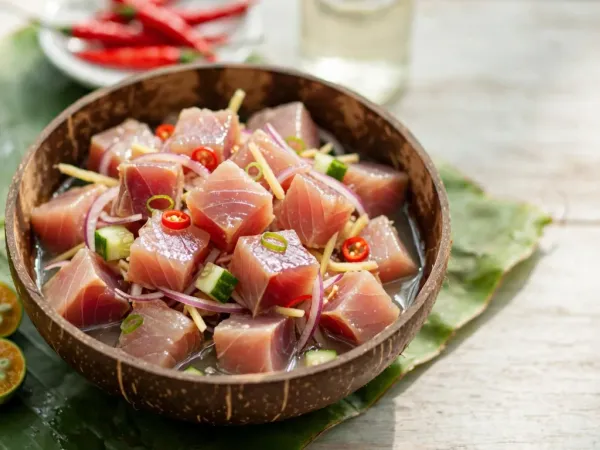
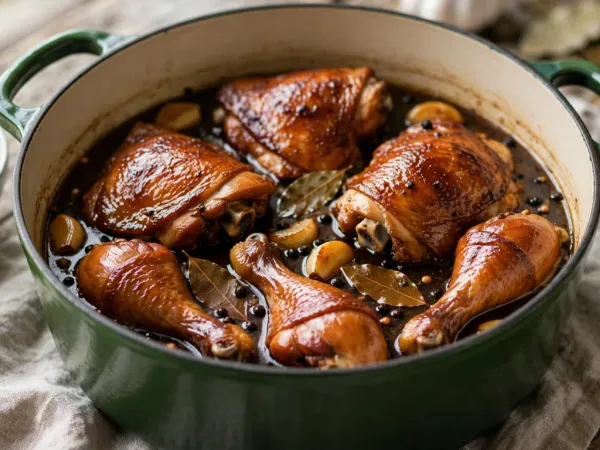
For a Filipino dinner, start with kinilaw, raw fish cured in vinegar, then serve chicken adobo with rice and finish with halaya. If you like slow-stirred sweets, India’s carrot pudding, gajar ka halwa, works on the same patient principle. For another dessert with coconut milk, try Thai mango sticky rice.
Safety, storage and allergens
Always cook ube
Cultivated yams carry no toxins, the FAO says, unlike some wild species. Raw ube still irritates the mouth, and every recipe cooks it. Check the label of frozen ube: most packs are boiled already, but a few are raw.
Keeping it
Homemade halaya is not a shelf-stable jam. The commercial method of the Philippine science department’s food institute acidifies ube jam and processes the jars under pressure. Halaya made at home, full of milk and butter, gets neither, so treat it as a leftover. The USDA’s leftovers guide allows cooked food 2 hours out of the fridge at most. Chilled, it keeps 3 to 4 days; frozen, 3 to 4 months.
Some recipes promise 2 weeks or even a month in the fridge. We follow the USDA instead. If mold appears, throw the whole batch away. Don’t scrape off the spots, because mold can reach below the surface.
Calories and allergens
One slice, a twelfth of the recipe, has about 245 calories, with 5 g of protein, 12 g of fat and 31 g of carbohydrate. We added up USDA FoodData Central figures for each ingredient and divided by 12. The ube figures come from USDA’s general yam entry, since it has none for purple yam.
Ube halaya contains milk, one of the nine major food allergens. It also contains coconut, which the FDA no longer counts as a tree nut under its January 2025 allergen guidance. Anyone who reacts to coconut should still skip it. It has no wheat or gluten.
Fixes for halaya that is runny, grainy, pale or scorched
- It will not set: it came off the heat too soon. Put it back in the pan and stir for 10 more minutes, until it pulls from the sides.
- It is dry and crumbly: it cooked too long. Stir in 2 to 3 tablespoons of coconut milk over low heat.
- It is grainy: the ube was undercooked, or the fibers stayed in. Boil fresh ube until fully soft, and grate or blend it fine.
- Brown flecks: it caught on the bottom. Lower the heat, scrape as you stir, and use a heavy pan.
- It is pale or grayish: the ube was a light variety. That is natural. Add ½ teaspoon of extract if you want a deeper color.
- It sticks in the mold: butter the mold more thickly, and dip it in hot water before you turn it out.
Substitutes for hard-to-find ingredients
- Fresh ube: frozen grated ube from a Filipino or Asian grocery. Thaw it in the fridge.
- Frozen ube: ube powder, soaked in boiling water for 20 minutes, then cooked a little longer.
- Evaporated milk: whole milk. Cook it 5 to 10 minutes longer.
- Coconut milk: more evaporated milk, for a dairy-only halaya.
- Butter: coconut oil, which gives a stronger coconut taste.
- A llanera: a buttered loaf pan, pie dish or small glass jars.
Frequently asked questions
What does ube halaya taste like?
Sweet and milky, with a nutty, vanilla-like flavor from the yam and a dense, smooth texture like soft fudge.
Is ube the same as taro or purple sweet potato?
No. Ube is a yam, Dioscorea alata. Taro is a different plant, and purple sweet potatoes, including Okinawan ones, belong to the genus Ipomoea.
Can I make ube halaya with frozen ube?
Yes. Twelve of the 33 recipes we compared use frozen grated ube. Thaw it in the fridge overnight, then start at step 3.
Why is my ube halaya not purple?
Natural ube ranges from deep violet to lavender and even white. Bright purple halaya often contains extract or food coloring.
How do I know when ube halaya is done?
It pulls away from the sides of the pan as one mass, and a spatula drawn through it leaves an open path.
How long does ube halaya last?
Four days at most in a covered container in the fridge. Frozen, it keeps 3 to 4 months.
Can I freeze ube halaya?
Yes. Wrap the slices tightly or pack them in a lidded box, and let them thaw overnight in the fridge.
Did the Philippines ban ube exports?
Only fresh ube and planting material, since mid-August 2026. Processed ube, including halaya, powder and jam, can still be exported.
Tags: dessertcondensed milkcoconutmake aheadgluten freeholiday