The Sunday Potthesundaypot.com/recipes/buldak/
Buldak: Korean Fire Chicken with Melted Mozzarella
By The Sunday Pot Kitchen Updated
- • Four servings take 1¾ lb (800 g) of chicken thighs, 3 to 4 tablespoons of gochugaru and 8 oz (225 g) of mozzarella
- • Taste the gochugaru first: heat varies hugely from one bag to the next
- • Sear the chicken for 8 to 10 minutes until the pan is almost dry, then add the sauce
- • Simmer the sauce for 4 to 6 minutes, until it turns to a glaze, and cook the chicken to 165°F (74°C)
- • Spoon off the red oil before the cheese goes on
- • Broil for 1 to 3 minutes and never walk away
Ingredients
4 servingsInstructions
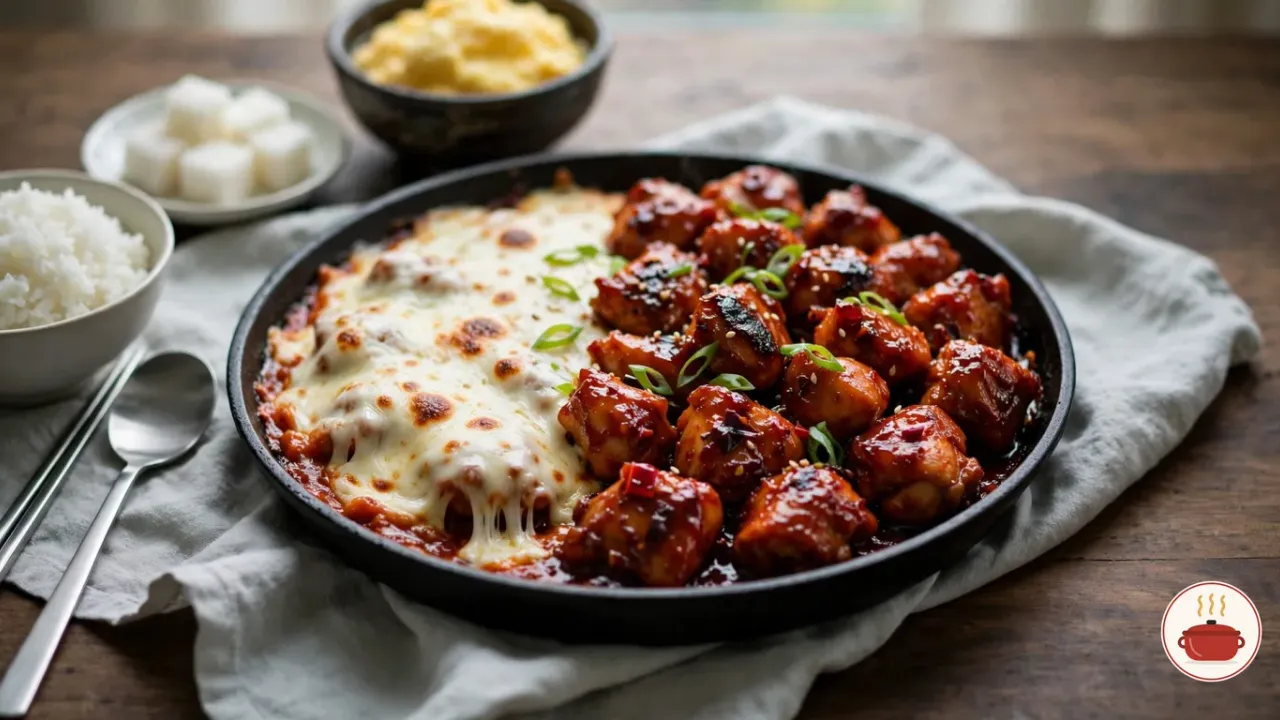
Buldak is Korean fire chicken: bite-sized chicken in a sticky, very hot sauce of chili flakes and chili paste. Korean bars serve it under a blanket of melted mozzarella, as cheese buldak. This version serves 4 in about 40 minutes, in one cast-iron pan. Serve it with rice and something cold.
What buldak is
The name is two Korean words: bul, fire, and dak, chicken. The fire is mostly the chili. Buldak is a dish of boneless chicken cooked in gochugaru (chili flakes), gochujang (fermented chili paste), garlic and a sweet syrup. Today it very often comes under melted cheese.
Born in Seoul in the early 2000s
Buldak was a craze before it was a recipe. In October 2004, the Korean daily Munhwa Ilbo described queues in Sinchon, Hongdae and Jongno for a chain called Hongcho Buldak. About 70% of the customers, it said, were women in their twenties.
The owner, Hong Seong-pyo, had reopened in Sinchon in September 2002, after a first shop failed in Ilsan. His buldak was not the skillet dish of today. Cooks steamed chicken legs, coated them in a secret sauce of cheongyang chili, garlic and about 30 other ingredients, and grilled them over charcoal. To cool the mouth, the shop served nurungji-tang, a soup of scorched rice.
His first franchise opened in July 2003. Within a year, about 100 Hongcho Buldak shops had opened. By 2005, the daily Seoul Shinmun counted a whole “fire” fashion: fire pork belly, fire squid, fire fish cake, even fire cold noodles.
Cheese came early
On 8 October 2004, Hongcho launched ssamdak, buldak wrapped in cheese for younger diners, the same Munhwa Ilbo article reported. The cheese stuck. By 2015, CNN was telling visitors to order buldak “surrounded by a ring of mozzarella cheese” to tame the heat.
Who owns the word
A company in Wonju, Buwon Food, registered “buldak” as a trademark in 2001. Hongcho went to court. On 30 April 2008, Korea’s Patent Court ruled that buldak had become the common name of a dish, the Hankyoreh reported. In a survey the court cited, 60.3% of 600 adults saw it as a dish, not a brand, the Law Times noted.
The noodle named after the dish
In April 2012, Samyang Foods launched Buldak Bokkeum-myeon, spicy instant noodles named after the dish. It looked like a flop until February 2014. That month a British YouTuber filmed his friends and family struggling with it in London, the Los Angeles Times recounts. The video drew 11 million views, and the “fire noodle challenge” followed.
In June 2026, Samyang finally won a trademark for the word in Korean script, but only for ramen, the Korea Herald reported. For sauces and everything else, the Korean word stays a common noun, The Asia Business Daily notes. The chicken dish belongs to everyone.
Why buldak is having a moment
We found no sales or search figure for buldak the dish. The numbers belong to the noodle brand, and they are huge.
On 7 October 2026, the food research firm Datassential listed buldak among ten foods “on the radar for potential future growth” in its 2027 trends report. It gave no figure.
Samyang’s own results show the brand’s pull. Its second-quarter 2026 sales rose 39.3% to 770.3 billion won, and overseas sales hit a record 645.8 billion won, the Korea Herald reported in August. Buldak noodles passed 10 billion units sold at the end of May 2026, 14 years after launch, according to the Korea Times.
Korea’s instant noodle exports rose 27.9% to $935.4 million in the first half of 2026, by the agriculture ministry’s provisional count. In June 2026, Wagamama put Buldak dishes, made with Samyang’s sauce, on its UK menus, The Grocer reported.
The dish itself is catching up. In March 2026, America’s Test Kitchen published a cheese buldak recipe, calling it “a favorite Korean bar snack (or one-pan meal)”.
What you need for buldak
Gochugaru
Gochugaru is Korean red pepper, dried and ground into flakes or powder. Its heat swings widely. In a 2011 study, Korean researchers measured fine gochugaru from 12 pepper varieties. The hottest, cheongyang, held about 190 times the capsaicin of the mildest (Korean Journal of Community Living Science). Shops sold it in four heat grades, from very hot to mild.
So taste a pinch before you measure. Maggie Zhu of Omnivore’s Cookbook does the same, because heat varies “by brand, harvest year, and grind”. Coarse flakes work here, and a bag labeled hot or very hot gives the classic burn.
Gochujang
Gochujang is a thick, sweet, fermented paste of chili, rice and soybeans. It brings depth and stickiness. Some brands add soy sauce made with wheat, so check the label if you avoid gluten.
Syrup
Korean cooks sweeten buldak with ssal-jocheong, a rice syrup, or mulyeot, a lighter grain syrup sold abroad as corn syrup. Either gives the glaze its shine. Honey works too.
Chicken thighs
Ten of the 16 recipes we compared start with thighs. They stay juicy through high heat and a hot sauce. Breast works too, but it dries out quickly, so take it off the heat as soon as it reaches 165°F (74°C).
Low-moisture mozzarella
Use the firm, shredded mozzarella sold in bags, not fresh balls in water. By US rules, low-moisture mozzarella holds 45% to 52% water, against up to 60% for the fresh kind. Fresh mozzarella “does not form blisters nor does the cheese flow when heated”, the University of Wisconsin’s Center for Dairy Research explains. It also weeps water into the sauce.
A heavy pan
A 12-inch (30 cm) cast-iron skillet holds the heat, sears well and can go under the broiler. Any oven-safe pan of that size works. One warning from Lis Lam of The Subversive Table: cast iron can carry a little of the chili into the next thing you cook.
How to make buldak in one skillet
We compared 16 published buldak recipes, 10 of them by Korean or Korean-heritage cooks. All 16 use gochugaru, 15 use gochujang, and all 16 offer a cheese topping.
Sear first, sauce second
Recipes split on method. Maangchi, on her own site and in her NYT Cooking version, cooks raw chicken in the sauce under a lid. Others brown the chicken first.
We follow the second camp. America’s Test Kitchen cooks the chicken until the skillet is “almost dry”, and only then brings it together with the sauce. Seoul chef Aaron of Aaron and Claire tells you to cook off as much of the chicken’s moisture as you can. A dry pan means a thick glaze, not a watery red pool.
Watch the sugar
Syrup and chili both burn. “Be sure not to burn the chicken,” Maangchi writes. Aaron gives the same warning. That is why the heat drops to medium once the sauce goes in. Stir often, and loosen a sticky pan with a spoonful of water.
Skim, then broil
Thighs release fat, and the red oil gathers at the edges. Zhu tilts the pan and spoons it off before the cheese goes on, so the cheese melts onto the chicken. Seven recipes melt the cheese under the broiler, six in the oven, two in the microwave and one on the stove under a lid.
The starch in bagged shredded mozzarella helps it stay fluid once melted, ATK notes. If you grate your own, toss it with ¼ teaspoon of cornstarch.
How much per serving
Our amounts sit near the middle of the 16 recipes. The median is about 200 g (7 oz) of boneless chicken per serving, and 2.35 tablespoons of gochugaru per 500 g of chicken. Most use 8 oz (225 g) of mozzarella for 4.
Seven recipes marinate the chicken, for a median of 1 hour. Searing skips that step, since the glaze carries the flavor. To marinate anyway, toss the chicken with half the sauce and chill it: the USDA allows up to 2 days in the fridge. Then cook it covered with ¼ cup (60 ml) of water for 10 minutes, as Maangchi does, before glazing it with the rest.
How hot is buldak, and how to tame it
Restaurant buldak can be brutal. Four of the 16 recipes add pure capsaicin, hot sauce or bottled buldak sauce, and all four are by Korean cooks. Seonkyoung Longest warns readers not to try hers unless they are used to “REAL Korean” heat. Ours sits at medium-hot. For a milder pot, use a mild gochugaru and leave out the fresh chili.
Spicy food and children
In June 2024, Denmark’s food agency recalled three Samyang Buldak noodle products over their capsaicin, judging from the sellers’ marketing figures. In July, after its own lab tests, it cleared two of them; the 3x Spicy stayed off the shelves, the Danish Veterinary and Food Administration said. By then, Denmark’s Poison Line had logged 14 reports after people ate chili noodles.
“In particular, children may react sensitively to hot chilli products,” Germany’s Federal Institute for Risk Assessment warns. For children, scoop some chicken out before the chili goes in, and glaze it with gochujang and syrup alone.
Drink milk, not water
When 72 people tested drinks against a capsaicin burn at Penn State, whole milk, skim milk and, oddly, cherry Kool-Aid worked best. Skim did as well as whole, which suggests the milk’s protein matters more than its fat.
Variations: rice cakes, no cheese, extra fire
With rice cakes
Eight recipes add tteok, Korean rice cakes. Soak 6 oz (170 g) of sliced rice cakes in warm water for 10 minutes, then stir them in with the sauce. Add 2 extra tablespoons of water, since they drink it up.
Without cheese
Leave the cheese off and serve the glazed chicken with rice and lettuce leaves for wrapping. That is closer to the early 2000s bar dish.
Extra fire
Use very hot gochugaru, or add 2 Korean cheongyang chilies or a serrano. Some Korean home cooks add a little capsaicin extract. Go slowly: you cannot take heat back out.
Serving and storing buldak
Serve buldak in its pan, with bowls of short-grain rice. Korean cooks add cubes of pickled radish or rice balls. A soft steamed egg often comes with spicy dishes to ease the heat, Korea JoongAng Daily notes. With beer or soju, buldak is anju, food for drinking.
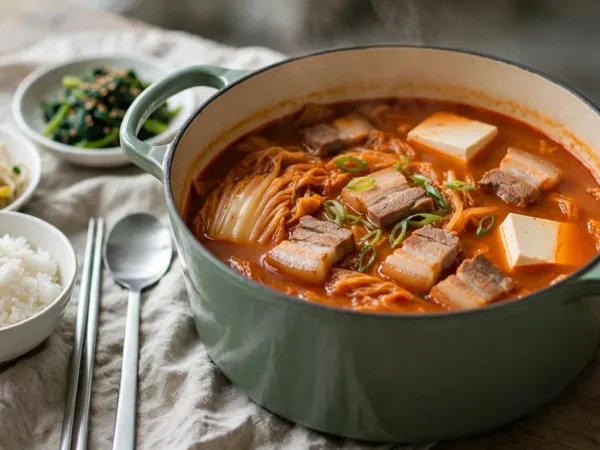
For a whole Korean table, start with kimchi jjigae. If you like a numbing kind of heat too, try Sichuan mapo tofu.
Make it ahead
Cook the glazed chicken up to a day ahead and refrigerate it. Reheat it in the pan until it steams, and add the cheese just before it goes under the broiler.
Leftovers
Follow the USDA’s leftovers guidance:
- Get the chicken into the fridge within 2 hours, in shallow containers.
- Eat it within 3 to 4 days, or freeze it for 3 to 4 months.
- Reheat it to 165°F (74°C).
To freeze it, freeze the glazed chicken before the cheese goes on, and add fresh cheese when you reheat it.
Is the chicken done?
Chicken is safe at 165°F (74°C), by the USDA’s chart. Check the thickest piece with an instant-read thermometer before the cheese goes on.
Calories and sodium
One serving, a quarter of the pan, has about 630 calories, 51 g of protein and 23 g of carbohydrate, by USDA figures, without the rice. It has about 38 g of fat, 13 g of it saturated, most of that from the cheese.
Soy sauce, gochujang and cheese make buldak salty. One serving has about 1,250 mg of sodium. The FDA sets the Daily Value at less than 2,300 mg. Low-sodium soy sauce brings it down, and part-skim mozzarella cuts the fat.
Allergens
Buldak holds milk, soy, wheat and sesame, all on the FDA’s list of major food allergens. Wheat comes from the soy sauce and, in some brands, the gochujang.
Fixes for burnt, watery or oily buldak
- The sauce burns: the heat is too high, or the pan is too big for the chicken. Turn it to medium, stir often, and add water 1 tablespoon at a time.
- The sauce is thin and watery: the chicken went in wet, or the sauce went in too soon. Simmer it uncovered a few minutes more.
- The cheese floats on oil: skim the red oil before the cheese goes on.
- The cheese turns hard or black: it stayed too long under the broiler. Lower the rack, and pull the pan as soon as the cheese browns in spots.
- The cheese breaks into oily lumps: fresh mozzarella. Use shredded low-moisture mozzarella.
- It is far too hot: serve it with extra cheese, rice and cold milk. Next time, use a milder gochugaru and skip the fresh chili.
- It tastes flat: add a little more soy sauce or gochujang, and a squeeze of syrup.
Substitutes for missing ingredients
- Gochugaru: Aleppo pepper or mild paprika with a pinch of cayenne. The taste is close, but not the same.
- Gochujang: there is no true substitute. Use 1 more tablespoon of gochugaru and 1 tablespoon of red miso.
- Rice syrup: light corn syrup, honey, or 3 tablespoons of brown sugar.
- Chicken thighs: chicken breast, cooked to 165°F (74°C) and no further.
- Mozzarella: a mix of mozzarella and cheddar, or Monterey Jack.
- Cheongyang chilies: jalapeño, or serrano for more heat.
- Cast-iron skillet: any oven-safe pan, or a baking dish for the broiler step.
Frequently asked questions
What does buldak mean?
Buldak means “fire chicken” in Korean: bul is fire and dak is chicken. The fire is the chili.
Is buldak the same as the noodles?
No. Buldak is a chicken dish from Seoul in the early 2000s. Samyang named its spicy instant noodles after it in 2012.
How spicy is buldak?
It can be very hot. This recipe is medium-hot. Taste your gochugaru first and use less of a hot one, or leave out the fresh chili.
What cheese goes on buldak?
Shredded low-moisture mozzarella, the kind that melts and stretches. Korean recipes sometimes add a slice of cheddar.
Can I make buldak without an oven?
Yes. Scatter the cheese over the chicken, cover the pan and cook on low heat for 2 to 3 minutes, until the cheese melts.
What do you serve with buldak?
Rice, pickled radish, rice balls or a soft steamed egg, and something cold to drink. Lettuce leaves make good wraps.
Can I freeze buldak?
Yes, before the cheese goes on. It keeps 3 to 4 months. Thaw it in the fridge, reheat it to 165°F (74°C), then add the cheese.
Is buldak gluten-free?
Not as written. Soy sauce and some gochujang contain wheat. Use a wheat-free tamari and a gluten-free gochujang.