The Sunday Potthesundaypot.com/recipes/ribollita/
Ribollita: Tuscan Bread, Bean and Cavolo Nero Soup
By The Sunday Pot Kitchen Updated
- • Cook 12 oz (350 g) of dried cannellini and purée about two-thirds of them
- • Simmer cavolo nero, savoy, chard and potato in the bean water for up to an hour
- • Layer 10 oz (300 g) of stale, dense bread with the soup
- • Rest the pot in the fridge overnight so the soup sets
- • Boil each portion again and finish it with raw olive oil, never cheese
Ingredients
6 bowlsInstructions
Ribollita is the bread and bean soup of Tuscany. Cannellini, cavolo nero and savoy cabbage simmer with stale bread, rest overnight, then go back on the heat until thick. The name means “boiled again”. This version makes 6 bowls, takes about 3¼ hours of cooking, and needs an overnight soak and an overnight rest.
What ribollita is
A soup you eat the next day
Ribollita is thick enough to stand a spoon in. Visit Tuscany, the region’s tourism site, describes the method in one line. A vegetable and bean soup “is thickened with stale bread and recooked the day after until it becomes thick and dense.”
It is not minestrone. “It isn’t brothy and it has no pasta in it,” Jamie Oliver writes. Tuscan cooks go further: the Florentine restaurant Buca Mario says it must be “dense, smooth, inviting and even”. The food site Gustoblog notes that it is a semi-solid soup, really eaten with a fork.
Three things every pot shares
There is no single recipe. Each corner of Tuscany has its own, and the vegetables change with the season. Still, every ribollita rests on three things, the Florence newspaper La Nazione writes: cavolo nero, savoy cabbage and beans. Bread and olive oil complete it.
The recipe Tuscan chefs hold up today has no cheese and no meat. That makes it a meal of vegetables, beans and bread, vegan unless you add Parmesan.
Where ribollita comes from
Boiled again for two or three days
The earliest printed use of the word we could find is from 1910. Alberto Cougnet’s L’arte cucinaria in Italia, written for a Milan dining club, gives two meanings. One is a Florentine bean soup with pasta, poured over toasted bread.
The other is plainer. In working-class families, Cougnet writes, the soup is made to last two or three days. It is called ribollita because it is reheated each time it is needed. That is still the heart of the dish.
Florentine by 1931
In 1931 the Touring Club Italiano’s Guida gastronomica d’Italia listed it under Florence. Its entry is one sentence. Ribollita is the Florentine bean soup “left to cool and made to ribollire”, with fresh oil added.
That bean soup, in the same guide, already holds white beans, cavolo nero, leeks, celery, tomato, dark bread, thyme and rosemary.
Artusi’s peasant soup
Pellegrino Artusi printed a close cousin. In the 1922 edition of La scienza in cucina, recipe 58 is a “Tuscan lean soup, peasant style”. It uses 400 g of stale brown bread, 300 g of white beans, cabbage, “as much cavolo nero and more”, chard, thyme and a potato.
Artusi never calls it ribollita and never reboils it. He pours it over sliced bread and serves it after twenty minutes, “good hot and better cold”. His “lean” soup also cooks the beans with strips of cured pork rind. The recipe is not in the first edition of 1891; it was added later.
Stories without sources
You will read that ribollita began with medieval servants, boiling the bread plates their masters had eaten from. Several Italian sites tell it. None gives a source, so treat it as a tale.
Tuscan writers also say the soup was made in a big pot on Friday, a meatless day, and reheated over the weekend. It fits the dish, but we found no early document for it.
A notary’s recipe
In 2001, La Nazione reports, the Florence branch of the Accademia Italiana della Cucina registered a “true ribollita” recipe with a notary, on May 24. We could not find the deed itself. The paper printed that recipe in 2024: three-quarters of the beans puréed, and served “with a thread of raw oil, fresh pepper and no cheese”.
Ribollita and the new oil of 2026
Made after the first frost
In Tuscany, ribollita belongs to late autumn. Cooks wait for cavolo nero to be touched by frost, which makes the leaves tender. “It must have taken the ice, or nothing,” the food site Dissapore quotes.
There is science behind the saying, at least for kale, cavolo nero’s close relative. In 2019, researchers at Jacobs University Bremen found that cold makes kale turn complex carbohydrates into smaller, sweet sugars.
Ribollita Day on December 1
Tuscan chefs launched a Ribollita Day on December 1, 2024, La Nazione reported. The regional cooks’ union set it up with the Pane Toscano DOP bread consortium and the Confraternita della Ribollita. The date follows tradition: the soup was made from the end of November, once the first frosts had softened the cavolo nero. We found no programme yet for a 2026 edition.
A big Tuscan harvest
The soup is poured with new olive oil, and 2026 looks like a good year for it in Tuscany. On October 15, the Consorzio Olio Toscano IGP, which protects the region’s oil, said output should beat the ten-year average by 35 to 40%. A dry summer kept the olive fly away, its president Fabrizio Filippi explained, as La Nazione reported.
New Tuscan oil sells for 15 to 16 euros a litre in shops, Filippi said on October 24, in a second La Nazione report. Wholesale, it fetches 10.50 to 11 euros.
Italy as a whole may have less. ItaliaOggi and the trade magazine Teatro Naturale estimate a national crop of 260,000 tonnes, 25% down, with big falls in the south. That is a newspaper estimate, not an official one. The state market agency ISMEA puts the 2025-26 harvest at 325,000 tonnes.
Olive oil festivals
Tuscan villages hold new-oil festivals, too. In the Valdambra valley, the 6th Festa olio nuovo is set for San Leolino on November 29, 2026, the area’s 2026 events calendar shows.
No figure for the soup
These are numbers for oil, not for soup. We found no 2026 count of ribollita sales, menus or searches, and no 2027 food forecast that names it. Whole Foods Market’s 2027 trends do predict a “bean boom”, which ribollita fits well.
What 28 ribollita recipes agree on
We read 29 ribollita recipes in full and counted 28. One, without beans or cavolo nero, was not the dish. Fifteen are Italian, from GialloZafferano, La Nazione, Buca Mario, Dissapore, the Juls’ Kitchen recipe on Visit Tuscany and others. Thirteen are in English, from cooks such as Felicity Cloake, Jamie Oliver, BBC Good Food and Anna Jones.
The common base
Nearly all start with a soffritto: carrot in 28, celery in 27, onion in 27 and garlic in 24. Tomato appears in 27, mostly as a few tinned tomatoes or a spoon of paste, so the soup is never red. Cannellini are named in 23. Raw olive oil goes on at the table in 24.
Italy and the rest split
The real divide is between Italian and English recipes. Ten of the 15 Italian ones start from dried beans; only 5 of the 13 English ones do. Dissapore is blunt: “don’t use tinned beans for ribollita”.
Eleven Italian recipes purée part of the beans, against 3 in English. Savoy cabbage joins the cavolo nero in 13 Italian versions, and potato in 13 too. Ten of them rest the soup and boil it again; only 2 English ones do.
Cheese is the exception
Parmesan, grated or as a rind, appears in 7 of the 28. Only 2 of those are Italian. Most Tuscan cooks leave it out on purpose. Dissapore sets out to make ribollita “with one great rule: avoid Parmigiano Reggiano”.
How much of each
For about 6 bowls, the Italian recipes use 350 to 400 g of dried beans and about 300 g of stale bread. Cavolo nero runs to 350 or 400 g. Our recipe follows those numbers, with 350 g of beans and 300 g each of bread and savoy.
Tips for a thick, deep ribollita
- Use old, dense bread. BBC Good Food warns that if the bread is “too fresh, it will turn into soggy paste”. Use bread that is a few days old.
- Choose unsalted bread if you can. Tuscan bread has no salt, so taste the soup after the bread goes in.
- Purée most of the beans. The cream gives body without any flour or cheese.
- Don’t rush the cabbage. Savoy and cavolo nero need close to an hour to turn silky.
- Rest it in the fridge. The overnight rest is what turns soup into ribollita.
- Let it catch. A little browned crust from the pan adds a toasted taste, as some Tuscan cooks like it.
Serving ribollita
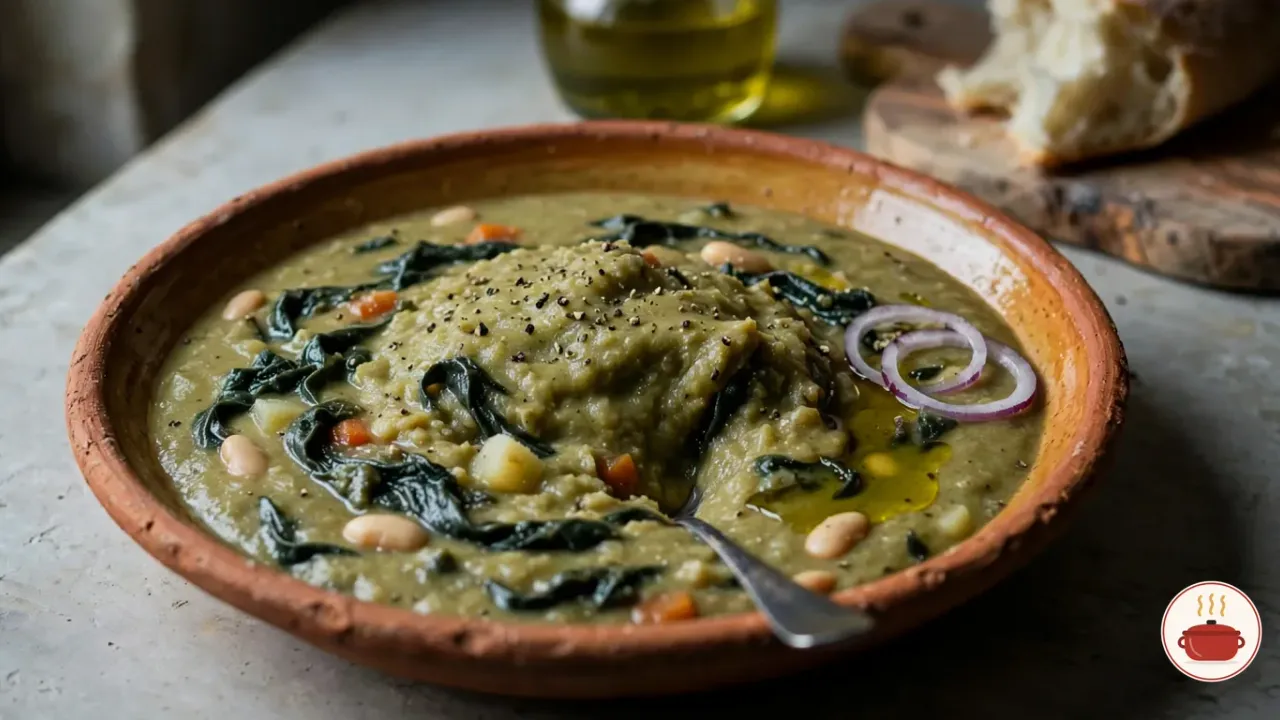
Serve it hot in wide bowls. Pour a thread of your best raw olive oil over each one, ideally new oil, and add black pepper. La Nazione’s recipe adds thin slices of raw red onion on top.
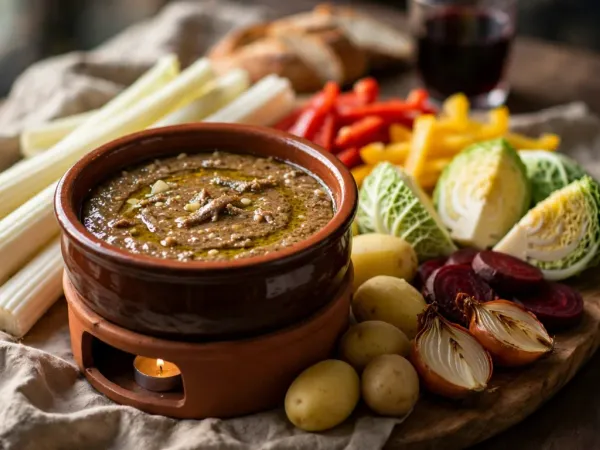
It is a meal in itself. For a longer Italian dinner, start with bagna cauda and its raw vegetables. Greek cooks make a cousin of it without the bread: fasolada, a white bean soup.
Safety, storing and nutrition
Boil dried beans properly
Raw and undercooked beans hold lectins that can upset the stomach. Soak them for 6 to 12 hours and change the water. Then “boil them for at least half an hour at 100° C,” the European Food Safety Authority advises in its 2026 note on lectins. Don’t cook dried beans in a slow cooker, which may never get hot enough. Tinned beans are already cooked.
Cool the pot quickly
A big pot of soup cools slowly. It should be in the fridge no more than two hours after cooking. That is the UK Food Standards Agency’s advice in its guide to chilling food. Split it into smaller containers if your fridge is small. Eat it within 48 hours, or freeze it.
Reheat one portion at a time
Tuscan tradition reheats the same pot again and again. Food-safety advice is stricter. The FSA says to reheat leftovers only once, until “steaming hot throughout”, in its cooking guide. So take out only what you will eat, and bring it to the boil.
Allergens
Ribollita contains wheat (gluten) from the bread. Celery, from the soffritto, must also be declared as an allergen in the UK and EU. It contains milk only if you add Parmesan.
Nutrition
A bowl has about 630 calories, with 24 g of protein, 26 g of fat, 81 g of carbohydrate and 18 g of fiber. We added up the USDA’s per-ingredient figures to get these numbers. Kale stands in for cavolo nero, which the USDA does not list. A third of the calories come from the olive oil, mostly the spoonful on top.
The sodium, about 200 mg, assumes unsalted Tuscan bread and no added salt. With ordinary salted bread, it is closer to 500 mg.
Fixes for runny, stodgy or bland ribollita
- It is too runny: simmer it uncovered, or tear in another slice of stale bread and rest it again.
- It is too stiff after the rest: add a splash of water or bean liquid as you reheat.
- It is pasty: the bread was too fresh. Use older bread next time.
- The beans are still firm: keep cooking them before you go on. Cooking times vary from one batch of beans to the next.
- It tastes flat: add salt, more pepper and a generous pour of good oil.
- It sticks to the pan: reheat smaller portions, and stir more often.
Substitutes for missing ingredients
- Dried cannellini: three 14-oz (400 g) tins, drained. Skip the bean cooking, and use stock or water for the bean water. Toscanelli or borlotti beans also work.
- Cavolo nero: curly kale, with the stalks removed.
- Savoy cabbage: green or white cabbage.
- Tuscan bread: any dense, crusty country loaf, a few days old.
- Chard: spinach, or leave it out.
Frequently asked questions
Why is it called ribollita?
The word means “boiled again” in Italian. The soup is made one day, rested, then brought back to the boil.
Is ribollita the same as minestrone?
No. Minestrone is a brothy vegetable soup, often with pasta or rice. Ribollita has no pasta and is thickened with bread until it is almost solid.
Does ribollita have cheese in it?
Not in Tuscany. Most Tuscan recipes serve it with raw olive oil and pepper, with no Parmesan.
Is ribollita vegan?
The Tuscan version is: beans, vegetables, bread and olive oil. Check that your bread contains no milk or lard.
Can I make ribollita in one day?
Yes, rest it for at least 2 hours in the fridge before you reheat it. It is thicker after a whole night.