The Sunday Potthesundaypot.com/recipes/hojicha-latte/
Hojicha Latte: Roasted Green Tea Latte, Hot or Iced
By The Sunday Pot Kitchen Updated
- • One mug takes 2 teaspoons (4 g) of hojicha powder, 3 tablespoons (45 ml) of water at 195°F (90°C) and 1 cup (240 ml) of milk
- • Sift the powder, then whisk it in a zigzag for 20 to 30 seconds, until smooth and frothy
- • Heat the milk to about 150°F (65°C), steaming but never boiling
- • About 60 to 80 mg of caffeine a mug, well under half a 12-ounce coffee
- • About 195 calories with whole milk and brown sugar, ready in 10 minutes
Ingredients
1 servingInstructions
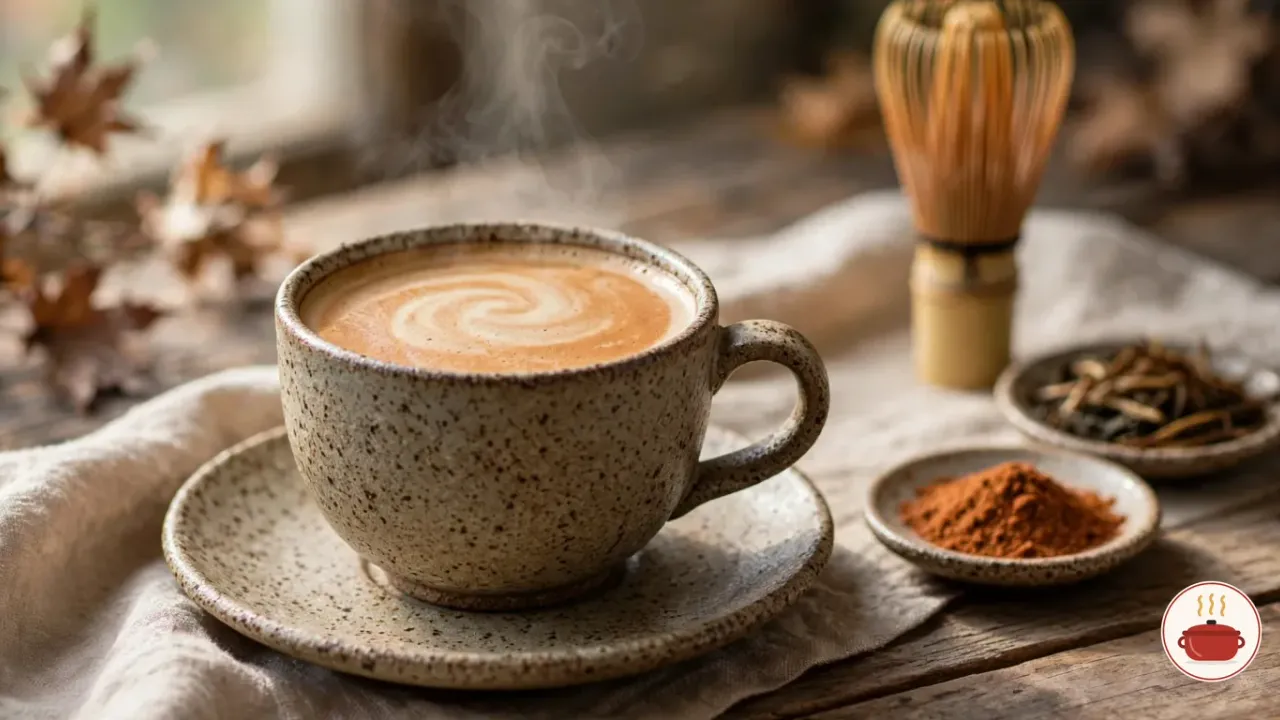
A hojicha latte is roasted Japanese green tea, whisked into a small shot and topped with steamed milk. It tastes of toasted nuts and caramel, with little bitterness, and it is brown, not green. One mug takes 2 teaspoons of hojicha powder, 1 cup of milk and about 10 minutes, hot or iced.
What hojicha is
Hojicha is green tea, toasted until it turns brown. Japan’s Ministry of Agriculture describes it as tea made by roasting sencha or a large-leaf tea. It counts hojicha among the Uji teas of Kyoto.
Most hojicha starts as bancha: larger tea leaves, picked later in the season, along with their stems. Ippodo, a Kyoto tea house founded in 1717, roasts dried bancha leaves and stems. It says they come out tasting of coffee, caramel and roasted nuts.
The roast changes the tea completely. A 2024 study in Scientific Reports puts it at 160 to 180°C (320 to 356°F), and notes that it cuts bitterness and astringency. The heat breaks down the bitter catechins in the leaf. It also builds new nutty, toasty aromas, through the same browning reactions that toast bread, as a 2025 paper in Foods explains.
Brewed from leaves, hojicha pours a clear amber. The powder is a soft reddish-brown, somewhere between cocoa and milk chocolate. In Japan, people often drink hojicha after meals or before bed, as the Japan National Tourism Organization notes.
Where hojicha comes from
The usual story says hojicha began in Kyoto in the 1920s. The Japanese tea shop Yunomi calls it just that, a story, and says the real origin remains a mystery. It points to a roasted-stem tea from Ishikawa, Kaga bōcha, on record as early as 1902.
In Japan, hojicha is an everyday tea, and the latte has long been a café staple there. As far back as 2018, GlobalData described a hojicha boom in Japan. It ran from Ito En’s bottled hojicha latte to hojicha latte ice cream from Häagen-Dazs.
Why the hojicha latte is trending now
Matcha’s success made room for hojicha. As the world fell for matcha lattes, Japanese farmers moved fields over to tencha, the shaded leaf that becomes matcha. Japan’s green tea exports almost doubled in 2025, to ¥72.1 billion, Nippon.com reported from farm ministry data.
That left less of every other tea. In February 2026, Ippodo announced that from March it would limit its bancha teas, hojicha and genmaicha among them. Farmers were shifting to matcha leaf, and Ippodo expected bancha production to fall sharply.
Cafés began to steer matcha fans toward hojicha instead. National Geographic named hojicha one of the 11 biggest food trends of 2026. It cast the tea as matcha’s smokier, nuttier cousin, stepping in during the matcha shortage.
The numbers followed. In April 2026, Country & Town House cited Google Trends data showing searches for “hojicha latte” up 173%. In September 2026, Restaurant Business reported that hojicha on restaurant menus grew 17.6% in the second quarter, from Technomic data. In August 2026, The Coffee Bean & Tea Leaf added hojicha lattes to its fall menu, and Starbucks Korea launched one too.
Hojicha vs matcha
Both teas come from the same plant, but they could hardly taste more different.
- The leaf: matcha is shade-grown tencha, stone-ground to a fine powder. Hojicha is mostly bancha, larger leaves grown in full sun, roasted with their stems.
- The color: a matcha latte is pale green. A hojicha latte is caramel brown.
- The taste: matcha is grassy and savory, with some bitterness. Hojicha is toasty, nutty and caramel-like, with very little bitterness.
- The caffeine: matcha holds more, gram for gram. Hojicha leaf holds about half to two-thirds as much.
Caffeine: gentler, not caffeine-free
Many shops sell hojicha as a low-caffeine tea. That is only half true.
Japan’s official food composition tables give brewed hojicha about 20 mg of caffeine per 100 ml, the same as sencha. A 1996 survey by a Japanese government food research institute found about 2% caffeine in hojicha leaves. Matcha and gyokuro held 3.5 to 4%.
A latte made with powder puts the whole leaf in your mug. So 2 teaspoons (4 g) of hojicha powder carry roughly 60 to 80 mg of caffeine. That is well under half a 12-ounce coffee, but it is not nothing. Even Ippodo says in its tea FAQ that its bancha teas are “lower in caffeine, but they are not low caffeine.”
For an evening mug, use 1 teaspoon (2 g) of powder, about 30 to 40 mg. The FDA cites 400 mg a day as an amount most healthy adults can have without ill effects. If you are pregnant or breastfeeding, ask your doctor how much caffeine suits you.
What you need for a hojicha latte
Hojicha powder
Buy pure hojicha powder, with hojicha as the only ingredient. Some powders sold for lattes already hold sugar, so check the label, and leave out the sugar here if yours does.
Good powder feels fine and soft, like cocoa. It clumps easily, as the Kyoto coffee company Kurasu warns, so always sift it. Roasted tea loses its aroma faster than green tea. Buy small bags, roll them tight after opening, and keep them away from light, heat and damp.
A whisk or a frother
A bamboo whisk, or chasen, makes the smoothest shot. A handheld milk frother works just as well for a latte, and it froths the milk too. With neither, shake the powder and the hot water in a small lidded jar for 30 seconds.
Milk
Whole milk gives the creamiest latte and the best foam. For a dairy-free mug, choose a barista-style oat or soy milk. A 2025 study in Food Systems found that barista plant drinks foamed well when steamed at 65°C (149°F). Not all of them foamed with a frother, though. Heat plant milk to about 150°F (65°C) before you froth it.
How to make a hojicha latte at home
Water at 195°F (90°C)
Tea shops disagree about the water. Some whisk hojicha powder at 175°F (80°C) and others at 195°F (90°C). Ippodo brews its hojicha leaves with boiling water to bring out the roasted aroma.
The roast leaves hojicha with far fewer of the catechins that turn green tea bitter in hot water, so it takes the heat well. This recipe uses 195°F (90°C), which brings out more of the roast. Boil the water and let it stand for 1 to 2 minutes, or check it with a thermometer.
Whisk in a zigzag
Sift the powder into a wide bowl or mug. Add 3 tablespoons (45 ml) of the hot water and whisk fast in a zigzag, from side to side, for 20 to 30 seconds. Stirring in circles only mixes; the zigzag builds froth. Stop when the shot looks smooth, with a light tan foam and no dry lumps.
Milk at 150°F (65°C)
Heat the milk until it steams and small bubbles form around the edge, about 150°F (65°C). Never let it boil. Then froth it with a handheld frother for 20 to 30 seconds. Or pump it in a French press for 30 seconds, as the London tea company Good & Proper suggests.
Pour the milk into the shot, and hold back the foam with a spoon. Spoon the foam on top, and dust it with a pinch of powder.
Variations: iced, loose leaf and homemade hojicha
Iced hojicha latte
Whisk the shot as usual. In a tall glass, stir 2 teaspoons (10 ml) of maple syrup into ¾ cup (180 ml) of cold milk, since sugar does not dissolve well in cold milk. Add 1 cup (140 g) of ice, then pour the hojicha slowly over the top.
The sweet milk stays at the bottom, and the tea floats above it in a brown band. Stir it before you drink it.
Hojicha milk from loose leaves
Without powder, loose-leaf hojicha makes a deep, toasty latte when you simmer it in the milk. This method adapts the hojicha milk from Yunomi.
Crush 3 tablespoons (8 g) of leaves lightly in a mortar. Bring ⅓ cup (80 ml) of water to a boil, take it off the heat and add the leaves. Pour in 1 cup (240 ml) of milk, and keep it at a gentle simmer for 2 to 3 minutes. Strain it, press on the leaves, and sweeten it to taste.
A strong brew or tea bags
For a lighter latte, steep 4 tablespoons (10 g) of leaves in ½ cup (120 ml) of just-boiled water for 2 to 3 minutes. Strain it, then top it with ¾ to 1 cup (180 to 240 ml) of frothed milk. Hojicha forgives a long steep and rarely turns bitter.
With tea bags, check the weight. Ippodo’s hojicha tea bags hold 2 g each, so use 4 or 5 of them.
Roast your own hojicha
With no hojicha at all, you can roast your own from sencha or bancha. The Global Japanese Tea Association says a plain frying pan works, and it is a good use for old green tea.
Sift out the fine dust first, since it burns. Then toast 20 g of leaves in a dry pan over low heat for about 10 minutes, shaking or stirring the whole time. Stop when they turn brown and smell toasty, as Yunomi’s home roasting guide suggests. Let them cool, then use them as loose leaf, or grind them in a spice grinder and sift them.
Serving a hojicha latte after Sunday dinner
Hojicha belongs at the end of a meal. Japanese families drink it after dinner, and its roasted taste suits a cold autumn evening. Serve it after a big pot of Nigerian jollof rice, or with a slice of sticky toffee pudding. The toffee sauce matches the tea’s caramel notes.
For coffee lovers, set out a pot of Vietnamese coffee beside it. A hojicha latte has well under half the caffeine of a mug of coffee, so it suits the guests who want to sleep.
For 4 guests, whisk 8 teaspoons (16 g) of powder with ¾ cup (180 ml) of hot water in a bowl with a spout. Heat and froth 4 cups (960 ml) of milk in two batches, and pour 4 lattes at once.
Calories and caffeine
One hot latte with whole milk and 2 teaspoons of brown sugar has about 195 calories, by USDA figures. Without sugar, it has about 160. The iced version, with less milk and maple syrup, has about 155. Each mug holds about 60 to 80 mg of caffeine.
Substitutes for missing ingredients and equipment
- No hojicha powder: grind loose-leaf hojicha in a spice grinder for about 3 minutes, then sift it. Or use one of the loose-leaf methods above.
- No hojicha at all: roast sencha or bancha in a dry pan, as described above.
- No bamboo whisk: use a handheld milk frother, or shake the powder and water in a lidded jar for 30 seconds.
- No frother: pump the hot milk in a French press for 30 seconds.
- No dairy: a barista-style oat or soy milk, heated to about 150°F (65°C) before frothing.
- No brown sugar: maple syrup, honey or kuromitsu, a Japanese black sugar syrup. Muscovado comes close to kuromitsu’s dark, molasses taste.
- Less caffeine: use 1 teaspoon (2 g) of powder, or kuki hojicha, which uses the stems. Stems hold less caffeine than leaves.
Frequently asked questions
What does a hojicha latte taste like?
It tastes of toasted nuts and caramel, with a hint of smoke and very little bitterness. It sits somewhere between a milky tea and a mild coffee. It does not taste grassy like matcha.
What is the difference between hojicha and matcha?
Both come from the same tea plant. Matcha is shade-grown tencha, ground to a bright green powder. Hojicha is mostly bancha leaves and stems, roasted until brown. Hojicha tastes toasty and holds less caffeine per gram.
Does a hojicha latte have caffeine?
Yes. A latte made with 2 teaspoons (4 g) of powder holds roughly 60 to 80 mg of caffeine. That is less than coffee or matcha, but hojicha is not caffeine-free.
Can I drink hojicha at night?
Many people in Japan do. If caffeine keeps you awake, use 1 teaspoon (2 g) of powder, about 30 to 40 mg, or choose kuki hojicha, made from the stems.
Should I use hojicha powder or leaves?
Powder gives a fuller body and takes 5 minutes, so it suits a latte best. Loose leaves simmered in milk give a deeper roasted taste but take a little longer. Both make a good latte.
Does a hojicha latte need sugar?
No. In Japan, people drink hojicha plain, and its roasted taste reads as naturally sweet. A little brown sugar or maple syrup rounds out the latte, but you can leave it out.
Why is my hojicha latte lumpy?
Pure hojicha powder clumps. Sift it first, then whisk it into a little hot water before you add the milk. Home-ground powder also needs a fine sieve.
How do I make an iced hojicha latte?
Whisk 2 teaspoons (4 g) of powder with 3 tablespoons (45 ml) of hot water. Pour it over ¾ cup (180 ml) of cold, sweetened milk and 1 cup (140 g) of ice, and stir before drinking.
How many calories are in a hojicha latte?
About 195 calories with 1 cup of whole milk and 2 teaspoons of brown sugar, and about 160 without sugar. Oat or soy milk changes the count, so check the carton.