The Sunday Potthesundaypot.com/recipes/omurice/
Omurice: Japanese Omelet Rice with Ketchup Chicken Rice
By The Sunday Pot Kitchen Updated
- • Use rice that is warm but dry: day-old rice warmed through, or fresh rice left to steam off
- • Fry the ketchup on its own for 30 to 60 seconds before the rice goes in
- • Per serving, about 160 g of cooked rice, 2 eggs and 1½ tablespoons of ketchup
- • Cook each omelet in an 8-inch (20 cm) nonstick pan
- • Stop when the bottom has set and the top is still soft, then wrap at once
- • Shape the finished omurice under a paper towel

Ingredients
2 servingsInstructions
Omurice is Japanese omelet rice: chicken, onion and rice fried with ketchup, then wrapped in a thin, soft omelet and topped with more ketchup. It is a home and diner classic in Japan, ready in about 40 minutes. This recipe makes two, one omelet at a time.
What omurice is
A dish of yōshoku
Omurice belongs to yōshoku, the Western-style food that Japanese cooks built from European and American dishes from the late 19th century. Curry rice, tonkatsu pork cutlets and spaghetti Napolitan come from the same family. The name joins two borrowed words, omelet and rice.
The rice is usually “chicken rice”, cooked with ketchup. Japanese Wikipedia describes the usual form as a spindle of egg over ketchup rice, topped with ketchup, demi-glace or white sauce (our translation). Town diners often use pork instead of chicken.
Two restaurants, two stories
Two old restaurants claim the dish. Rengatei in Ginza, Tokyo, opened in 1895. By its own account, its staff ate a rice omelet around 1900. The rice went into the beaten egg, so a spoon was all they needed. Customers asked for it, and it went on the menu. That is a different dish from today’s.
Hokkyokusei in Osaka tells the other story. Its founder, Shigeo Kitahashi, opened a diner in 1922. In 1925 he felt sorry for a regular with a bad stomach who always ordered an omelet with plain rice. He fried mushrooms and onion with ketchup rice and wrapped it in a thin omelet. “Omelet and rice: omurice,” he said, as the restaurant’s former website tells it (our translation).
Osaka’s tourism bureau repeats the second story, calling it “one theory”. Nobody can settle it. Japanese books already printed rice omelet recipes in the 1900s and 1910s, according to sources Japanese Wikipedia cites from the National Diet Library.
Ketchup comes to Japan
Ketchup rice needs ketchup. Kagome, now Japan’s best-known brand, began making tomato ketchup and Worcestershire sauce in 1908, its company history records. A Yokohama maker sold Japan’s first ketchup in 1903, the food writer Yuko Shibukawa notes.
The Tampopo omelet
A second style lays a soft, rolled omelet on top of the rice and slits it open, so the runny egg spills over. Juzo Itami’s 1985 film Tampopo made it famous, in a scene shot in the kitchen of Taimeiken, a Tokyo diner founded in 1931. Taimeiken’s menu still lists “Tampopo omurice (Juzo Itami style)” and tells diners to open the omelet themselves (our translation).
Sources disagree on who devised it, the director or the chef. Shibukawa writes that soft-egg omurice is older than the film. Since the late 1990s, cafés and omurice chains have favored this soft style. A third style, the “dress” or tornado omurice, twists the soft egg into a swirl.
Why omurice is in the news
A Whole Foods prediction
On October 14, 2026, Whole Foods Market’s trends council named Japanese comfort food among its predictions for 2027. It gave omurice as one of five examples of yōshoku, beside tonkatsu, Napolitan, curry rice and hambagu. “Social media is also fueling discovery through viral omurice and shio pan videos,” the release says.
That is a retailer’s forecast, not a measurement. It gives no figure, and we found no 2026 sales, survey or search figure for omurice itself. Datassential’s and Nestlé USA’s 2027 forecasts, out the same month, don’t mention Japanese comfort food at all.
Still on Japanese television
In Japan omurice needs no trend. In May 2026, TV Tokyo ran a feature on the old Tokyo houses, Taimeiken among them. Its third-generation chef cooks the ketchup with the chicken before the rice goes in, so “the sourness turns to sweetness”, the broadcaster reported (our translation).
What goes into omurice
We compared 57 recipes: 35 Japanese, from Kagome, Kikkoman, NHK’s Kyō no Ryōri, Orange Page, Kurashiru and others, and 22 in English. Fifty of them are classic ketchup-rice omurice, and the figures below come from those.
The ratio
Per serving, the median is 158 g of cooked rice, 2 eggs, 50 g of chicken and 27 g of ketchup in the rice, about 1½ tablespoons. That works out to 17 g of ketchup per 100 g of rice. Japanese recipes use one rice bowl, 150 g. English ones lean on a US cup, about 186 g.
This recipe uses 160 g of rice, 2 eggs, 60 g of chicken and 27 g of ketchup per serving.
Chicken, butter and milk
Thirty-two of the 50 use chicken thigh, which stays juicy. The rest use breast, ham, sausage, bacon or no meat at all. Taimeiken’s classic version uses ham.
Butter appears in 28 of the 35 Japanese recipes, but in only 10 of the 22 English ones. Milk or cream goes into the eggs in 23 of the 50, usually 1 tablespoon per serving. Six use mayonnaise instead, for a fluffier egg.
Warm rice or day-old rice
This is where the two languages split. English recipes ask for day-old rice from the fridge, 14 of 22 of them. Nineteen of the 35 Japanese recipes ask for warm rice, and none recommends day-old.
Both camps want dry, separate grains. Just One Cookbook splits the difference: day-old rice, warmed in the microwave first. Kagome says the same, and adds that fresh rice should rest in a bowl to let its steam escape.
How to make omurice
Start with dry rice
Wet rice turns the dish mushy and makes it hard to wrap. Warm cold rice through before it goes in the pan, or it mixes unevenly. Freshly cooked rice works if you spread it out for 10 minutes first.
Cook the ketchup down
Many Japanese cooks fry the ketchup before the rice joins it. Kikkoman says frying it softens its sourness. Reducing it also drives off water, “so the rice doesn’t go soggy once mixed”, explains Masaru Zama, a chef on NHK (our translation). Give it 30 to 60 seconds, until it darkens and stops spitting.
Use a small pan
A wide pan spreads the egg too thin, so it cooks through at once and turns hard. For one omurice, NHK’s Kyō no Ryōri recommends a pan 18 to 20 cm across, with a nonstick surface for beginners (our translation). The median among the recipes we compared is 20 cm, or 8 inches.
Stop while the top is soft
Heat the pan until a drop of egg sizzles at once. The underside must set, or the omelet tears as you wrap it. The top should still be soft and a little wet, because the egg keeps cooking from the heat of the pan and the rice. Turn the heat off before you start to fold.
Shape it with a paper towel
Fold the edges over the rice, slide it to the rim and tip it onto the plate. Japanese cooks then lay a paper towel over it and press it into a rugby-ball shape with both hands. The towel tucks in torn edges and hides small mistakes. Under the ketchup, nobody will see a patch.
For a Tampopo-style omurice
Shape the rice on the plate first. Cook 3 eggs in the same pan, stirring for about 20 seconds, then roll them toward the far edge into a soft oval omelet. Slide it onto the rice and slit it lengthwise with a knife, so it falls open over the sides. Spoon demi-glace or ketchup around it.
Serving and storing omurice
What to serve with it
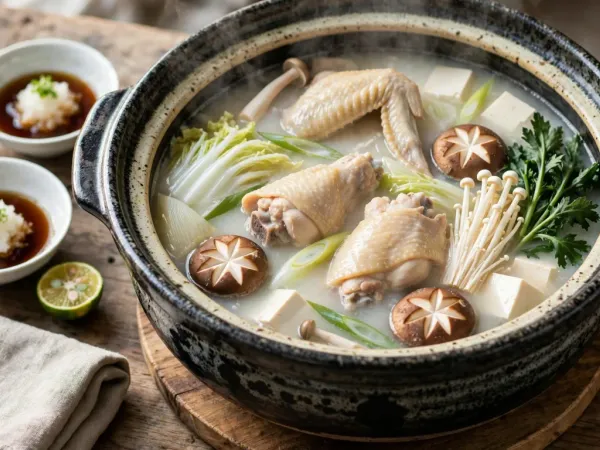
Serve omurice on its own, with a little salad of shredded cabbage or a cup of soup. In Japan it is a standby of family kitchens and old diners alike. Follow it with a hojicha latte, or keep a slow pot of mizutaki for the weekend.
Soft eggs
The soft center of the omelet isn’t fully cooked. The FDA advises cooking eggs “until both the yolk and the white are firm” and using pasteurized eggs where a dish keeps them runny. That matters most for young children, older adults, pregnant women and anyone with a weak immune system.
In the UK, eggs with the red British Lion stamp can be eaten “partially cooked (runny yolk)” even in pregnancy, the NHS says. Otherwise, cook the omelet until it is firm, which still wraps well.
Rice and chicken safety
Cook the chicken to 165°F (74°C), the USDA minimum for all poultry. Rice also brings a risk of its own: spores of Bacillus cereus live through the cooking. Food Standards Scotland says to chill rice within an hour, eat it within 24 hours, and “never reheat rice more than once”.
Leftovers
Omurice is best eaten as soon as it is wrapped. If you make the rice ahead, chill it within an hour and keep it no longer than a day. Reheat it until steaming, then cook a fresh omelet. The USDA allows 3 to 4 days in the fridge for leftovers, but the UK rice advice is stricter.
Calories and allergens
One omurice has about 610 calories, 30 g of protein, 26 g of fat and 64 g of carbohydrate. We totaled USDA FoodData Central values for each ingredient and halved the result. Most of the 970 mg of sodium comes from the ketchup and salt.
It contains egg and milk, two of the nine major allergens the FDA names. Butter and milk are easy to swap for oil and water. Worcestershire sauce, which some cooks add, usually contains anchovy.
Fixes for torn, hard or soggy omurice
- The omelet tears: the bottom hadn’t set, or there was too much rice. Patch it with the paper towel, and cover the gap with ketchup.
- Hard, thin egg: the pan was too wide or too hot. Use an 8-inch (20 cm) pan and turn the heat off sooner.
- The rice sinks into the egg: the egg was still liquid. Wait a few seconds longer before adding the rice.
- Soggy rice: the ketchup wasn’t cooked down, or the rice was freshly cooked and wet. Fry the ketchup first and let fresh rice steam off.
- Too sour: fry the ketchup longer, or add 1 teaspoon of butter to the rice.
- The egg sticks: the pan wasn’t hot enough when the eggs went in. Heat it until a drop sizzles.
Substitutes for missing ingredients
- Japanese short-grain rice: a California medium-grain rice such as Calrose. Jasmine works, but it is drier and less sticky.
- Chicken thigh: chicken breast, diced ham, or sliced mushrooms for a vegetarian omurice.
- Butter: neutral oil, for a dairy-free version, with water instead of milk in the eggs.
- Japanese ketchup: any tomato ketchup. Cooking it down matters more than the brand.
- Demi-glace: equal parts ketchup and Worcestershire sauce, warmed with a little butter.
- An 8-inch nonstick pan: a well-seasoned 8-inch carbon-steel pan, with a little more butter.
Frequently asked questions
What does omurice mean?
It joins two English words borrowed into Japanese, omelet and rice. In Japanese it is written オムライス, omuraisu.
What is the difference between omurice and an omelet?
An omelet is egg with a small filling. Omurice is a meal of seasoned fried rice, usually ketchup chicken rice, wrapped in or topped with a thin omelet.
Is omurice Japanese or Korean?
It is Japanese. It belongs to yōshoku, the Western-style cooking of Japan, and dates from the early 20th century.
Why is my omurice rice soggy?
The rice was too wet, or the ketchup went in raw. Use day-old rice warmed through, and fry the ketchup for 30 to 60 seconds before adding the rice.
How many eggs do you need for omurice?
Two large eggs per serving is the median in the recipes we compared. The soft Tampopo style often uses 3.
Can I make omurice ahead?
Make the ketchup rice up to a day ahead and keep it in the fridge. Reheat it until steaming, then cook and wrap the omelet just before serving.
What sauce goes on omurice?
Ketchup at home and in old diners, demi-glace in many restaurants. Ketchup with a knob of melted butter is a simple middle ground.
What pan size is best for omurice?
An 8-inch (20 cm) nonstick frying pan for a two-egg omelet. A larger pan makes the egg too thin.