The Sunday Potthesundaypot.com/recipes/mizutaki/
Mizutaki: Hakata Chicken Hot Pot with a Milky White Broth
By The Sunday Pot Kitchen Updated
- • Per 2¼ lb (1 kg) of bone-in chicken, use about 10½ cups (2.5 liters) of water: the median of 17 Japanese recipes
- • Boil the broth hard, uncovered, for 75 to 90 minutes: a rolling boil turns it milky white, a gentle simmer keeps it clear
- • Blanch the chicken for 2 minutes first, so the broth stays clean
- • Drink a cup of the broth with salt before anything else, the way Hakata restaurants serve it
- • Add the vegetables in batches at the table, hardest first, and finish with zosui
- • Cook the egg in the zosui until it is set, and refrigerate leftovers within 2 hours
Ingredients
4 servingsInstructions
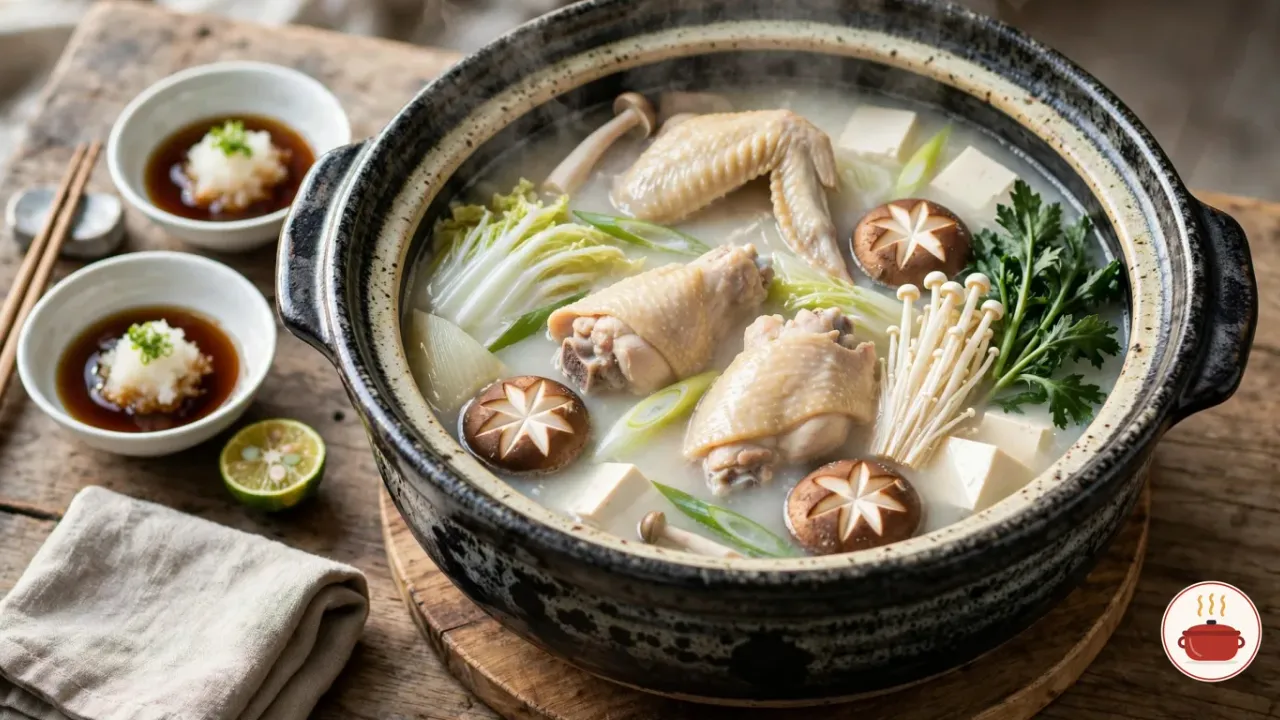
Mizutaki is the chicken hot pot of Hakata, in the city of Fukuoka on Japan’s southern island of Kyushu. Bone-in chicken boils in water until the broth turns milky white. You drink a cup of broth first, cook vegetables in the pot at the table, and finish with rice porridge. This recipe serves 4 and takes about 2 hours.
What mizutaki is
The name means “water-cooked”. “Mizu (水) means water in Japanese and taki means simmering,” writes Namiko Chen of Just One Cookbook. Nothing seasons the pot itself. The flavor comes from the chicken, and from the ponzu, salt and yuzu kosho you add in your own bowl.
Mizutaki is cooked all over Japan, often in a light kombu broth. The Hakata version is different. “Kyushu-style mizutaki is known for its cloudy white chicken soup,” Chen explains.
Two broths in one city
Even in Hakata, not every pot is white. Suigetsu, which calls itself the original mizutaki restaurant, opened in 1905, the travel guide Mapple notes. Its broth is clear, made from young Kyushu roosters.
Shin-Miura opened in 1910. On its Gurunavi page, it claims to be where the cloudy white broth began. It says it has kept topping up the same broth ever since. The white style won. Fukuoka Prefecture describes Hakata mizutaki as chicken bones simmered for hours until the broth turns white, served first on its own at specialist restaurants.
From Hong Kong to Hakata
Suigetsu’s founder, Hayashida Heizaburo, went to Hong Kong alone at 15, the Japanese travel magazine Tabiiro reports. He lived with an English family and learned Western and Chinese cooking. Back home, he combined the two into Hakata mizutaki.
Japan’s farm ministry tells a similar story on its regional food site, Uchi no Kyodo Ryori. Chinese-style boiled chicken caught on in the port of Nagasaki, it says. It then met Western soups such as consommé and moved to Fukuoka. The ministry presents this as what “is said”, not as settled fact.
A pot for festivals and school lunches
The ministry calls mizutaki one of Fukuoka’s signature dishes, eaten all year. The Hakata Gion Yamakasa festival in July ends with a shared meal for the men who carry the heavy floats. Mizutaki is said to be always on the table. Schools serve it at lunch too.
Fukuoka even bred a chicken for it. Hakata jidori, a cross developed by the prefecture in 1999, was meant to make dishes such as mizutaki taste better.
Why mizutaki matters this hot pot season
2026’s trend pot is its opposite
Every autumn since 2009, the restaurant booking site Gurunavi names a “trend nabe”. On September 30, 2026, its 18th pick was haitoku nabe, a “guilty pleasure” hot pot. Think piles of meat, pork back fat, garlic and cheese, as LIVE JAPAN describes it.
Gurunavi’s own data show menu items using the word haitoku up about 8 times in 3 years. In a May 2026 survey of 1,300 members, about 53% said they eat this kind of food often or sometimes. Mizutaki is the other side of the coin: chicken, water and vegetables.
More hot pots at home this winter
Prices are pushing Japanese cooks toward the hot pot. In the seasoning maker Mizkan’s 2026 home nabe survey, about 80% said they expect to eat nabe more often this winter, as macaroni reported in September. High prices and eating out less were the reasons.
The same survey found that 89.3% finished their last hot pot with a shime, a final course of rice or noodles, Impress Gourmet Watch reported.
Hakata’s specialists are spreading out
On October 7, Toriden, a Hakata mizutaki house, announced its first restaurant outside Fukuoka, opening in Osaka in March 2027. Its broth is “made only from Kyushu whole chickens and water”, the company says in its press release (our translation).
Fukuoka is popular with travelers this autumn as well. On the travel site Travelko, it rose to third place among Japan’s domestic destinations for October and November, at 119% of last year’s searches. Its announcement names motsunabe and mizutaki among the city’s draws.
Chicken and cabbage cost more in Japan
The pot is not cheap there this year. In September 2026, chicken thigh in Japanese shops averaged 155 yen per 100 g, 13% above the five-year average, the farm ministry’s price survey shows. The ministry also expects napa cabbage prices to stay above normal in October, after a wet September.
We found no 2026 number for mizutaki on its own, whether for sales, searches or menus. What moved this year is the hot pot season around it.
What you need for mizutaki
We compared 29 published mizutaki recipes, 27 of them by Japanese cooks. Nineteen are in Japanese, from sources such as NHK, Kikkoman, Orange Page and the farm ministry. This recipe follows the Hakata style and sits on their medians.
Bone-in chicken
Use 2¼ lb (1 kg) of bone-in, skin-on chicken for 4 people. Wings, drumsticks and thighs chopped through the bone all work. The bones, skin and joints give the broth its body and its color.
Ask a butcher to chop thighs into 2-inch (5 cm) pieces. Nine of the recipes also boil a chicken carcass or bones for extra richness. Add one if you have it.
Water, and not much else
The median is about 10½ cups (2.5 liters) of water per 2¼ lb (1 kg) of chicken, across the 17 recipes that give both. Much of it boils away. Twelve recipes add sake. Eight use kombu, and two more make it optional. Hakata restaurants often use neither: Toriden’s broth is chicken and water.
A few slices of ginger and the green tops of the onions take away any raw smell. Lift them out before the pot goes to the table.
Napa or green cabbage
Napa cabbage is in 15 of the 29 recipes, and round green cabbage in 14. The ministry’s Fukuoka recipe uses green cabbage, so either is right. Long green onion, tofu and shiitake are in most recipes too.
Ponzu and yuzu kosho
Ponzu is the dipping sauce in nearly every recipe: soy sauce with citrus juice. Hakata restaurants such as Suigetsu and Toriden make theirs with daidai, a sour orange. Yuzu kosho, a paste of yuzu peel, green chili and salt, is in 12 recipes, and sliced scallions in 20.
To make ponzu, mix ⅓ cup (80 ml) of soy sauce with ¼ cup (60 ml) of fresh citrus juice and 2 tablespoons of rice vinegar. Yuzu, sudachi or lemon mixed with lime all work.
A pot and a burner
A donabe, a Japanese clay pot, is traditional. A shallow Dutch oven works too, as for our kimchi jjigae. Boil the broth on the stove, then move it to a tabletop burner. Without a burner, cook the vegetables in the kitchen and bring the pot to the table.
How to get a milky white mizutaki broth
Blanch the chicken first
Twelve of the recipes blanch the chicken before the long boil. Two minutes in boiling water sets the blood and scum on the surface, so it won’t cloud the broth gray. Rinse those blanched pieces, but never rinse raw chicken: washing raw poultry “is not recommended”, the USDA warns.
Boil hard, not gently
This is the step that makes Hakata mizutaki. A strong, rolling boil breaks the fat and the gelatin from the bones into tiny droplets. They cloud the broth white, like milk.
Ten of the 29 recipes aim for a white broth, and they boil it for a median of 75 minutes. Restaurants go much longer. Hakata Hanamidori says it simmers chicken feet and whole chickens for more than 6 hours, in its October 2026 release.
Keep the chicken covered
Keep the lid off, and add hot water whenever the chicken starts to show. Cold water stops the boil. After 75 to 90 minutes, you should have 6 to 8 cups (1.5 to 2 liters) of broth.
Prefer it clear?
Seventeen of the recipes don’t aim for a white broth. For a clear one, as at Suigetsu, simmer the chicken gently for 30 to 40 minutes instead. It will taste lighter and cleaner.
How to eat mizutaki at the table
Broth first, with salt
In Hakata, you drink the broth before anything else. “The first thing to do is drink the soup!” writes Lina Kawase, who grew up in Hakata, on Gurunavi’s English site. Ten of the recipes say the same. Add a pinch of salt and a few scallions to each cup.
Chicken, then vegetables
Eat the chicken next, dipped in ponzu. Then add the vegetables, the hard ones first. Cabbage stems, carrot and shiitake take about 5 minutes. Tofu, cabbage leaves, onions and enoki take 2 to 3. Greens need only a minute.
Add a little at a time, so the pot keeps simmering. As the vegetables cook, the broth gets sweeter.
Zosui to finish
Nineteen of the recipes end with rice, most often as zosui, a soft rice porridge with egg. Others use udon, ramen or mochi. Mizkan’s survey found that people in Kyushu most often finish a hot pot with udon.
For zosui, season the broth with salt, add the rice and simmer it for 3 to 4 minutes. Pour in beaten eggs and cover the pot until they set.
Serving and storing mizutaki
Is the chicken cooked?
In this recipe, the chicken boils for over an hour before it reaches the table, so it is well done. Poultry is safe at 165°F (74°C), the USDA says.
If you add raw chicken at the table, such as meatballs, use separate chopsticks for raw and cooked food. Take food out “only when the soup is boiling completely”, advises Hong Kong’s Centre for Food Safety.
In Japan, Campylobacter causes about 200 food poisoning outbreaks a year, mostly from raw or undercooked chicken, the health ministry says. Its advice is to heat the center to 75°C (167°F) for at least 1 minute.
Use the burner safely
A portable gas burner needs a pot of the right size. Oversized pans “will concentrate heat back towards the gas canister, causing it to overheat and explode”, warns Singapore’s Consumer Product Safety Office. Use it in a well-ventilated room, and take the canister out afterward.
Leftovers
Refrigerate leftover broth and chicken within 2 hours. They keep 3 to 4 days, according to the USDA. Bring the broth to a rolling boil before you eat it again.
Cook the zosui egg until it is set. Dishes with eggs should reach 160°F (71°C), the FDA advises.
Calories and allergens
One serving has about 470 calories, 38 g of protein, 28 g of fat and 14 g of carbohydrate, without the zosui. The zosui adds about 140 calories. We worked these out from USDA values for chicken thigh and wing with skin, tofu and vegetables, plus 3 tablespoons of ponzu.
Most of the salt comes from the ponzu and the salt you add, so you control it. Ponzu contains soy and usually wheat, and many brands add bonito, a fish. The FDA counts all three, and eggs, among the major food allergens.
Fixes for mizutaki broth that is thin, gray or greasy
- The broth stayed clear: it simmered instead of boiling. Turn the heat up and keep it at a rolling boil for another 20 to 30 minutes.
- It looks gray: the chicken wasn’t blanched, or the foam wasn’t skimmed. Strain it through a fine sieve.
- It tastes thin: it needs more bones or less water. Boil it uncovered to reduce it, and add wings or a carcass next time.
- It’s greasy: skim some fat from the top before it goes to the table.
- The chicken is dry: boneless breast was used. Bone-in thighs and wings stay moist through the long boil.
- The pot stopped bubbling: too many vegetables went in at once. Add them in small batches.
Substitutes for missing ingredients
- Negi: leeks, or the white parts of thick scallions.
- Napa cabbage: green cabbage, or bok choy.
- Shungiku: mizuna, spinach or watercress.
- Fresh shiitake: oyster, shimeji or button mushrooms.
- Ponzu: soy sauce mixed with lemon and lime juice, as above.
- Yuzu kosho: a little grated lemon zest with a pinch of chili flakes and salt.
- Donabe: a shallow Dutch oven or any wide, heavy pot.
- Tabletop burner: cook each round of vegetables on the stove, then bring the pot to the table.
Frequently asked questions
What does mizutaki mean?
It means “water-cooked”. The chicken cooks in water with no seasoning, and each person seasons their own bowl.
Why is Hakata mizutaki broth white?
The broth boils hard for a long time. The boil breaks fat and gelatin from the bones into tiny droplets that turn it milky.
What is the difference between mizutaki and shabu-shabu?
Shabu-shabu is thin-sliced meat swished briefly in broth. Mizutaki is bone-in chicken cooked long in the broth, which you also drink.
How do you eat mizutaki?
Drink a cup of broth with salt first, then eat the chicken and vegetables dipped in ponzu. Finish with rice porridge or noodles in the broth.
Can I make mizutaki without a tabletop burner?
Yes. Cook the vegetables in the pot on the stove, then bring it to the table and serve from it.
Can I make the broth ahead?
Yes. Cool it quickly, refrigerate it, and use it within 3 to 4 days. Boil it again before you add the vegetables.
Is mizutaki gluten-free?
The broth is. Most ponzu contains wheat, so use a gluten-free ponzu or make it with tamari.
What do you drink with mizutaki?
Sake, beer or shochu in Hakata. For something warm without alcohol, try a hojicha latte after the meal.